
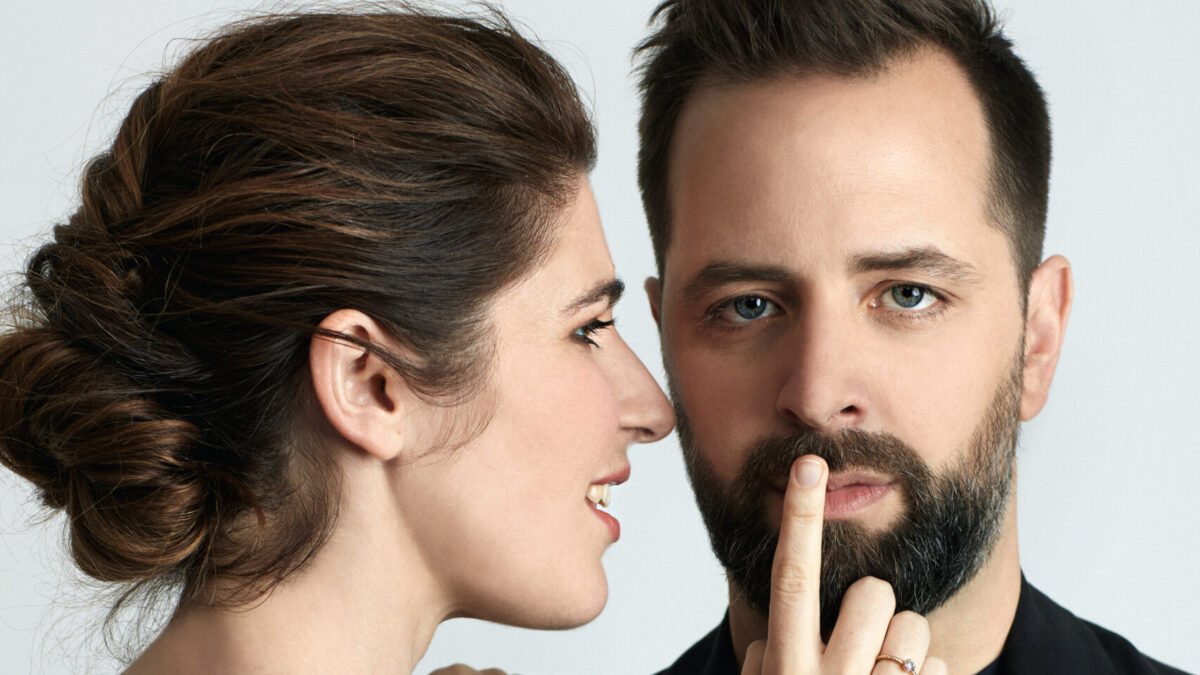
Nicole Car and Étienne Dupius / Photo: Yan Bleney
Opera singers occasionally get together romantically—though not always under legal sanctions–but it can be rare when both partners are concurrently at the top of the profession. U.S. opera companies have lately ignored married international stars Australian soprano Nicole Car and Canadian baritone Étienne Dupuis, but many intrepid opera travelers will be gathering at the Dallas Opera tonight to see them in a new production by Louis Désiré of Verdi’s Don Carlo in its four-act Italian version. Car and Dupuis lead the cast as Elisabetta and Rodrigo, appearing along with Stephen Costello in the title role and Christian Van Horn and Clémentine Margaine as Filippo II and his mistress Princess Eboli with Morris Robinson as the Grand Inquisitor.
Prior to the opening, the couple shared some thoughts with Parterre Box about many things operatic including Don Carlo versus Don Carlos, Regie directors and the advantages of performing together.
Car is returning to the Dallas Opera where she made her US debut in 2014 as the Countess in Le nozze di Figaro, but Dupuis is making his company debut in what has become a signature role for him. His dashing Rodrigue all but stole the show when the Metropolitan Opera for the first time presented Verdi’s sprawling historical work in its original language in Sir David McVicar’s darkly dull production in 2022.
“I’ve done the role many times,” Dupuis shared. “Every time it grows inside of me, and I start to develop habits that solidify that–for me–are the core of Rodrigo.” Going from production to production, from director to director, he often has to stop and say to himself “wait, but the music here does this, and you’ve justified it by thinking your character will be thinking this. So, it’s almost impossible now for me to change that. It’s cemented in me.” And yet he adapts.
Car, too, has performed the opera in French, as Élisabeth in the celebrated Paris Opéra production by edgy Polish director Krzysztof Warlikowski “who seems to carry the energy of every character within himself, and he creates fully realized, three-dimensional people, not caricatures or pastiche versions. That gives us [as singers] something rich and alive to inhabit and explore.”
In examining the difference between the two versions of Verdi’s opera, Dupuis finds that “as soon as you change the language, it’s almost like changing the opera. The music may be familiar, but everything shifts.” As a native French speaker, he finds that everything in Don Carlos feels “organic;” however, “Verdi reworked portions of the music when adapting it into Italian, so Don Carlo is a not straightforward translation. It’s a carefully revised version meant to function dramatically and musically in a different language. The challenge, then, is not to assume that knowing the opera in one language means we automatically know it in another. Each version requires a thorough relearning, almost as if we were approaching the work for the first time.” Another French edition of an Italian classic awaits the baritone in late April when he performs Henri Ashton in the new Opéra-Comique mounting of Lucie de Lammermoor starring Sabine Devieilhe.
Like all those performing at top opera companies worldwide, both have to work in a variety of production styles from the most traditional and conservative to the most challenging and transgressive. In 2017 Car starred as Mimì in Claus Guth’s (to some) outrageous outer-space La bohème at the Paris Opéra. When asked about it, she said, “I believe every director has something meaningful to say. Our responsibility as performers is to engage with their vision and try to understand why they have set an opera in a particular time period or made specific choices about the characters. Even when a production departs from a traditional approach, I see it as part of my role to help guide the audience through the director’s thinking, and to clarify how I understand and embody that concept in my own performance. Ultimately, it is our task, and above all the director’s, to make those choices feel justified and coherent. Opera, after all, can resonate in any period and in any setting, as long as the vision behind it is clear and convincing.” Very diplomatic!
An unorthodox approach can sometimes be remarkably illuminating for a singer. Dupuis performed his first-ever Don Giovanni in the premiere of Ivo van Hove’s production, one that eventually arrived years later at the Metropolitan Opera. The provocative Belgian director told Dupuis two things about his character: “He talked about him being a sociopath, and then he talked about the movie Shame with Michael Fassbender. I found it so much fun and so liberating to be able to go in this direction, having not done the role before, not having all these other thoughts constantly trying to come in my head to tell me something else than what I was trying to do.”
Some Regie stagings, however, can prove more difficult than others. When she took over Elisabetta from Asmik Grigorian, Car found “probably the most challenging Don Carlo I’ve done so far was the Vienna production, directed by Kirill Serebrennikov which removes the story entirely from its traditional context. The visual world he creates, with historical artifacts and museum-like costumes, is incredibly sophisticated and striking. But I think audiences sometimes struggle to connect with it emotionally. When you watch it as a spectator and then perform in it yourself, you feel that distance.”
The couple, who has an eight-year-old son, met more than a decade ago when performing Eugene Onegin together at the Deutsche Oper Berlin. Tchaikovsky’s opera, which ends unhappily for the pair they portrayed, was also the vehicle for their first visit together to Dallas four years ago when they joined Fabio Luisi and the Dallas Symphony Orchestra for an Onegin semi-staging.
Like so many singers before them, they made their Met debuts together as Mimì and Marcello in the legendary Franco Zeffirelli production of La Bohème,
During the winter of 2020 they returned separately to Lincoln Center for Mozart, he for the Count in Le nozze di Figaro, while she glided over the amusement park in a balloon as Così fan Tutte’s Fiordiligi, its run cut short by the worldwide explosion of COVID-19. A month later, the couple joined many others for the Met’s At Home Gala where they memorably performed a duet from Massenet’s Thaïs accompanied by Dupuis on the piano from their Parisian home.
2022 was a banner year for Car and Dupuis in the US: following the Met Don Carlos and the Dallas Onegin, they debuted with the San Francisco Opera as Donna Elvira and Don Giovanni and appeared in an all-Verdi concert under SFO music director Eun Sun Kim. In the fall, Car joined Allan Clayton for the Met’s acclaimed revival of Peter Grimes as a warmly sympathetic Ellen Orford, a role she repeated the following year in Robert Carsen’s new production at La Scala.
But since Carlos/Grimes neither of these elegant and versatile artists have appeared at the Met, nor anywhere else in the country until the current Don Carlo. Their inexplicable absence will continue for Dupuis: I’ve been told that after Dallas he has no US engagements on the books for next three years!
But they remain very busy elsewhere, particularly at the Vienna Staatsoper where they have been featured in a number of important new productions. In the fall of 2020 Dmitri Tcherniakov produced Onegin in which Car was paired not with Dupuis but with André Schuen in the title role. The couple did however co-star as Marguerite and Valentin in Frank Castorf’s pitch-black Faust in 2021. Later that year Dupuis was Figaro in the theater’s antic new Il barbiere di Siviglia opposite Vasilisa Berzhanskaya and Juan Diego Flórez.
His sterling Rodrigo was featured in the premiere of the Serebrennikov Don Carlo as well as in the revival later that season in which Car joined him. In the spring of 2023 Car became Blanche in Vienna’s new Dialogues des Carmélites after Devieilhe wisely decided the role wasn’t for her. In January she performed Rusalka at the Staatsoper, a role she sang in Sydney last summer for her return to the Opera there after an absence of seven years.
Beyond the upcoming Donizetti, Dupuis might be seen as having evolved into a Verdi specialist. He recently moved from Paolo Albiani to the title role of Simon Boccanegra which he performed in Berlin with Car as his daughter Amelia. Together they performed Il trovatore in his native city with Opéra de Montréal, and Dupuis’s Don Carlo was singled out for special praise in the Royal Opera’s La forza del destino co-starring Sondra Radvanovsky and Brian Jagde. Before arriving in Dallas, Dupuis jumped in as Renato for the opening of the Paris Opéra’s new Un Ballo in Maschera opposite Anna Netrebko and Matthew Polenzani.
But he demurred when asked about this concentration. “I’m not consciously focusing more on Verdi, but those are the roles that are coming my way more and more. And I certainly can’t say I don’t enjoy them, as I adore them. I love the drama in Verdi and inhabiting those characters to find the light within the shadows. Many of the roles I sing are either considered villains or dark figures, often associated with darker, larger voices. What I try to do is bring them into the light, into a more human space, to show them as complete human beings, not just the antagonist of the piece.”
When asked about non-Verdi roles he’d like to tackle, Dupuis said, “Wolfram in Tannhäuser, certainly. And perhaps one day I wouldn’t say no to Telramund in Lohengrin. Or Scarpia. If my wife were singing Tosca, I’d love to sing Scarpia. I think we could do some real damage in that Act II duet.”
Before their Tosca happens, Vienna will soon host Car’s particularly demanding role(s) debut(s) when for the first time she takes on the three heroines of Puccini’s Il Trittico. Joined in June by Ambrogio Maestri, Arsen Soghomonyan and Violeta Urmana, she deems this tour-de-force “a huge challenge. Truly monumental.” She’s finding Il Tabarro’s Giorgetta the most fascinating, “a character who operates on a very instinctive, almost primal level. She doesn’t come from privilege or refinement. She says what she feels. There’s something raw and deeply realistic about her. There’s so much heartbreak in Tabarro. If we focus only on the lovers, Giorgetta and Luigi, we miss half the story. The despair written into her music, especially in relation to Michele and within herself, runs very deep. That emotional complexity is what I’m really immersing myself in.”
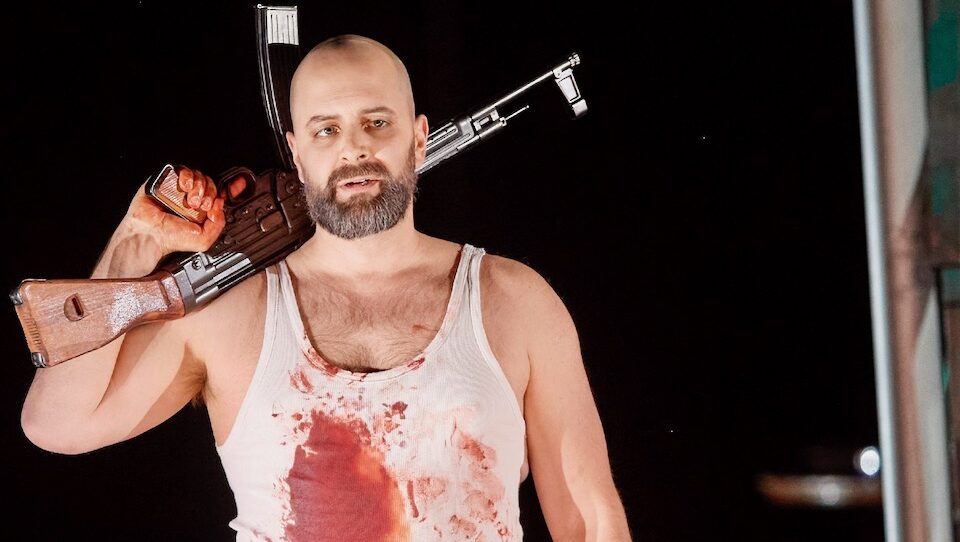
Étienne Dupuis in Faust in Vienna / Photo: Michael Pöhn
Massenet’s Hérodiade is a rarely performed work that the couple has recently embraced appearing in concert performances in Lyon, Paris and Berlin, she as Salomé, he as her predator Hérode. Their German engagement formed the basis for the recent Naxos recording conducted by Enrique Mazzola and featuring Don Carlo(s) partners: Margaine in the title role and Polenzani as the prophet Jean.
As to why they enjoy performing together so often, Car suggested, “I think Étienne would agree that it’s always a gift when we get to share the stage. Not only do we create these characters side by side, but we also get to witness each other’s artistry up close. As both an artist and his partner in life, that’s an extraordinary privilege.” Dupuis joked that “immediately after Nicole sings her aria the entire company turns to me and says,’“So what’s it like being the second-best singer in your household?’” But he feels “it’s a healthy dynamic — I don’t even see it as competition. We’re not competing with each other. We’re pushing each other to be better. I always sing better when I know Nicole is onstage or even sitting in the audience, and I’m fairly certain the same is true for her.”
She considers it “a luxury to have a trusted set of ears both in the house and onstage, someone who can say, “I noticed you tried this tonight,” or “Maybe experiment with a different vowel there, it might feel easier.” That kind of support is invaluable.” He concluded that “there’s no downside to it. If anything, it deepens everything we do onstage.”
This interview won’t be the last Parterre readers will read about Car and Dupuis, with upcoming reviews of both the Dallas Don Carlo and Car’s new recording, Palazetto Bru Zane’s latest resurrection: Clemence de Grandval’s Mazeppa.
Though there are many more YouTube videos online of Nicole Car and Étienne Dupuis, Chris’s Cache makes a brief reappearance offering the pair in some rarer audio excerpts:
Nicole Car and Étienne Dupuis Extracts
Massenet: Werther Dupuis—Lyon 2020
Puccini: Manon Lescaut Car—Melbourne 2024
Verdi: Don Carlo Car, Elina Garanca & Dupuis—Vienna 2025
Verdi: Un Ballo in Maschera Car & Dupuis—Melbourne 2025
Dvořák: Rusalka Car & Piotr Beczala—Vienna 2026