Photo by Chris Lee
If you have been paying attention to Hollywood recently, you may have noticed a surfeit of biopics.
Bohemian Rhapsody. Rocketman. The forthcoming Michael. Take an artist’s life—usually, but not always, a musician—and compress it into a rise, fall, and rise again narrative. Have your lead actor undergo a “transformation,” for which they will receive acclaim and possibly awards. It’s been a lucrative formula for cinemas, so why not try it out at the concert hall?
Pulitzer Prize–winning composer Kevin Puts, in collaboration with mezzo-soprano Joyce DiDonato and string trio Time For Three, has seemingly given Emily Dickinson the biopic treatment in Emily – No Prisoner Be, a semi-staged song cycle that made its New York debut at Carnegie Hall last week.
The Belle of Amherst is no stranger to biographical treatments; the strangeness of her verses and seclusion invite all manner of interpretation and speculation. There have been two films and one television series on Dickinson (ranging in reverence) within the last ten years, as well as countless settings of her poems since their posthumous publication. Puts, too, is no stranger to setting biography to music; The Brightness of Light, commissioned by another American diva, Renée Fleming, dramatized the life of Georgia O’Keeffe in song, while The Hours, adapted from the Michael Cunningham novel of the same name, cast DiDonato as Virginia Woolf. (Some may recall that the film version of The Hours won Nicole Kidman, also as Woolf, her Oscar “by a nose.”) So, up he goes to another room of one’s own, entreating its solitary, sphinxlike occupant to descend for our perusal.
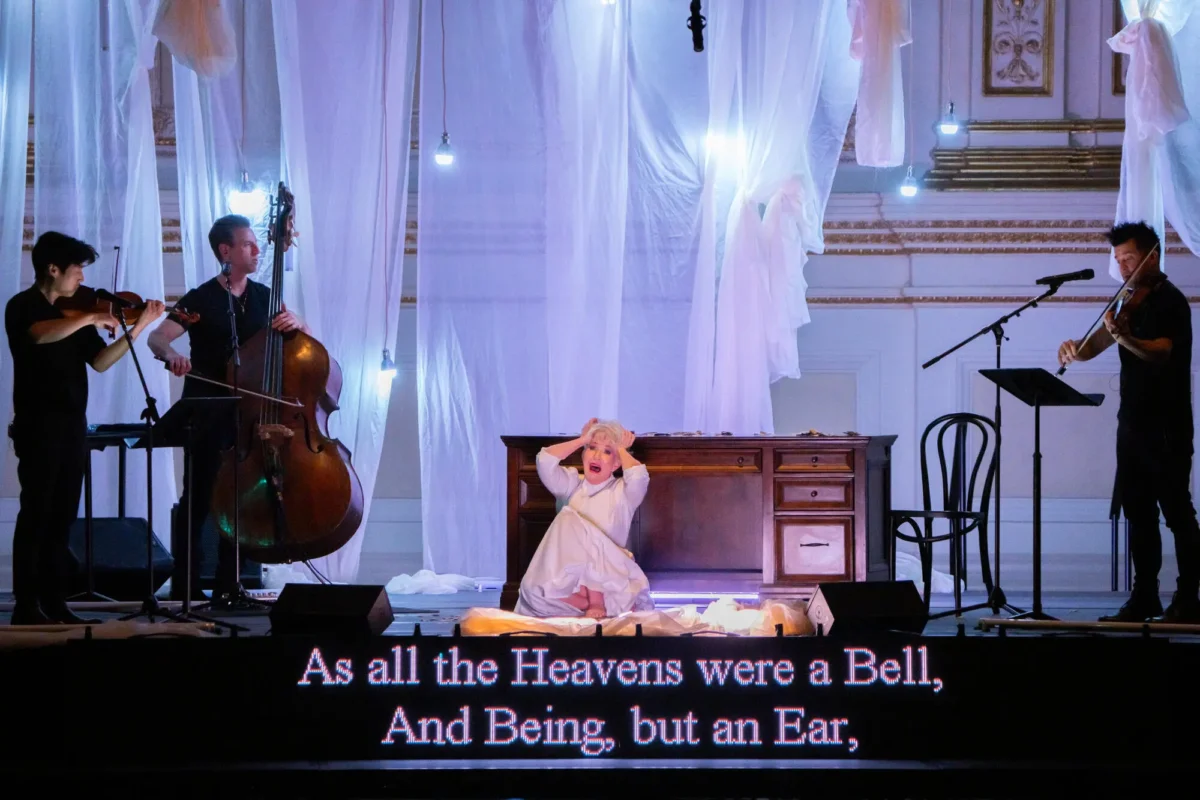
Emily – No Prisoner Be sets 24 of Dickinson’s poems to music, including three instrumental “Bee” Scherzos, which, when combined with Andrew Staples’s direction and lighting design, form a rough arc: Dickinson resolves to commit herself to poetry, undergoes periods of doubt and emotional strain, and eventually affirms the worth of her art and life. Barefoot and dressed in a white frock, DiDonato mimes moments of inspiration and inhibition, climbing across a recreation of the poet’s desk and dancing between the diaphanous, white curtains positioned around a central platform. She occasionally interacts with the trio—violinist and violist Nicholas Kendall, violinist Charles Yang, and double bassist Ranaan Meyer—, who occupy the corners of the platform, providing both accompaniment and, impressively, backing vocals. Projections of Dickinson’s poems and the woods beyond her window appear on the curtains. Industrial Edison bulbs and LED strips (very hipster chic) brighten and dim depending on the poet’s state of mind. There is a smoke machine at the beginning, for some reason.
The choice to open with “They shut me up” establishes the piece’s mission; as Dickinson rails against the hegemonic forces of “prose” that would keep her slight and “still,” Emily – No Prisoner Be seeks to liberate itself from the conventions of the concert hall. Where there were once a singer and a piano, side-by-side and still, there are strings, lights, and movement—it’s less recital, more theater piece. Likewise, Puts’s score combines classical lexicons with flourishes of Americana and Pop, conforming to no style. It is often tuneful while maintaining ample texture, thanks in large part to Time For Three’s vigorous playing. It ends with the titular “No Prisoner Be,” a paean to liberty set as a folksy earworm; Dickinson has found liberation through her writing. DiDonato invites the audience to sing along. We walk out, uplifted.
And yet, I could not feel that Puts and his collaborators had merely found an alternate prose in which to shut their heroine up: that trite formula of the Hollywood inspirational biopic. I am not suggesting that one must imagine Dickinson unhappy, but ending on such a mawkish note rather obfuscates the complexities and mysteries of her poetry and life—the very qualities that have allowed her to endure—and, indeed, some of the finer qualities of this piece: the aching lyricism that breaks through mannered strains of “Again—his voice is at the door—”; the insistent, rhythmic pulse of “Because I could not stop for death” that emulates the carriage’s journey towards “eternity”; the neurotic bravura of “I tie my hat—I crease my Shawl”; and the swooning, echoing interplay of the vocal lines in “Her face was in a bed of hair.” The staging, too, confined our view of Dickinson’s works to a purely biographical reading—valid, but restrictive.
If anyone could pull off this mixture of artistic ambition and extreme earnestness, it’s Joyce DiDonato. She is as transparent an artist as one could hope for; what could be saccharine in lesser hands reads as true in hers. Her voice (here, necessarily amplified, alas) has retained its richness in the lower register, even if some tightness has crept into her top at points. Her phrasing is immaculate, as she accentuated the vocal line to draw attention to Dickinson’s unusual use of punctuation—those dashes!—and capitalization. She shared a warm rapport with the members of Time For Three.
DiDonato and Time For Three have released a recording of Emily – No Prisoner Be, ensuring that the piece will live on in streaming, but I wonder if it will have a future in the concert hall beyond its original interpreters and mode of presentation. Or has its carriage already passed the setting sun?