Photo by Karli Cadel
If one sees enough operas, once in a blue moon, a staple-repertoire performance comes along that knocks your socks off, challenges all your notions of the piece, and, eventually, offers new perspectives. Such was the case with San Diego Opera’s tenth production of Gioachino Rossini’s evergreen The Barber of Seville, which played at San Diego Civic Theatre for three performances only.
The popularity of this tale of a cunning barber who helps a young Count woo his bride is unquestionable, and Rossini’s adaptation of Pierre Beaumarchais‘s play – with an Italian libretto by Cesare Sterbini – has been widely regarded as the greatest example of opera buffa. In popular culture, the barber’s “Largo al factotum” has been parodied by everyone from Bugs Bunny to Mrs. Doubtfire.
Much of the success of SDO’s The Barber of Seville was attributed to debuting director Chuck Hudson, whose unorthodox direction gave the production a particularly effervescent yet elegant look, unlike the usual slapstick take the opera usually receives. A protégé of Marcel Marceau and renowned for coaching singers to be better actors, Hudson incorporated many of Marceau’s techniques here, and it showed. For this revival, Mathew LeFebvre’s colorful costumes were rented from Minnesota Opera, where the production originally premiered, and Hudson worked with SDO’s Tim Wallace and Jason Bieber on scenic and lighting designs.
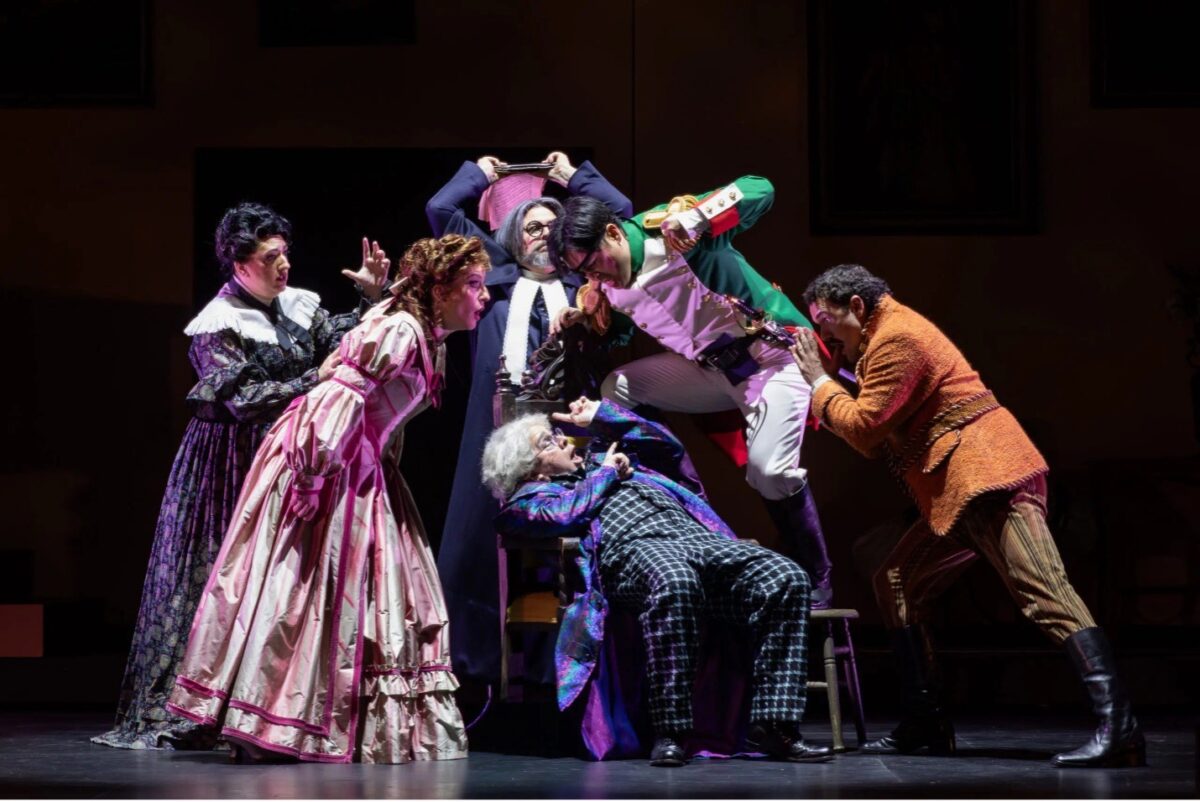
In an illuminating interview, Hudson identified “presentationalism,” the art of “sharing everything with the audience,” as the key to his direction. “The audience gets to be ‘in’ on the various characters’ plots, which the other characters are not aware of.” Through specific gestures and facial and hand movements, the singers were deliberately placed in every scene to create distinct moods and compelling, picture-worthy storylines. It also helped that Hudson had previously worked with many people in the cast, including chorus master Bruce Stasyna.
One of my favorite moments was the drunken scene in Act 1: Almaviva threatens to hit Don Bartolo as the others tried to stop him, and just before the soldier bangs on the door, time comes to a stand-still. In addition, the soldiers’ placement in sharp marching lines, yet with bobbing heads, in the extended Act 1 finale offered a more refreshing interpretation of the text (“Mi par d’esser con la testa in un’orrida fucina; dell’incudini sonore l’importuno strepitar” / “My head seems to be in a fiery forge: the sound of the anvils deafens the ear”) than the usual chaotic running around.
Hudson set the action in 1820s Seville, a period when commedia dell’arte was transitioning into a “nineteenth-century performance style.” LeFebvre’s costumes underscored this transition, using kaleidoscopic colors in most characters’ costumes, particularly for Almaviva, Don Bartolo, and the soldiers, while keeping Figaro in earthy colors, as if to symbolize that he was the most well-rooted person in the room. If I may nitpick, I felt Rosina’s dress was a little too Victorian for my taste. Wallace took a simple, almost minimalist approach to Doctor Bartolo’s house, with a hint of Spanish colonial architecture. Unfortunately, two giant black curtains hanging on either side were visible to the audience (at least to me) and somehow cheapened the staging. Nevertheless, the combination of his sets and Bieber’s sepia-toned lighting effectively depicted Seville in the 1820s. In other scenes, Bieber highlighted each character under spotlights, never losing sight of who was currently singing, making the production a joy to follow without being overly reliant on subtitles.
A simple giant white screen was used to cover the stage during the set change, and some scenes were sung in front of it, enabling smooth transitions. Notably, the screen was also used during the storm scene in Act 2, with the cast walking back and forth hysterically to provide additional backstory. I was particularly happy that the curtains were completely closed during the Overture, allowing the audience to be fully immersed in the famous tune, a practice that seems to be becoming less common these days!
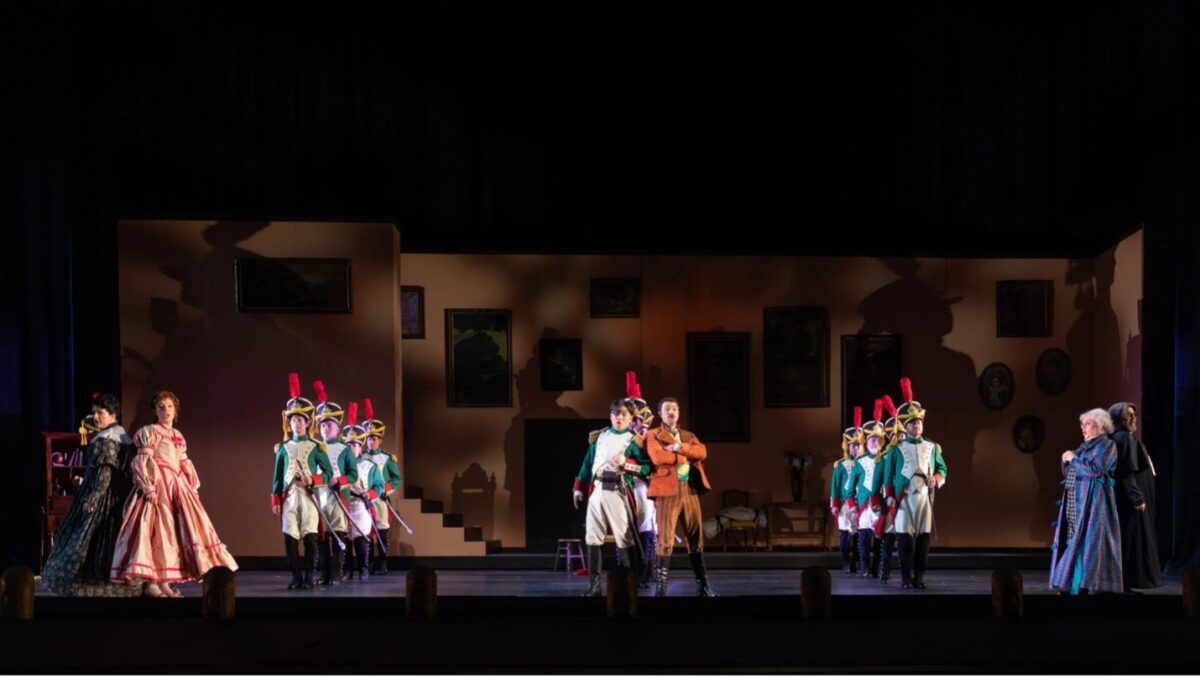
Photo by Karli Cadel.
On the musical front, SDO’s The Barber of Seville offered much to recommend, making it a truly memorable night at the opera. Principal Conductor Yves Abel coaxed glorious playing from the San Diego Symphony Orchestra, bringing out the joie de vivre in Rossini’s score. With a swift tempo, clarity, and vigor, he delivered a coherent reading that propelled the action forward while remaining sensitive to his singers. It’s little wonder he received the most enthusiastic cheers during the bows, as the audience’s reaction by the end of the famous Overture had foretold.
Obviously, Abel couldn’t do it alone, and he had a great cast to bring out the musical splendor while realizing Hudson’s vision. The cast, a combination of young rising stars and esteemed veteran singers, many of whom were making debuts, was, top to bottom, one of the strongest I’ve heard in a while. Collectively, the cast worked exceptionally well together, an important factor for Rossini’s operas, especially in their finales.
In the title role, rising American baritone Dean Murphy made a much-heralded return to the United States (after eight years) to debut one of his signature roles at SDO. A member of the Deutsche Oper Berlin ensemble since the 2021/22 season, Murphy brought a cool, calculating demeanor to his portrayal of the barber, imbuing the role with an aura of ambiguity. His voice was warm, with a well-supported middle register, and he navigated the patter section of “Largo al factotum” with ease. His take on that famous aira was particularly interesting: less of a boastful salesman, more of a cunning mastermind who knew his worth!
Chinese tenor Minghao Liu assumed the role of Conte Almaviva effortlessly. A true leggero tenor, Liu used his bright, lyrical voice to portray a lovesick young lover, and with his elegant phrasing, he infused the role with a sense of royalty. On Friday, it took him a bit to warm up, but he ultimately contributed significantly to the opera’s success.
Local favorite Stephanie Doche made a welcome comeback as the shrewd Rosina, Almaviva’s love interest. With a dark, round sound and an irresistible stage presence, Doche’s Rosina became one of the highlights of the night, and the audience certainly loved her. My only quibble with her was that she tended to take the most outrageous embellishments, some of which pushed her top notes into an uncomfortable range.
SDO was fortunate to have acclaimed singers Patrick Carfizzi and Craig Colclough in this production as Doctor Bartolo and Don Basilio; it almost felt like an embarrassment of riches. Not only were they both extremely comfortable singing the roles, but they had also worked with Hudson in the past, enabling them to realize Hudson’s direction wonderfully. Carfizzi, who also sang the role in the company’s 2021 production, gave the role a grumpy, ripe-for-the-picking outlook. On the other hand, the debuting Colclough turned in a wicked, sinister Don Basilio (complete with an outrageous wig) that he played with glee. It was astonishing that both would return to the Met to perform the limited (re-)run of The Amazing Adventures of Kavalier and Clay just two days after the end of this run!
Tasha Hokuao Koontz completed the supporting cast as Berta, Doctor Bartolo’s housekeeper. With a powerful voice and great comic timing, Koontz made her presence felt. This was the first time I realized that Berta scaled up to C6 during the grand concertato in the first-act finale! Joseph Calzada, Phil Johnson, and Jeffrey Goldberg contributed handsomely in the comprimario roles of Fiorello, Ambrogio, and an Officer, respectively.
This was a truly great achievement for SDO to present such a fun yet thought-provoking show, and the audience left the hall feeling exuberant. Next month, SDO will present Carmen with an interesting double-cast on March 27-29.