Photo: Umberto Favretto
In 1987, conductor Lorin Maazel created the symphonic suite Der Ring ohne Worte (The Ring without Words). The title was a nod to Mendelssohn’s famous Lieder ohne Worte (Songs without Words) for piano, but the Ring was that of Wagner’s Nibelung Cycle, from which Maazel had extracted some of the most musically significant moments, stripping them—where present—of vocal intervention. The result was a continuous flow of music, commensurate with the length of the then-newly released Digital Audio Compact Disc and immediately recorded with the Berlin Philharmonic for the Telarc label — practically a response to those who consider Wagner’s operas a series of musically sublime quarter-hours punctuated by half-hours of boredom.
Maazel’s interventions on Wagner’s music were limited to cut-and-paste, without touching the original instrumentation. Maazel himself defined his composition as “merely a synthesis,” devoid of any non-Wagnerian notes, intended as a listening journey that would take audiences back to the composer’s symphonic roots. Perhaps this is also why the new score hasn’t attracted much attention from conductors, but it has now become a focus of interest for Teodor Currentzis, the Greek-Russian conductor who today is increasingly arousing curiosity and enthusiasm among audiences with his unconventional, unorthodox, often exuberant and over-the-top approaches.
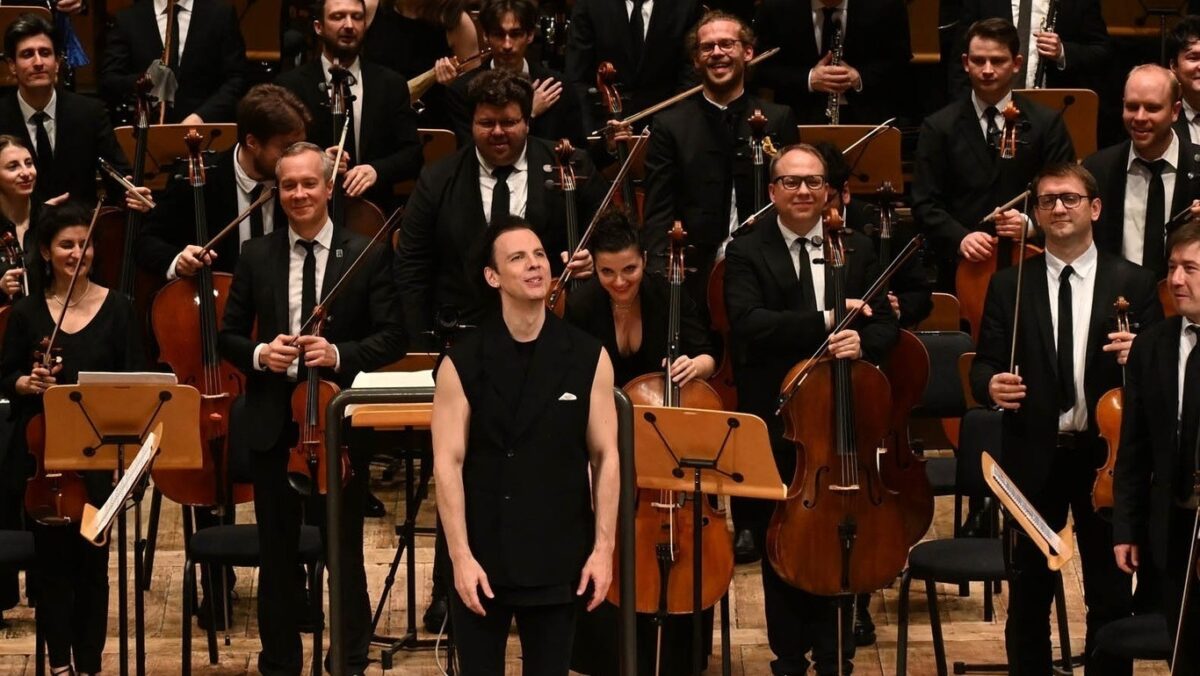
In his Nibelungen-esque current tour, which spans Italy and Spain (Brescia, Modena, Florence, Zaragoza, Seville, Madrid, Barcelona), Currentzis appears sleeveless, his long, muscular arms swirling in the air, caressing the sound of his dazzling musicAeterna orchestra. The orchestra is fabulous in many ways, a killing machine originally founded by Currentzis himself (2004) for the Novosibirsk Opera and trained over the years to tackle the entire musical repertoire, from historically informed performances of early music to the stylistic diversity of the many forms of contemporary classical music.
Over a hundred instrumentalists crowded onto the stage of the Teatro Comunale “Pavarotti-Freni” in Modena on 12 February, saturating the not-so-large theater hall with Wagnerian melodies. But it wasn’t a single, standardized sound. The opening of the score, for example, retracing the first bars of Das Rheingold, sounded unsettlingly bare, arid (chamber-like?), devoid of any real sonic consistency. Only as the performance continued did the orchestra’s timbre emerge, reaching that fullness and roundness that so appeals to the most riveted audiences.
And that Currentzis’s concerts (whether Mozart or Mahler) engage a “physical” listening experience even more than a “mental” one is made clear by the reaction of the devoted and enchanted spectators who follow him on his European wanderings and lavish raving applause, rapturously entranced at the end of each performance. The visual dimension of each of his concerts contributes as much as the aural one to the creation of each performance as an absolute or unrepeatable event — though there remains a minority who continues to suspect it is just smoke without fire.