Photo by Michael Strickland
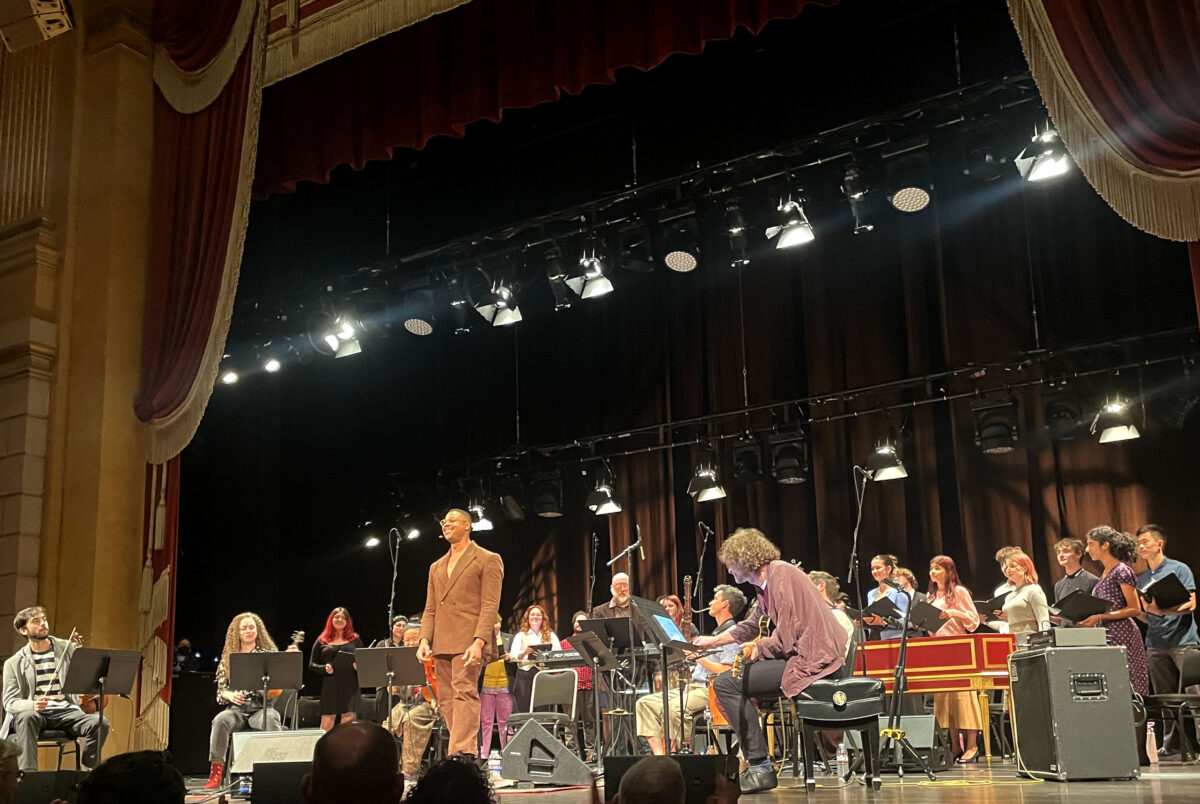
Bass-baritone Davóne Tines and Ruckus, which San Francisco Classical Voice described as “the world’s only period-instrument rock band,” brought their program, called “What is Your Hand in This?”, to San Francisco’s Herbst Theatre on February 7.
“What Is Your Hand In This?” is a gently confrontational program, described as conceived by Douglas Adam August Balliett, Tines, and Clay Zeller-Townson. Balliett is Ruckus’s bass player – that’s electric bass – and Zeller-Townson is the group’s double reed player and (at least for this program) percussionist. It’s not a conventional recital program, but something looser, less formal, and more participatory.
For these concerts, Ruckus, which has flexible membership, also included violinist Keir GoGwilt, violists Shelby Yamin, and Manami Mizumoto, Baroque guitarist Paul Holmes Morton, and Elliot Figg on keyboards. The string players used Baroque bows; see “period-instrument rock band.”
The program, marking the 250th anniversary of the Declaration of Independence and the tradition of dissent in American music, included about 20 works from the 18th to 21st centuries by famous composers and composers who should be famous. The vocal and instrumental selections drew on a range of traditions: classical, blues, and hymns from the Black church by Handel and Balliet.
The program lasted an hour and a quarter and flowed seamlessly from one number to the next. Sometimes you couldn’t even tell where they began and ended, particularly the selections from Balliet’s Compassion Preludes, written last year and commissioned for this program. I hope to hear them on their own one day, particularly because of Ruckus’s beautiful playing.
Of course Tines was the star of the show – he was up front singing much of the time – but he he did not domineer, sharing the stage generously with Ruckus, spread in a semi-circle on stage, and choristers. At each tour stop, a different chorus participated; in San Francisco, it was the Ruth Asawa School of the Arts Concert Choir, directed by Michael Desnoyers.
They were wonderfully responsive and alert, enthusiastic. They were focussed and musical throughout, even in the improvisatory thickets of Julius Eastman’s “Buddha,” surely the most challenging music on the program. The music of Eastman, a musical radical, a gay Black man like Davóne Tines, resonated with the whole program.
Tines is a welcoming presence, speaking to and welcoming the audience, inviting us to consider the formation of the United States, and what the program refers to as “the founding hypocrisy of the American Revolution,” in which the founders fought for freedom while enslaving people who had no freedom.
Founding father John Dickinson, a delegate to the First and Second Continental Congresses, was represented on the program by his song “The Liberty Song,” sung to the tune “Heart of Oak,” and hugely popular at the time. Dickinson himself had enslaved people working on his farm.
Counterbalancing Dickinson’s personal hypocrisy came “What Mean Ye?”, by the abolitionist George W. Clark, who compiled a collection of anti-slavery songs, two songs from around 1801 by Sawney Freeman, who might have been the country’s first Black composer, and Joshua McCarter Simpson’s “To the White People of American,” from 1854.
The title of the program comes from lyrics Tines wrote to a tune he based on Black American folk tradition, called “What is My Hand in This?,” which he first sang at a party of wealthy people. The song is a challenge to the listener, whether wealthy or not, to try to right any wrongs they have committed – a responsibility for us all.
Tines not only challenged the audience to consider this, but made us a part of the work by inviting us to sing along with the refrain, which we did. Elsewhere on the program, he had the audience clapping. The singing and the clapping drew us into the communion of musical performance.
One might wonder – I certainly did – about why Tines and each of the instruments were amplified. Herbst is a small theater, seating 928, with good acoustics: much smaller ensembles have no difficulty making themselves heard. The amplification didn’t make it easier to understand the words.
Tines is a remarkable performer – magnet, charismatic, an enveloping presence – with a remarkable voice, a warmly resonant bass-baritone of great range, extending to a beautiful falsetto that he put on display from time to time during the performance. And Ruckus was a marvelous partner in “What Is Your Hand In This?” Perhaps there will be a recording or video release of this moving, thoughtful program, so appropriate when our political life is fraught with danger and our very democracy, such as it is, is threatened.