Dmitrijus Matvejevas
Accentus Music recently released what they have dubbed the “first professional recording” of Almicare Ponchielli’s I Lituani (The Lithuanians), his first commission from the Ricordi publishing house the great success of his revised version of I promessi sposi . Ricordi proposed the enormously popular, nationalistic 1828 poem Konrad Wallenrod by Adam Mickiewicz as the subject.
The Polish-language poem fictionalizes the details of the life of its eponymous hero and his role in helping to defeat his people’s long-standing enemy, the Order of Teutonic Knights. It was a thinly veiled protest against the Russian partition of the Poland-Lithuanian Commonwealth and is credited with inciting the 1830 uprising against Russian rule.
The operatic version fictionalizes things further. Walter (tenor, of course) is a Lithuanian who goes behind enemy lines disguised as the Teutonic Knight, Corrado Wallenrod . After 10 years, he becomes the Grand Master of the Teutonic Knights and plans to undermine them in battle with the Lithuanians. His wife Aldona (soprano), brother-in-law Arnoldo (baritone), and neighborhood Oracle ( Albano, bass) sneak into the celebration for Walter’s investiture disguised as bards. They sing about the sad fate of Lithuania and its imminent liberation.
The evil Vitoldo (bass) recognizes Aldona, but Corrado prevents their arrest. Vitoldo is very suspicious. Corrado is found out, but not before causing the Teutonic Knights to lose to the Lithuanians in battle. He is sentenced to death, but drinks poison before he can be executed. He dies in Aldona’s arms. The Divine Spirt of Lithuania arrives to welcome his soul to heaven. Everyone sings “He who redeems a people will have eternal fame.”
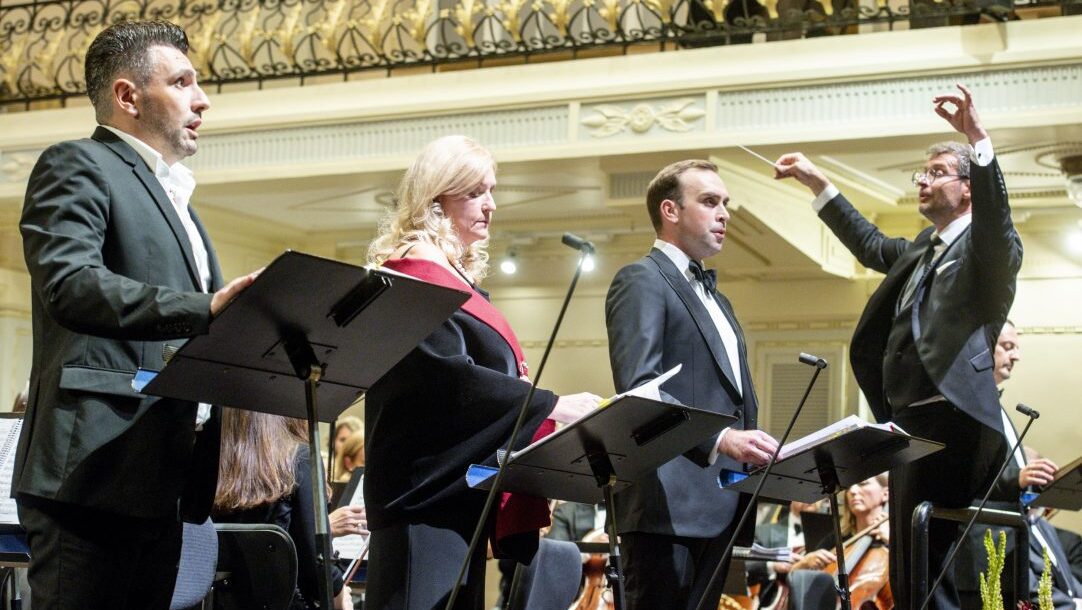
The work certainly shares many of the strengths of La Gioconda: a brooding, lyric overture that builds to a dramatic climax, passionate arias for all the principles, impressive ensembles, and lots of vivid choral writing. For me, the biggest downside of the work is that it probably has too much choral singing, which is something I thought I’d never complain about in an opera. There are large ceremonial choral sections in two of the acts and they grind the action to a halt even when sung as well as they are here by the Kaunas State Choir. Nonetheless, the work is definitely worth your attention. Conductor Modestas Pitrėnas, leading the Lithuanian National Symphony Orchestra and an all Lithuanian cast, succeeds in making a compelling case for the work despite a few soloists whose voices are less glamorous than the work requires.
The most successful is baritone Modestas Sedlevičius who displays a lush, powerful voice and he gives an impressive rendition of his big aria “O rimembranze.” I’m surprised this doesn’t appear on more baritone recitals. Bass Tadas Girininkas kicks the opera off strongly with his lament over the destruction of his nation by the Teutons.
Tenor Kristian Benedikt is probably the best known name in the cast (at least to me). He has the power and stamina for the grueling role, but his timbre can turn acidic. As his wife Aldona, soprano Jūratė Švedaitė-Waller has her challenges as well. The temperament is there but at times the singing sounds breathy and unsupported and lacks clear articulation of the text. Despite these caveats, the recording is recommended.
This opera has a very slim discography and performance history. There was a radio broadcast on RAI in the 70s that was released unofficially. There are a couple of other concert performances on youtube, and Jonas Kaufmann included the act III aria in his 2010 verismo album. Otherwise, I learned that there is a company called The Lithuanian Opera Company of Chicago which performed this work several times. Anybody seen it?