Photo by Kyle Flubacker
This Sunday, over nine inches of snow fell on Chicago. But as the snowstorm raged outside, inside the Civic Opera House a different kind of tempest was swirling: a tumultuous Salome that proved a welcome addition to the wintery mix.
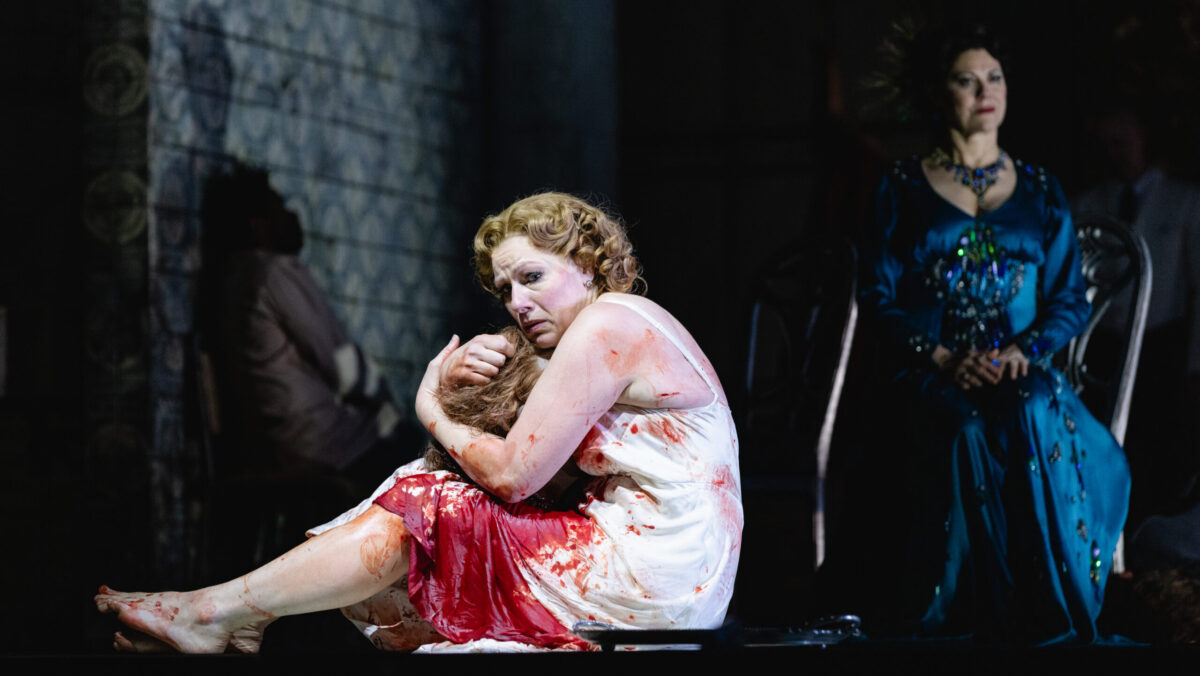
The Lyric’s Salome comes by way of the Royal Opera House, where David McVicar’s production first premiered in 2008. The action took place on two levels: the thin upper slice of a banquet hall in which the party guests were mostly visible from the knees down, and a basement level whose bare lightbulbs and grimy tiled walls evoked an abattoir. A long staircase in a stark beam of light, stage left, connected the two.
The program claims that McVicar was inspired by Pasolini’s shocker Salò, but the aesthetic was more Old Hollywood than fringe Italian art film: bias-cut gowns, finger-waved hair. The female supers who stumbled around in thigh-highs and girdles did more to date the production to the late aughts (I associate vintage lingerie on the operatic stage strongly with the year 2008. Wasn’t it also around then that the Met got busted for paying dancers extra to go topless in their burlesque-y Contes d’Hoffman? But I digress!) than to create the desired air of heady debauchery.
Still, if the production was a little staid, the music was anything but. Making his Lyric debut, Tomás Netopil led the Lyric Opera Orchestra in a wild and whirling Salome, one that seemed always on the verge of careening out of control. At times Netopil seemed to be barely holding the chaos of Strauss’s score at bay—a quality that was occasionally distracting, as in the first scene between Salome and Jochanaan, but more often thrilling, as in the blistering instrumental interlude immediately after. This thrilling quality was taken up by every cast member, from the instant spark of Ryan Capozzo as Narraboth and Catherine Martin as the page onward.
Another spark was Nicholas Brownlee, who was loud as hell and ferocious to boot as Jochanaan. One difficulty where Jochanaans are concerned is that if you want him to seem plausibly like a man who has been trapped at the bottom of a hole for a week, it’s not easy to make him also seem like a man that a young girl might sexually imprint on.
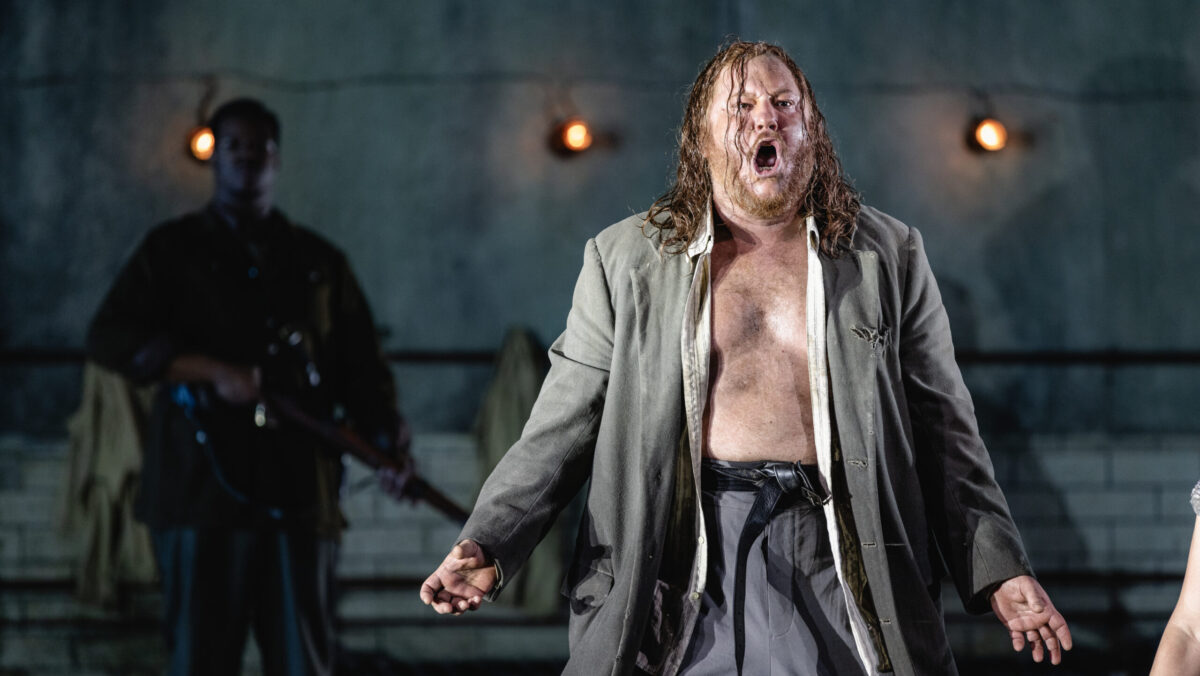
Photo by Kyle Flubacker
Brownlee’s stage presence was forceful and energetic; his voice had the simultaneous bulk and dexterity of a shark in open waters. He seemed more than capable of summoning the wrath of God. But his wig, which was brown, stringy, and far limper than his voice, was definitely the wig of an earth-bound man. It may seem petty, but Brownlee is a good looking guy with an imposing stage presence—and his wig noticeably diminished that presence. Jochanaan’s violent menace still read, but his hypnotic appeal—that quality that enthralls Salome and audience alike—was blunted.
Bad hair day notwithstanding, Brownlee just didn’t seem very tapped into the role’s strange and enticing sensuality. In this, he joined his conductor, Netopil, whose high-octane, controlled-chaos approach to the score was likewise not so oriented towards moments of romanticism and seduction, and his leading lady, Jennifer Holloway, who was at her best in moments of passionate intensity.
Like Brownlee, Holloway had a passionate, tumultuous quality that was thrilling to hear, but rarely softened into wonder or romanticism. This harmed Brownlee and Holloway’s earlier scene together, which never cohered enough to temper their conflict with her infatuation. Rather, it was after the dance that Holloway’s ferocious Salome really came into her own, as she channeled Salome’s furious demands for Jochanaan’s head into ringing torrents of sound.
In the hushed and eerie moments of the opera’s finale, Holloway’s Salome seemed less like someone lost in an erotic reverie and more like someone still struggling to make sense of her own anger, even as she cradled her adversary’s severed head in her arms—an effective choice, and one which made the violence with which the opera concludes all the more fitting.
Here, too, costuming decisions seemed to have an outsized impact. Holloway’s Salome was dressed in a slinky ankle-length gown, with finger waves in her hair—she just didn’t look like the teenager Salome is, in theory, supposed to be. Add this to the decidedly grown-up tenor of Holloway’s onstage intensity, plus her slight tendency towards a wide vibrato, and the overall sense of the opera became that Salome was an adult woman engaged in a relatively equal-footed contest of wills with Jochanaan.
What’s more, Alex Boyer, stepping in to replace Brandon Jovanovich, cut an unusually youthful figure as Herod. Boyer was gamely pompous and in fine voice, but he hardly seemed older than Salome, which obscured somewhat the nature of Herod’s interest in his stepdaughter, and furthered the idea that Salome was an adult in conflict with other adults. As Herodias, Tanja Ariane Baumgartner was appealingly bloodthirsty, if occasionally lost in the tumult of the orchestra.
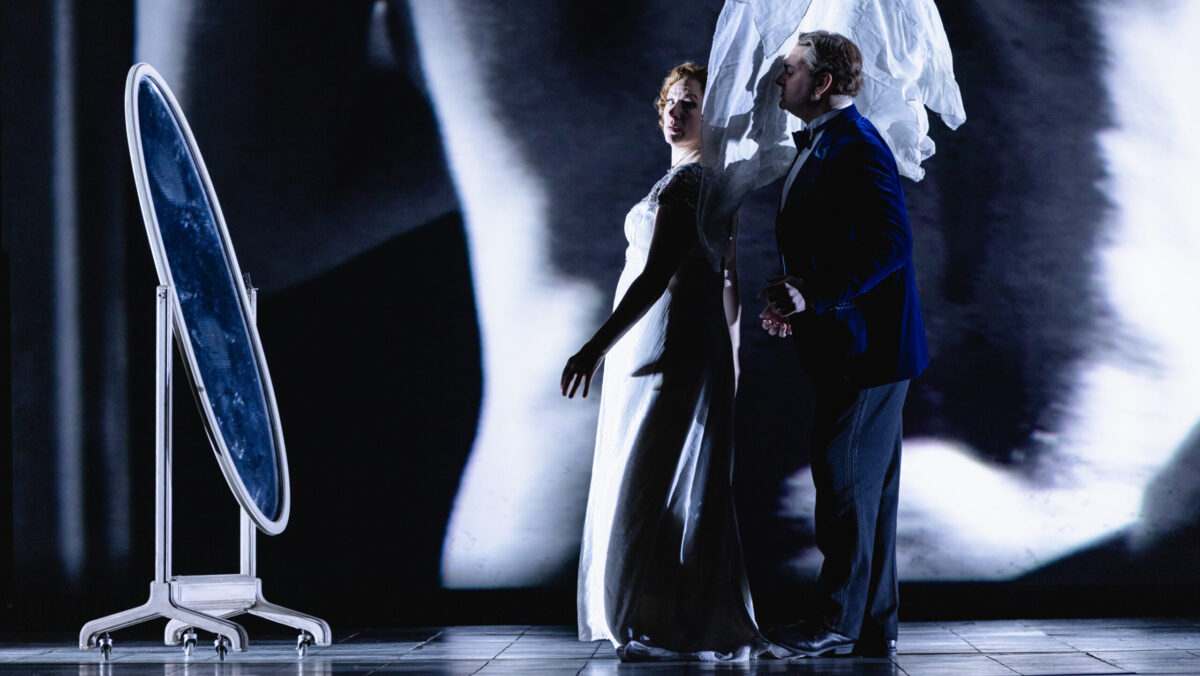
Photo by Kyle Flubacker
One of the few moments where Salome seemed more childlike was in the staging of the dance, which saw Salome progressing through a series of rooms that represented life stages. Much of the sequence played like an MFA’s first foray into feminist video art (massive projections of baby dolls and zippers being unzipped, ritual hand washing—you get the picture), but a moment in which Herod helped Salome change into a prom dress and then waltzed her around the stage evoked those creepy purity ceremonies where fathers symbolically marry their teenaged daughters, to skin-crawling effect.
Overall, the Lyric has a whirlwind Salome, a blow-you-back-in-your-seat and make-your-ears-ring Salome. It’s not quite a lean-forward-with-bated-breath Salome, nor a seduce-you-against-your-better-judgement Salome. Call it a Winter Salome, maybe, rather than a Summer Salome—less simmering humidity and more daredevil ski-jumps. But whatever you want to call it, why not just call the Lyric box office? After all, I hear there’s more snow this weekend.