Bernd Uhlig
One of my favorite reads from last summer was Jack Zipes’ Fairy Tales and the Art of Subversion. In it, Zipes maintains that the literary fairy tale “developed a long tradition of commenting and reflecting social reality in a critical fashion through the play on and ingenious symbols, motifs, and plots.” In the overwhelming present, can we turn to fairy tales to remind us of modes of resistance and care? Can fairy tales serve as a vehicle for commenting on our current political reality?
The creative team at the Staatsoper Berlin may have wondered the same thing when producing Das kalte Herz, a new opera with music by Matthias Pintscher and a libretto by Daniel Arkadij Gerzenberg. Das kalte Herz premiered at the Staatsoper on January 11, 2026, and is loosely based on Wilhelm Hauff’s 1827 fairy tale of the same name. Composer and conductor Pintscher is not known for his vocal compositions; rather, he is praised for his artistic direction, having recently been appointed music director of the Kansas City Symphony. Admittedly, I have been a fangirl of Pintscher since seeing his 2018 performance of Stockhausen’s Gruppen at the TATE Modern with his Ensemble Intercontemporain. With his conducting career in mind, I expected the opera to sound like a new music take on a nineteenth-century Bildungsroman tale. Pintscher delivered exactly this, describing his compositional process as “painting with a really broad brush on a really large canvas,” eliciting a gestural soundscape of forest imagery.
Hauff’s Das kalte Herz centers on an unhappy Peter who trades his heart for wealth (and dancing skills). In the original tale, Peter visits a Glasmännlein to cast his wishes and sells his heart to Holländermichels, but librettist Gerzenberg abandons these characters. Rather, Gerzenberg introduces a trio of women who shape Peter’s destiny: his mother, lover, and the goddess Anubis. For fans of the Strauss/Hoffmansnthal operas, it might be interesting to note that we were close to seeing a realization of this tale from the duo, Hofmannsthal leaving behind notes and correspondence for a project titled Das steinerne Herz. Likewise, Hofmannsthal cites Hauff’s tale when drafting Die Frau ohne Schatten, suggesting that Strauss revisit the tale in letters from around 1911. All to say, this tale has been in the popular imagination since its publication in 1827, with many film adaptations to date.
The opera is presented as twelve tableaus with four orchestral interludes. The opera opens in the forest where an old woman decked in a fur coat (yes, symbolism already), tells a young Peter about “an eerie ritual where the people of the village make a sacrifice to the gods.” The vocal writing for the old woman role, sung by Adriane Queiroz, was disjunct to the point where I found myself asking whether it was Sprechstimme. The orchestration’s broad paint strokes in the opening scene created a mimetic soundscape of the forest, birthing flowing brooks and singing birds, but it did not provide any melodic material. The program notes suggested that there would be leitmotifs in the orchestration, and while my conservatory-trained ear listened out for them, I felt as if I was searching for the animals in Peter and the Wolf! And yes, eventually we did hear a wolf-like French horn motif.
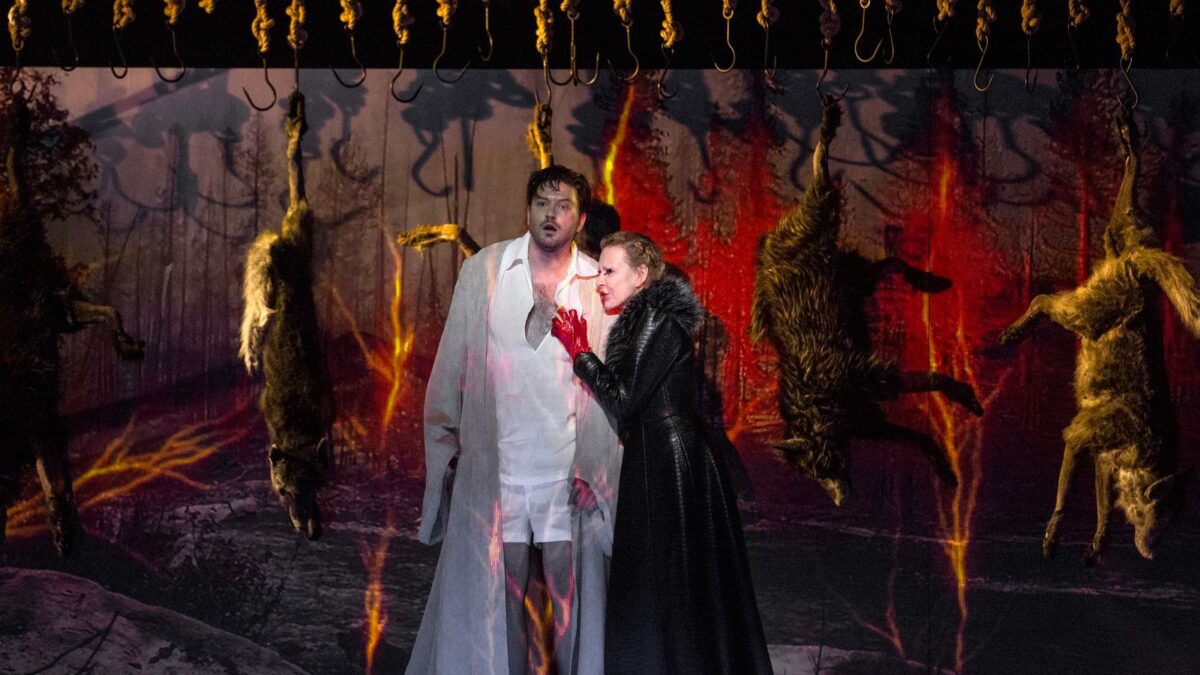
In the second tableau, we meet our protagonist, Peter, who sings an aria invoking the goddess Anubis. The vocal writing for Peter (baritone Samuel Hasselhorn) was an improvement, with Pintscher giving Hasselhorn long vocal phrases to showcase his abilities. In Peter’s aria, the orchestration moves out of the way for the sung phrases, the vocal writing depicting wind wisping through the space between the trees. Here, however, is when the libretto begins to fail us. Peter sings of how he is “consumed by sorrow,” yet we don’t know why (other than because he was born on a Sunday?) The staging, directed by James Darrah Black, does not give us any answers either, as ropes hoisting a collection of dead wolves descend and hang over the stage, remaining there for the entire opera. In the next tableau, we meet Clara (soprano Sophia Burgos), Peter’s lover. Burgos’ coloratura sparkled above the forest soundscape, singing along with bird song provided by the woodwinds. Yet, the audience is left to assume details of their relationship from their body language, rather than the libretto or accompanying musical material.
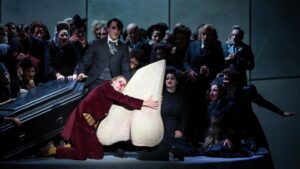
The chat between lovers is short, as Azaël (a speaking role performed by Swiss actress Sunnyi Melles) appears and tells Peter a fairy tale. The tale, which is meant to be the moral throughline of the work, is about an old man who refuses to help a wolf. The tale presents an “every man for himself” mentality which will undoubtably come back to haunt us. While Azaël tells the tale, she skins a wolf. Call me a prude, but there has been too much skinning on the operatic stages of Berlin lately! In the next tableau, Peter’s mother (mezzo-soprano Katarina Bradic) appears and promises Azaël that she will personally remove Peter’s heart. Finally, when Anubis (mezzo-soprano Rosie Aldridge) arrives in a red Queen of the Night-like gown, she requests Peter’s heart and informs him that it will be replaced with a stone. Finally, the orchestra awakes, and we are introduced to the full breadth of the Staatskapelle’s brass section. During this tableau, a chorus of twelve heartless men roll out a line of TVs that are seemingly showing a knockoff of the Rocky Horror opening (the reason for this remains unclear).
The highlight of the opera was when Peter realizes he lacks all emotion after having his heart replaced with a stone. Following a fabulous bass clarinet solo, Peter’s aria is sung a cappella, allowing Hasselhorn’s voice to envelop the audience without orchestral disruption. The silence of the orchestra throughout Peter’s aria captures the essence of a heartless life—that without music. “I feel nothing,” Peter sings, leaving the audience to wonder if it is better to feel nothing or feel the wide range of human emotion. The vocal writing almost sounded Baroque, Monteverdi’s “Possente spirto” coming to mind when basking in Hasselhorn’s appoggiaturas. If it is not obvious yet, Hasselhorn’s voice is marvelous; I’ve been listening to his Schubert recordings non-stop since leaving the opera house Friday night, and I highly recommend them!
In the final tableau, “night without morning,” Peter’s mother realizes her wrongdoing and refuses to turn over his heart to Anubis. What did we learn? Did Azaël’s tale of “each man for himself” warn us of the danger of selfishness? Did repeating the phrase “the law compels you to be quiet” teach us about the dangers of collective silence? Black suggests that the “piece is about the conflict of humanity and nature and the savagery of mankind destroying nature and therefore destroying mystical qualities.” While Black’s message did not fully land, I applaud attempt to return to a realm of mysticism and fairy tales.