Lilly Lorber, Chloe Claudel in What to Wear / Photo credit: Stephanie Berger
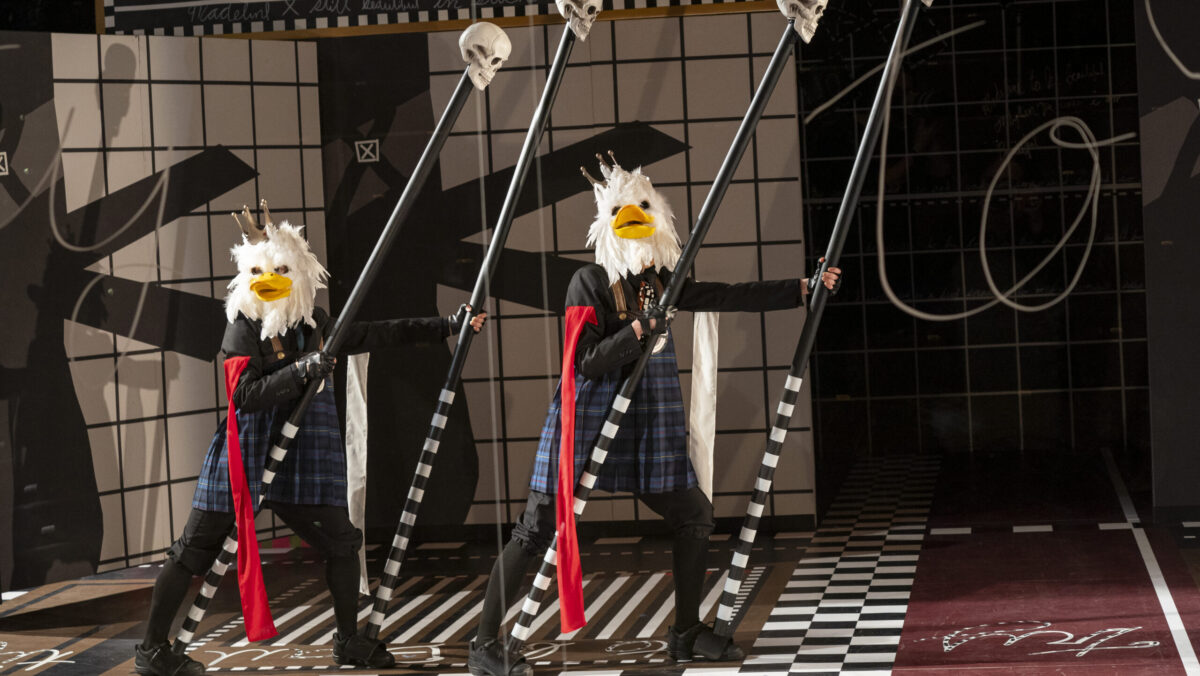
I’ll spoil it for you. Here’s what to wear: a simple black top, a simple black hat accented with multicolored plastic balls, a tartan skirt hiked up just under your bust, and black breeches. You’re going golfing, after all. Or maybe wear something a little more traditional, a sash pinned with a brooch over a modest frock and asymmetrical pinafore, like you’re in an old-fashioned ladies’ club by way of Doctor Caligari. Either way, sensible black tennis shoes are a must.
At least that’s what they were wearing Thursday at the BAM Harvey Theater for the 20th anniversary revival of What to Wear by underground theater legend Richard Foreman and composer Michael Gordon of the Bang on a Can collective, presented by the PROTOTYPE Festival just one year after the death of the avant-garde writer and director. Even the orchestra, the Bang on a Can All-Stars, were wearing those little ball-bedecked hats (designed by E.B. Brooks), with varying degrees of success: conductor Alan Pierson, one of Gordon’s most dedicated champions, didn’t quite pull it off, whereas violinist Darian Donovan Thomas should probably ask to keep it at the end of the run.
I guess that’s not much of a spoiler, but then, there’s not much of a plot. The libretto mentions a couple of characters: an ugly duckling, represented by a giant prop duck, who at first seems to be metaphorical, but then maybe not; Madeline X, who is trying on clothes and perhaps pondering larger questions than—well—what to wear, and may or may not be represented by anyone or everyone in the cast. If I had to compare Gordon and Foreman’s conception of opera to anybody else’s (always a dangerous game) based on what they show us here, it wouldn’t be Alban Berg or Kevin Puts, it would be Frank Zappa, a composer whose narrative works, like What to Wear, rely heavily on dramatic, spoken narration, and whose nonsensical lyrics and plots, while reflecting satirically on the absurdity of a superficial, conformist society, are mostly an excuse for dizzying displays of abstract complexity and abstraction.
Gordon and Foreman are aesthetically well matched. Objects, images and symbols—boxes, Xs, stripes, golf clubs, those little colored balls—repeat all over Foreman’s manically detailed visual designs, while the blocking and choreography create deeply layered, kinetic stage pictures; Gordon’s primary composition strategy, here as elsewhere, is to introduce simple, albeit asymmetrical musical ideas with a rock-steady pulse, and then demonstrate how they can be combined in close counterpoint to create something complex and unpredictable. Foreman’s lighting (designed by Joe Levasseur) alternately dazzles the audience and plunges the stage into total darkness, while Gordon’s heavily amplified sonorities provide the audio half of the audiovisual overload.
To clarify the counterpoint, and to lean away from the warm, florid sounds of operatic vocal production, the amplified singers use little to no vibrato. There were some standout singers—a strong tenor belt from Morgan Mastrangelo; a solid, earthy mezzo from Hai-Ting Chinn; and though she got a little pitchy on her highest notes, soprano Sarah Freireprised her role from the original production admirably, given the unforgiving demands of the vocal writing and performance practice—but the matching sets of costumes, alternately suggesting social conformity or the alien pageantry of some fantastical realm, lent the performers an anonymity that often made it difficult to single anyone out. For instance, I absolutely did not clock that indie rock superstar St. Vincent (Annie Clark) was in the cast until I glanced at my program afterwards.
The score is one of Gordon’s most effective, owing largely to that tight ensemble counterpoint and close harmonies for upper voices. I spotted a few of his trademark gestures—deep rhythmic hemiolas, melodic lines descending in thirds through all seven pitches of the diatonic scale. But the strong dramatic structure of each number made What to Wear stand out from his earlier work, as well as the moments where a surprisingly compelling melody emerged from the mathy, post-punk textures.
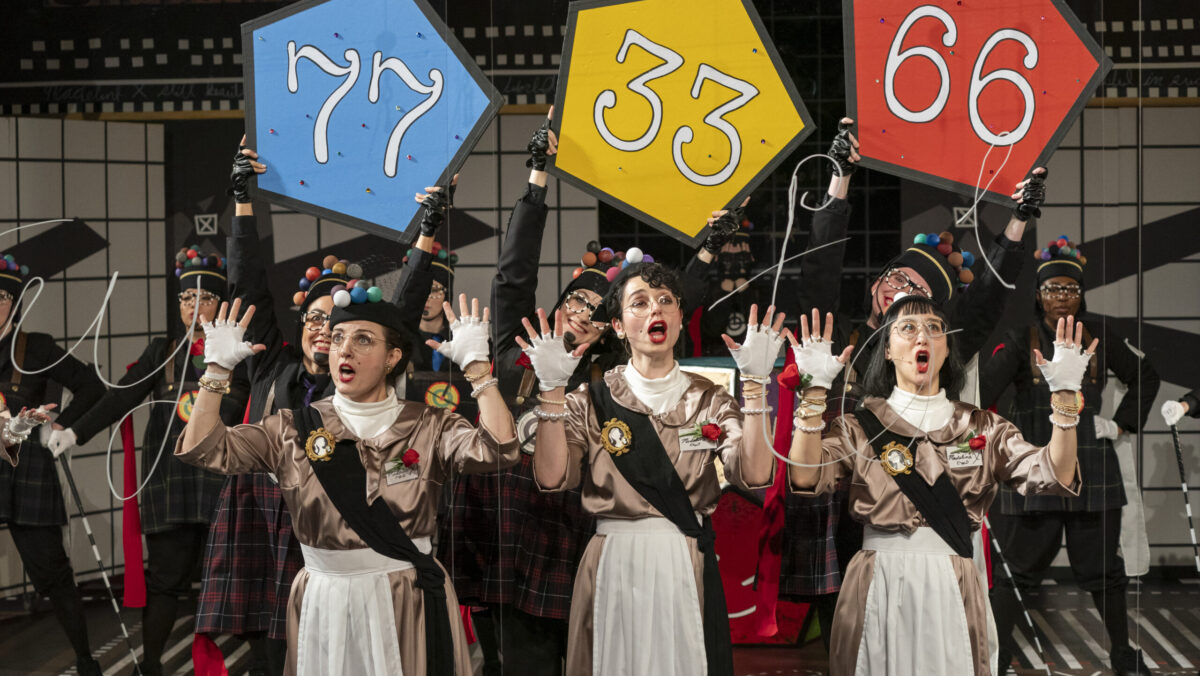
Sarah Frei, Sophie Delphis, Hai-Ting Chinn in What to Wear / Photo credit: Stephanie Berger
For their part, the All-Stars, whose regular lineup includes drums and electric guitar, gave an appropriately raw, high-energy rock band performance, and there were a few exciting moments where solo instrumentalists broke free of the almost relentless pulsing for apparently improvised moments of sheer sonority, with especially notable contributions from violinist Thomas and clarinetist/keyboardist Ken Thomson.
All in all, it was one of those evenings at the theater that I felt privileged to attend. In his heyday, Foreman’s name seemed inescapable in the pages of the Village Voice and on posters wheatpasted around the city, but being a deeply uncool person, I missed my chance to see any of his shows when he was alive. Now that I’ve finally taken in one of these delicious spectacles, I’m savoring in my mind the work of an artist who seems a worthy 20th/21st-century American successor to the Dadaists, the Surrealists, or artists like the Picasso of Diaghilev’s Parade at the Ballets Russes. And of course, I’ll forever quote these lines from his libretto:
When a duck enters a fine restaurant
Dressed very beautifully
That duck is eaten.