Cody Pickens
The Los Angeles Philharmonic ushered in 2026 with its Body & Soul festival on Friday, January 9, featuring an ambitious program that also marked the return of esteemed Finnish conductor Esa-Pekka Salonen to Walt Disney Concert Hall. Body & Soul is a multisensory concert series that showcases how music engages all five senses. Last Friday’s concert focused specifically on hearing and sight.
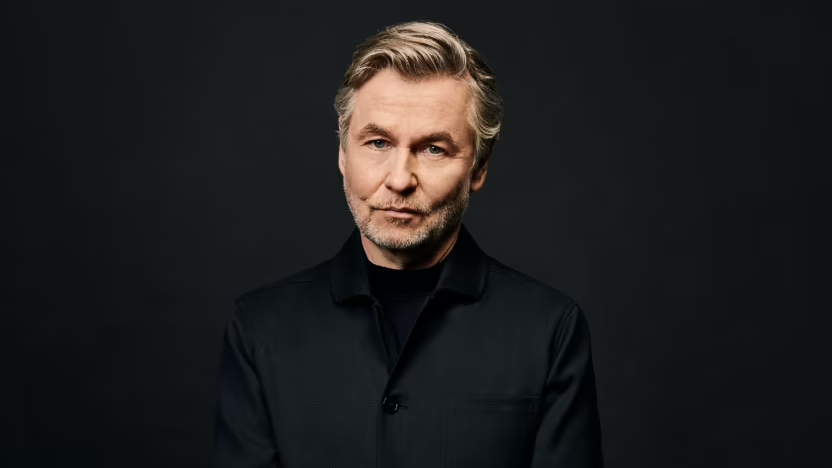
Salonen, who was appointed LA Phil’s first Creative Director last September, served as Music Director from 1992 to 2009 and has been Conductor Laureate since. He seemed like the ideal candidate for the festival, as he intelligently selected a handful of short works closely associated with him that still embodied its spirit and intent.
The first half of the concert featured two pieces that were literally picturesque in their evocation of landscapes, beginning with Jean Sibelius’s 1914 one-act tone poem The Oceanides. Inspired by the nymphs of Greek mythology, the piece depicts water in all its forms and is among Sibelius’s most atmospheric compositions. Notably, it is one of his rare pieces not derived from the Finnish Kalevala mythology. It also marked Sibelius’s only trip to the US, where he premiered the composition at the 1914 Norfolk Music Festival. Salonen himself led the LA Phil’s premiere in 2003.
On Friday, Salonen led the LA Phil in an assured reading, emphasizing the piece’s continuity, depicting the aquatic metaphor rather than the more philosophical playfulness of the ocean nymphs. After observing his Sibelius interpretations over the years, I strongly believe Salonen is one of the greatest Sibelius proponents living today, not only because he admires and respects his scores but also because he builds a structural foundation around them, which is particularly important, as Sibelius’s scores can become very fragmented and disjointed in the hands of the uninitiated.
The superlative performance became a perfect example of the Body & Soul’s theme; the woodwinds (with the flutes in particular) transformed into breezes and winds, the strings morphed into currents and undercurrents, and Sibelius’s gradual dynamic progression denoted a journey to the ocean, complete with a wave crash at the coda before the vastness and calm of the sea engulfed them all.
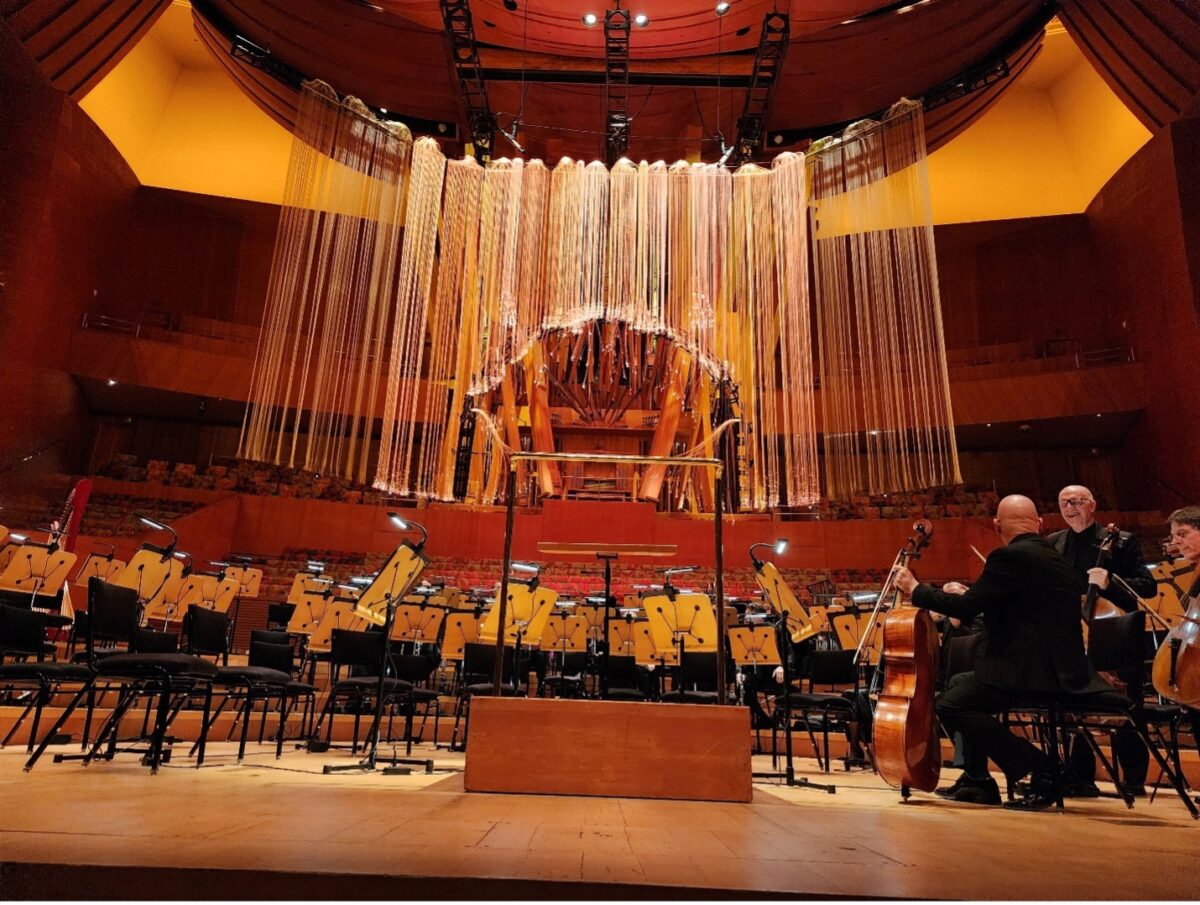
To further illustrate the festival’s points, the LA Phil engaged multimedia artist Grimanesa Amorós for these performances, and she installed an enormous electronic lighting sculpture at the back, above the choir (and the organ. While the sculpture was primarily intended for the final piece, Prometheus (more on that later), during The Oceanides it was lit in a beautiful, translucent turquoise with bright white tips, immediately evoking James Cameron’s Avatar movies.
Michael Anthonio
We moved inland for the second piece of the first half, Gabriella Smith’s Rewilding. Composed last year and commissioned by the SF Symphony, Cleveland Orchestra, Orchestre National de France, and Barcelona Symphony, the work premiered in San Francisco last June under Salonen’s baton. It was inspired by Smith’s other passion: ecosystem restoration. The title refers to the practice of removing invasive plants and planting native ones, and Smith herself offered insights into the piece in her brief introduction before the performance.
The program notes offered a lengthy description of the percussion section (which included 2 used bicycles, metal mixing bowls with walnuts or chickpeas, and twigs/branches, among others), and the audience discussed it fondly during the intermission. Unfortunately, as I sat right in front of Salonen, I missed seeing it all. However, to my ears, the piece worked as a companion to The Oceanides, essentially a tone poem about the forest. This time, the strings played the role of the breezes, and the percussion constituted the sound of the jungle: weird, almost lonely, fascinating, and terrifying all at once. I was thoroughly amazed by the variety of techniques Smith employed to produce those sounds. At one point, the music stopped, and the woodwinds evoked a pond in the middle of the forest, while the strings, playing pizzicato, imitated a chorus of frogs! Nevertheless, Salonen’s guidance in bringing all those elements to life couldn’t be overstated. Personally, the work was a great reminder of why we must care for nature.
The second half entered a more philosophical realm, beginning with Claude Debussy’s cantata (or, to be precise, poème lyrique) La Damoiselle élue for soprano and alto soloists, a two-part women’s chorus, and orchestra. Based on the 1850 poem The Blessed Damozel by the English poet and painter Dante Gabriel Rossetti (in a French translation by Gabriel Sarrazin), the piece tells the story of a young woman who can’t enjoy heaven while her lover remains on Earth. Debussy composed La Damoiselle élue in 1888, during the heyday of his fascination with Richard Wagner’s works, particularly Tristan und Isolde. While Cinq poèmes de Charles Baudelaire (from the same period) was widely regarded as Debussy’s most Wagnerian composition, La Damoiselle élue, with its lush orchestration and leitmotifs, is often described as such. (It was interesting that Debussy moved away from that influence in his only opera, Pelléas et Mélisande, just two years later.)
Salonen recorded La Damoiselle élue for Sony in 1994 with the same force, featuring soprano Dawn Upshaw and mezzo Paula Rasmussen. This time, he engaged soprano Liv Redpath and mezzo Jingjing Xu, along with the Los Angeles Master Chorale. To me, this was the main selling point of these concerts, a rare opportunity to hear this sumptuous score performed live, especially with musicians of this caliber.
There was something remarkably consistent between the recording and Friday’s performance. Salonen took a cool approach to the score, emphasizing the music’s ethereal, dreamlike quality and downplaying the Wagnerian influences—more Pelléas, less Tristan. Both artists sang earnestly, and Xu’s expressive, dark timbre contrasted gorgeously with Redpath’s elegant, radiant voice. On Friday, they were unfortunately glued to the score, which limited their interpretative takes. Nevertheless, it was a delight to finally experience this score in such a grand manner.
Most discussions of how music affects the senses ultimately lead to Alexander Scriabin’s Prometheus: The Poem of Fire, the main selling point of these concerts. After all, the famous tone poem calls for piano, orchestra, (optional) choir, and clavier à lumières, a color organ. Scriabin also devised specific color schemes for the color organ, though he didn’t live to experience it. Loosely based on the myth of Prometheus (who stole fire from the Olympian gods and gave it to humans), the complex composition reflects Scriabin’s metaphysics and belongs to a collection of works that would “lead to the transformation of human consciousness.”
In 2024, Salonen presented a totally over-the-top multisensory production of Prometheus with the SF Symphony, working closely with pianist Jean-Yves Thibaudet (who also performed in these concerts) and collaborating with Cartier’s perfumer Mathilde Laurent and lighting director Luke Kritzeck to engage not only sight and sound but also smell. This time, Salonen, Thibaudet, and Amorós were determined to overwhelm the senses of sight and sound, with both the lighting sculpture and the projected lights on the ceiling of Disney Concert Hall. Unfortunately, I sat right in front of Thibaudet’s grand piano, so I didn’t have access to the sculpture, but I was thoroughly satisfied with Salonen’s way with the score. He continued the night’s modus operandi, presenting a reading marked by clarity and focus, more so than the SF performances two years ago. Similarly, Thibaudet dramatically depicted the struggle of man (the purpose of the piano in this piece) with his lean, mean piano playing. My favorite moment was when the piece reached its orgiastic fulfillment on the very loud F-sharp major chord; the whole auditorium was bathed in blinding white light that would certainly shake the body and soul of the audience!
Judging by the audience’s long rounds of applause, the sold-out show on Friday was a resounding success and a great start to the LA Phil’s Body & Soul festival. Thibaudet will return in April in another synesthetic presentation of Olivier Messiaen’s maximalist Turangalîla-Symphonie, conducted by Simone Young and directed by Zack Winokur.