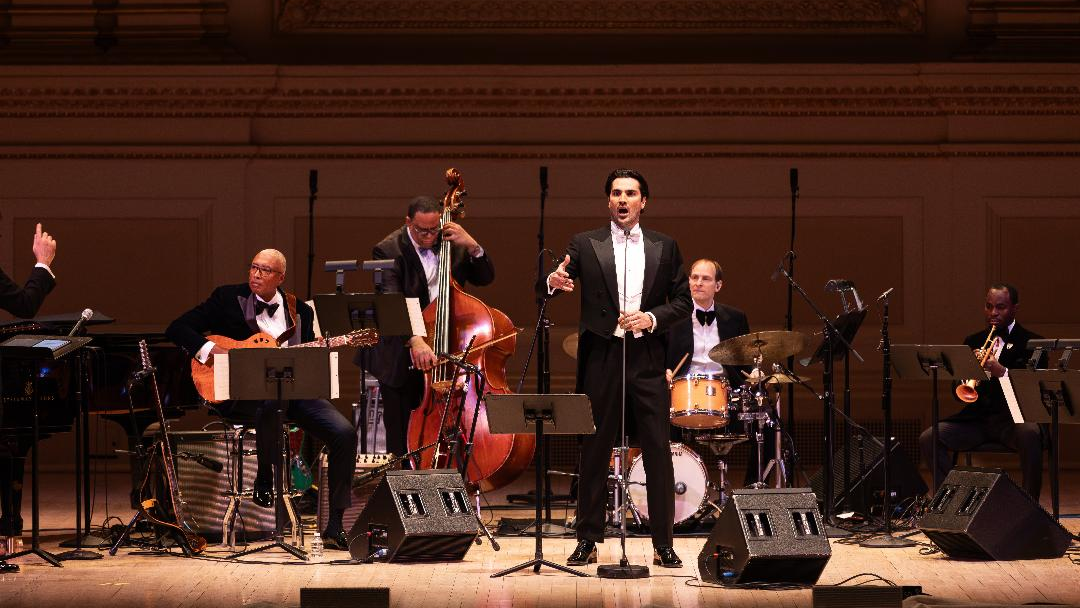
Photo: Fay Fox
The combination of retired Yankees All-Star center fielder turned guitar virtuoso Bernie Williams and rising star tenor Jonathan Tetelman seemed a mismatch. And yet, there was that banner advertising their participation in a duo concert at Carnegie Hall right here on Parterre Box. What is that? And why??
Well, I went to it, dear readers and I am still not sure what it was. It filled the house and entertained a huge number of attendees. So fuck my opinion.
For the why? we need to look at the promoter and organizer of the event, Adam Unger, a man who has worn many hats in his (still fairly young) lifetime: a baseball cap as a former player for the New York Yankees and Colorado Rockies, and a mortarboard graduation cap from Queens College in 2009 with a minor in Music as well as a juris doctor from University of Pennsylvania Law School in 2015. He also trained for opera as a baritone and has worn the hats of parts like Monterone in Rigoletto and Alfio in Cavalleria Rusticana with local opera companies. One of his concert appearances was with an up-and-coming tenor Jonathan Tetelman. Currently, Unger is an attorney with Herrick, Feinstein LLP.
With practicing law, singing opera and playing professional baseball under his belt, Unger has turned to concert promotion. At Tetelman’s home in New Jersey, Unger said he wanted to produce a joint concert with Bernie Williams and “the greatest tenor in the world”. Tetelman offered himself as a great tenor, if not the greatest saying “I’d do that”, and so Unger’s new career as a concert promoter started on Tuesday night.
A friend and former teammate of Unger’s, Bernie Williams has also worn many hats: He said that at the age of eight he fell in love with the flamenco guitar his merchant-marine father brought home from Spain, picking up the baseball bat around the same time. Baseball won out when he joined the Yankees in May 1991. But after his retirement, Williams picked up his guitar again. In 2003, Williams released a Latin jazz and salsa album The Journey Within, which included his own original compositions that sold well and won awards. Williams received a bachelor’s in jazz performance from Manhattan School of Music in 2016. Clearly, Unger and Williams’ common trajectory from baseball to music cemented a friendship that led to this unique collaboration. This was Williams’ Carnegie Hall debut.
The concert was listed as sold out, I think due to the presence of Bernie Williams, who has both a large sports and musical following. There were empty seats here and there (possibly sold?), but the upper levels looked well filled. The audience was enthusiastic and often vocal in their approval. (Synchronized clapping was heard like we were in Yankees Stadium.) From my observation, this was not an audience there to hear Jonathan Tetelman. They liked what they heard but you wouldn’t see these people at the Metropolitan Opera.
Where the concert was strong was in the variety and quality of talent onstage. Williams is fine guitarist, and his original music was striking. Tetelman has a quality instrument, somewhat generically used, and enough personal charisma and charm to pull off this popular stadium type event. But was this a musical collaboration? I didn’t think so.
There was a ten-piece chamber orchestra that had to bounce around from opera to pop to zarzuela to The Beatles. Also, more guest performers than were necessary but who all seemed to be friends of Unger’s.
Williams, who is unassuming onstage, mostly did his guitar thing, and Tetelman did his opera and crossover thing. Williams sat in the back with the musicians while Tetelman took center stage. They didn’t speak to one another once all evening. The only place where they managed to really sync their musical energies was in a striking rendition of “E lucevan le stelle” from Puccini’s Tosca where Williams played the haunting opening theme on his guitar. The audience responded enthusiastically to Puccini’s hauntingly beautiful melody and Tetelman’s committed, well-sung rendition.
The opening salvo of “Granada” in a lackluster arrangement showed no one to their best advantage (though Tetelman has the voice for it). Then Williams excelled in his original composition “Ritmo de Osono”. Tetelman blazed through the zarzuela aria “No puede ser” from La Tabernera del Puerto with William Hicks on the piano (Unger’s former vocal coach). It continued with more of Williams’s original music “Para Don Berna” and a solid rendition of “La donna é mobile” from Rigoletto from Tetelman. First half ended with a bouncy “Libiamo” duet with poperatic soprano Ariana Maloney in a statement low cut red satin evening gown.
The second half veered into crossover, standards and pop music with an emphasis on the middlebrow. “On the Street Where You Live” got a jazzy up-tempo rendition from Tetelman while Williams tore into a jazz fantasia of “Can’t Buy Me Love” with drummer Ari Hoenig trying to steal the show with an extended percussion solo.
ESPN sports journalist and commentator Darren Rovell acted as compère, introducing all the varied and eclectic acts while providing color commentary intermittently throughout the evening. Unger felt the need to draft a lot of supporting talent that distracted rather than supported the two central artists. Ariana Maloney sounded better in the poppy arrangement of “The Prayer” by David Foster and Carole Bayer Sager than she did as Violetta. For Bernstein’s familiar “Maria” from West Side Story, instead of the natural assignment to our star tenor, the piece went to guest pop tenor Stevie Mackey, a coach for NBC’s “The Voice,” who has worked with Jennifer Lopez. He was sensational and ready to take the stage with clear diction and expert blending into head voice but was a one-off. Violinist Katia Reguero Lindor got a big introduction but then sat down, turned away from the audience and joined the other two string players with no solo. What?? Broadway vet and George Steinbrenner granddaughter Haley Swindal was dragged on to belt “New York, New York” with Tetelman for the finale. Even Unger himself got into the act coming out to take over “D’Habitude” from Tetelman, giving us a few verses in Paul Anka’s familiar, maudlin English translation as “My Way” in a sturdy musical theater baritone. An 18-year-old Unger used to entertain his Yankee teammates with “New York, New York” and “My Way,” so their inclusion reflected his own Sinatra-influenced tastes.
Tetelman got a big push by the Met in his debut season with two rather secondary tenor leads (Ruggero in La Rondine and Pinkerton in Butterfly), replete with HD double exposure. The Met seemed poised to promote the telegenic tall, dark and handsome tenor as a company star. That was derailed when lingering illness compromised his singing, and divo attitude allegedly erupted backstage. Tetelman compounded the negative impression by complaining in interviews of the Met’s exploitative promotion (aimed at making him a house favorite, although that didn’t work out too well for previous Gelb pet tenor Vittorio Grigolo). He hasn’t been back since, and his name is missing from any future prospectus.
Both the voice and the looks are dark and handsome, and his technique is solid with a ringing secure top. He doesn’t go very deep as an interpreter, and his style is rather American regional B lister rather than international artiste. (I admired Tetelman’s acting as Pinkerton where he was unafraid to bring out the louche and manipulative aspects of the character.) He has good, unaffected English diction and can sound natural crossing over into pop, Broadway, and jazz (he’s a former DJ). In some of the pop pieces Tetelman went for the foreign language text – he sang “D’Habitude” in excellent French that bodes well for his upcoming debuts in the title roles of Faust and Werther in Europe. Parla più piano by Nino Rota showed again how much film scores owe to Puccini and verismo. His encore of “Nessun Dorma” was rousingly sung with real spinto thrust and color. He can cross over without embarrassing himself and the audience responded well to him. As a popular concert attraction, he shows definite potential.
I think Williams is more a natural for a smaller cabaret room; he seemed a bit swamped and lost in a crowd on the Carnegie Hall stage despite great ability. He also doesn’t seem comfortable speaking in public and did not interact much. Tetelman, who comes from opera, was better at working a big room as a star. Williams seemed to be part of the ensemble a lot of the time, which is no aspersion on his musical ability or talent.
Unger might be better at showcasing his performers if he cut down a bit on the three-ring circus aspect removing all the guest performers. Keep it simple and put the music first.