Angel Origgi
On Friday January 9, Hildegard, a new opera by composer and librettist Sarah Kirkland Snider, made its New York City premier as part of the Prototype Festival. Directed by Elkhanah Pulitzer, with music direction by Gabriel Crouch, the “operatic historical fiction” looks at the life of Hildegard von Bingen, a 12th century abbess, composer, prophetess, and polymath. Set in 1147, it deals specifically with a seminal period in the life of the prophetess as she was transcribing her visions for papal evaluation, engaging in power struggles with her church superiors, and founding her first monastery. The narrative revolves around the largely fictionalized story of her relationship with novice Richardis von Stade.
I came to this opera with enthusiasm and an open heart. I’m having a medieval nun moment; somehow this year I can’t get enough of pious dead virgins. I should have known better than to walk into a new opera with certain expectations. Perhaps it was the recitative laden singing that made the opera like aurally challenging musical theatre. Or perhaps it was the casting of mostly young, nice-looking performers, all with traditionally gendered voice parts. Or just maybe it was the Disney princess casting of Nola Richardson and Mikaela Bennett as Hildegard and Richardis. But 75% of Hildegard glided by me as frictionless as a sit-com.
Richardson, performing as Hildegard, has a lovely bell-like voice, and her charged crescendos burst overhead and tinkled down upon us like so many small blessings. It was all very pretty and seamless. I wondered whose Hildegard was this really? The historical Hildegard von Bingen, the migraine plagued Sibyl of the Rhine, composed music, wrote volumes of visionary theology, tracts on medicine and science, and invented her own language. She did all this in her spare time when she wasn’t founding monasteries and corresponding with half the clergy in Europe. She was weird, dynamic, brilliant, and sinister. I don’t think this opera did her justice.
I kept contrasting Snider’s opera with another very different operatic historical fiction, Philip Glass’s Akhnatin. Hildegard made me think of the characters in Akhnaten and how Glass messes with our ears in his gender bending vocal parts, helping us to feel the unearthly strangeness of the pharaoh rather than just being told to accept it. It made me wonder why Snider made Hildegard a soprano. Why not a 60-year-old, gigantically tall alto? Why was Richardson paired with Bennett, performing as Richardis von Stade, another soprano just a shade earthier than her? As a modern feminist opera, why was it all so gender normative?
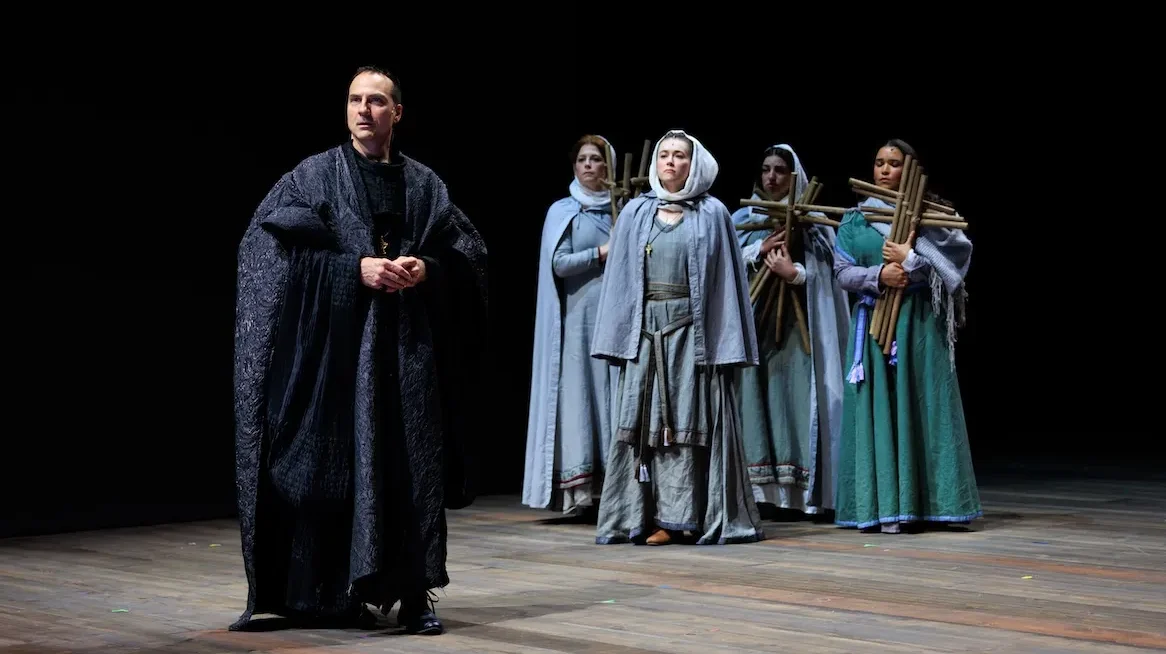
Fortunately, the opera had some excellent performances and a handful of scenes that approached the subject matter with creative brilliance. Baritone David Adam Moore, performing as Abbot Kuno, had a dynamic stage presence and a rich, opprobrious voice. He loomed with satisfying menace. But lugging around those zestless lyrics, performing as the strawman patriarch in a story about the power of girl-bossing in the Middle Ages, even he wilted for me over the course of the opera. I kept waiting for him to punch his fist through a wall, shouting, “Damn you Hildegard! Your visions are too visionary! Prophetesses these days just do apostasy, eat pottage, and lie!” The opera gives Hildegard von Bingen the Bridgerton treatment. Much of the opera creeps around the challenges of historical fiction, seemingly only for the ease and comfort of its audience.
Angel Origgi
Tenor Roy Hage, as Volmar, was three clicks warmer and cuddlier than Kuno, appropriate to his ally status in the storyline. Mezzo Blythe Gaissert, with her commanding chutzpah and dynamic eyes, would have been better cast as Hildegard in a different kind of opera. She nevertheless stole the scene as Richardis’s mother, Margravine.
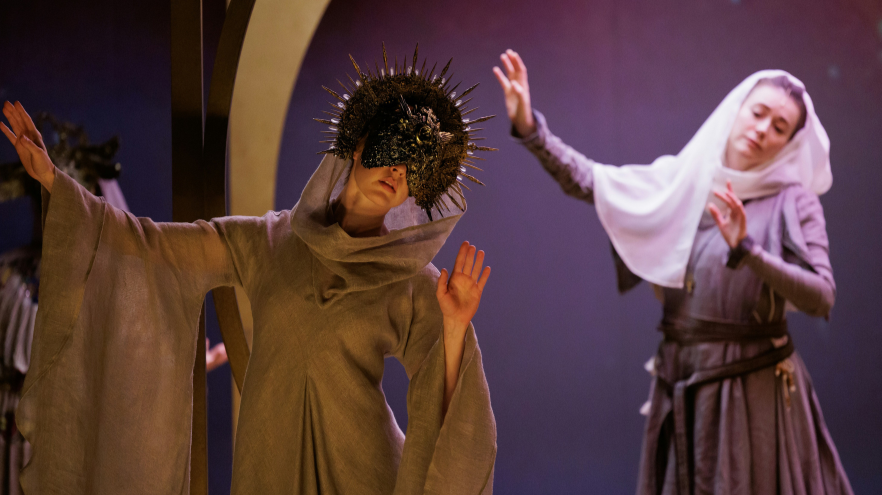
Sophisticated new music instrumentation, combined with some quirked up musical theatre-style recitative, made up most of the music. The instrumentation, and in particular the use of the harp, was full of bright, clean, high modern thrills. The conducting was sharp, fast, and exciting. I was thoroughly dazzled by the scenes of Hildegard’s visions, which included excellent singing, design, and dancing. The angel performers wear elaborate masks and rich, sumptuous gowns depicting illuminated manuscripts of Hildegard von Bingen’s own writing. Deborah Johnson’s background projections in these scenes pay homage to existing illuminations of the saint’s visions, melding them with contemporary design and animation to create a new aesthetic whole. The music in the vision scenes, which I assume borrows from Hildegard von Bingen’s plainchant, was immaculately arranged and performed. The art that the prophetess made and what she wrote about is so interesting in and of itself, I wondered why Snider chose to sequester the actual person and her works to these handful of scenes. I could easily have watched 3 hours of just these scenes, which have exactly the right combination of modern and medieval ingredients. They reach for that intimated understanding of life in a different era and do not condescend to the audience with contemporary melodrama.
There are so many excellent artistic pathways into the Middle Ages that allow us to intimate the experience of people living 900 years ago. It’s unfortunate that the creators of Hildegard weren’t interested in that. It didn’t feel like they were interested in telling the story of the real prophetess at all. The story of how Hildegard von Bingen actually started her first nunnery is actually a lot more interesting than what’s depicted in the opera. Snider’s Hildegard feels like a missed opportunity.