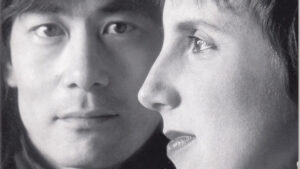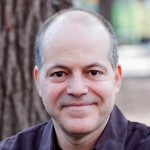
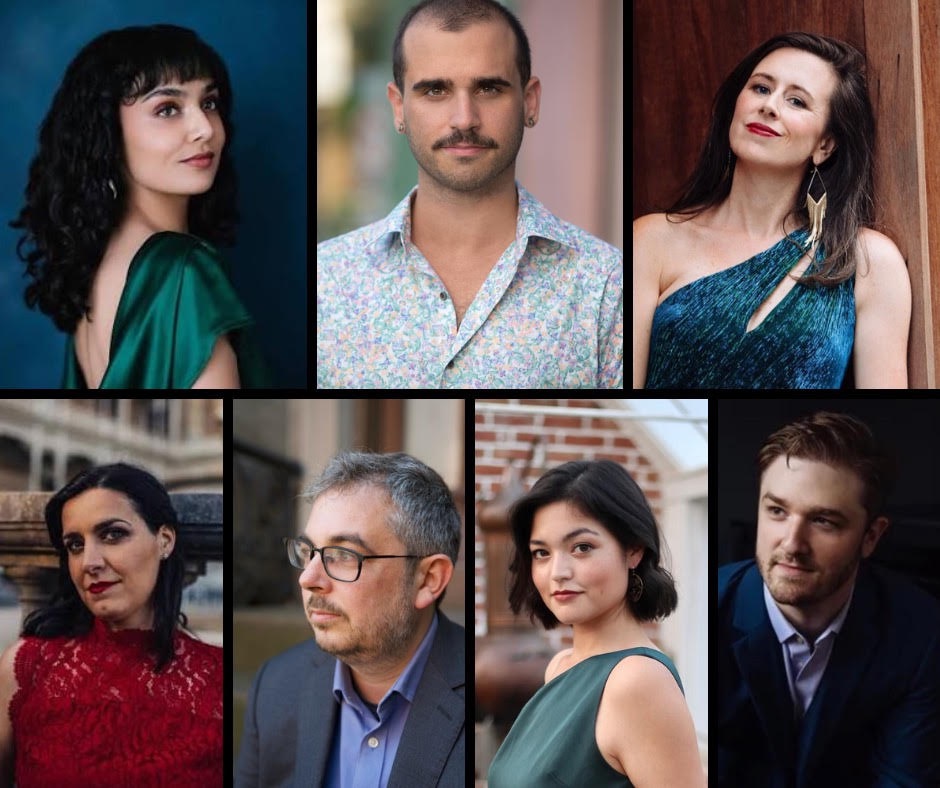
Left to Right Top Row: Maia Sumanaweera, soprano Dylan Morrongiello, tenor Kate Maroney, mezzo soprano Second Row Katherine Lerner, mezzo soprano Michael Brofman, piano Katherine Lerner-Lee, mezzo soprano Brent Funderburk, piano Photo courtesy of Brooklyn Art Song Society
The Brooklyn Art Song Society (BASS) has been doing innovative song recital programs for 16 seasons, but somehow I only made it to one of their concerts for the first time this past Sunday when they presented a double bill of Arnold Schoenberg’s Das Buch der hängenden Gärten (The Book of the Hanging Gardens) and Leoš Janáček’s Zápisník zmizelého (The Diary of One Who Disappeared) at Roulette in Brooklyn. I will certainly be returning.
This concert was the fourth in a series entitled “Cycles” devoted to “monumental classics” of the song cycle literature, most of which are too rarely heard. The Schoenberg work has not been reviewed in the New York Times since 2006. The work was written in 1908-9 when Schoenberg was also working on his Second String Quartet, a piece that also includes settings of Stefan George. Inspired by trends in painting, Schoenberg experimented with pantonality (his preferred name for atonality) in these works as a way to move beyond literal text setting. Instead, he conjures up an unstable, dangerous harmonic landscape where tonal gestures take unexpected turns and the vocal line makes rapid leaps between extreme moods. These destabilizing settings capture the essence of Stefan George’s expressionistic texts remarkably well, even if the composer’s insights only fully manifest after repeated listenings.
We were fortunate in this performance to have artists who were returning to this work after having done it previously: mezzo soprano Kate Maroney and pianist Michael Brofman, who is also the founder and artistic director of BASS. Together, they delivered a memorable rendition of this work, emphasizing its underlying motivic scaffolding without sacrificing its unapologetic strangeness. Maroney delivered the complex vocal line with a strong sense of intention and precisely calibrated levels of emotion.
The Janáček was an inspired pairing; it found its own way to reinvent the song cycle as psychological drama. The 1921 work was based on a set of anonymous poems that appeared in a Moravian newspaper entitled From the Pen of a Self-Taught Writer. They tell the story of an unnamed village boy who falls in love with and eventually impregnates a Romani girl. By the work’s end, he has abandoned his parents and sister and perhaps lost his sanity entirely. The work takes the song cycle to an operatic extreme, including, as it does, songs for the narrator and his beloved, stage directions, an erotically charged intermezzo for piano and a small, but essential role for a trio of female singers who help lure the protagonist into his new life.
It’s an emotionally charged work with an extremely challenging part for the tenor who must carefully chart out the hero’s emotional decline while handling increasingly challenging vocal writing, culminating in a full-bore cry of existential despair. Tenor Dylan Morrongiello rose ably to all these challenges with excellent support from pianist Brent Funderburk. Katherine Lerner was suitably alluring as the temptress, while Maia Sumanaweera, Katherine Lerner-Lee, and Kate Maroney set the appropriate atmosphere as the chorus. Together they gave an excellent performance of this intense short masterpiece.
For those of you outside of NYC, BASS allows you to buy a season pass which includes the option of attending their concerts in person and watching the filmed recordings of their concerts. I wish more organizations provided similar online subscription options.