Having been Opera Gala Guy © all my adult life, I was both excited and skeptical when I first learned of the planned Christmas Night Opera Gala at Carnegie Hall. Randomly scrolling through their website, I noticed that Nadine Sierra, Asmik Grigorian, Thomas Hampson, Sondra Radvanovsky, and Brian Jadge would be performing arias and duets with the American Symphony Orchestra under conductor Francesco Lanzillotta. As the Richard Tucker Music Foundation had skipped its annual fall concert (I understand there might be one this spring), I was eager to hear this exciting line-up but plagued by nagging doubts.
As none of the singers would already be around to perform at the Met, each would be coming to town specifically to perform at the concert, for which no producer had been announced. Shocked to see very high prices attached, I’d periodically visit the Carnegie site to check on ticket sales, which were initially very poor. Eventually, ads for the event placed by Wintour Group International, an organization based in Latvia, started to dot my Facebook feed. Yet as it got closer to Christmas, my suspicions grew that this ambitious gala might not take place at all. Or surely several of its stars might fail to appear, as such drop-outs have occurred at nearly every opera gala I’ve ever attended.
But not only did every announced star appear—in superlative form—but the unusually interesting program went ahead (in slightly shuffled order) with only one slight change. With probably little rehearsal, the ASO performed admirably a repertoire far from what it usually tackles under Leon Botstein, its long-time Music Director. The orchestra contributed a rambunctious overture to Guillaume Tell to get the evening off to a rousing start, as well as another, more unexpected overture—Thomas’s Mignon—to begin the second half. Lanzillotta throughout favored slowish tempi, which probably made his singers happy.
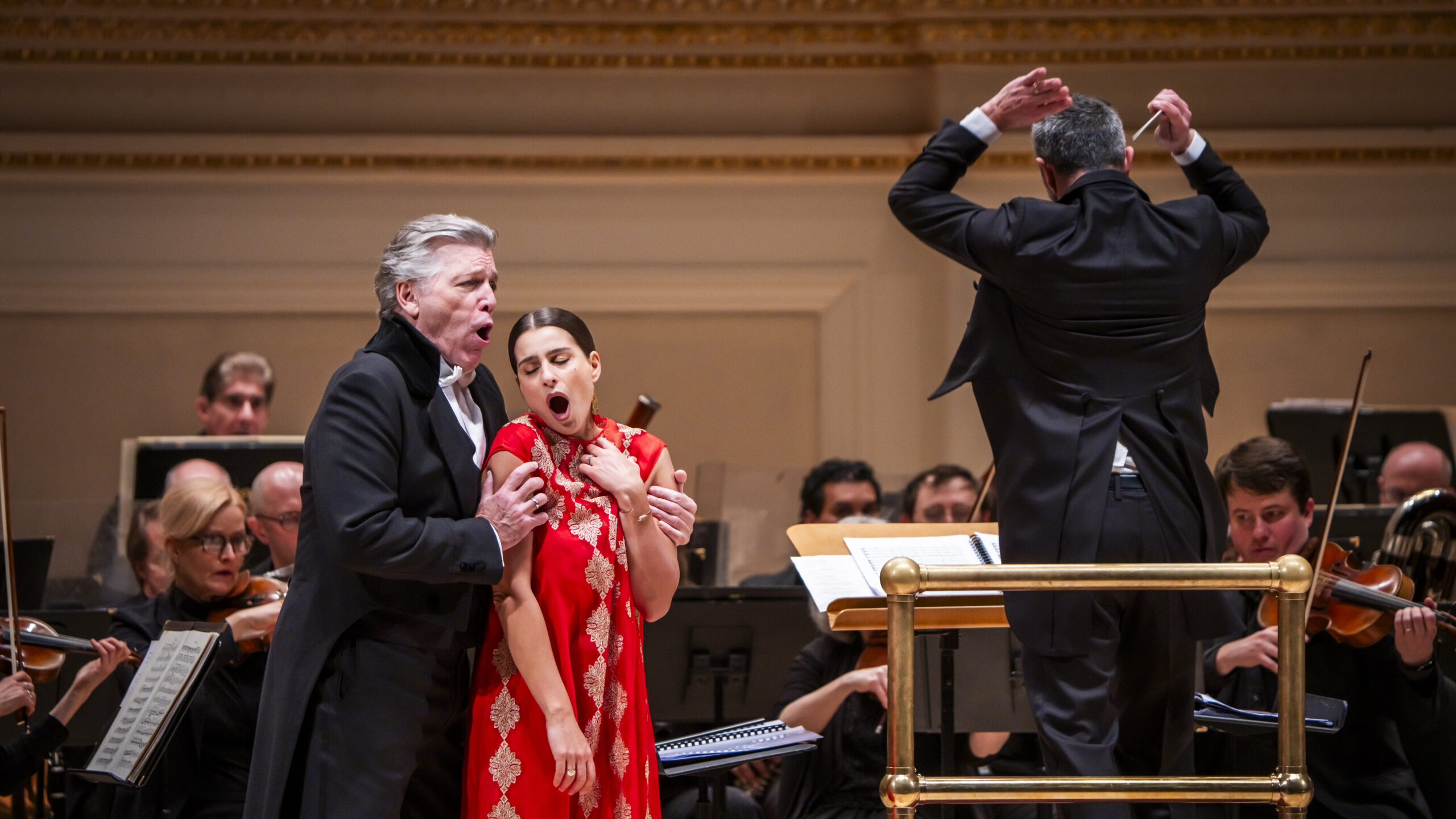
Beginning the vocal portion of the evening with a bang, Grigorian offered an unusually nuanced, yet still impressively powerful “In questa reggia” from Turandot. On entering, the Lithuanian soprano was greeted with only polite applause, but after rocking the Puccini, her subsequent numbers aroused loud and hearty ovations, particularly a haunting “Song to the Moon” from Dvořák’s Rusalka, one of her signature operas. Absent from the Met for nearly nine years, Hampson at 70 joined Grigorian in a potent performance of the final duet from Eugene Onegin. As with several of the numbers throughout the evening, the pair dropped usual staid concert decorum and, using the full width of the Carnegie stage, brought striking dramatic commitment to the opera’s poignant finale. Based on this searing excerpt, Grigorian’s Met Tatiana this spring should be something special.
Hampson’s voice, while now shorn of its previous richness, remains in good shape as he demonstrated in the Count’s aria from Le Nozze di Figaro, the same music in which I heard him for the very first time during his debut season at the Met nearly forty years ago. His subsequent aria, “Pietà, rispetto, amore” from Macbeth, once again demonstrated that Verdi is really not for him. On the other hand, the composer offered Jagde the opportunity to give New Yorkers a preview of Otello, his newest role. The character’s anguished monologue “Dio, mi potevi scagliar” drew from the tenor the most dynamically sensitive singing I’ve yet heard from him. However, he was his usual stentorian self in a powerful Pagliacci “Vesti la giubba.”
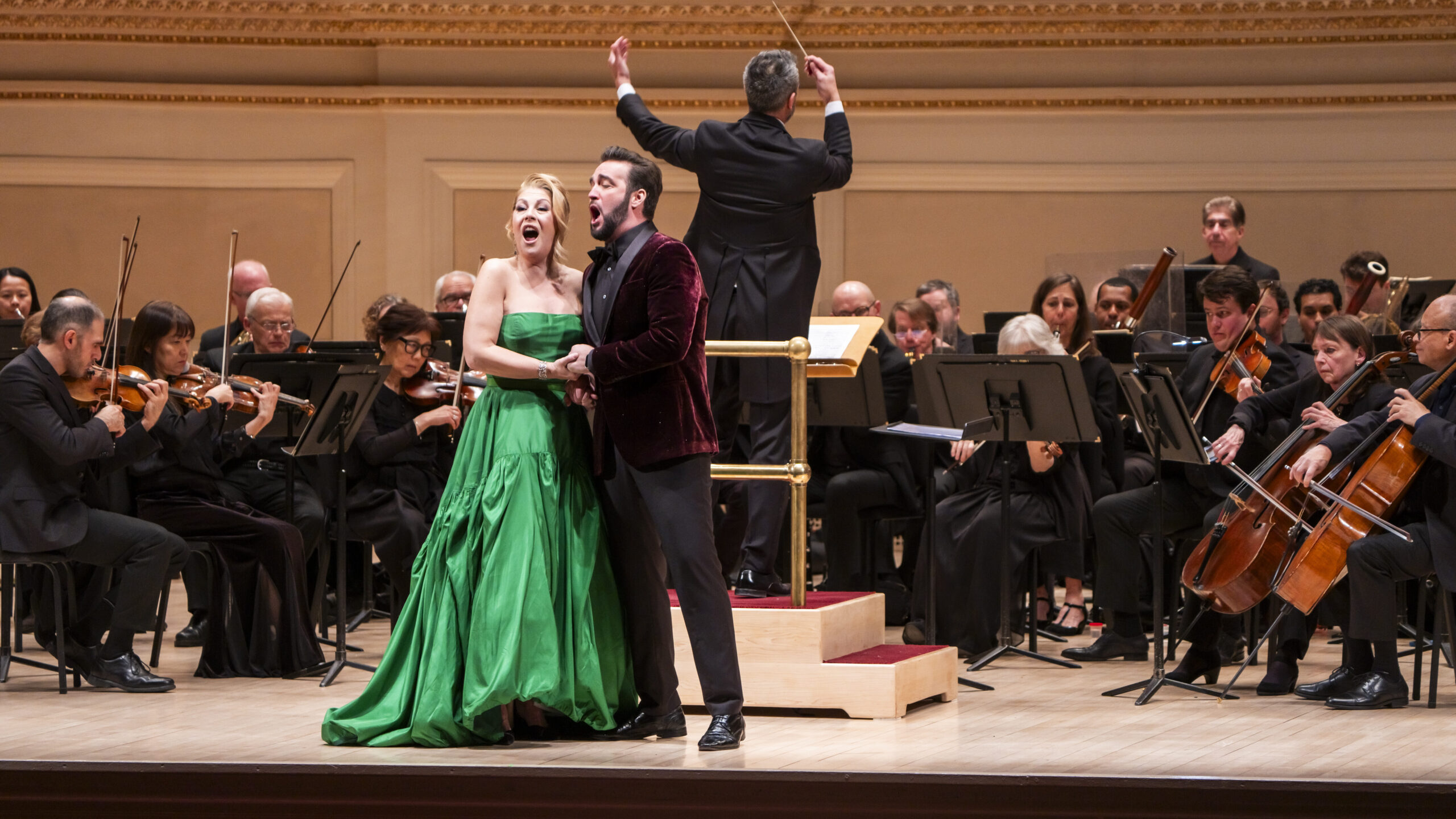
The single change from the announced list (found toward the back of the sumptuous four-color program given to audience members) found Jagde joining Radvanovsky in a blazing “Tu, tu, amore? Tu?” duet from Manon Lescaut instead of that opera’s final act. The soprano, in her only NYC appearance this season, brought a raw and wild energy to Manon and Jadge bravely matched her decibel for decibel. Earlier, apologizing for using a music stand, Radvanovsky confided that she was making her world debut as a mezzo to join Sierra in a lush “Flower Duet” from Lakmé, a startling partnership that clearly delighted the two singers. Radvanovsky’s single solo was an unexpected “Bolero” from I Vespri Siciliani; if she no longer concluded it with a stunning interpolated high E-natural as she had at the Met more than twenty years ago, her extravagant enthusiasm (perhaps more appropriate to Die Fledermaus’s “Csárdás” than Verdi) brought the first half to a crowd-pleasing conclusion.
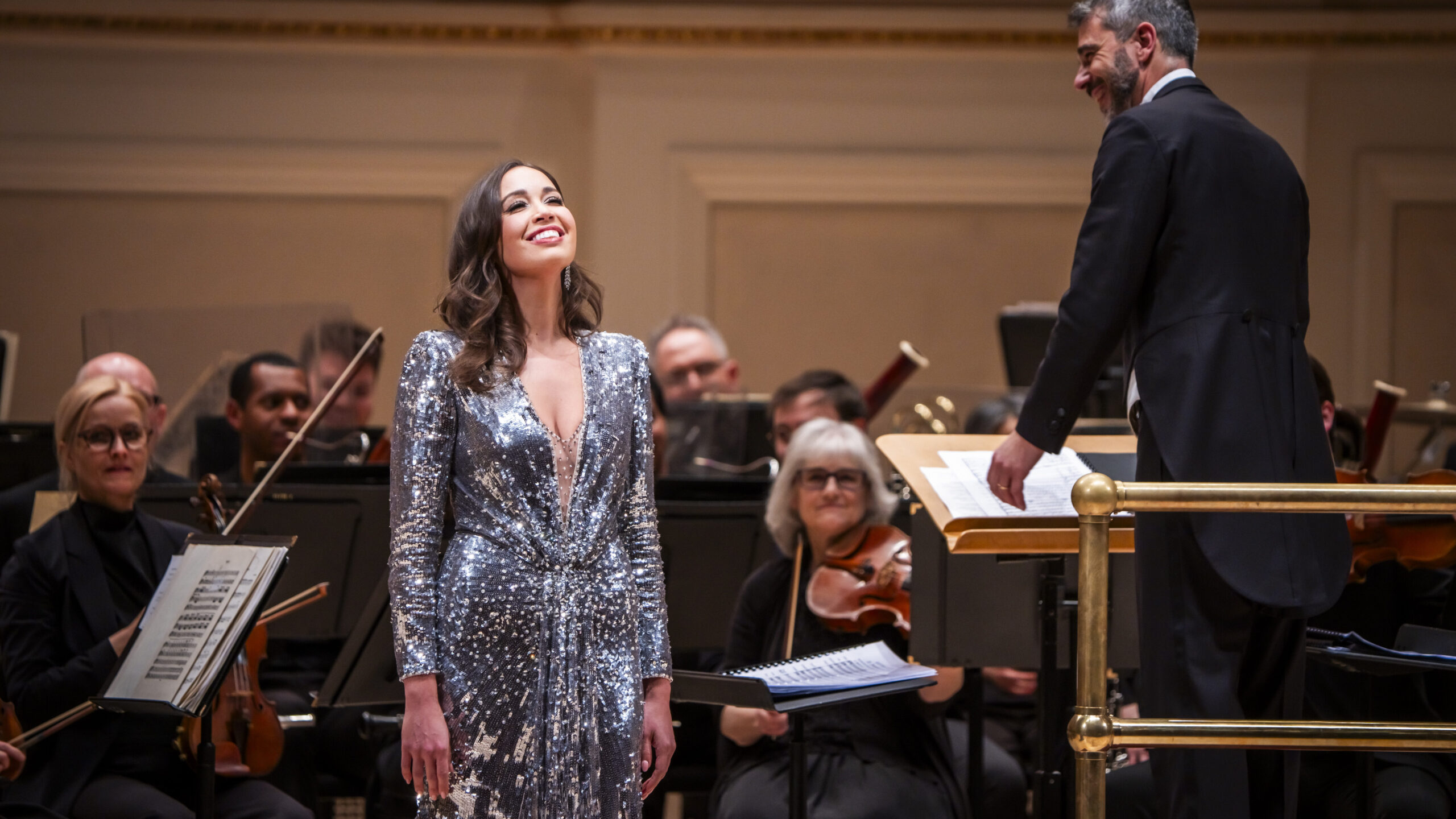
Sierra, in a chic gown of blinding silver sequins, once again offered “Caro nome” which, as her voice has grown more opulent, perhaps no longer comes as easily to her as it once did, while her supremely confident “I feel pretty” offered further evidence that a Met West Side Story might be a very good idea. The evening’s wild card was the nearly unknown British mezzo soprano Anita Montserrat. In her likely U.S. debut, she tiptoed fluently through the concluding rondo from La Cenerentola which failed to demonstrate hints of the mighty star power that surrounded her. However, she did prove an alluring partner to Grigorian in the lovely Liza/Polina duet from The Queen of Spades.
The finale from Bernstein’s Candide has been presented at the conclusion of more than a few such galas, and this evening’s six soloists brought an earnestly gung-ho enthusiasm (eyes glued to scores or iPads) to “Make Our Garden Grow” which stirred the audience, grateful for the sinfully enjoyable operatic smorgasbord, to rise to its feet.
A note at the front of the program from the evening’s organizer, Eugene Wintour-Irverstag (resplendent in pearls on the facing page), boasted that this year’s concert would be the start of an annual NYC winter tradition. Based on this highly accomplished maiden effort, let’s hope that the enthusiastic entrepreneur will return with another edition next year.