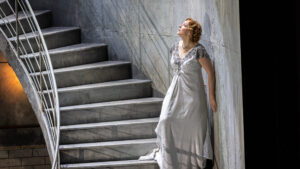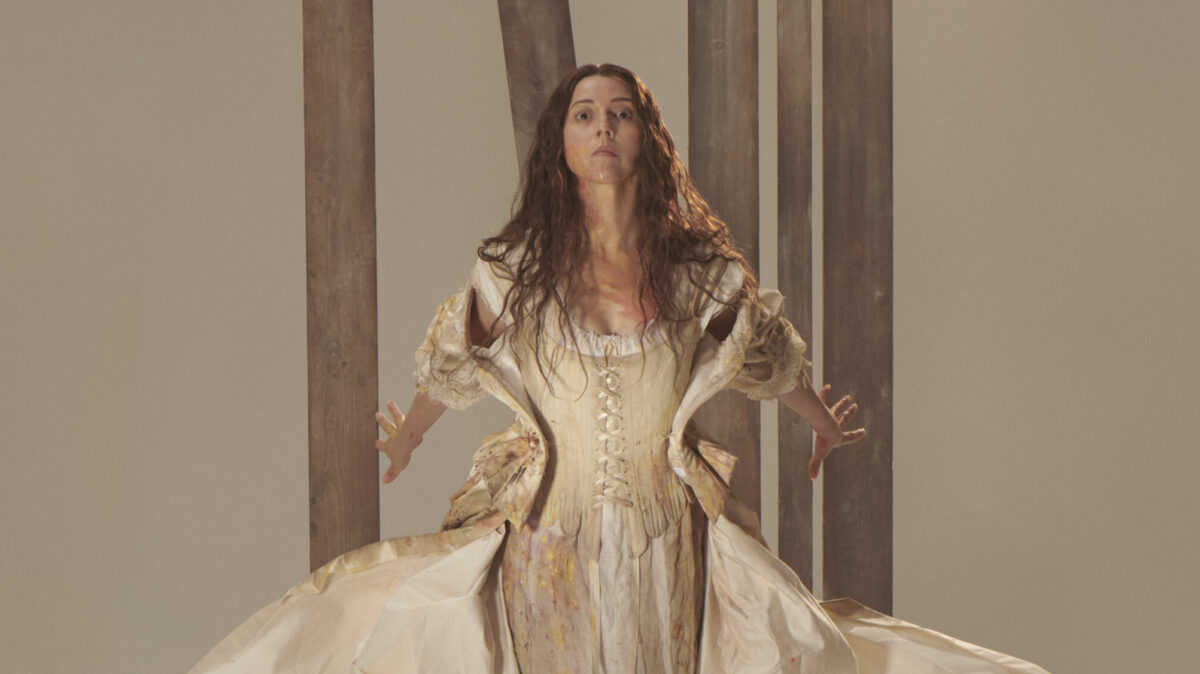
Lisette Oropesa as Elvira in Bellini’s “I Puritani.” Photo: Paola Kudacki / Met Opera
Vincenzo Bellini’s final opera, I puritani, completed in 1835, is about the forbidden love between a Puritan and a Royalist during the English Civil War and features a plot rife with violence, madness, and political intrigue in addition to containing some of the most technically difficult singing in opera. Set in 17th century England, based on a 19th century French play, and composed using an 18th century Italian singing style, the opera crosses borders and centuries. The Metropolitan Opera’s first new production of I puritani in 50 years will premiere New Year’s Eve with the roles of Elvira and Arturo performed by bel canto veterans Lisette Oropesa and Lawrence Brownlee. Brownlee has performed as Arturo around 10 times, more than any other tenor alive today, including opposite Oropesa in a production in Paris in February. (Parterre Box featured a snippet of their performance here.) The new production comes from director and set designer Charles Edwards in his directorial debut at the Met.
Before even delving into the music, the setting and history of I puritani present a fascinating window into the past. 17th century English Puritans, with their flat pilgrim hats, plain clothes, and hatred of dancing and theatre, seem like curious subjects for the soaring romantic phrases of bel canto — the Puritans themselves balked even at hymn singing. The notion of American Puritans recently deposited from the Mayflower singing long, florid lines in Italian itself sounds like a farce. The residents of Plymouth Colony would have damned Bellini for a papist sorcerer and run screaming into the night, but in high romantic fashion, Bellini makes vivid and nuanced even these grim zealots. Fortunately for us, he focused on the historical crux point of the English Civil Wars and never dealt with the genocidal, scurvy-ridden lunatics who founded this great nation.
Based on the 1833 play, Têtes Rondes et Cavaliers (Roundheads and Cavaliers), by Jacques-François Ancelot and Joseph Xavier Saintine, I puritani is a portrait of the past inside the past. It shows what French and Italian artists nearly 200 years ago thought about English Puritans nearly 200 years before their time. While the opera presents an exaggerated version of the past, in the fashion of romantic opera, it can also be read as commentary on the politics of its own day. At the time Têtes Rondes et Cavaliers was written, the July Revolution of 1830 had just occurred, which helped crown the Duke of Orléans, Louis Philippe, “King of the French.” The “citizen king” ascended the throne with popular appeal but reigned over an era where the rich got richer and conditions for the working classes worsened dramatically. The years of Louis Philippe’s July Monarchy were marked by popular upheaval that would lead to the Revolution of 1848 and the birth of communism.
The violent costs of revolution and democracy were being reckoned with in the 1830s, alongside the rhythmic creep and fade of monarchism. During the reign of the citizen king began the widespread recognition that rule by the bourgeois class, with all its rhetoric on rights and democratic values, could be just as bad as rule by an absolute monarch. It’s no wonder, then, that artists in the 1830s were interested in the era of Oliver Cromwell: the 17th century Puritan who began as an organic leader, a parliamentarian, but who, like Louis Philippe, became gradually absolutist.
In our interview, director Charles Edwards discussed the historical context of I puritani and the stakes of an opera dealing with characters who find themselves changing the course of history.
“It’s set in a stronghold that is largely, from a philosophical and religious point of view, trying to rebel against the status quo, attempting to harness God as a mechanism and as a justification for any kind of warfare against the status quo, against the monarchy. The concept of what it means to have a king, the context of what it means to have a populist leader, Cromwell, is inevitably incredibly alive.”
Edwards did an enormous amount of historical research in preparation to direct I puritani, including reading Têtes Rondes in the original French. In our phone conversation in early December, he expressed a desire to ensure that the production captured the entire richness of the opera. Edwards told me he’d posted up in the rehearsal room Bellini’s note to librettist, Carlo Pepoli: “Carve into your head in adamantine letters: The opera must draw tears, terrify people, make them die through singing.”
“This is bel canto, this is about beautiful singing at one level, but that doesn’t mean it’s soft-edged,” said Edwards. “It doesn’t mean it doesn’t have a message; it doesn’t mean that we dishonor the intention of the composer by presenting it in a soft focused blandified way just because it’s New Year’s Eve. This is an opera that Bellini wanted to upset people, terrify people, he wanted them to be thrilled, exalted, and to make them cry. Nowhere in that quote does he say he wanted people to have a great night out.”
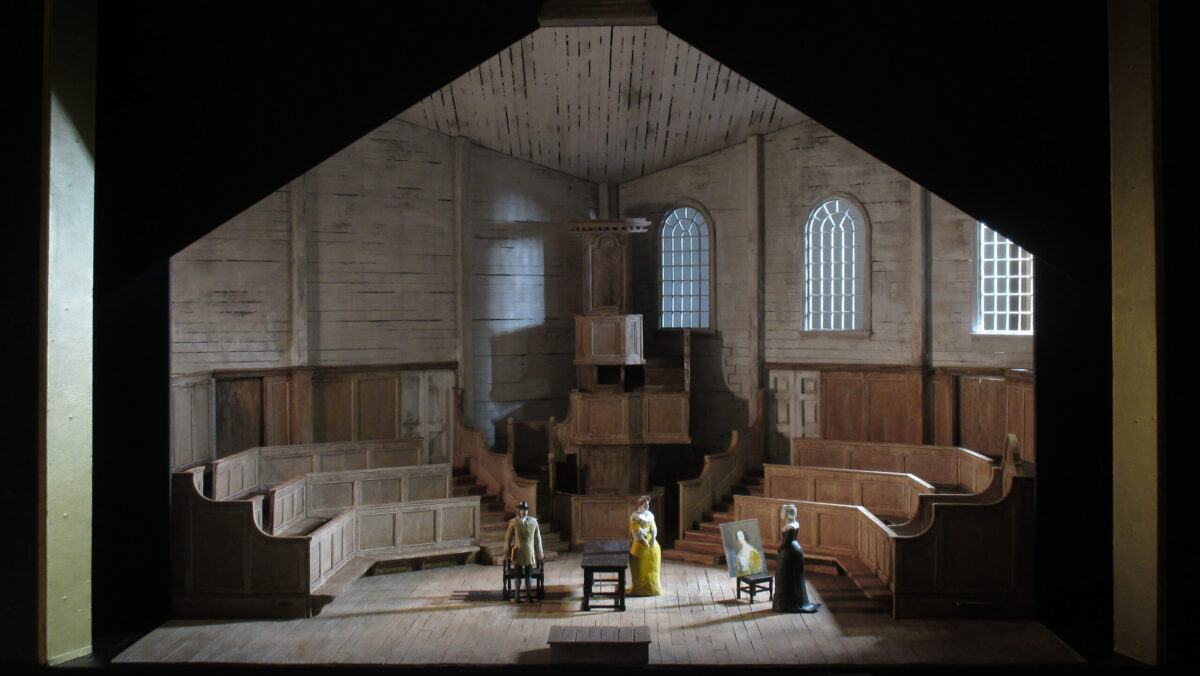
A set design by Charles Edwards for the new production of Bellini’s I puritani.
In stark contrast to last year’s New Year’s Eve premiere of Aïda, Edwards’s I puritani design is stark and foreboding. Its treatment of the puritan setting is like a cross between Rembrandt’s The Night Watch and Robert Eggers’s 2015 horror film The Witch. For inspiration he looked not to England, where puritan structures were destroyed after Cromwell’s death, but to the churches and meeting houses of puritan New England. He was also thinking about his audience, and how roughhewn plank puritan structures would resonate for many Americans. He captures in his set design not just the architectural detail but the paranoid ethos and awesome beauty of 17th and 18th century congregationalist structures.
In rehearsal, the acoustically active set thundered and echoed like a creaky old church. Light comes in through slats in the planks as well as windows, creating a shifting kaleidoscope of golden sunlight or ghostly moonlight. This contrasts with the stark simplicity of the meeting house. Edwards’s I puritani is New England gothic at peak romantic saturation. Sitting in on rehearsal, I was immediately brought back to the hours I spent as an undergraduate in the Berkshire wilds, skulking around colonial houses and smoking clove cigarettes in puritan cemeteries.
“American audiences probably have a slightly better, adjusted sense of history about the Puritans than the English,” said Edwards. “We’ve erased it, [but for Americans] it’s so much part of your society, it’s part of why you celebrate thanksgiving, it’s part of why whole areas of the country vote the way they do. It’s intrinsic to the American sense of history in a way that we’ve erased in the UK. So, it’s actually almost more your story than ours.”
When I arrived at the Met just before the start of rehearsal, Edwards was laser focused and sitting with technicians at a bank of computers. He looked as though he’d been locked in for hours. The lights were off and the air was electric. Thudding, hammering, drilling, and shouting emanated from behind a perfectly black curtain. Four translators bickered excitedly over line breaks in the supertitles. Performers in a marion helmet and a soft brimmed cavalier awaited the start of rehearsal in orchestra seats. “Hello, hats,” a worker muttered before skirting backstage. While the performers were not yet fully costumed, Edwards told me the costumes for the royalist characters were inspired by Van Dyck paintings from the era, in particular his portraits of Queen Henrietta (Enrichetta in I puritani), widow of King Charles I.
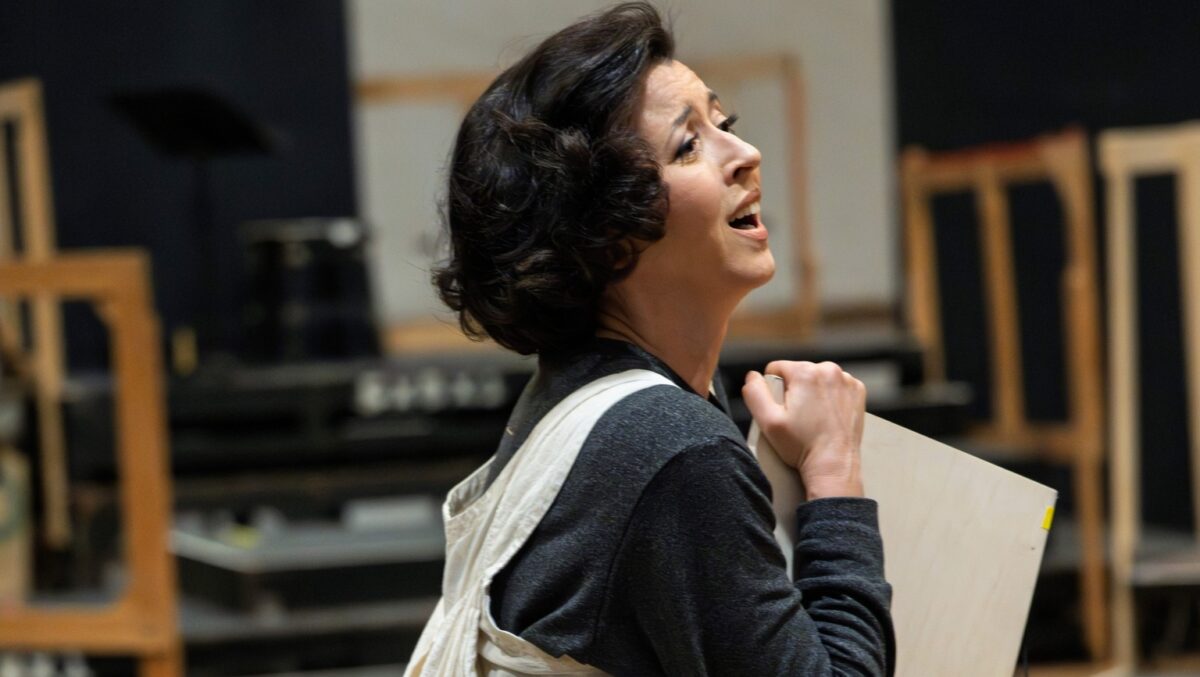
Lisette Oropesa in a rehearsal for I puritani at the Metropolitan Opera / Photo by Jonathan Tichler / Met Opera
Edwards, having trained as a designer, decided early in his career that he wanted to go beyond the bounds of what designers are able to do. He moved into directing 20 years ago, following a common career trajectory in British opera. In rehearsal he was everywhere: with the technicians, watching from the orchestra, flitting in and out of the performers between scenes, giving impassioned, imploring instructions. Like some of the best grand operas, the creation of I puritani seemed in and of itself an opera. Rehearsal was uniquely suffused with a sense of seriousness. The first new I puritani in 50 years seems to be a show that an awful lot of people care about and Edwards’s locked in, determined approach seemed infectious.
“I have never met a director more prepared than Charles Edwards,” Lisette Oropesa told me in our interview. “He has thought it all through, he’s thought of every scenario.”
Oropesa seemed full of genuine pride in the production. She said they were going to “let the opera be what it is and not try to apologize for it or cover it up or hide it or disguise it. We are very much letting the piece speak for itself.”
Oropesa has performed as Elvira once previously and several times in concert. She described the role as suiting her training perfectly, since many of the roles she studied at the Met’s Young Artist Program were bel canto ones.
“All of her [Elvira’s] music is very high, very low, very florid passages where she has to sing a lot of coloratura, a lot of fast notes, a lot of musically complicated stuff,” Oropesa said. “But also, there are lines that are just long and drawn out which is the polar opposite of what maybe just happened on the previous page. I feel like it’s kind of a roller coaster as far as dips and drops and climbs and things like that. But it’s very rewarding to sing. I feel like you have to be in really great health and really great voice to sing it effectively. I do my best with it. I try not to let the challenges show too much, but certainly I have to pull out all my stops.”
She described bel canto as being about vocalism that serves emotion, not the text. I puritani is not text driven. It’s not there to be analyzed like poetry or an art song. Bellini’s composition style she described as “so complete and so thorough that it’s all in the music and we really don’t need to add a lot of spice. It’s all there.”
Oropesa went on to describe her relationship to the libretto and her process of getting into character. “The music guides the color choices that I would like, ideally, to use with my voice. I’ll come and present: these are the colors that I use, these are the dynamics that I use, here or there. Then the text will help me cement that.”
Her onstage physicality, she said, and taking instructions from her director, come only after these choices have already been made.
“If that’s my skeleton—music, emotion, color with the text—then what the director says [is], ‘ok well this is a mad scene, I want you to be completely unhinged, I want you to be unpredictably moving about the stage,’ or, ‘I want you to stand perfectly still.’ Once the movements come into play, as in my physicality, then I can start to say, ‘ok what is my face doing, what is my musicality doing.’ That affects my voice. Without me having to change anything at all, it immediately comes out.”
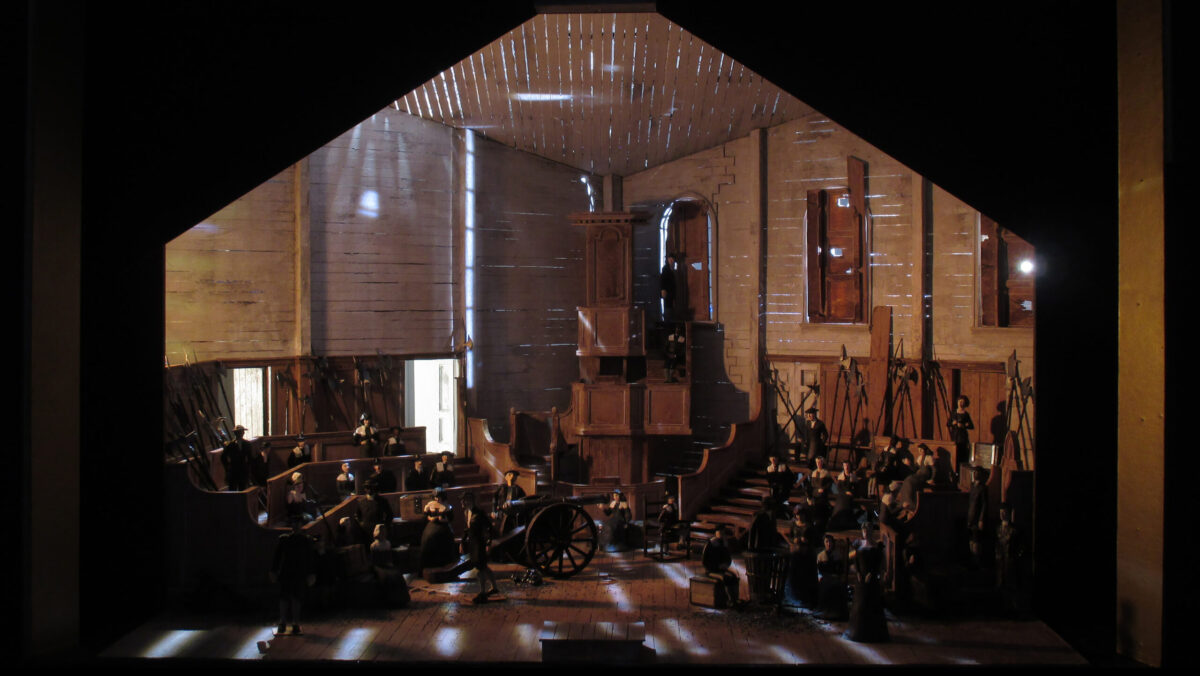
A set design by Charles Edwards for the new production of Bellini’s “I Puritani.”
Edwards’s stark and haunted set seems like an ideal background for Elvira’s madness, her dips and drops, and the sudden reversals in the music. He similarly described the libretto of I puritani as extremely spare and the music driving the opera.
“The psychology of these characters, the way they are presented — when the libretto doesn’t give you that much but something about the actual musical line and the way characters are delineated…it’s hard to quantify exactly, but that’s what leads you into an understanding of the dramaturgy of the piece and the incredibly rich characters that are produced in Puritani.”
Allowing the music and the relatively spare libretto speak for themselves, allowing the characters to shine through, unvarnished and untranslated for a modern audience, seemed of peak importance to Edwards. He said he’d considered setting the opera in modern Britain or America to have it appear more politically relevant but ultimately decided not to patronize the audience in this manner and to instead put forward a very pure and raw production.
“I want to at least throw the debate open and for us as modern, responsible citizens to be able to watch a production like this and to understand how it throws light on our present plight. I think the audience is perfectly capable of understanding that without updating it and without relocating it in another country. But it inevitably has a huge political voice in the present context.”
Edwards’s staging of I puritani, created in our own time of political unrest, gestures back 200 years to revolutionary France, which in turn gestures back 200 years to the English Civil War, connecting a 21st century audience to the universal anxieties experienced by all who live in interesting times.