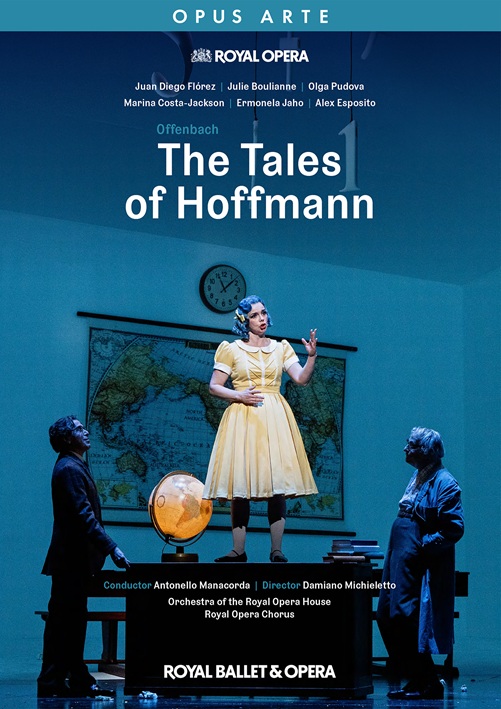
Over the past decade, tenor Juan Diego Flórez has been expanding his repertoire to include heavier tenor roles such as Romeo, Rodolfo, and Hoffmann. He even tried out Pollione in Vienna, but he had some health issues during that run; I’m curious as to whether he will attempt that part again. Unfortunately, we have not been able to experience most of these new roles in NYC as he has not returned to the Met since his 2018 role debut as Alfredo in the new production of La traviata. Judging by this new video of Offenbach’s Les Contes d’Hoffmann from the Royal Ballet and Opera, he is doing extremely well in his broadened repertoire.
His voice retains its characteristic sweetness and his tightly focused sound serves him well in cutting through the orchestra, at least as recorded here. There are few signs of strain, he finds room for nuance and dynamic variation in his interpretation, and he can even summon a surprising amount of oomph for the big moments. He delivers a strong performance while taking on all the physical challenges in the production (by Damiano Michieletto) which keeps him and everyone else – on stage and off – very, very busy.
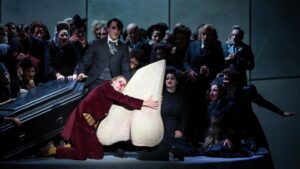
The performers are nearly constantly in motion; there is a surprising amount of choreographed movement for the chorus and even more for the ballet dancers and acrobats that play a prominent role in this staging. On top of that, there are precisely timed lighting cues, set changes, and special effects. It’s impressive that the Royal Ballet and Opera can flawlessly deliver this ambitious production in a non-festival setting. All of the chorus members are fully committed, without any slackers in the lot. With all the activity, it’s also a real challenge for a video director to strike a balance between capturing all the details of the production and exhausting the viewers with constant shifts in focus. Rhodri Huw, credited as having “directed for the screen,” does an admirable job.
This production is an absinthe-fueled fever dream with all the scattershot chaos and sickly green that implies. At the start, The Muse appears looking like a mashup of Mary Poppins and the Riddler. She is sung by the very heartfelt and expressive Christina Rice who summons up three flashbacks for the elder Hoffmann, starting with him as a 10 year old boy in short pants for Act I. His love Olympia is a robotic math whiz; I thought it was a nice change after all the sexbot Olympias of late, to have her be an automaton in STEM. Olympia is portrayed by Olga Pudova, whose voice is a little curdled in the lower range but brightens considerably up top. The coloratura and upward interpolations are well executed.
Hoffman makes it to young adulthood for the Antonia Act. For this staging, Antonia is also a ballet dancer with a corps de ballet joins the staging at key moments.. This creates some striking visual images, but gives the Antonia, Ermonela Jaho, even more medically-inadvisable stage business. By rights, she should have been dead 10 minutes into the act. Jaho sings with her customary intensity and depth of feeling, even if the voice spreads under pressure early on. Apparently, Jaho had some ballet training and it shows in her performance which includes several spectacular physical collapses.
The Venice Act is staged in a nightclub, without a gondola in sight. Still, the action and storytelling are quite gripping. Marina Costa-Jackson is a very glamorous Giulietta, vocally and dramatically. The voice comes across as large and dramatic in character, but she scales it back effectively to blend with Nicklausse. Of Hoffmann’s loves, she has the best chemistry with Flórez.
Alex Esposito portrays the villains and sings and acts with charisma, but the staging of his actions is too cartoonish for my taste. His full sound and demeanor make him menacing, but never terrifying. For this production Nicklausse, is a parrot (or a human trapped in a parrot or a feathery?) which means that mezzo Julie Boulianne has to wrangle a parrot puppet for the entire show. She manages that surprisingly well, never letting the parrot steal the show while bringing lots of personality and elegance to her part.
The conducting by Antonello Manacorda is brisk and incisive but somewhat clinical for my taste. The booklet is vague on the edition used, but the singers mention new material for Nicklausse and additional previously unheard recits. It makes for a long show. Can we stop looking for missing music from Contes d”Hoffman? It’s starting to feel like an elaborate prank because every chateau in France seems to have some ariette retrouvée from this opera. If we must continue to seek out all the Hoffmann ephemera, can we agree to have a summit every ten years where negotiators agree on a new performing edition? It seems cruel to make singers learn a different edition every time they perform this opera.
The blu-ray disc includes a very short feature; there is a much more interesting video about the production on Youtube. This performance is not available through the Royal Opera Streaming service. If you are intrigued by the performers or production, this is worth your time.