The recorded history of Mikhail Glinka’s Ruslan and Lyudmila is an entirely Russian affair. In fact, the Bolshoi Theatre has a near monopoly on the opera, from the earliest recording in 1939 (featuring a still unsurpassed Mark Reizen as Ruslan) to a DVD of Dmitri Tcherniakov’s production, which captured the 2011 inaugural performance after years of extensive renovations on the theater. Amidst this Bolshoi-fest are the 1994 recording and DVD from the Mariinsky Theatre led by Valery Gergiev. A joint endeavor with the San Francisco Opera, the literally by-the-books production of Lofti Mansouri and Thierry Bosquet aimed to replicate the sets and costumes of Ivan Bilibin’s famous 1905 staging and ended up serving as many Western operagoers’ sole live experience of the opera. (It was also the United States’s first encounter with perfectly-unproblematic soprano Anna Netrebko, who has certainly never divided opinions in the comment threads of this very blog.) I say all of this to emphasize that Hungarian directing team Alexandra Szemerédy and Magdolna Parditka entered a decidedly sparse field with their production for the Hamburg State This allowed them free rein either to establish a traditionalist staging that reintroduced this operatic rarity to the 21st century or commit to a revolutionary modern retelling of this 19th-century fairy tale. While they sought to do the latter, their production ultimately fails to cohere into anything truly meaningful so that, in the end, they wind up accomplishing neither.
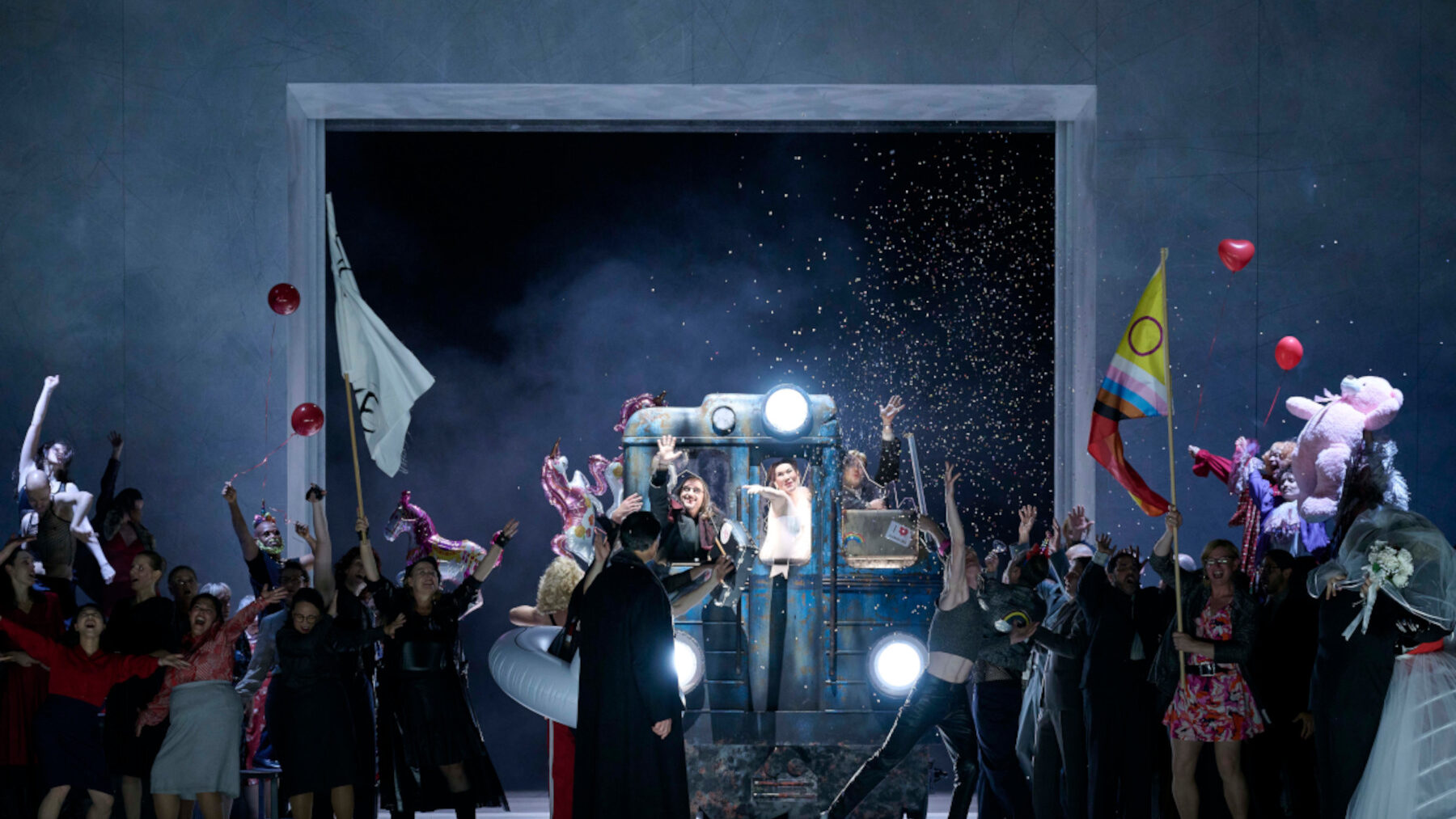
Let me begin by saying that the précis is strong. Szemerédy and Parditka turn the fable on its head by suggesting the corruption and repression inherent in the supposedly “good” and the liberation and self-actualization offered by the purportedly “evil.” A rotating set in the opening and closing scenes contrasts the sterile and colorless wedding banquet for the titular characters—all performativity and empty pomp—with the grimy reality of the unhoused people, drug addicts, and sex workers upon whom such wealth is built.
Despite the good intentions of the production, the imagery is repeatedly undermined by the actual music and text of the opera. These tensions begin early: during the staged overture (wHyYyYyY?!?!), Ruslan blearily slugs on a bottle of vodka (natch) and picks fights with best man Ratmir in the empty banquet hall, while Lyudmila looks on, popping pills and dramatically clutching her head. Obviously, no one wants to be here. Staging a scene of such emotional disarray during the nervous energy of the overture makes a certain type of sense; however, the effervescence of Glinka’s rushing strings and ebullient melodies feels antithetical to the unrelenting grey of the set and the anguished dynamics between characters, creating a gulf between opera and production that widens as the evening progresses.
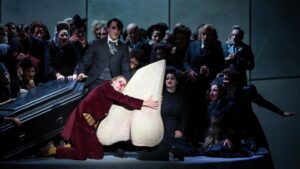
While the directors have mined the libretto for textual evidence of their darker interpretation (after all, the opening lines of Lyudmila’s cavatina are “I am sad, dear father!”), the production fails to resolve its jarring contradictions with the (admittedly) outlandish libretto. Why is the giant singing severed head at the end of Act 2 (barely making sense in Pushkin’s original poem) now a singing metro train hurtling toward the audience (making, if it can be believed, even less sense)? Why is the obviously empty-handed Ruslan victoriously singing about having obtained the magical weapon that will slay the evil sorcerer who has abducted Lyudmila? And for that matter, where the heck is this Chernomor (the aforementioned “evil sorcerer”) that everyone keeps referring to? Any modern production that chooses to veer from the fantastical elements of the plot must still contend with the realities of these surreal stage directions, but Szemerédy and Parditka’s habit of simply overlooking them (or even omitting chunks of the score—from recitatives and dances to entire duets and arias) further disassociates the production from the work itself.
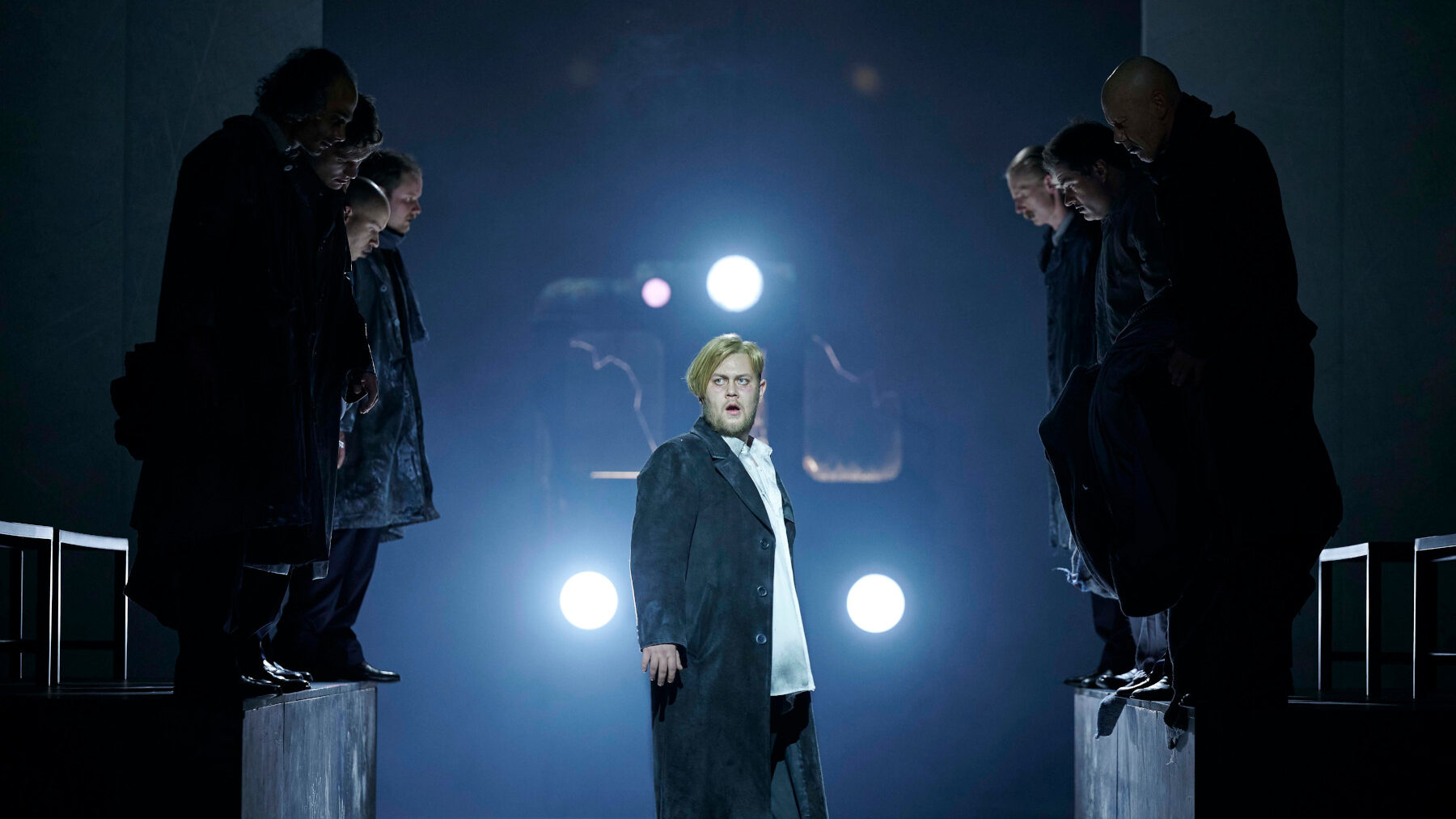
Most egregious, the directors resort to unimaginative and ham-fisted imagery to hammer their points home. How, pray tell, do they communicate that this is a distinctly Russian story? Well, Lyudmila is a former figure skating prodigy who struggles against the control of her domineering coach…I mean, father, Svetozar (Tigran Martirossian). This tired stereotype is then reinforced by the inclusion of dancers who perform an unintentionally stilted pas de deux on ice skates for the banquet guests. Are we absolutely sure that Lyudmila feels like a puppet, stripped of her agency by her forced marriage to Ruslan? Szemerédy and Parditka trot out yet another dancer to pantomime Lyudmila’s mechanical-doll dilemma, popping-and-locking Coppelia-style while the soprano sings her introductory cavatina. This all culminates in Act 4, where, drugged out and haunted by visions of her father, Lyudmila takes her own life by, I wish I were kidding, slitting her wrists with her skate blades.
And yet, I cannot deny that certain components of this artistic vision carry a powerful resonance. The opera truly catches fire in the third act, where Szemerédy and Parditka transform the evil witch’s pleasure palace into an underground club where trans and queer individuals mingle and flirt openly. Our main characters, in the thrall of magical seduction, begin to shed their inhibitions, seen most explicitly as Ratmir strips out of his burgundy tuxedo to reveal a corset and stockings underneath. Then, at the end of the act, as our heroes are brought to their senses through the intervention of goodly wizard Finn, the bar is raided by Farlaf and his cronies. In a truly haunting tableau, the performers mime the violence in slow motion, as the patrons are wrestled to the floor, kicked, and clubbed while our heroes benightedly sing in the foreground about their restored interest in rescuing Lyudmila.
Taken as a whole, these elements result in a production that only fitfully succeeds in arguing its artistic thesis and seems to value its source material even less. Thus, the celebratory finale feels like an unearned deus ex machina that retcons the suffering inflicted upon its characters over the course of the previous four acts.
Possibly due to the enervating qualities of the production, the music likewise suffered. Conductor Azim Karimov coped with the strange patchwork version of Ruslan and Lyudmila assembled for the evening, but set pieces like the famous overture lacked propulsion and élan. Fittingly, though, some of his best work came out in the rich textures of the third act, where Karimov brought verve and movement to the dance rhythms in Gorislava’s and Ratmir’s arias.
Overall, the cast was a mixed bag. Scottish tenor Nicky Spence, looking like the love child of a carnival barker and “Dragula”-era Rob Zombie, brought more musical intelligence than tonal beauty to the dual role of troubadour Bayan and “good witch” Finn, which fit the production’s interpretation of this wily emcee. In truly luxe casting, Hamburg’s very own Angela Denoke, looking exquisitely patrician in a long blonde wig and black vinyl gown as the proprietress of “Naina’s,” lent true star power (and a rich voice) to the traditionally superannuated mezzo cameo role. Alexei Botnarciuc certainly looked the part of Svetozar’s slick henchman rather than simply one of Lyudmila’s rejected suitors. While he possesses a perfectly serviceable bass voice, his effortful performance of Farlaf’s famous rondo was again symptomatic of the dour production; Karimov even slowed the patter section of his aria to a criminally casual tempo, only to have singer and orchestra stumble over one another. As Gorislava, the sex-worker-with-a-heart-of-gold who serves as Ratmir’s eventual love interest, Moldovan soprano Natalia Tanasii brought a much-needed vitality to the third act, the attractive flutter in her voice infusing her aria with an appropriate urgency.
Many of you will be quick to point out that there is no historical justification for casting Ratmir as a voice type other than mezzo-soprano or contralto; however, Artem Krutko made a strong case for a countertenor assumption of the Turkic prince. No, the instrument was not at its purest on the night I saw the opera (there were occasional “gear shifts” between registers, and certain passages sounded less secure than others), but Krutko was able to suggest both the regality and longing of the character through his singing and even capped his Act 3 aria with a thrilling high E flat. As the first half of the opera’s title, Ilia Kazakov has a gorgeous cantabile bass and offered musicality in abundance throughout Ruslan’s extended scene in Act 2. What he does miss, though, is the warrior’s heroic qualities, even abruptly snapping off high notes rather than allowing them to ring out fully.
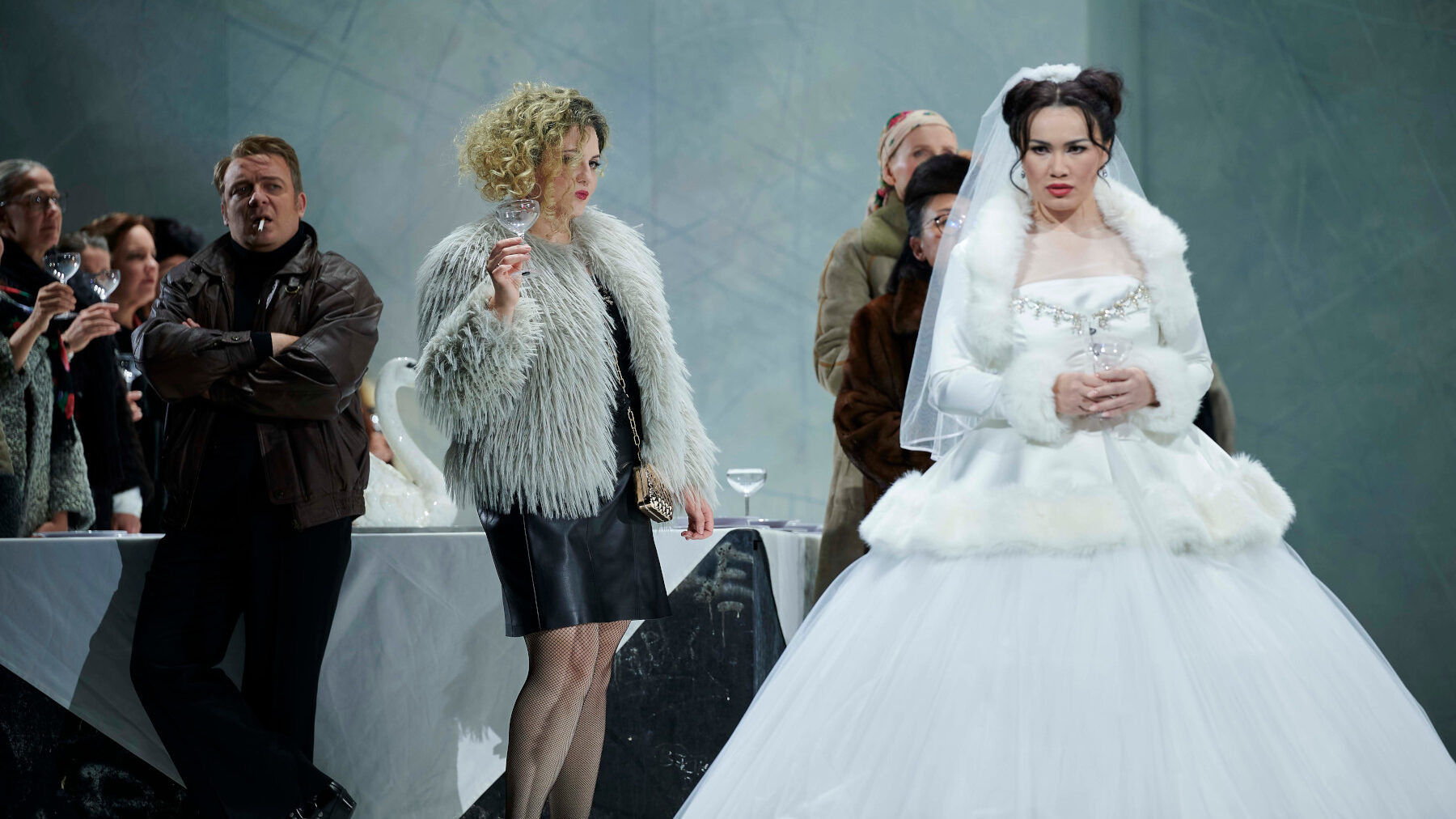
It is a pet theory of mine that the role of Lyudmila is actually written for two different sopranos: the first act aria is by-the-numbers bel canto coloratura, but the act 4 scena is pure drama, swinging between desperation and indignation. In recordings, then, it is very common to find Lyudmilas who excel at one of these aspects or the other, but never truly both (barring, of course, a young Netrebko). Uzbekistani soprano Barno Ismatullaeva, unfortunately, does not break with this tradition. While she had the requisite agility for her Act 1 cavatina, where was the young princess’s charm and playfulness? (Yes, I realize I sound like a broken record by this point, but the austere production surely compounded this joyless delivery.) The fourth act, however, was uncommonly moving: the sheer loveliness of Ismatullaeva’s instrument shone forth, and the soprano made excellent dramatic choices, pushing against the beauty of the tone to suggest the righteous anger of her predicament. I don’t think I have ever found myself so affected by the plight of this fairy tale heroine. By the opera’s finale, though, which requires Ismatullaeva to revert back into valedictory, above-the-stave roulades, repeated lunges at harsh high notes left me with aural fatigue.
So, would I deny an operagoer the opportunity to see one of Ruslan and Lyudmila’s rare forays outside of Russia during the final dates of its run at the Hamburg State Opera (the last performance of which will be held on December 19th)? Of course not! Did, however, audiences deserve a more enduring and successful production to assist this opera in persisting in the Western repertoire? Absolutely.