Photo: Caitlin Oldhman
Only the second Gluck opera presented by the company, which specializes in less frequently performed works, Iphigénie ultimately derives its plot from a play by Euripides about an episode in the Trojan War. After being given up for sacrifice by her father, King Agamemnon, so that the wind will blow the Greeks’ ships across the sea to Troy, Iphigénie (or Iphigenia) was saved by the goddess Artemis (Diane in the francophone libretto) and deposited in Tauride (or Tauris, modern-day Crimea), as a priestess at her temple.
The locals have their own custom of practicing human sacrifice, a threat that will confront Iphigénie’s brother, Oreste, and his companion Pylade when they shipwreck on the coast. Iphigénie is then tasked with overseeing the sacrifices and decides to let one of the prisoners escape, not recognizing Oreste as her brother at first. Iphigénie was one of Gluck’s “reform” operas, in which he stripped away dance sequences, vocal frills, and continuo in favor of a tighter drama.
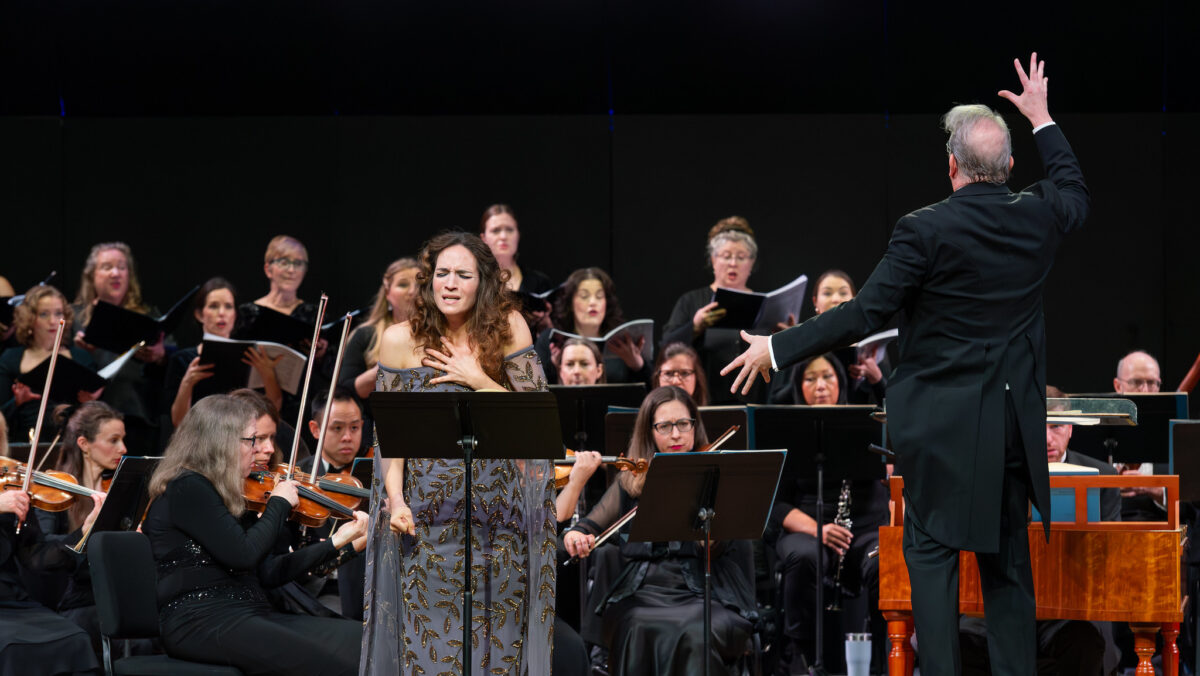
Mezzo-soprano Kate Lindsey gave a sensitive portrayal of the titular character. Her smoky, haunted tone provided insights into Iphigénie’s psychological state, though her enunciation was gauzy at times. Lindsey’s captivating take on the opera’s best-known aria, “Ô malheureuse Iphigénie,” in which she mourns the loss of her country and brother, was a highlight of the evening, her performance of the aria showcasing delicate intonation and strong breath control.
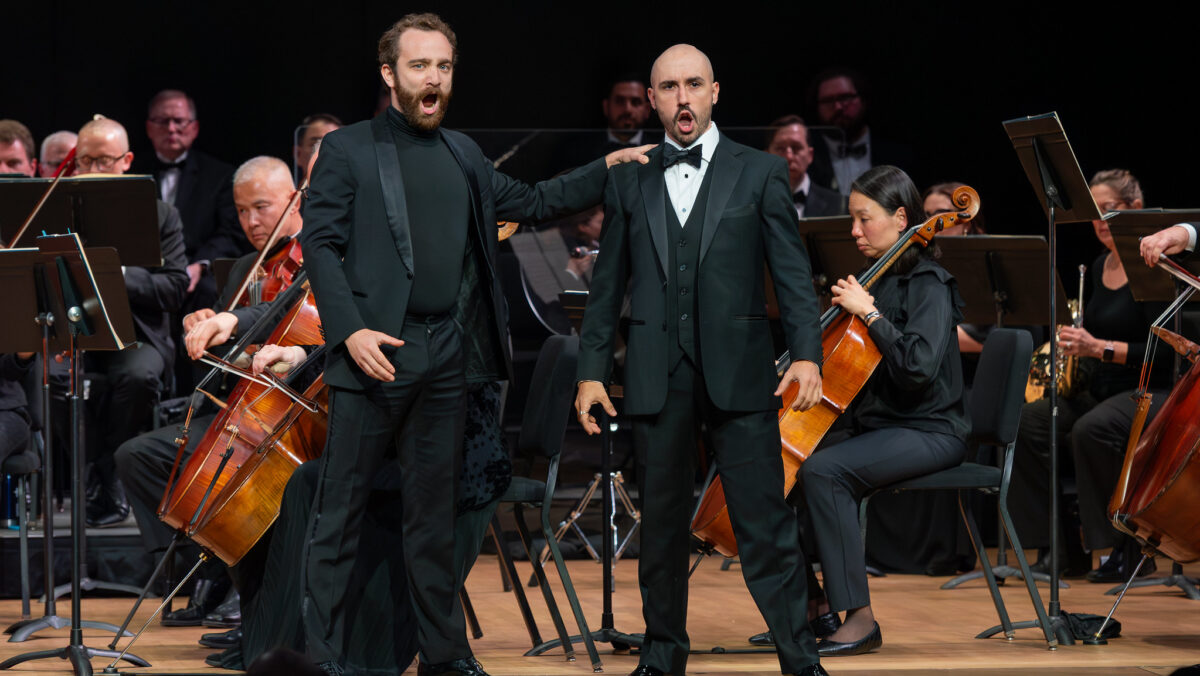
Photo: Caitlin Oldham
Baritone Theo Hoffman sang Oreste with gusto. Having sung the role in a run of Iphigénie at the Opéra-Comique in Paris earlier this fall, Hoffman clearly knew the part well, forgoing a printed score and leveraging precise French diction. Hoffman’s warm, rich baritone vividly conveyed the character’s tortured conscience. His expressive acting, beyond what is typical for opera in concert, complemented his vocal performance but occasionally veered over-the-top. Also singing off-book, Fran Daniel Laucerica lent his sweet-toned, smooth tenor to Pylade and conveyed a deep emotional connection to Oreste. Hoffman and Laucerica’s chemistry portrayed the characters’ relationship as a backslapping Platonic bromance.
Baritone John Moore sang the Scythian king Thoas with a gleaming bite and imbued his Act I aria, “De noirs pressentiments,” with resonant fear. Moore is a singer with aptitude for roles from both the 18th and 21st centuries and most recently appeared in DC this spring as Steve Jobs in Washington National Opera’s production of The (R)evolution of Steve Jobs. In the minor but narratively important role of Diane, Erin Ridge’s silvery soprano brought the opera to a satisfying conclusion. According to a program note, Iphigénie is the penultimate composed opera with a deus-ex-machina ending still regularly performed and WCO will present the final one, Wolfgang Amadeus Mozart’s Idomeneo, in the spring.
WCO’s artistic director, Antony Walker, conducted the WCO Orchestra with enthusiasm and a fine understanding of the score, though a disproportionately loud piano dominated the first half of the opera.