Photo: Fadi Kheir
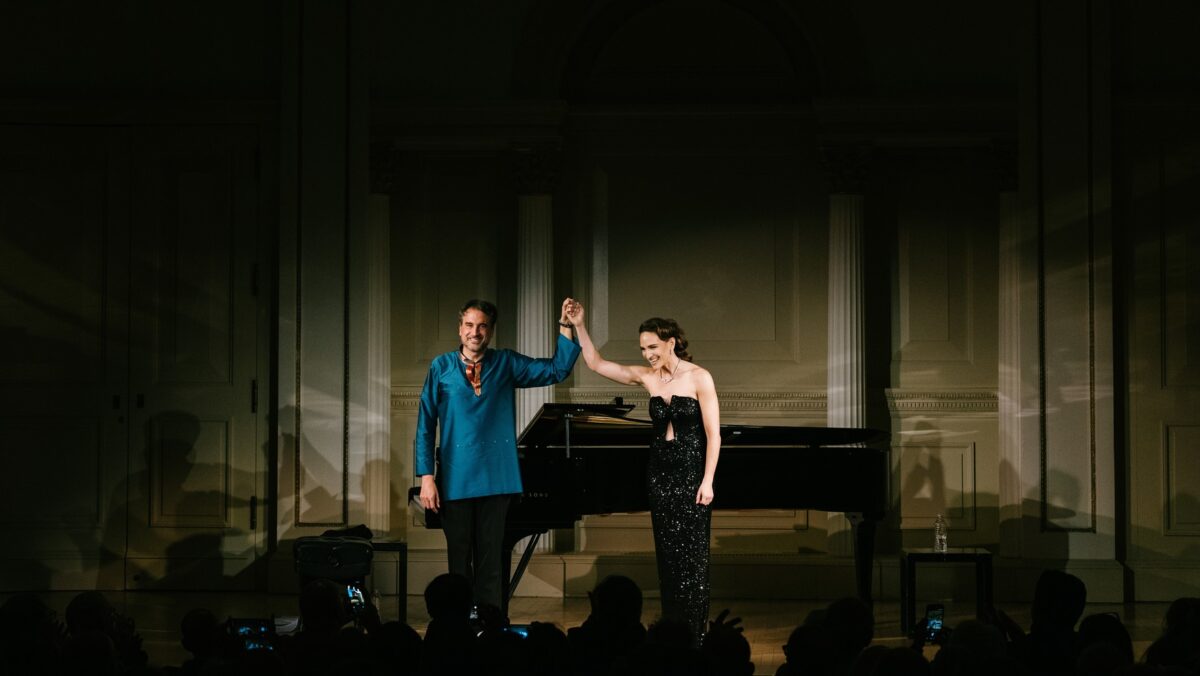
Tuesday night Kate Lindsey, the impressive American mezzo soprano, sang a program of the songs of Kurt Weill at Carnegie’s Weill Recital Hall (no relation) with half a dozen fine but unfamiliar songs by his contemporaries, like him refugees to America, which wittily varied the style of the program.
Lindsey’s accompanist—but he was more than that; a partner in several ways—a Frenchman named Baptiste Trotignon, able enough at the traditional Lieder-piano responsibilities but also an award-winning jazzman who occasionally took off on his own, inserting riffs on the themes to link one number to another, or (when the singer slipped off stage for a breather) doodling his own variations on such familiar Weill standards as “September Song” and “Mack the Knife.” It proved a refreshing way to construct a program of art song.
Weill, in his short life, composed in an exceptional number of styles, adjusted to locality and collaborator and theatrical form. Best known are the songs he wrote with Bertolt Brecht when they were rebels and radicals in Weimar Berlin, the satiric and political songs from Threepenny Opera and Mahagonny that we tend to associate with Weill’s wife, Lotte Lenya.
Fleeing the Nazis, first to Paris and then to New York, the composer applied himself to the local stages, from opera to musical comedy, including some remarkable experiments in that diverse form. The grander numbers are the ones we associate with recordings by the likes of Teresa Stratas. Singers devoted to Weill often try to “cross over” from cabaret to operetta, from the cigaretted Sprechstimme of Lenya to the intimate phrasings designed for Gertrude Lawrence and Mary Martin—I once heard Bebe Neuwirth give an all-Weill show traipsing across these bounds. It’s not easy. Different muscles are called for.
Lindsey, whom I last heard as Gounod’s Sappho with the Washington Concert Opera, has an instrument loud enough and rich enough for any opera house that loses none of its delectable quality in little Weill Hall. It is a physical pleasure to hear her at close quarters. Her emotional colors bloom to fill any space—her sumptuous operatic moments often reminded me of the Stratas-Weill album. The notes soothe while their size and beauty startle. She is capable of rising to soprano range when that is called for, and in her ironic “cabaret” mode, she can make points with lines in a gravelly baritone.
The program began with “Nanna’s Lied,” a lilting, ironic lullaby. Then she jumped ahead to “Thousands of Miles” from Weill’s Apartheid operetta, Lost in the Stars—a hopeful song, whose title she applied as a theme to the entire concert, suiting Weill’s life experience. This was followed by another song from the same show, “Big Mole,” a deceptively happy patter song. While Lindsey’s diction was in general very good in three languages, the patter lyric was muddy. She followed it with “You Must Make Your Bed,” Jenny’s great aria from Mahagonny, and here one thought of Stratas as she sang it at the Met. (The Met could do worse than revive it for Lindsey.) “Ein Mensch ist kein Tier,” a man is not a beast, is a message that would resonate today.
Then we were offered a song Erich Korngold composed, Lindsey informed us, when the future movie man was a teenage prodigy in Vienna, followed by Alexander Zemlinsky’s “Und hat der Tag all seine Qual.” These and two later songs, “Die stille Stadt” and “Hymne,” by Alma Mahler, were in contrasting styles of vocal melody, but they fit cozily with Weill’s jazzier Brechtian pieces, like period furniture in a comfortable Austro-Hungarian salon.
But here I must mention the one flaw in an otherwise charming evening of song. We had been given a booklet of texts, but the lights in Weill Hall were turned way down—it was darker than a smoky cabaret. Impossible to read the lyrics. Did I want to read them? Well, for the unfamiliar songs, I did. If we could not have the full texts, a sentence or two of introduction to hint at the song’s subject would have been useful. Alma’s songs, in particular, are very beautiful, with heartful melody in a moving and personal style, nothing like her husband’s famous songs. I was glad to encounter them, especially as beautifully as Lindsey sang them. But they were just flowing sounds to me. I hadn’t a clue what they were about until I read the texts on the subway home.
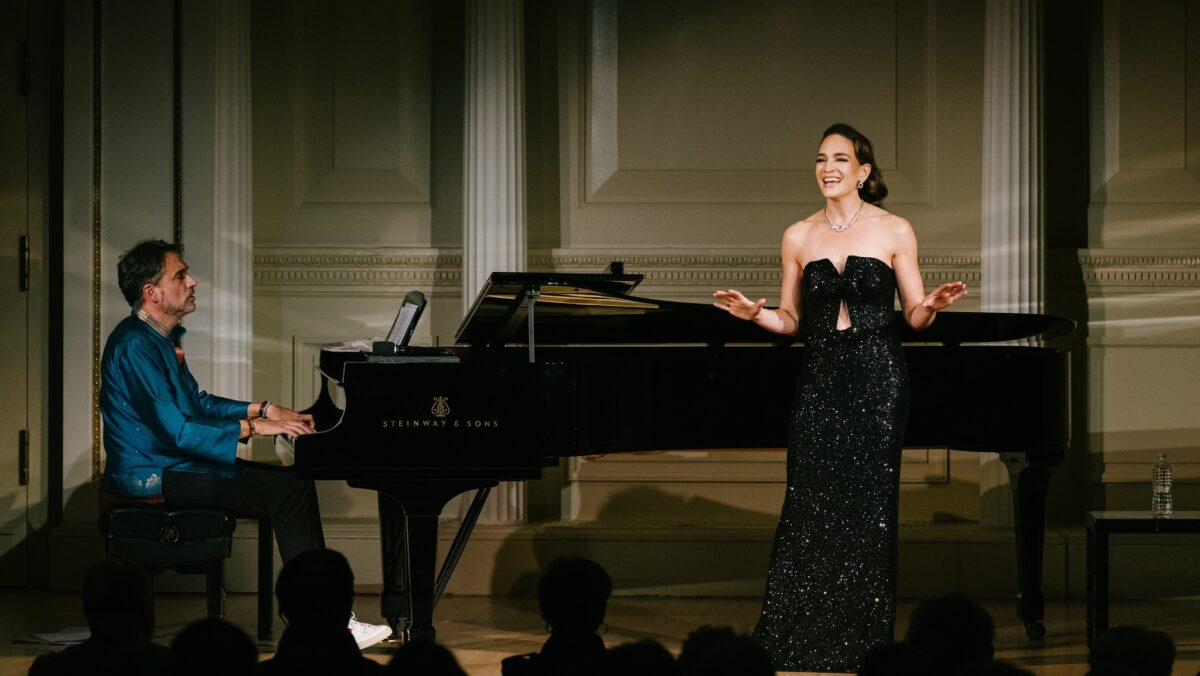
Photo: Fadi Kheir
Now, I don’t want flashing lights at the top of the stage in a Lieder program—it is distracting enough in the opera house. But I fondly remember many recitals given by Elly Ameling over the years, and she always insisted the lights be bright enough to read the printed texts, and if texts were not available, she gave a little summary of each less-than-familiar chanson. She cared that we not listen merely to her silvery voice but what the composer, and the singer, were doing with it. I’d have appreciated that from Ms. Lindsey, glamorous as she is.
For “Pirate Jenny” and the “Barbara-Lied” from Threepenny Opera—the former in English (since most of us know it), the latter in German, Lindsey was in hardbitten mode, reminding us that Brecht and Weill presented unsentimental views of the ordeals and the courage of women of the back alleys. Today, they are rightly seen as revelatory: the overlooked females are being noticed, and such songs appear in a proper heroic light.
In contrast, we had “Don’t Look Now But My Heart Is Showing,” Weill in waltz time. The song was composed for Mary Martin in One Touch of Venus, but Lindsey preferred to sing the rewritten lyric from the film version. In another song from Venus, “That’s Him,” the Ogden Nash lyrics gave her trouble.
A particular delight (I think it’s also on the Stratas album) was “Je ne t’aime pas,” written during Weill’s year in Paris between exile from Germany and asylum in America. The lyric is very French indeed—“I don’t love you,” a woman sings, again and again, to a too-charming man who has placed her in the friend zone. We don’t believe her, and neither does Weill, and neither did Lindsey. I was reminded of Ophuls’s The Earrings of Mme de … but only when I finally could read the text. In the dark, the melody and the way Lindsey brought her passionate descriptions to a prim stasis were affecting, and her French excellent, but … it was hard to grasp the shading of the passing words.
A couple of arias from Weill’s opera Street Scene, the interlocking lives of strangers in a New York tenement, benefited from Langston Hughes’s deceptively simple lyrics, set by Weill with thoughtful restraint. The program concluded with “Trouble Man” from Weill’s last show, Lost in the Stars, and an unfamiliar but romantic song by Zemlinsky. All Zemlinsky is unfamiliar these days—as our singer pointed out, not every artistic refugee made a success here.
The encores were “That’s Him” and “This Time Next Year,” Weill’s last song before his untimely death at 50, a composer who wasted not a minute in his musical journalizing about the world around him.