Photograph: © 2025 Richard Termine
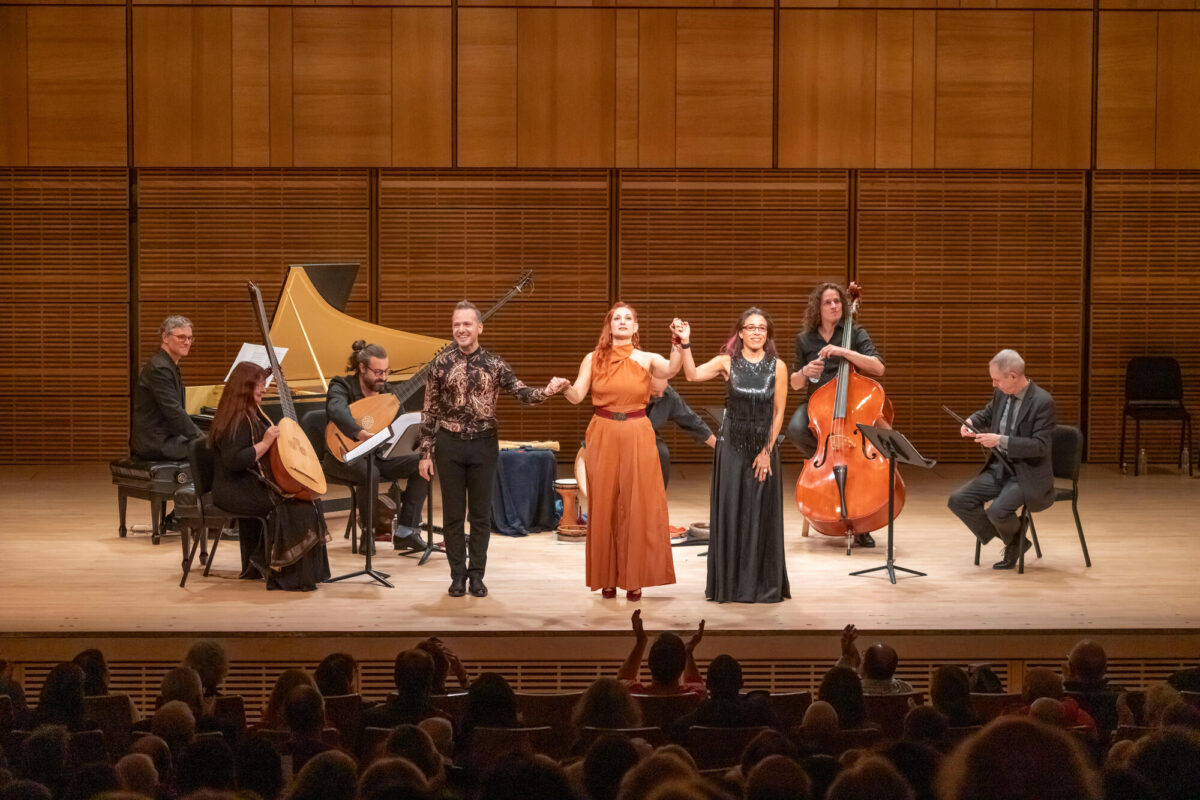
“What can one do?” sang mezzo-soprano Benedetta Mazzucato at the start of “Wonder Women,” presented by L’Arpeggiata under the direction of Christina Pluhar at Zankel Hall. “Calamities rain down upon me incessantly from the stars.”
“Che si puó fare,” a passacaglia by the Baroque composer Barbara Strozzi, could well describe the nature of the evening. At the last minute, the soprano Céline Scheen had to withdraw due to illness. Her absence left two mezzos (Mazzucato and Luciana Mancini) and one alto (Vincenzo Capezzuto). What can one do?
But the musicians seemed unfazed. Atop the passacaglia’s repeating, descending bassline, Mazzucato’s voice intermixed with Doron Sherwin’s doleful cornetto.
Though Mancini and Mazzucato occupy similar ranges, their voices are about as different as can be. At this concert full of varied vocal “grains,” Roland Barthes would have a field day.
Mancini’s voice is growly, almost stuck-in-the-throat, but in the best way during Pluhar’s arrangements of Mexican songs. In “La Bruja,” she sounded almost possessed.
While Mancini’s singing oozes sexuality, Mazzucato’s is full of sensuality. Her honeyed tone could not be more perfectly suited to Strozzi, especially in her “L’amante consolato.”
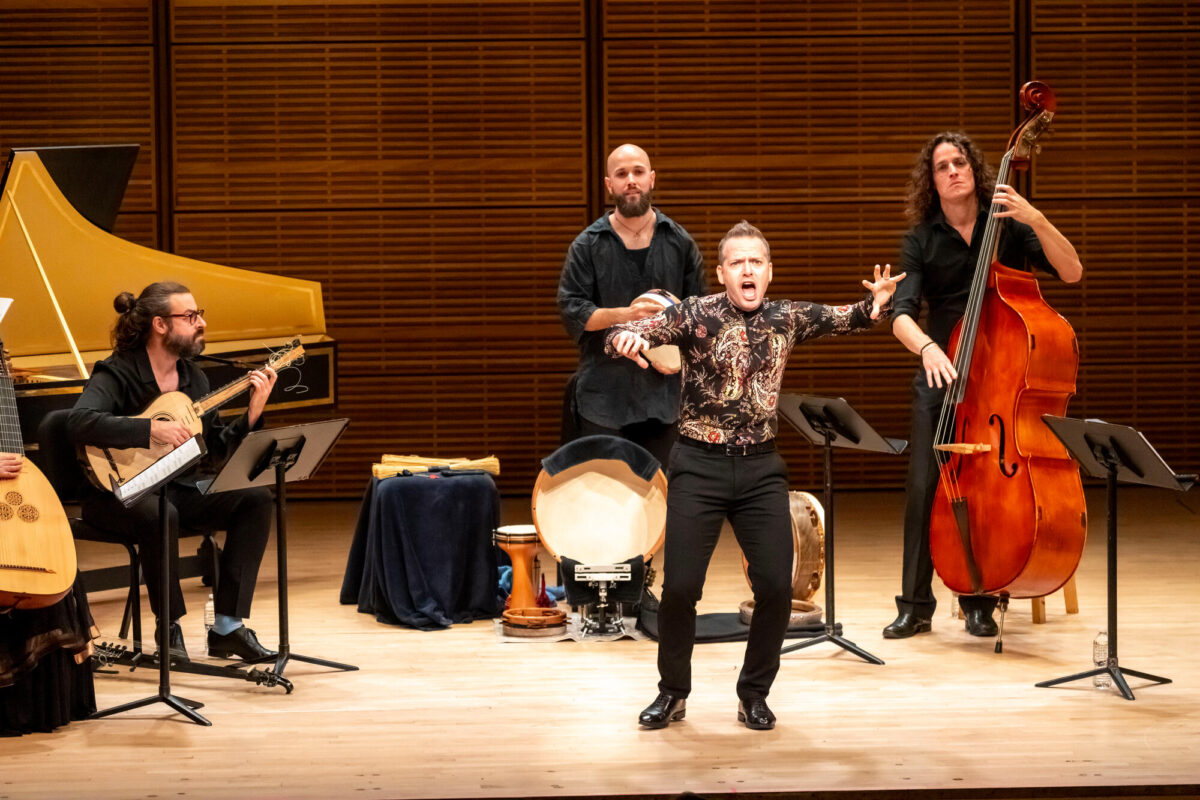
Capezzuto’s voice, on the other hand, is small but lovely and nimble. During his rendition of “Lo Guarracino,” a tongue-twister in Neapolitan dialect, Capezzuto reminded me of a sleight-of-hand magician. And his singing was made even more delightful by his Flamenco-inflected dancing. Seeming to take Capezzuto’s lead, all members of L’Arpeggiata sang and played with their whole bodies.
Photograph: © 2025 Richard Termine
I found myself transfixed by Tobias Steinberger’s tambourine interludes. Almost as percussive was Leonardo Terrugi’s pizzicato double bass playing, while Dani Espana improvised at the harpsichord with jazz-like fluency.
But the musician who made me lean in the most was Pluhar herself. During one group improvisation, Pluhar raised a finger, and everyone went instantly hush.
Leaning in at Catapult Opera’s production of “Nothing Follows” at Columbia University’s Italian Academy on Friday would have meant falling onstage. That’s because this double bill, combining Claudio Monteverdi’s Il Combattimento di Tancerdi e Clorinda with Nico Muhly’s The Glitch, was presented in-the-round, or rather in-the-rectangle. The audience felt like part of the action, literally in spitting distance.
This was made all the more exciting by Monteverdi’s word-painting—heavy steps, breathless gasps, galloping horses—interpreted deftly by Catapult’s orchestra under Neal Goren’s baton. At one point, Ezra Seltzer’s slapping cello bow evoked sword fighting.
In Monteverdi’s madrigal about mistaken identity, the Christian knight Tancredi (baritone Efraín Solís) kills his lover, the Saracen warrior Clorinda (mezzo-soprano Devony Smith), because he doesn’t recognize her in armor.
Most of the singing is done by the narrator Testo. Tenor Karim Sulayman’s emotive performance as Testo was astonishing, with gorgeous glides into his head voice. But there was also damn good singing by Smith as she lay dying. Solís was muscular in both voice and body.
Certain moments of Tancerdi e Clorinda made me wonder if Monteverdi was into sexy wrestling; lovers left “exhausted, breathless” or lines like “her garment is soaked.” But erotics soon devolve into tragedy.
When Testo sings “He recognizes her,” followed by a loud silence, that moment’s heartbreak is on par with when Orfeo looks back at Eurydice.
Photograph: Marcus Shields
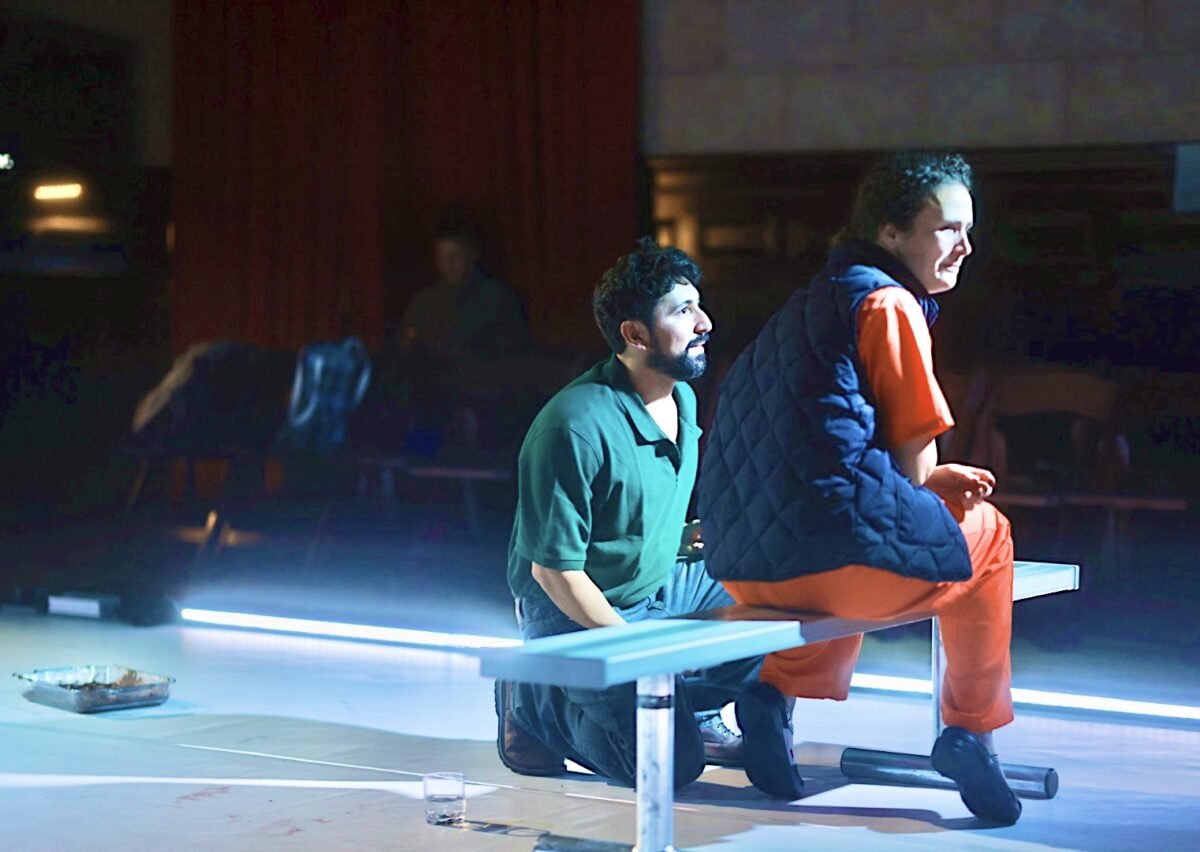
The Glitch is a modern counterpoint to Monteverdi’s miniature. It is scored for solo piano (Jason Wirth) and two singers (Smith and Solís). In it, the motif of a repeated piano note conveys, paradoxically, both motion and stasis at once.
The Glitch’s premise is perhaps as improbable as Tancredi e Clorinda’s: A former prison guard, now incarcerated herself for helping her lover escape, is visited by the husband whom she cheated on.
The most direct thematic quotation from Tancredi e Clorinda is when Solís sings “What kind of husband twists the knife/into his already hemorrhaging wife.” But also borrowed is the theme of looking/not looking; Smith and Solís often sang facing away from each other.
As a Baroque bookend to Muhly, Sulayman reappeared and seamlessly launched into Strozzi’s “Che si puó fare,” accompanied by Luce Burrell on theorbo, Caitlyn Koester on harpsichord, and Seltzer again on cello.
“What can one do?” he sang. “When crafty Cupid denies respite to my distress?” It felt like déjà vu.