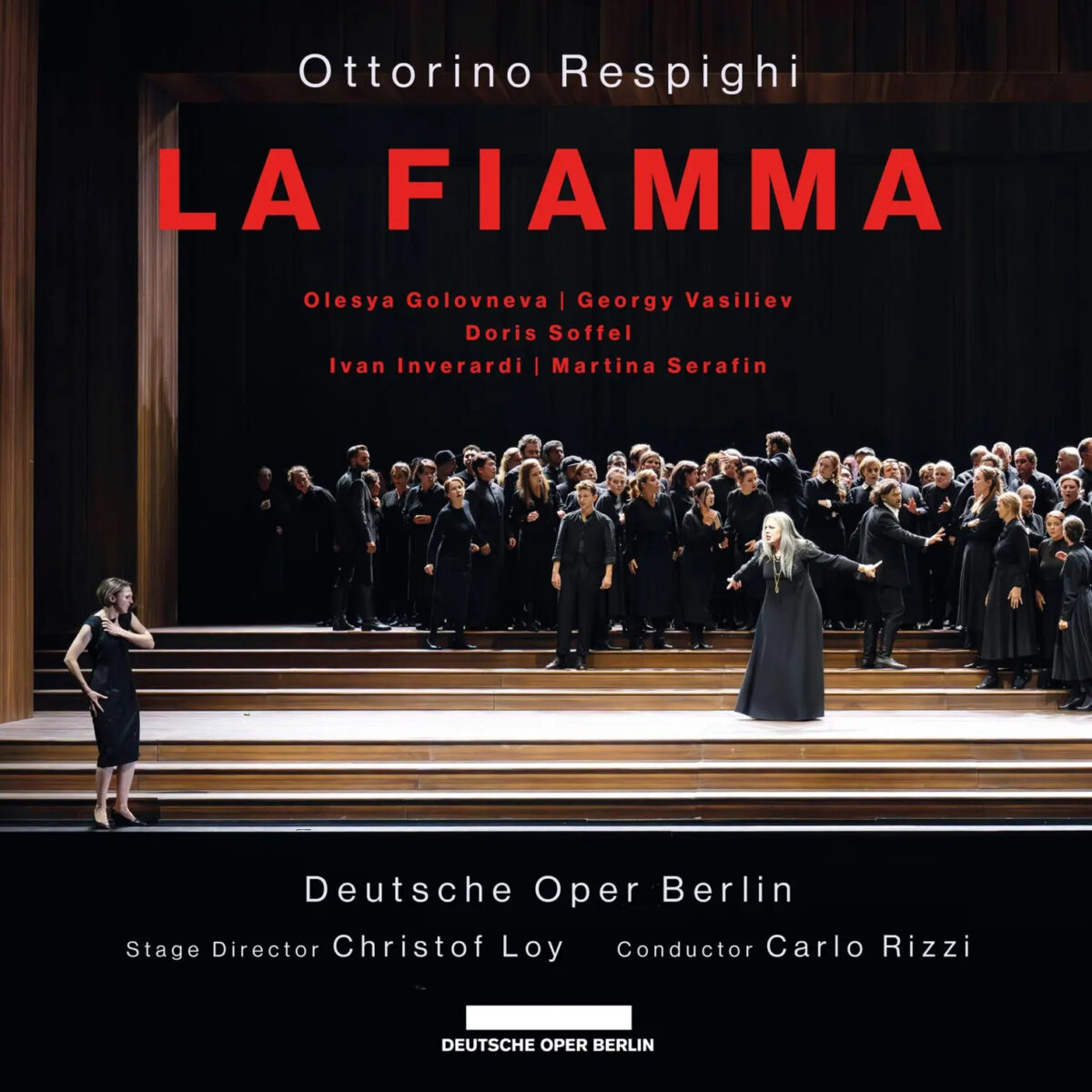
While I don’t think Ottorino Respighi’s operas will ever be cornerstones of the repertory, they definitely deserve to be seen more frequently. Thus, it was gratifying to see Deutsche Oper Berlin mount a new production by Christof Loy of La fiamma. This production was recently released on DVD. An audio recording from the same performances is also available for streaming.
This is Respighi’s most ambitious dramatic work and a full-bore melodrama with tempestuous music to match. The libretto is based on Hans Wiers-Jenssen’s 1908 play Anne Pedersdotter, The Witch about a woman who was accused of witchcraft and burnt at the stake in 1590. Respighi and his librettist Claudio Guastalla changed the setting of the opera to 7th century Ravenna. Critics have debated whether the opera was intended as a critique of Fascism and groupthink and one wonders what Mussolini, who attended the world premiere in Rome, thought of the opera.
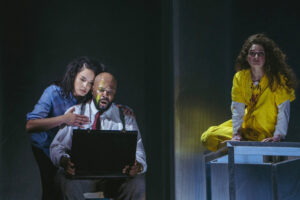
The main character Silvana is the second wife of the ruler of Ravenna (Basilio). Her mother-in-law, Eudossia, does not approve and harangues her daughter-in-law as only a dramatic soprano can. Silvana’s stepson, Donello, returns home after a long absence and there is instant chemistry between the two who have not seen each other since childhood. Suddenly, a mob bursts in searching for Agnese who is accused of witchcraft. She is found and Eudossia gleefully joins the village exorcist in condemning her to death by burning at the stake. Before dying she curses everyone in sight, singling out Silvana who she predicts will also die in fire.
Silvana and Donello begin a torrid affair. When Silvana finds out her husband is sending Donnello back to Constantinople, she tells her husband Basilio about the affair and that she despises him. He collapses, dead. Eudossia accuses Silvana of witchcraft and she dies at the stake.
The music makes use of a large, sumptuous orchestra and it seethes with passion, especially in the riveting Act I finale where Silvana is cursed. Doris Soffel as the accused Agnese is simply galvanic here. The orchestral contribution is formidable and this creates considerable challenges for the singers who must rise above the simmering cauldron of orchestral sound. They manage this with the inevitable signs of strain, but it does not detract significantly from the overall impact of the work. Carlo Rizzi does not seem to hold back to help his singers out.
Martina Serafin is the mother-in-law and she digs into her characters machinations with gusto, even if the voice is showing some signs of wear and tear. Olesya Golovneva sings Silvana with confidence and an impressive emotional range, even if the voice is still working its way into heavier parts like this one and Turandot. Georgy Vasiliev is her lover Donello and I found his singing and acting appealing even if he did not match the others in intensity. Baritone Ivan Inverardi was Basilio the Exarch of Ravenna, displaying a plush, attractive voice and he effectively captured his character’s torments.
Two singers in smaller parts made strong impressions: bass Patrick Guetti was the exorcist and he sang with commanding authority. Soprano Caitlin Gotimer only gets a few lines as the mother who accuses Agnese of bewitching her son (she was also covering Silvana), but even so, I took note of her secure, impactful voice for future reference.
Loy sets his production in the present day using a simple wooden box with sliding panels that occasionally moved to reveal a lush nature painting. He quickly established the tense, oppressive atmosphere that the work requires. That tension was sustained through the three Acts and overall I found it very effective.
I hope other companies borrow this production or are inspired to present this work. And for those with more traditional tastes, there is actually a grainy video from Barcelona with Montserrat Caballé as the doomed Silvana.