Photo: Erich Schlegel
On 15 November, Austin Opera—founded in 1985 as Austin Lyric Opera and renamed in 2014—launched the celebrations for its 40th anniversary with a gala program titled “Celebrate Opera! A Spectacular Birthday Concert.” The evening traced the company’s four decades of operatic history while offering glimpses into its artistic future.
The program opened with the overture to Mozart’s The Magic Flute, the company’s first production in 1987. Under the baton of Austin Opera’s Music Director, Timothy Myers, the orchestra moved fluently across a wide stylistic terrain: 19th-century staples (Verdi, Wagner, Puccini), 20th- and 21st-century operas (Barber, Dvořák, Sosa), and even musical-theater selections from Oscar Hammerstein II, Stephen Sondheim, and Leonard Bernstein. As always, Myers conducted with admirable consistency—precise and thoughtful in the core repertoire, and fully engaged in exploring the rhythmic, timbral, and cross-cultural layers that characterize more contemporary music, including works influenced by Mexican musical idioms.
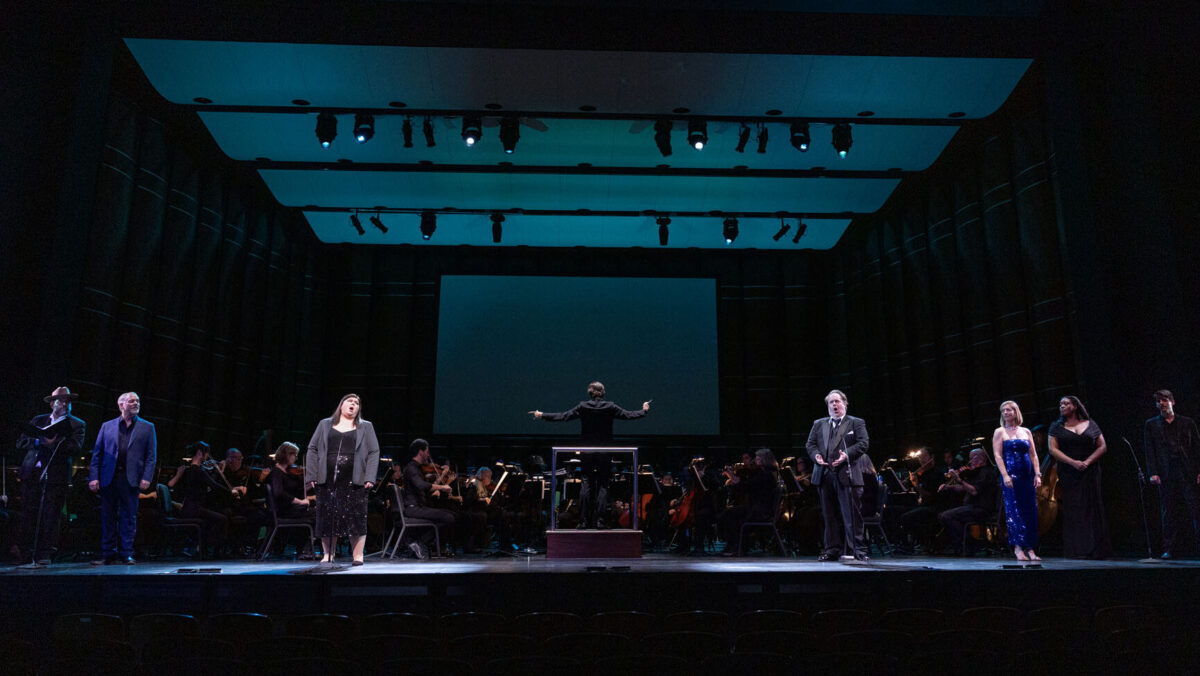
The performance featured four singers—soprano Leah Crocetto, mezzo-soprano Zoie Reams, tenor Jonathan Burton, and baritone Malcolm MacKenzie—each offering a distinctive repertoire strategy and vocal range.
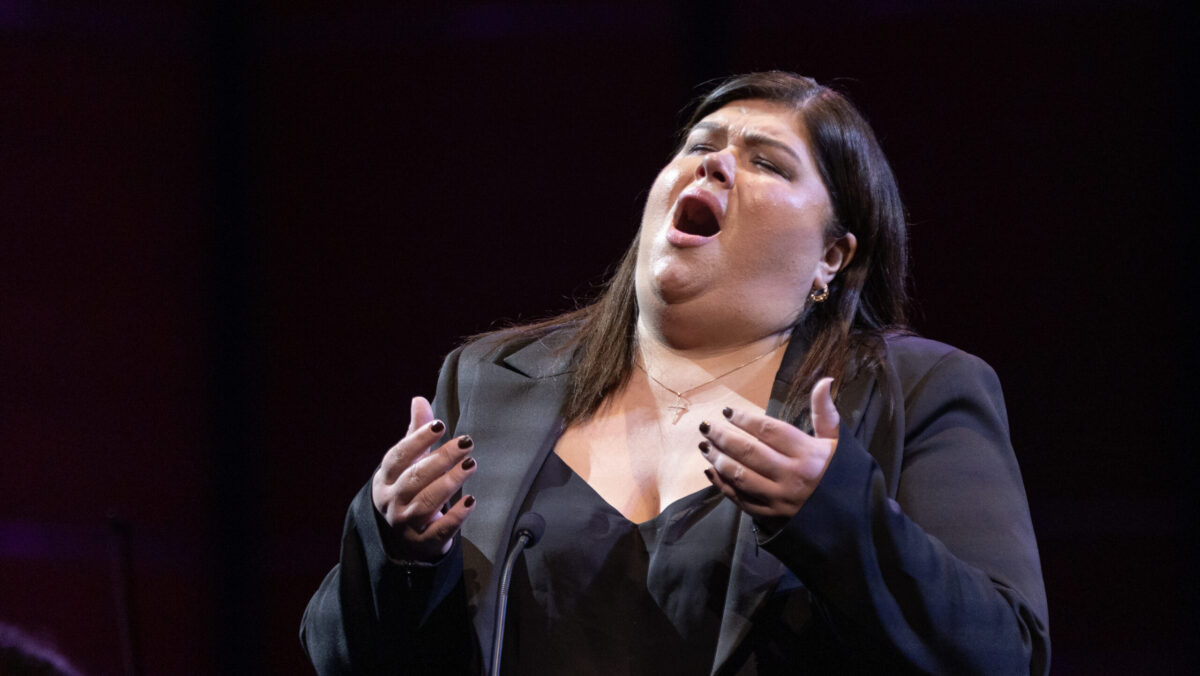
Photo: Erich Schlegel
Leah Crocetto displayed the widest emotional and stylistic range of the evening, moving convincingly from Verdi’s Aïda to the Mother Abbess in Rodgers and Hammerstein II’s The Sound of Music. Her “Song to the Moon” from Dvořák’s Rusalka unfolded with pleading yet radiant lyricism, capturing both yearning and fragile hope. In “O patria mia” from Aïda—a role she has performed with major companies including the Metropolitan Opera—her tone was sorrowful yet restrained, with a glint of steel at the top that conveyed Aïda’s pain without melodrama. Her phrasing in the descending lines—each note released with careful attention—suggested not resignation, but a resolve forged through grief. Immediately afterward, in “Tace la notte! Immersa nel sonno” from Il trovatorewith Burton and MacKenzie, she lightened the voice and offered bright, clarion top notes that deftly differentiated Leonora from the weightier Aïda—an effective demonstration of her interpretive versatility.
Jonathan Burton came armed with tenor showpieces—“Di quella pira” from Trovatore and “Nessun dorma”—and delivered the high-lying repertoire with secure, ringing tone, including a clean high C in the Verdi. The audience responded enthusiastically, though some of the final high notes tapered off more quickly than one might have wished; sustaining them with more amplitude could have heightened their impact. “Di quella pira” was also hampered by the concert staging. With Burton downstage and the Austin Opera Chorus upstage behind the orchestra, the essential dramatic exchange—Manrico rallying his soldiers to rescue Azucena—never fully ignited. The chorus sang with forceful attack in the compound meter, but without physical interaction or unified dramatic direction, the musical-emotional build did not cohere, and the orchestra’s exuberance ultimately swallowed Burton’s climactic high C. More surprising—and impressive—was Burton’s middle register in Agustín Lara’s “Granada,” where his warm, unforced tone made a stronger musical impression than the high-note fireworks.
Malcolm MacKenzie, aside from the musical-theater standard “The Impossible Dream” from Leigh and Darion’s Man of La Mancha, devoted his selections to the great 19th-century baritone repertory: “O du, mein holder Abendstern” from Tannhäuser and “Te Deum” from Tosca. It was a confident, even bold, setlist. His delivery is crisp, his diction incisive, and his projection immediate—attributes that suit this repertory exceptionally well. At times, though, the overall effect was almost too secure, bordering on predictable. But his Conte di Luna in “Tace la notte! Immersa nel sonno” was a standout; he shaped the villain’s desire for Leonora with insinuating swagger, and the muscular resonance of his voice lent the character exactly the right dark edge.
Zoie Reams excelled in the modern repertoire. Her opening aria, “Amour! viens aider ma faiblesse” from Samson et Dalila, began with a strikingly dark timbre, but the dramatic arc never fully crystallized—perhaps understandable for a first entrance of the evening. The aria invites a careful balance between seductive sweetness and ruthless calculation, and Reams’s approach to Dalila’s emotional complexity felt somewhat undefined. But her second appearance, in Erika’s aria “Must the Winter Come So Soon?” from Vanessa, revealed a different level of artistic focus. Reams shaped the line with long breaths and restrained intensity, building Barber’s inward lyricism through subtle cycles of tension and release. Her delivery of the simple, devastating final question—“Must the winter come so soon?”—was haunting, and the aria’s brevity made her dramatic concentration all the more affecting.
Beyond the singers, the concert offered meaningful previews of future Austin Opera projects. Excerpts from the 2025–26 season’s new-to-Austin production of Fiddler on the Roof—the Entr’acte and the iconic opening number “Tradition”—introduced the musical’s world. Rabbi Neil F. Blumofe, who will play Tevye in February, delivered his spoken-sung lines with remarkable rhythmic precision and rhetorical flair, while the Austin Opera Chorus added buoyant articulation and characterful energy. Their blend created genuine anticipation for the upcoming production.
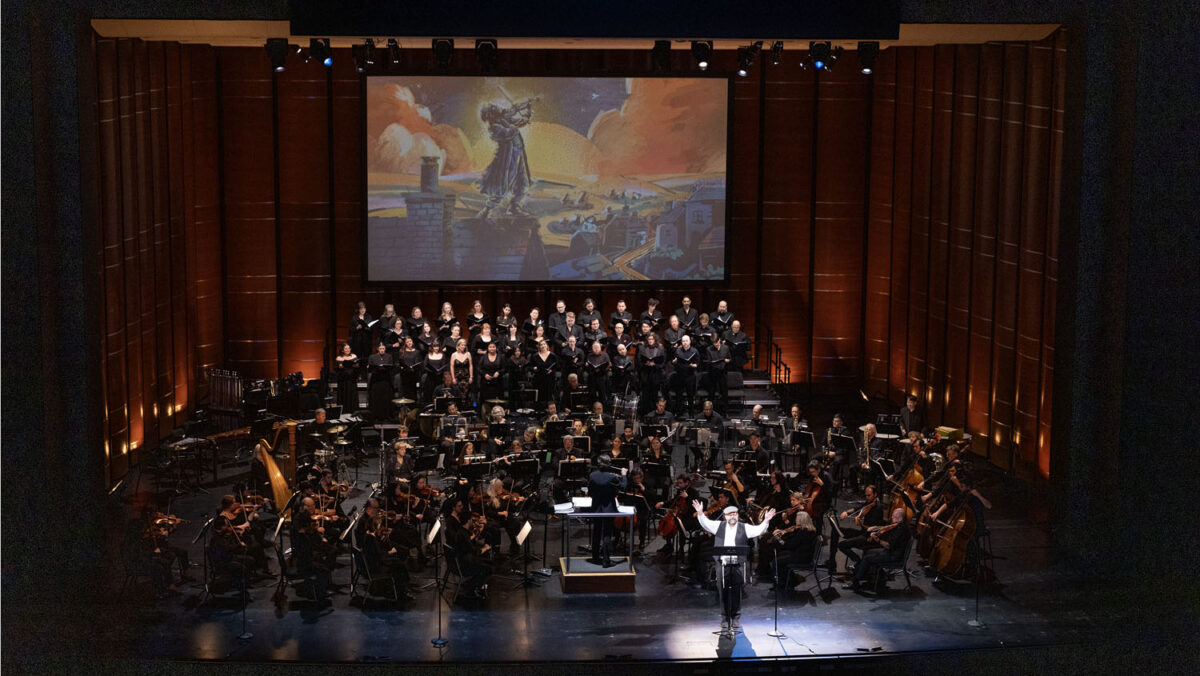
Photo: Erich Schlegel
The company also announced its first commission in honor of the 40th anniversary: Ofrenda, a new opera developed through the Residency for Latinx Creatives by John de los Santos and Jorge Sosa. Centered on a mother and daughter during Día de Muertos, the opera explores themes of death, memory, love, and healing. Crocetto and Reams performed the Scene II duet, which incorporates basso continuo with traditional Latin melodies and rhythms—a stylistic fusion that honored operatic convention while integrating Latinx musical heritage. Even in this brief excerpt, the warmth of the mother-daughter relationship and the cultural texture of Día de Muertos emerged vividly. After years of focusing largely on standard repertory—Madama Butterfly, Carmen, and other classics—Austin Opera’s turn toward new Latinx-centered work feels not only refreshing but genuinely promising. Sosa’s remaining puzzle pieces—how he will weave this sound world into a full dramatic arc—leave much to anticipate.
The company also begins construction on the new Butler Performance Center as part of its anniversary milestone. One wonders what Austin Opera will look like in ten or twenty years — how its repertoire will evolve, how its commissioning programs will expand, and how its investments in Latinx creativity might reshape its artistic identity. For now, “Celebrate Opera!” did exactly what a milestone concert should do: honor the past, showcase the present, and gesture boldly toward the future.