Photo: Mark Bachman
In an era of surveillance during which the federal government prizes traditional family values and gender roles over qualifications, two men, who are also civil servants, fall in love. Fellow Travelers is the story of an era which feels all too familiar today and the Pittsburgh Opera production, primarily cast with Resident Artist singers, offered an effective and moving performance which conveyed the cognitive dissonance of the characters as well as the score’s emotion and lyricism. Through a combination of community involvement, education and promotion, the company also presented an interesting model for how a modern opera can simultaneously engage an audience, present queer stories, and preserve a history that is not widely known.
The opera, which premiered in Cincinnati in 2016 and is based on a novel by Thomas Mallon, covers a period in United States history now called “The Lavender Scare,” when politicians and government officials capitalized on the midcentury anxiety surrounding the Cold War in order to purge anyone suspected of homosexuality from the civil service. The net effect was the firing of over 5,000 federal employees who had dedicated their careers to their country; given the attitudes of society regarding homosexuality at the time, the campaign resulted in an untold number of suicides.
The production premiered at San Francisco’s Opera Parallèle, and Pittsburgh was fortunate to have its creator, Brian Staufenbiel, directing. A challenge in staging this opera is moving between sixteen scenes in 110 minutes, but the static multi-level sets combined with lighting, projections (Todd Nonn), and occasionally furniture successfully conveyed the numerous locations. The first scene in the park included couples and workers walking through Dupont Circle during a lunch break, whereas the Christmas party scene was simple yet effective in its addition of tinsel garland scarves for the cast.
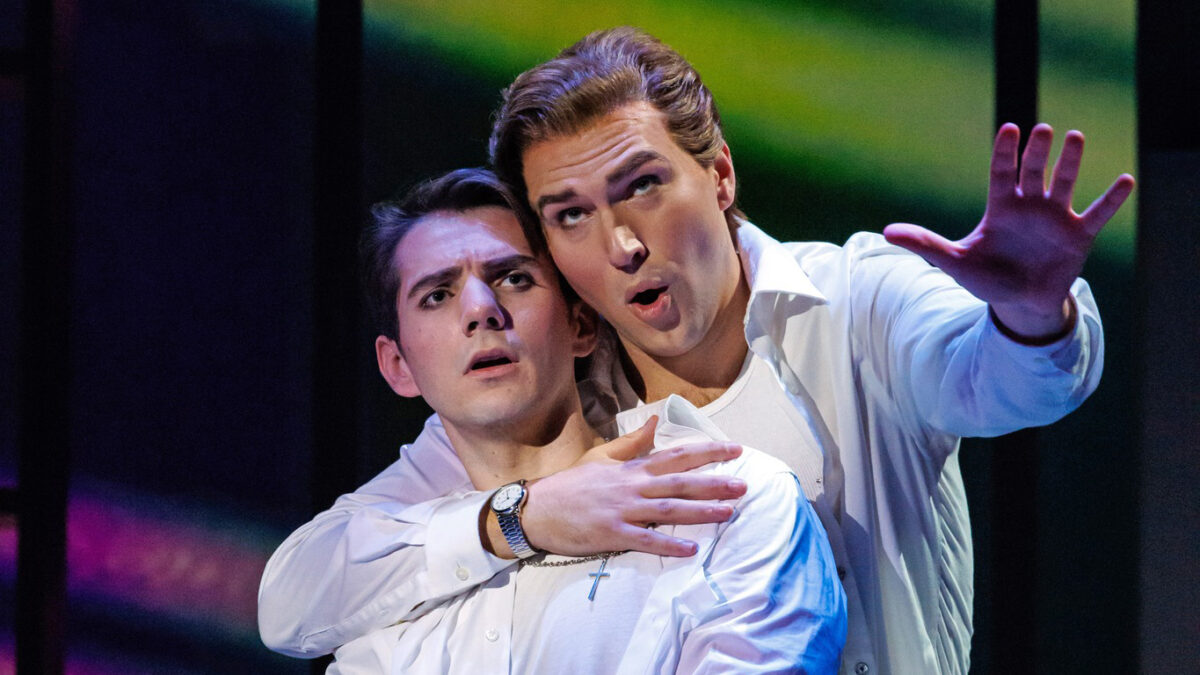
The plot centers on two closeted men working in government: Hawk, a butch, WWII-decorated veteran working in the state department, and Tim, a devoutly Catholic recent college graduate who gets a job with Senator Joseph McCarthy. The roles were sung by two Pittsburgh Opera Resident Artists who, in a stroke of fate, had not only performed these characters in college but had done so together at The University of Cincinnati College-Conservatory of Music.
Tenor Logan Wagner gave a deeply affecting performance as Tim, conveying both the innocence of the character but also his strong belief in the conservative cause. His lyric voice easily conveyed the character’s vulnerability, and he executed the brief, darting ornaments at the end of his aria “Last night” with impressive control and precision. Baritone Erik Nordstrom conveyed Hawk’s complexity: a man torn between society’s expectations and his desire for Tim, though whether that desire is rooted in love or in control is open to interpretation. Nordstrom demonstrated notable ease with the melismatic passages in his aria “That’s what we get” with clear articulation of each note while maintaining a clean line through the phrases. The leads were buoyed by a strong ensemble, particularly Shannon Crowley in the role of Mary, Yazid Grey as Tommy McIntyre, and Lauryn Davis who nearly stole her scenes as Miss Lightfoot.
Meshing naturally with the vocal lines and never sounding overly poetic, the libretto has a conversational quality and the cast was consistently intelligible – a feat not always achieved in operas sung in English. The work has some inconsistency between its first and second halves; the first half feels rushed, with the introduction of many characters and subplots which dilute the attention that could have been paid to developing the relationship between Hawk and Tim. After a single meeting in the park, the next time we see them they are going to bed together and fantasizing about a honeymoon trip to Bermuda. The second half of the work is much stronger, delving into the characters’ feelings and interpersonal dynamics. The culmination of the story is a brilliantly paired set of scenes, first with Tim’s confession to a priest about his relationship, followed by Hawk’s confession to Mary about how he has turned Tim over to the House Un-American Activities Committee.
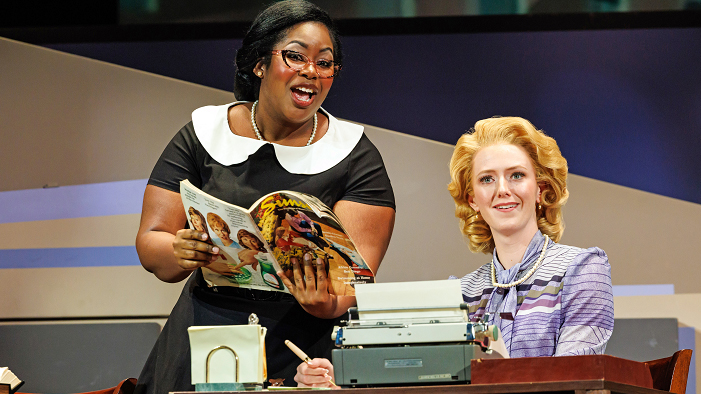
Photo: Mark Bachman
The orchestra, led masterfully by Anthony Walker, achieved an impressive balance in the acoustically challenging Byham Theater. Scored for a 17-player ensemble, the music is highly melodic, at times soaring, with an undercurrent of steady optimism. Spears anchors the score in several recurring motifs — particularly a descending scale with an upper-neighbor return and a series of ornamental turns — that begin to wear thin by the end of the performance. Although the opera’s broader themes celebrate freedom and hope, the score’s largely bright tone left moments of threat (such as the polygraph scene) without the darker orchestral mood that might have underscored the danger of the time.
Pittsburgh Opera is also to be commended for the programming they scheduled to accompany the work. In addition to the typical pre-show talk, the organization paired with a local LGBT organization to present a speaker panel which focused on the history surrounding the work with commentary from administrators working in current arts organizations, queer artists, and members of the local LGBT community who lived through the period. For the performances, one night was designated as “Pride Night” with a special promotion and a portion of the ticket sales’ going towards a local advocacy organization.
Fellow Travelers has been in the news recently after the creative team decided to pull the work from the Kennedy Center after concluding that the show’s message of “expansion of freedom and liberty for all people” was inconsistent with the center’s current leadership. A contrasting view was expressed at the speakers’ panel that preceded the Pittsburgh production. Several panelists emphasized the importance of presenting queer art, focusing on its responsibility not only to represent the full spectrum of queer life and provide a safe space for those it represents, but also to introduce queer stories to audiences who might otherwise never encounter them. The complexity and relevance of these issues in 2025 only serves to highlight the importance of presenting and seeing these stories today. We are fortunate to have art, artists and organizations that meet the moment.