Photo: Nick Rutter
Deception and romance, chaos and mayhem, wine and charcuterie… There was much fun and laughter when Pacific Opera Project (POP) launched the second production of its 15th anniversary season, the Los Angeles premiere of the rare Daniel Auber’s opéra comique Fra Diavolo at Highland Park Ebell Club on Friday 7 November.
As I mentioned in The Talk of the Town a few months ago, one of the things that excites me most about being in Southern California is POP’s current season. Now that Fra Diavolo is here, experiencing such a rare comic opera in a lively setting was truly a delight and a testament to POP’s goal of introducing lesser-known operatic treasures to a broader audience.
It’s almost a crime that Auber isn’t more widely known today, given that he was a leading composer in France during his time. He served as the director of the esteemed Paris Conservatory from 1842 to 1871, modernizing the institution and counting Bizet and Massenet among his students. Furthermore, he composed the first French grand opera, La Muette de Portici, in 1828 with a libretto by Eugène Scribe (who also wrote the libretto for Fra Diavolo), a year before Rossini’s swansong Guillaume Tell and three before Meyerbeer’s Robert le diable (also by Scribe). The partnership with Scribe, which lasted 41 years until Scribe’s death in 1861 and resulted in 39 operas, became as fabled in France as Gilbert and Sullivan in Britain decades later.
Despite the success of La Muette de Portici, Auber seemed to favor the lighter opéra comique form of which Fra Diavolois arguably his best example. (Fans of Laurel and Hardy might recognize the opera from the 1933 film of the same name which was based on it.) Loosely based on the life of the rambunctious guerrilla leader Michele Pezza and his meddling in the engagement of a young couple, the opera features all the hallmarks of a comic opera including mistaken identities, disguises, comic sidekicks, jealousy, and, of course, a happy ending for the central pair! I’ll let POP’s opera scholar Joel Balzun give a crash course on the opera (in 60 seconds!) below.
In an era when almost every opera company in the US is reducing their number of operas they perform, it’s truly encouraging to see that POP is offering six shows for its anniversary season, starting with Pagliacci last September. Founded by Artistic Director & CEO Josh Shaw in 2011, POP began its journey with four performances of Bernstein’s Trouble in Tahiti in July 2011 and in 2023, after 12 nomadic years, POP finally found its headquarters right next to the Highland Park Ebell Club (the venue for Fra Diavolo). Fra Diavolo marked POP’s 67th production.
POP’s mission is to reimagine opera as “an affordable adventure, by making unforgettable, entertaining performances accessible for all,” and it adopts an unusual approach. Not only does POP present content in a wide variety of venues (from outdoor gardens and historic theaters to intimate clubs and community spaces), but Shaw, who has directed all POP productions to date, embraces bold, imaginative concepts that are highly entertaining, while also keeping ticket prices low, engaging fully on social media, and creating new libretti that are relevant to today.
For Fra Diavolo specifically, POP creatively took a different approach: selling tickets for tables of 2 or 4 people, which included a charcuterie board and a bottle of wine courtesy of Cobblestone Vineyards (traditional seating options are also available in the back at discounted prices), creating a novel and immersive theater experience familiar to musical theatre — similar to Broadway’s recent Cabaret — but rarer in traditional opera.
Fra Diavolo was part of the standard repertoire in the 19th century in its original French, but it also came in German and Italian versions (the latter prepared by Auber and Scribe themselves), as well as in English translation. The program listed the English libretto for this performance as adapted by Shaw and Sarah Sturdevant “using multiple sources, with some original lyrics and dialogue.” I noticed hints of the late Donald Pippin (of Pocket Opera’s fame)’s influence in the lyrics, and, to my pleasant surprise, Shaw confirmed as much and also cited four other sources, including James Stewart’s for the Ohio Light Opera Company. With such witty English lyrics, the show bore some resemblance to Gilbert and Sullivan’s Savoy operas … maybe except for Gilbert’s made-up vocabulary!
Musically, the opera is full of delightful duets, trios, and even quintets, and Auber had a talent for composing catchy, hummable melodies. His choral writing was outstanding, here performed with gusto by the 10-person POP chorus (led by Benjamin Beckman). There’s a clear influence from his friend Rossini, but Auber proved that he was more than capable of standing on his own. Each finale was carefully crafted, with intertwined expressions and complex lines that led to a satisfying conclusion. Listen to the EMI recording (featuring Nicolaï Gedda and Mady Mesplé) for samples!
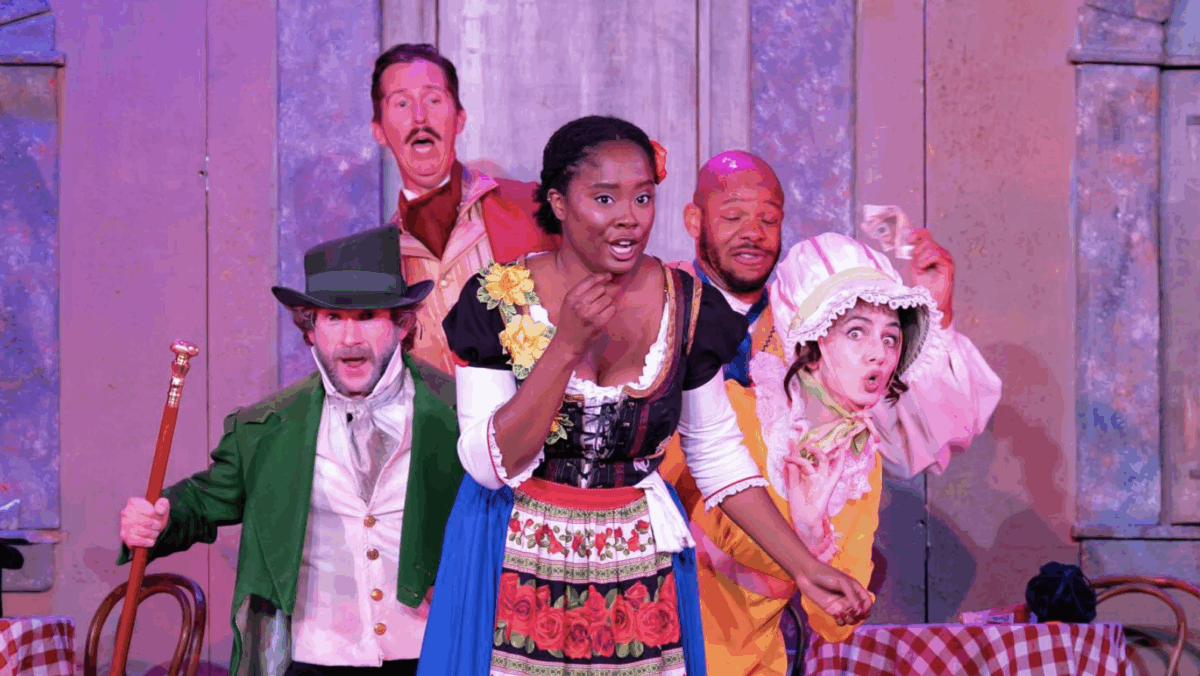
Shaw’s sets overcame their modest appearances as the cardboard façade representing the front of Matteo’s inn in the first and last Acts opened up in the second Act to reveal Zerlina’s bedroom (and the bedroom for the English aristocrats), allowing for a seamless transition, especially between Acts II and III (the intermission occurred only after Act 1). The lighting (by the unidentified designer) was dominated by a pinkish-violet hue that bathed the stage (and the auditorium), particularly in Act II, adding a whimsical quality to the production. Hailey Springer’s costumes also combined elements from different eras, ranging from British Regency for the aristocrats, a Zorro-like cape and hat for Fra Diavolo, and interestingly, French army coats and lederhosen for the soldiers and village women that my opera companion joked that POP could reuse them for La fille du régiment!
Shaw’s direction somehow emphasized the Rossinian nature of the score, including the “frozen on stage” scenes typical of Rossini’s finales. But more importantly, it reflected a joie de vivre radiating from the stage thanks to the highly committed and well-rehearsed cast. At a time when it seems difficult to find reasons to laugh, attending Fra Diavolo felt like both therapy and an escape. It was exhilarating to see such a high-energy audience enjoying this opera!
POP assembled a quite strong cast to bring out the fun in Fra Diavolo, led by Southern California native Randall Bills in the title role. Bills, who mentioned in the video below that he auditioned online, brought swagger and playfulness to the role and was believable as the carefree robber. Bills’s lyrical vocals contrasted well with the bright timbre of James Stevens’s Lorenzo, his arch-nemesis (and another tenor). Stevens used the steely quality of his voice to portray a lovelorn and naive simpleton while Sabrina Langlois completed the trio of main characters as Zerlina, Lorenzo’s lover. On Friday, it took a while for Langlois to warm up, but she eventually produced a well-rounded performance marked by ease of coloratura in her Act II aria.
The supporting cast was also filled with strong performers that greatly contributed to the night’s enjoyment. As Lord and Lady Hardcash (yes, the name was another POP invention), Matthew Ian Welch and Meagan Martin stole the show with their antics, especially their constant bickering and sarcastic jabs. Similarly, E. Scott Levin and Krishna Ramanenthusiastically took on the roles of Giacomo and Beppo (the Laurel and Hardy characters), playing them for laughs. With his booming voice, Errol Wesley Shaw’s Matteo worked hard to fend off all those nuisances and marry off his Zerlina to a wealthy farmer to no avail.
POP veteran Kyle Naig returned to conduct the nine-person orchestra for this show. While the absence of a full orchestra’s sound was noticeable, Naig nonetheless led the ensemble in a lively reading of the score that matched the stage action. Interestingly, the orchestra was positioned to the left of the stage with tables next to it, which made me wonder how the balance would be for the people seated nearby. Either way, the audience didn’t seem to mind and they erupted into loud cheers at the end to give the cast, Naig, and Shaw rousing rounds of applause!
Only one weekend remains to see Fra Diavolo and POP’s next production is the revival of the über famous, Star Trek-themed Abduction from the Seraglio, for just three performances (February 6-8) at Occidental College. The 2015 broadcast can be found here. You know I’ll be there!