
Scott Suchman
WNO raised the curtain on its 70th-anniversary season, its first to begin in the wake of major changes at the Kennedy Center, with Giuseppe Verdi’s late masterpiece Aïda. A co-production of WNO, San Francisco Opera, Seattle Opera, and Minnesota Opera, this production was first seen in DC in the 2017-2018 season.
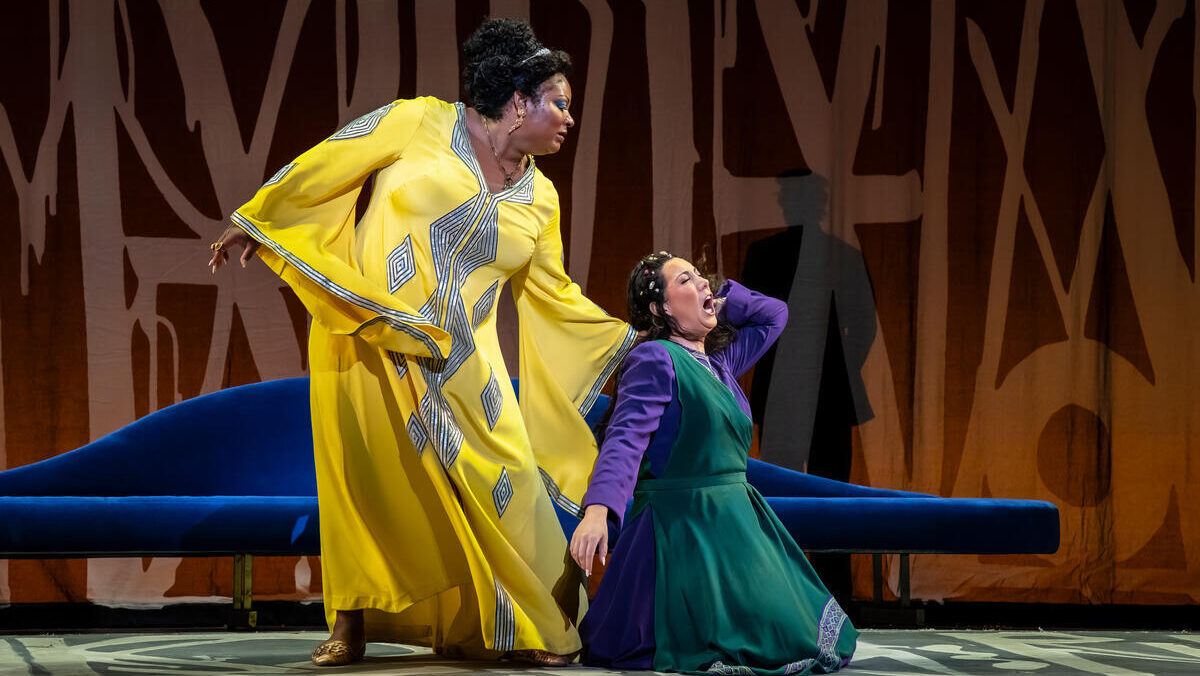
Shorn of the showy Egyptian trimmings typical for productions of this opera, Zambello’s Aïda adopted a leaner approach in a bid for universality. Artistic design by visual artist RETNA (born Marquis Lewis), whose style is inspired by calligraphy, graffiti, and hieroglyphics, nodded to ancient Egyptian aesthetics while cultivating a more abstract iconography. Sets by Michael Yeargan started off with a spartan cement bunker tagged with RETNA’s designs and focused on larger calligraphic emblems as the opera went on. Lighting by Peter W. Mitchell (the program credits Mark McCullough as the original lighting designer) added ambience to the scenes and 20th-century khaki military costumes by Anita Yavich completed the wartime look.
Jessica Lang’s elegant choreography is a highlight of Zambello’s Aïda, particularly the regimented, clocklike dances in Act II’s Triumphal Scene. Ballet principals Dwayne Brown and Jenelle Figgins and the WNO Corps of Dancers added significant visual interest to a rather sparse and gray production. Zambello’s inclusion of a troupe of skilled acrobatic youth dancers, dressed in miniature military uniforms, raised interesting questions about the nature of a highly militarized society and the indoctrination of children. The creative team’s effort to universalize the opera led to misleading and awkward translations of Antonio Ghislanzoni’s libretto that scrubbed it of references to Egypt and Ethiopia while occasionally introducing stilted effects, such as a line given to Radamès in Act IV: “I may have inadvertently revealed strategic information.” Try setting that to music.
In the titular role, soprano Jennifer Rowley sang an emotionally sensitive Aïda, though she sounded more constrained near the top of her register at some moments. Rowley deployed luxurious vibrato as she wavered between love for Radamès and duty to her country in “Ritorna vincitor.” Her strongest performance came during Act III’s Nile Scene, which showed her in greater command of the range of her shimmering instrument. Her duet with bass-baritone Shenyang’s Amonasro was a highlight of the evening. Winner of the 2007 BBC Cardiff Singer of the World Competition, Shenyang sang with velvety-voiced persuasion that turned on a dime to steel.
As Aïda’s love interest Radamès, tenor Adam Smith sang well (his “Celeste Aïda” was marked by a nice attention to Ghislanzoni’s words and a fine upper register) but his wooden stage presence lowered the opera’s dramatic stakes. This yielded the floor more fully to the relationship between Rowley’s Aïda and mezzo-soprano Raehann Bryce-Davis’s Amneris, a dynamic that enlivened this production.
I’ve personally always found Amneris to be the most interesting character in Aïda because of her complex psychology which waffles between jealousy, unrequited love, and regret. Bryce-Davis’s rich mezzo and skilled acting humanized the character. She effectively posed as a sweet-tongued yet manipulative big sister to Aïda in Act II’s soprano-mezzo duet, a standout moment of the night. Bryce-Davis’s quicksilver mezzo nimbly handled the character’s emotional seesaw of Act IV when she alternately seeks to save and condemn Radamès.
Rounding out the principal cast, perennially dependable bass Morris Robinson, a WNO favorite, sang Ramfis with his characteristic mastery (his calls of “traditore” in Act IV were downright chilling) and bass-baritone Kevin Short sang the King with oaken authority. Kwamé Ryan conducted the WNO Orchestra in an exciting, fast-paced rendition of Verdi’s score, enlivened by glistening on-stage trumpets played by guest performers during the Triumphal Scene.