Peter van Heesen
“Did men have to create an entire genre just to practice their kink?”
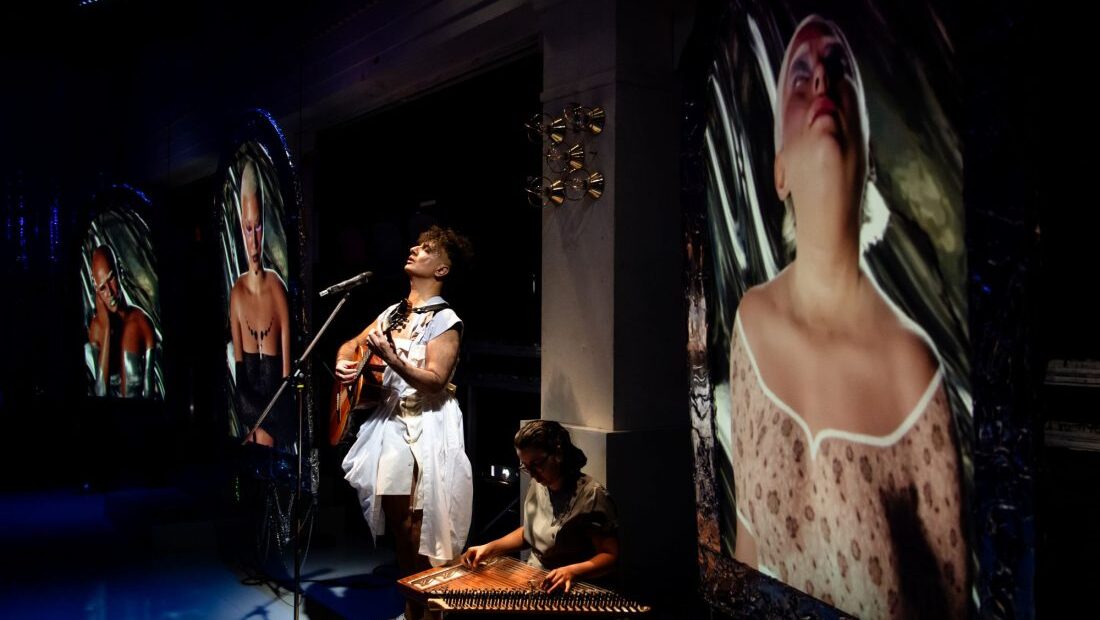
The sound of roasted watermelon seeds cracking between molars is an unlikely accompaniment to Handel’s “Ombra Mai Fu.” Nevertheless, during Neuköllner Oper’s new production CRIME OF PASSION, such an accompaniment moves even the staunchest of opera purists to tears. CRIME OF PASSION is a “musical reckoning” by non-binary artist and musician of Kurdish-Turkish and Arab descent, Anthony Hüseyin. The work simultaneously confronts the prevalence of femicide in opera and relives Hüseyin’s experience with domestic violence against their late mother, Fatma. An operatic cabaret of sorts, Hüseyin’s work included famous arias, Turkish ballads, and original compositions. When not accompanied by cracking watermelon seeds, Hüseyin is accompanied by the Kanun and live electronics.
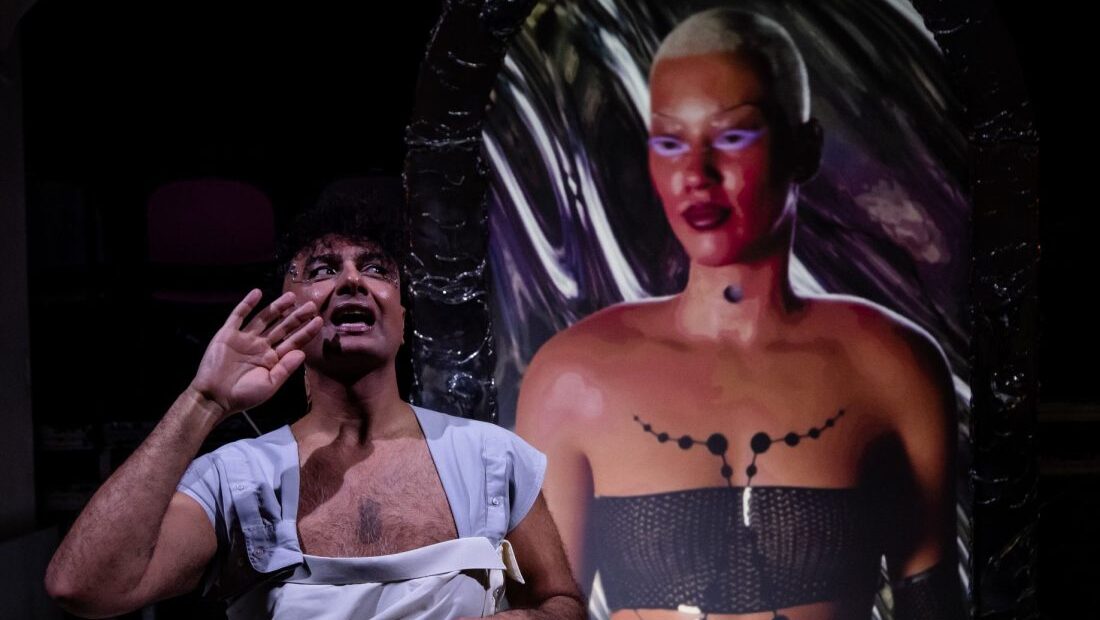
As the audience takes their seats Hüseyin paces around the venue warming up, alternating between lip trills and breathing exercises. The audience is then introduced to an animated, magic mirror trytipe of famous operatic women, Salome, Carmen, and Violetta. The three femme fatales serve as fairy godmothers, narrating Hüseyin’s subsequent journey. We then flash back to Istanbul in 2005 where we meet a young Hüseyin who is an opera singer in training. Hüseyin is too worried about their Fach placement and German diction to recognize that the career they are working towards replicates the very gender-based violence they face at home. In addition to the prevalence of femicide on and off the stage, Hüseyin also explores topics of xenophobia, colonialism, and sexuality, investigating the opera industry through a queer, nonbinary lens.
A collection of vignettes unveils moments from Hüseyin’s youth, from struggling with high notes in “La fleur que tu m’avais jetée” to proudly dancing in go-go boots and embracing their queer identity. Each vignette reveals more about thereality of their home situation, where their father, often intoxicated, beats their mother. The irony plaguing a young Hüseyin, who sings Leporello’s “Catalogue Aria” before their phone rings and they rush home to protect their mother from attempted femicide, is perhaps overstated to a modern audience. Yet, in a country where in the past year Carmen has been killed 2,000 times, Violetta 1,000 times and Salome 300 times, perhaps Hüseyin wants to remind operatic audiences that we remain complicit in such retellings of femicide. How can we continue to perform Carmen, La traviata, and Salome given the persistence of femicide, Hüseyin ultimately asks. What if we gave a voice to the very operatic women whose deaths we are compelled to watch again and again?
Peter van Heesen
The animated manifestations of Salome, Carmen, and Violetta are Hüseyin’s intervention, each providing hot takes about femicide in opera. Carmen asks, “Could it be that actually we are the drag versions of those composers? Or their alter egos? Or their wives and mothers that they hated to death? Or the women that they can’t even come near without paying? Imagine Bizet: high heels, red dress, dark, curly long hair with red lipstick, making out with Don José!” “We are an absolute fetish of emotionally suppressed and oppressed men” assures Salome. The women also reveal that they are dominatrixes, raising money for Germany’s underfunded women’s shelters. While Can Karaalioglu’s animations allow the audience to question temporal and corporeal realities, they also further dehumanize the three operatic women. While I enjoyed the digital dominatrix aesthetic of the operatic woman, I felt animating them led us further from the pertinent reality of femicide.
Reenactments of past traumas and calls to “Arm the Dolls” are paired with wholesome memories of their mother, notably when Hüseyin caught her snacking on roasted watermelon seeds during their final school recital. To bridge the gap between 2005 in Istanbul and 2025 in Berlin, Hüseyin hands two roasted watermelon seeds to each member of the audience. As the taste of salted seeds crossed my lips, I was transported to Istanbul, crunching with Fatma in the back of the recital hall.
For more information of the prevalence of femicide in both Türkiye and Germany, Hüseyin recommends the Monument to commemorate women who lost their lives due to domestic violence in Türkiye and a similar resource, “Stop Femicides,” that counts femicides in Germany.