Cory Weaver
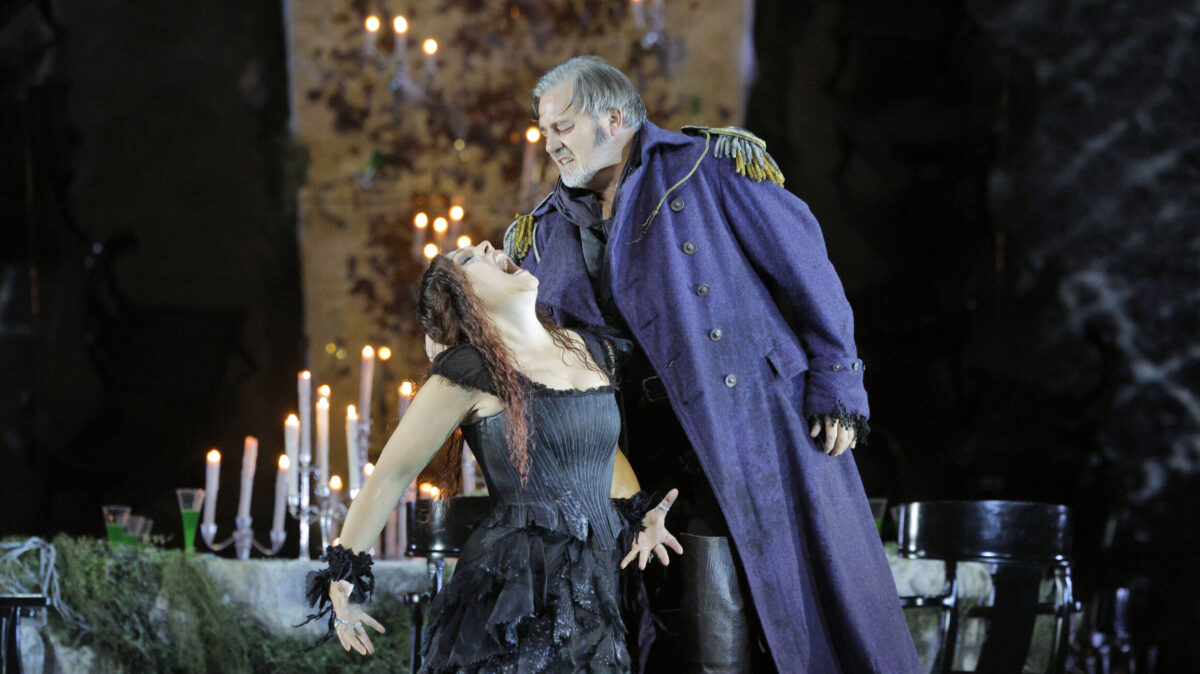
There’s a reason François-Benoît Hoffman, the librettist of Luigi Cherubini’s original French Médée (1797), oncecalled the composer a “terrorist musician.” The opera only works with the right soprano who can cut across its orchestration and tense, daring harmonic framework. Sondra Radvanovsky’s handling of the titular role in Medea at the Lyric Opera of Chicago establishes her as the ultimate scorned mother of our time.
It’s been three years since Sir David McVicar’s production of the Italian-translation Medea premiered at the Metropolitan Opera in 2022. But here in Chicago, his take on Cherubini’s turn-of-the-century opéra comique is refreshingly contemplative for an opera that could have been stilted by its classical subject matter, and for a house that often favors sterile—or perhaps economic—stagings.
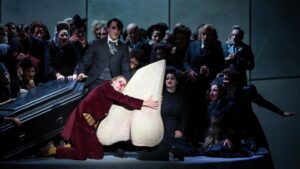
One would be hard pressed to find a better pictorial referent than the grotesque, gaping female head on the show curtain for the opening sing-along performance of the Star-Spangled Banner to mark the start of the Lyric’s season, given Trump’s deployment of the national guard here in Chicago and the political landscape these past few weeks. I, for one, felt camaraderie with her haunted look surrounded by the weak, warbly rendition from the audience.
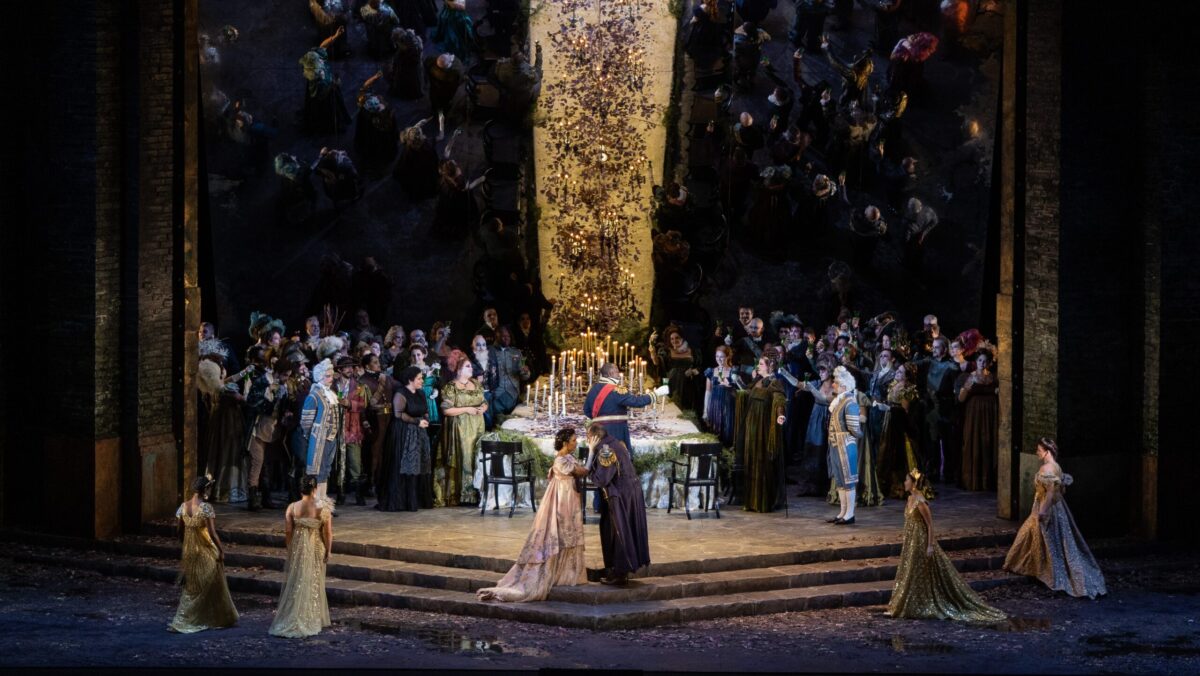
After that thrilling musical excursion, Enrique Mazzola’s commanding conducting of Cherubini’s overture cleansed the aural palette of the hall. Euripides’s tragedy needs little introduction, and the Corinth setting is blessedly understated through a crumbling, gold-brushed exterior. While we know Medea’s fate and her impending infanticide from the start, she is strikingly absent for most of Act I. Thematically, McVicar and the costume designer Doey Lüthi fill that gap with little nods to the time of the opera’s 1797 premiere—Empire gowns and most notably, a jaunty Napoleon-esque figure equipped with a bicorne hat. But the Napoleonic party set in place for Glauce and Giasone’s wedding is almost overshadowed by some overdone hollering by one of the actors. Less is more.
Musically, the orchestration in the opening feels somewhat heavy-handed, alternating between a cheery major key for the chorus and two handmaidens (Emily Richter and Camille Robles) and a darker minor mode that underscores each of Glauce’s anxious remarks as she vocalizes her fear of Medea. Elena Villalón brought an assertive stage presence and some nice tone to Glauce, but her diction left much to be desired. This only became more obvious as Matthew Polezani, clearly comfortable in the role of Giasone, comforted his bride in “Or che più non vedrò” with a syrupy tenor perfectly suited to gaslight Medea just a few scenes later.
In some ways, Medea really begins here, right at the end of the first Act with “Dei tuoi figli.” With Radvanovsky at the helm, this pitiful aria is the start of a monodrama—one dependent upon her convincingly unraveling from a pleading, scorned ex-wife willing to kill her own brother to support Giasone, to an unhinged matriarch who’d murder her children to hold him to account.
Cory Weaver
Alfred Walker (Creonte) and Zoie Reams (Neris) provided strong vocal counterpoints that enhanced Radvanovsky’s piercing Medea. It was a joy to hear Reams in a role that allowed her to showcase her stunning dark-hued mezzo-soprano, unlike last year’s production of Blue.
Shimmering and merciless, Radvanovsky’s squillo remained constant through every vocal leap and perfectly anchored high notes, but the real fun came with her smoldering chest register in the finale “E che? Io son Medea.” Although Cherubini’s score never quire rises to meet the horror of Medea murdering her children, seeing Radvanovsky sprawled across the floor, soaked in their blood, is proof that we’re witnessing an utterly haunting singer-actor.
It was Radvanovsky’s theatrical presence that tied together one of the most ostentatious elements of the production—a oppressive mirror taking up the back of the stage—with the tragedy’s Ancient Greek origins. Watching her conspire with Neris and rage around the stage, reflected in that looming mirror, made the audience feel almost complicit like the Greek gods, never intervening as Medea destroys her life, and breaks her own oath as a mother, all to make Giasone suffer.