
Winslow Townson
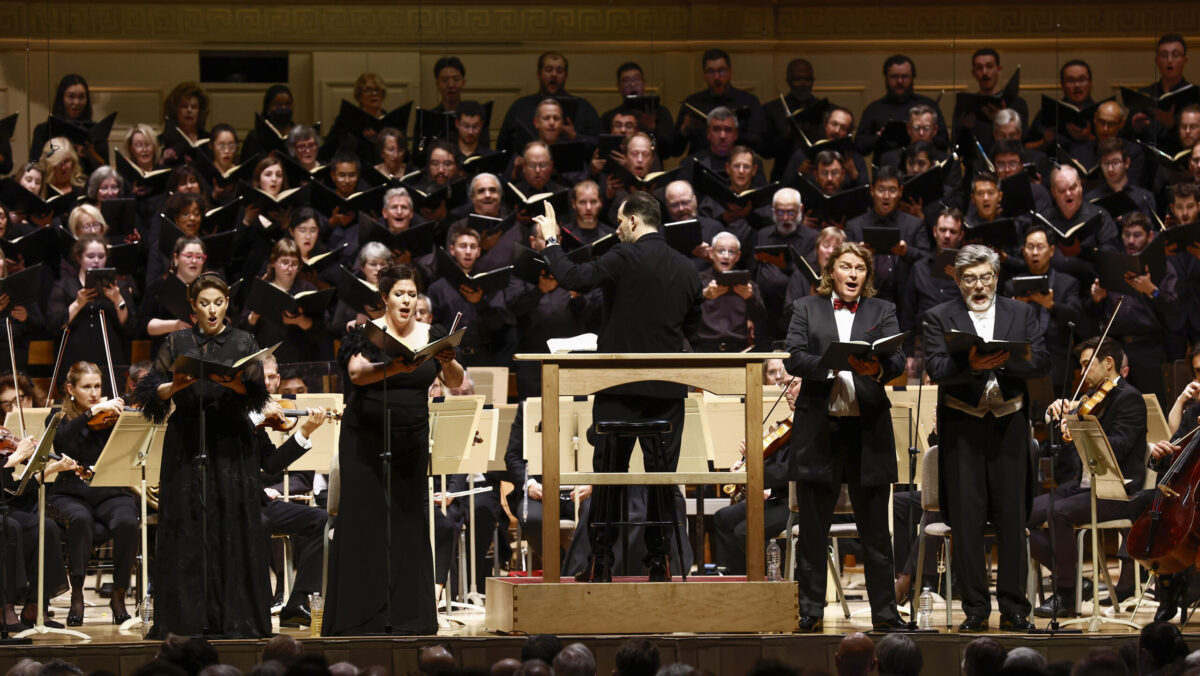
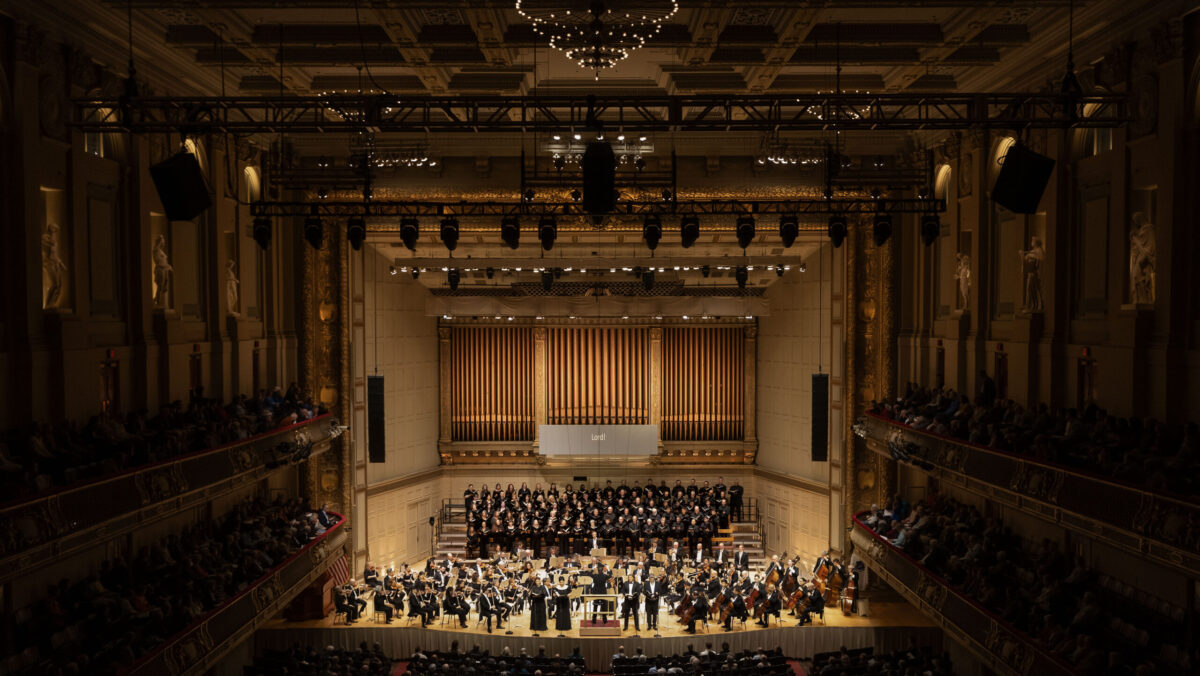
On 15 October, 1900, the Boston Symphony Orchestra inaugurated the acoustic wonderland of Symphony Hall with Beethoven’s monumental Missa Solemnis. 125 years later, the BSO’s dedication to the composer remains strong. Indeed, Beethoven’s name is the only one inscribed above the stage. Following last year’s symphony cycle, the infrequently-heard Missa Solemnis returned to celebrate the Hall’s anniversary, conducted by Andris Nelsons with a quartet of first-rate singers.
Beethoven wrote in the inscription to his Solemn Mass from 1824, “From the heart—may it go to the heart.” He intended the piece “to awaken and permanently instill religious feelings not only into the singers but also into the listeners.” While occasionally hinting at the triumphal humanism of the nearly contemporaneous Ninth Symphony, Beethoven’s liturgical work is more reserved and mannered compared to the occasional bombast found in his symphonic output.
Rather than the furious affirmative cadences so often found in the conclusions of his symphonies, each part of Beethoven’s Mass seems to leave something unsaid. Though the work’s enigmatic dimension might explain in part why the Missa Solemnis is far less popular than the Choral Symphony, both pieces are late masterworks.
The Missa’s pious quality—the score indicates “with devotion”—was matched by Nelsons and the BSO, who began the opening Kyrie in a stately manner. Tenor Klaus Florian Vogt and soprano Eleanor Lyons uttered the first word with a nuanced crescendo, inviting the audience into the liturgy.
Winslow Townson
The brisk Gloria began with rousing strings which Nelsons sculpted to sound akin to the Ninth Symphony’s finale. After a comforting woodwind chorale painting the “taking away the sins of the world,” Lyons and contralto Wiebke Lehmkuhl pleaded for mercy, followed by an intricate Bach-style chorale which pushed the four vocal soloists to their limits. Here Vogt almost ran out of breath on some of the extended lines, while bass Franz-Josef Selig had to navigate awkward leaps.
Nevertheless, the soloists proved their worth in Beethoven’s often challenging writing, arguably more demanding than the Choral Symphony. Lyons, a regular performer with leading orchestras and making her BSO debut, shone in her soaring lines during the Sanctus. Her ethereal voice complemented the orchestra’s largely restrained approach to the sacred meditations.
Lehmkuhl, Vogt, and Selig—all leading Wagnerians—were up to the task, showcasing the necessary vocal power and agility for Beethoven’s score. Vogt demonstrated an almost effortless dynamic range and clear upper register in his distinctive light timbre, particularly suited for the prayers to the Lamb of God.
Another BSO debutant, Lehmkuhl showcased her warm and rich timbre, particularly in the prayers of supplication and continued to prove her reputation as one of the leading contralti. Selig had Sarastro-like gravitas for the bass part. His low F suffered a bit during his solo at the beginning of the final Agnus Dei movement, yet Selig blended well with Vogt’s bright voice later in the movement. A particular highlight here was Lehmkuhl and Vogt’s pleas as the timpani and trumpets interrupt with martial warnings (noted “timidamente” and “ängstlich” in the score). Their almost frightened, repeated entreaties of “misere nobis” effectively conveyed the calls for divine mercy.
Winslow Townson
The Tanglewood Festival Chorus, led by guest conductor and Dallas Symphony Chorus Director Anthony Blake Clark, maintained bold enthusiasm and clear diction throughout the work. At times the choir’s emphasis on specific syllables, for example in “Kyrie” and “benedicimus,” meant that the overall grammar of the Latin phrases risked being buried in the polyphonic texture, yet this can also be attributed to Beethoven’s sometimes exhaustive ability to repeat material. A nice touch came in the third movement, the Credo, when the choir sat down for the hushed, intimate retelling of the incarnation of Christ, accompanied by subdued low strings and organ.
The singers were aided by an orchestra with extensive familiarity with Beethoven, although they last performed the Missa in 2012. Concertmaster Nathan Cole relished the challenging extended solo in the Sanctus movement. Representing the descent of the Holy Spirit with downward scales, Cole’s violin was warm, his rubato and tone not overly sentimental.
While Andris Nelsons may not be the most idiomatic interpreter of Beethoven’s sacred music—occasionally pounding the 3/4 dance rhythms a bit too heavy-handedly and risking covering the choir in softer passages—he nevertheless worked well with the singers, at times making sure individual instrumental lines were heard over the choral forces. Nelsons particularly shone in the final bars as he pushed forward the hushed calls for peace, grounded by an almost imperceptible timpani and strings, followed by a rousing concluding upward scale.
While the Missa Solemnis does not have as rousing a finale as the crowd-pleasing Choral Symphony, Beethoven inscribed the “dona nobis pacem” as a “prayer for inner and outer peace,” a sentiment that is equally apt today as it was when Symphony Hall opened. The hopeful ending is not as overtly triumphant as a Schiller text, yet it serves as an equally important reminder of shared humanity and the possibility for peace.