Curtis Brown for The Santa Fe Opera
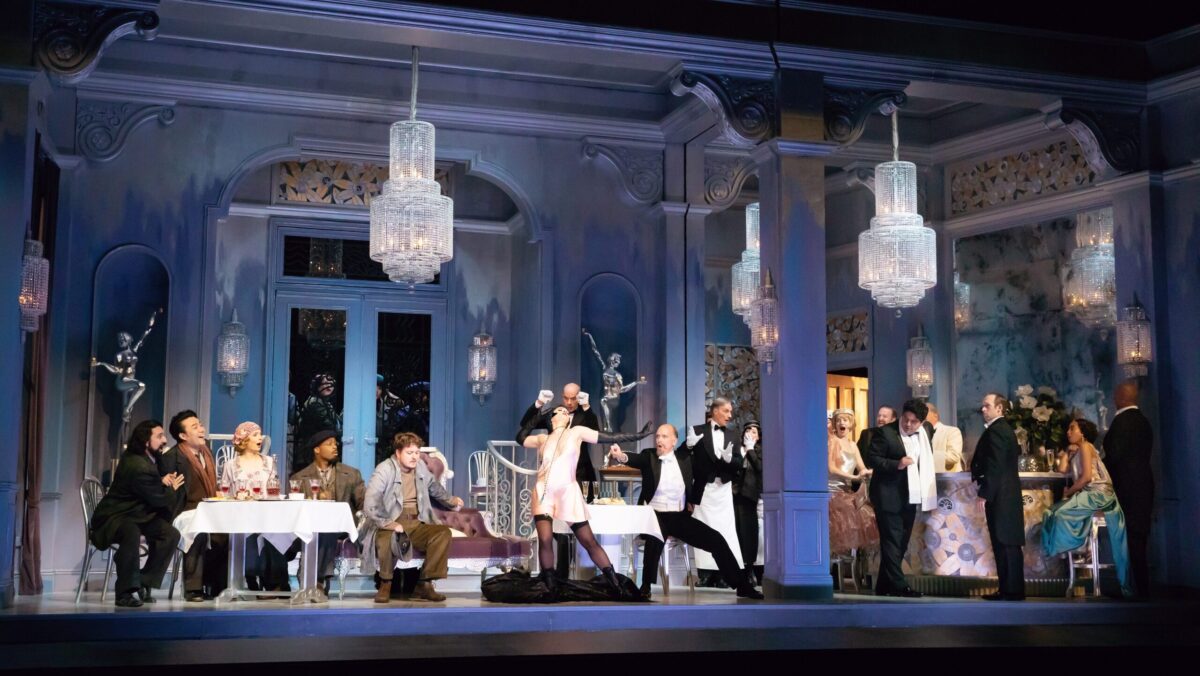
In Act II of La bohème, Musetta comes on to great acclaim from everybody on stage, from the Bohemians to the children hoping to buy toys from Parpignol. She eventually sheds her current paramour, Alcindoro by faking a sprained ankle from a damaged shoe, so that she can walk off with old flame Marcello. In the production by James Robinson at The Santa Fe Opera, before that point, she flings off her outer garment –– a long, feathered number that might be a coat or might be a dress –– leaving her in a camisole, culottes, and stockings.
Sure, this gets lots of attention, in addition to affirming the axiom that at Santa Fe, at least one scantily-clad singer will wind up freezing on stage when the rains –– or at least the damp –– close in on the open-sided Crosby Theatre. (On 28 July, the icicle singer was Emma Marhefka.) But it also distracts the audience from the more-important incident with the shoe, which comes a bit later and which barely registered here. This is just one way that Robinson’s update to the 1920s, and his frankly weak direction, undermined the effectiveness of this great opera.
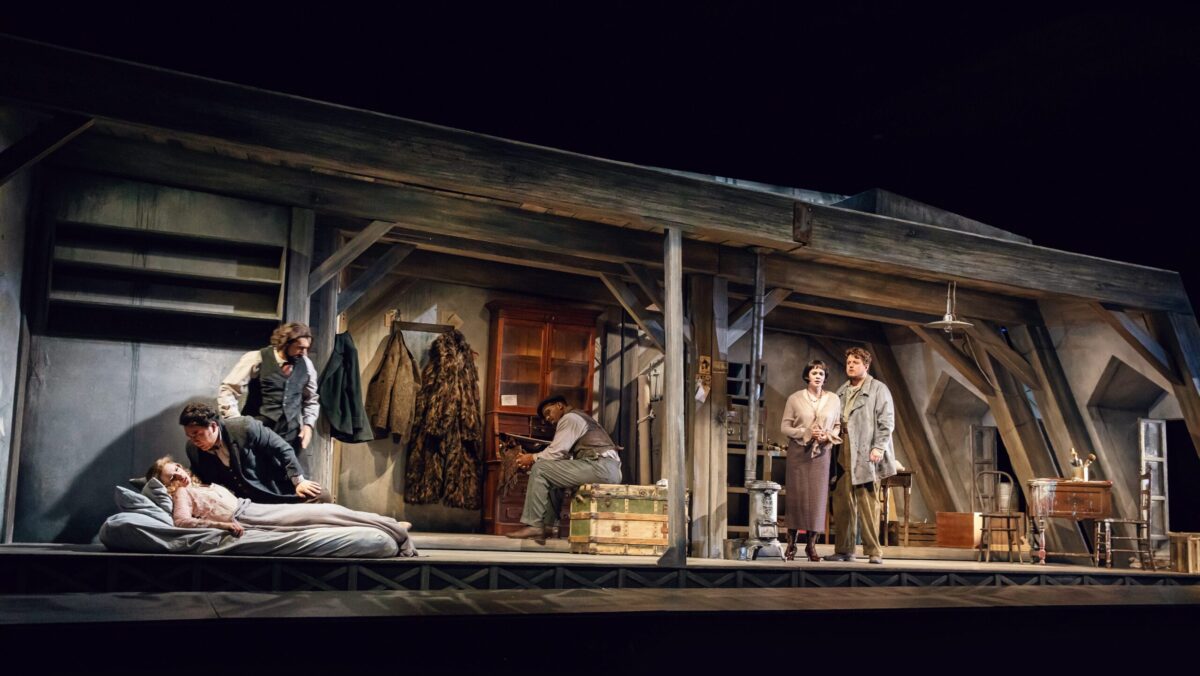
I’ve enjoyed, and learned a lot from, many updated productions (David Pountney’s Rusalka at Santa Fe in 2023 would be one example), but I saw no gains from this staging, even though it had some nice points. It was cute to see Rodolfo banging away on a typewriter, and the women’s 1920s outfits, by costume designer Constance Hoffman, certainly looked good. The Japanese prints on the wall behind Marcello in Act I were a nice touch, and those weren’t well-known in Europe until fairly late in the 19th c. Scenic designer Allen Moyer gave the garret set low ceilings and a charmingly appropriate smoking stovepipe above the roof.
But so much else seemed wrong. In the Café Momus scene, the Bohemians were apparently seated indoors, with a procession of fashionably dressed couples checking in with the maître d’hôtel behind them. Maybe the 1920s setting justified this, but it felt off.
The Bohemians looked too well dressed (excepting Marcello, whose coat showed some wear), too well fed, and, worst of all, too warm, even though Acts I through III take place during the winter and Act III is entirely outdoors. Poor Mimì, dying of tuberculosis, hardly coughed and rarely seemed weakened by her debilitating illness. Not only that, but the staging of Act IV drew the audience’s attention away from Mimì by putting her on a floor-level mattress at audience left while everyone else was on their feet and moving around, audience right.
The singers were all perfectly fine, but they were undermined both by the staging and by overly loud conducting from Iván López Reynoso. It’s a great score and you can understand conductors wanting to let the orchestra rip, but for heaven’s sake: this was my third Bohème since last fall, and the third in which the orchestra was too loud.
Curtis Brown for The Santa Fe Opera
Just as bad, or worse, López Reynoso’s conducting often failed to call proper attention to important moments happening on stage. Sylvia D’Eramo’s “D’onde lieta usci” was underway before I knew it, for example.
Emma Marhefka’s Musetta fared well, her bright soprano cutting easily through the orchestra. Szymon Mechliński has a big voice that might just be overkill for Marcello – and he was directed to be a coarser, less sympathetic character than you usually see, an interesting (and supportable) choice on Robinson’s part. He wasn’t a terribly sympathetic friend to Rodolfo and was more angry than hurt at Musetta’s behavior. Still, it’s more than a little hard to swallow Marcello disappearing with a streetwalker into a Red Cross van at the end of Act III.
There wasn’t a lot of chemistry between Long Long’s Rodolfo and D’Eramo’s Mimì, alas, nor did either of them make a strong individual impression vocally or dramatically. D’Ermano’s soft-grained voice didn’t contribute much to her character’s fragility, even though it could have. Soloman Howard was a sonorous Colline. The production put his towering size to good use when he briefly carried around the much-smaller Efraín Solís, who sang a charming Schaunard. The veteran Kevin Burdette was efficient as Benoît and Alcindoro.