Monika Rittershaus
Last year at this time, dear Parterre readers will recall, the curtain rose on Debussy’s Pelléas et Mélisande at the great Aix-en-Provence Festival to find Mélisande not lost in a forest but abandoned in a hotel room, where she proceeded to administer a pregnancy test. This year, Gustave Charpentier’s Louise appeared neither, as the libretto indicates, in her parents’ sweat shop (Act I) nor in the festive streets of working-class Montmartre (Acts II and III), but in the cavernous waiting room of a psychiatric hospital. Much like Katie Mitchell’s Pelléas, Christof Loy’s production of Louise (the second of his career), exemplifies so-called director’s opera (or Regieoper), the fundamentally German argument that the staging of legacy repertoire requires an argument that justifies the existence and argument of the work itself in and for the present.
Regieoper’s foundation is the Wagner problem: the problem of the legitimacy of the repertory itself following its Nazi appropriation. This kind of self-examination has a clinical side, and one tendency of the approach is the literal clinicization of the works themselves. The director-as-diagnostician makes medical subjects out of stories and characters. Often this results in cliché. How many more Tristans are we to suffer who spend the third Act in a hospital bed attached to an IV drip? (By the way, Robert Icke’s Don Giovanni at Aix this summer teetered back and forth across the stage in exactly that predicament—but that’s for another essay.)
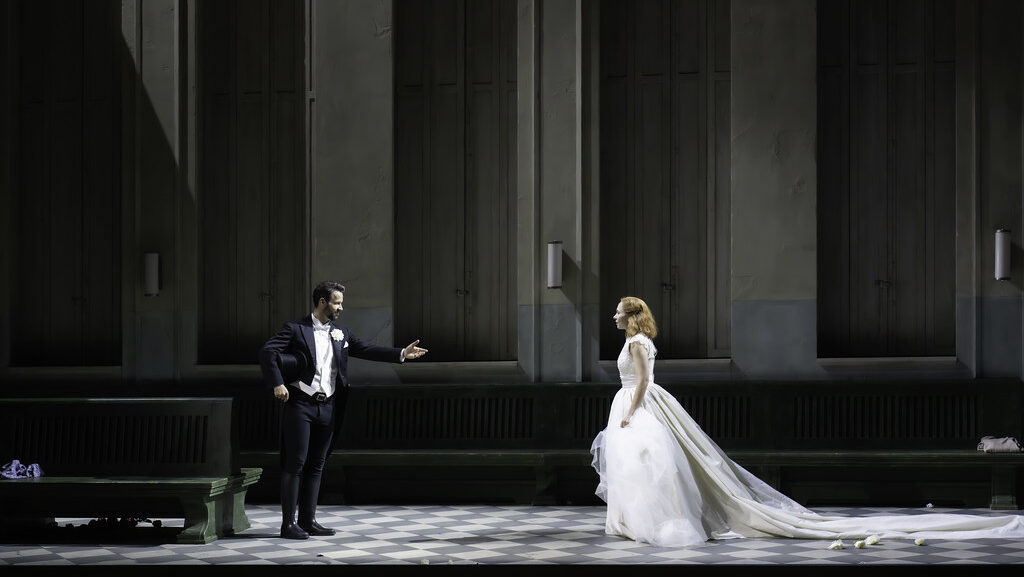
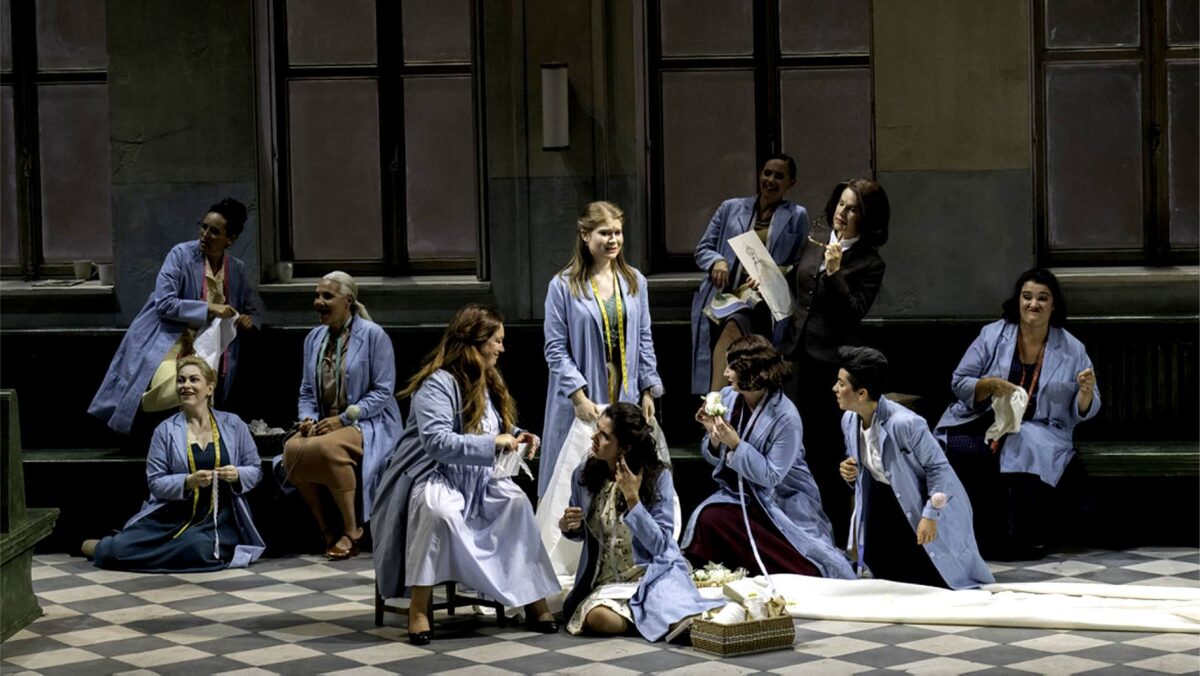
Christof Loy’s Louise takes this kind of literally clinical approach. His take is conscientious and largely successful. A cavernous unit set, designed by Etienne Pluss (Salome at the Met, 2025) proves hauntingly beautiful in its own way, recalling in its color palette and unfilled spaces Edward Hopper’s panoramas of urban loneliness. The setting reframes the opera’s action as the flashback and memory of Louise as she awaits admittance into the psychiatric hospital explicitly reminiscent of Paris’s Salpêtrière hospital, where the neurologist Jean Marie Charcot pioneered the diagnosis of hysteria via the treatment of young women traumatized by sexual violence.
If not without cost, the concept proves convincing and perhaps the best and indeed even the only way to understand this opera in the world we live in today, with the sordid saturations of Jeffrey Epstein on one side and Gisèle Pelicot on the other. If there is no evidence that Charpentier intended the presence of this degree of sexual violence, the naturalist underbelly of Paris, its surfeit of pleasure and danger, delivers it at least at the level of an urban– and operatic– unconscious.
Completed in 1893 with the libretto by the composer, Louise was rejected by several houses prior to its successful 1900 premiere at the Paris Opéra Comique, where it amassed performance numbers through the 1960s second only to Carmen and Manon. The opera was indeed a kind of scandal, perhaps even more so than Salome four years later. Charpentier called it a musical novel, a naturalist work in the manner of Émile Zola, portraying working-class life, the crushing anxieties of both poverty and patriarchy, and the liberation from both in the fulfillment and celebration of young female sexuality and desire. Richard Strauss admired Louise, as did Gustav Mahler, who brought it to the Vienna Court Opera and conducted it in 1904. No wonder: Louise’s lush orchestration, combinations of sensuality and dissonance, the exalted and the everyday, including the dissonances of the street and its plurality of sonic worlds, sound Mahlerian. At Aix, Giacomo Sagripanti’s orchestra seemed to embrace that association with its rich color palette and distinct dramatic momentum.
The young seamstress Louise escapes the clawing oppression of both her parents via a liberating love for the bohemian poet and Parisian flâneur Julien. Paris and freedom become allegories of each other. Ordered home to her ailing father by her tyrannical mother at the end of Act III — a kind of gender inversion of Don José’s summons to return to his mother in Act III of Carmen — she realizes a second escape at the opera’s end, presumably rediscovering her erstwhile liberation and happiness, if at the cost of the emotional desolation in which she leaves her parents behind.
Monika Rittershaus
The opera’s core scene comes at the Act III opening, with Louise’s exquisite aria “Depuis le jour où je me suis donnée” (Since the day I gave myself [to you]), a piece of sustained sensual exultation unequalled to my ear by any other aria, and perhaps only by Henri Duparc’s glorious 1882 song “Phydilé.” At the same time, “Depuis le jour” stands out for the harmonic complication and unpredictability of each of its long, arched phrases. As a personality developed in music, Louise is at once guileless and complex. In other words, there is an unconscious at work within her. Her aria is followed by an extended love duet with Julien—or perhaps more of a love dialogue, due to its Wagnerian form. (E poi Tristano, Charpentier might have claimed here—with more justification than Puccini had when he claimed as much for his Fanciulla love duet a decade later!) Louise compares her happiness to her earlier entrapment under the heel of a domineering mother and a poor soul of a father who always treated her like a child.
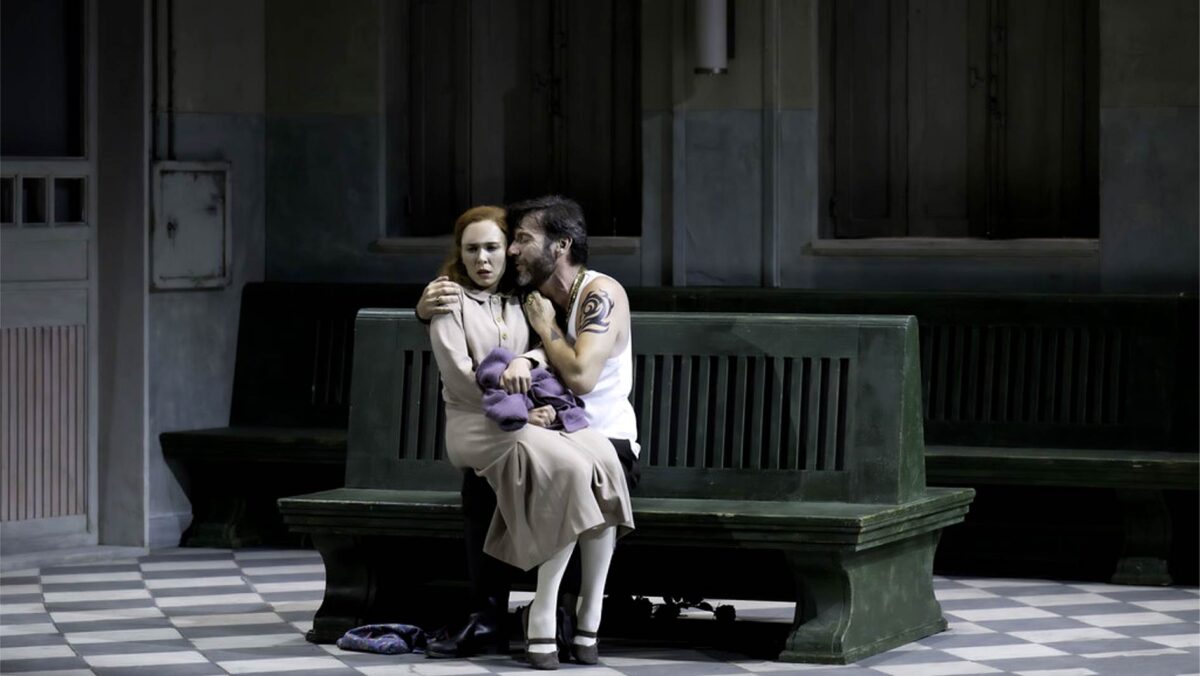
In our own day, it’s justified and perhaps necessary for this cloying paternal infantilization and possessive control of a daughter—evident in Act I but out of all proportion in Act IV– to be understood and portrayed as sexual abuse and forced incest. Act IV develops with the creepiest irony as the father sings a lullaby to the compliant Louise, accompanied by dark strings reminiscent of the entrance of the assassin Sparafucile in Act II of Rigoletto. This literalization of the text and music’s suggestion as abuse and incest is Loy’s choice, and it’s consistent with the framing in the clinic, the conversion of action into memory, and finally with the fate of Louise understood as the descent into dysfunction and trauma rather than her release into apotheosis and emancipation. The production’s final tableau suggests Louise’s defeat, remission into the hands of her parents, and admittance into the clinic.
Clearly aware that his flashback and memory-based concept might compromise the erotic energy of the opera’s present-tense, living-in-the-moment power, Loy inspired his youthful cast with a surfeit of kinetic, indeed balletic movement across the full proscenium. He was well served by his cast, led by Elsa Dreisig as Louise. Paris-born alumna and now star of the Berlin State Opera ensemble, Dreisig starred there as Mozart’s Countess, Donna Elvira, and Fiordiligi in the spring festival (Festwochen) in 2022, and sang Salome later that summer in Aix. She is precisely the Salome that Strauss wanted, as expressed in his precise but faintly disturbing wish for a sixteen-year-old with an Isolde voice. Dreisig’s clarion technique and lyrical, silver-sheened tone is matched by consummate French diction.
Monika Rittershaus
Adam Smith, the Julien, recalls the young Franco Corelli in his exuberant sound—both sexy and out of tune. Sophie Koch as Louise’s mother has lost much of the tone that made her an especially compelling Charlotte (in Werther) a decade ago. In Nicolas Courjal as the father, Loy secured an unusually young singer for this part, deliberately adding menace and literality to both text and music’s strong suggestion of incestual menace and abuse. Louise and her father, Loy argues in a program essay, form the central couple of the opera, displacing Julien, who disappears after Act III and seems thereby to support the notion that he is figure of memory, even fantasy.
Nevertheless, the flashback concept and the cavernous clinical set inevitably compromise the “now” energy of the opera’s central act. “Je suis heureuse”—I am happy—Louise asserts at the climax of “Depuis le jour”; “Louis est heureuse,” Julien affirms, at the start of the long duet that follows. The present tense reigns. The duet, moreover, has a didactic, indeed moral thrust that seems to speak for the opera itself. Julien insists:
Tout être a le droit d’être libre!
Tout coeur a le devoir d’aimer!
Malheur à celui qui voudrait garrotter l’originale et fière volonté d’une âme qui s’éveille et qui réclame sa part de soleil, sa part d’amour![Every being has the right to be free!
Every heart has the duty to love!
Woe to anyone who would bind the authentic and proud will of a soul who awakens and claims her share of the sun, her share of love!]
Louise will repeat these lines in Act IV, at the culmination of her rejection of her parental imprisonment and her father’s abuse. I don’t think Christof Loy would have compromised his or the opera’s naturalist argument by allowing Louise to walk out of the asylum and back into her freedom.