Rich Kessler
Next year marks the 70th anniversary of the completion of Francis Poulenc’s second opera, which is based on the story of the Martyrs of Compiègne, the 16 Carmelite nuns guillotined during the French Revolution’s Reign of Terror. (The opera debuted at La Scala the year following its composition.) Wolf Trap’s production was fortuitously timed, debuting one day after the Compiègne martyrs’ feast day (17 July) and half a year after their canonization by the late Pope Francis. The nuns were the last saints canonized during his papacy. As public polling shows a reversal in a long-time decline in US religiosity among members of Gen Z, Carmélites’ meditation on faith in turbulent times resonates anew.
Carmélites boasts one of the most complex female roles in opera, Blanche de la Force, a fearful noblewoman in search of safety and solace amid the tumult of the Revolution who ultimately finds a greater sense of purpose after joining the titular religious order. The success of a production of Carmélites relies heavily on its Blanche and mezzo-soprano Erin Wagner rose to the challenge. Gaining a more confident edge as Blanche was inducted into the convent and began participating in the religious community, Wagner’s capable mezzo effectively traced the character’s psychological evolution.
Rich Kessler
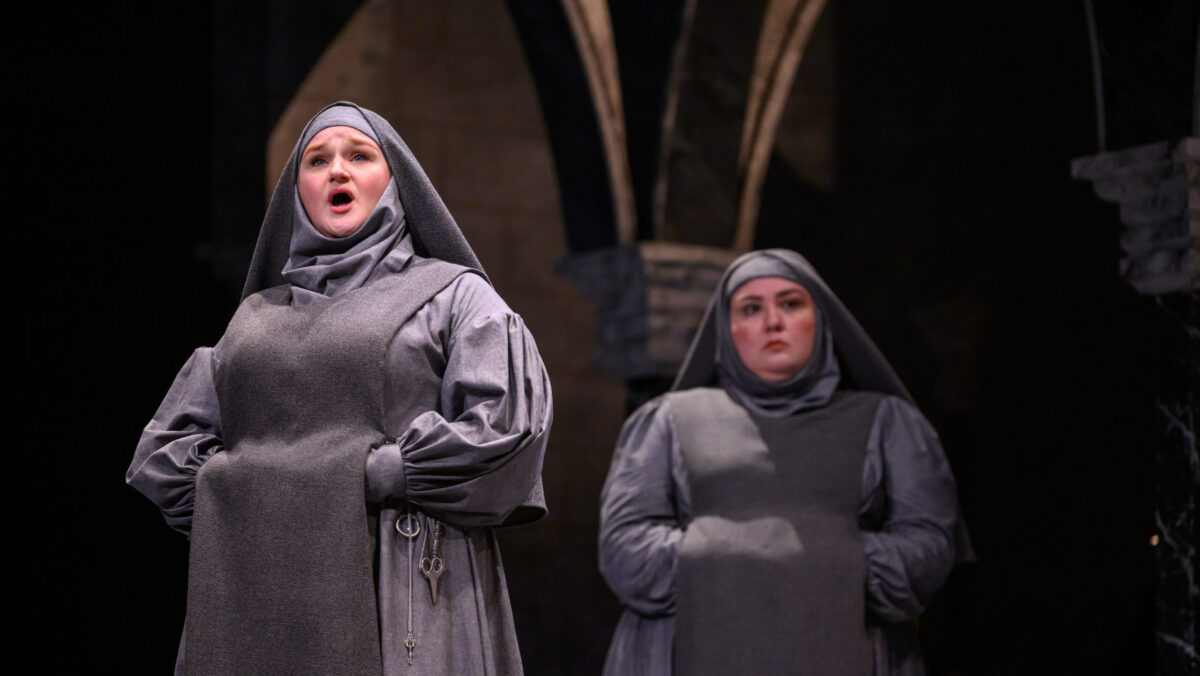
Soprano Gemma Nha sang Sister Constance, Blanche’s fellow postulant, with care. Nha’s sunny, nimble soprano effectively conveyed the chatty nun’s earnest devotion and her subtle, graceful vibrato was a vocal highlight. Wagner and Nha’s strong chemistry lent the pair’s conversation while they worked on the convent’s laundry in Act II a bright spark of authentic friendship.
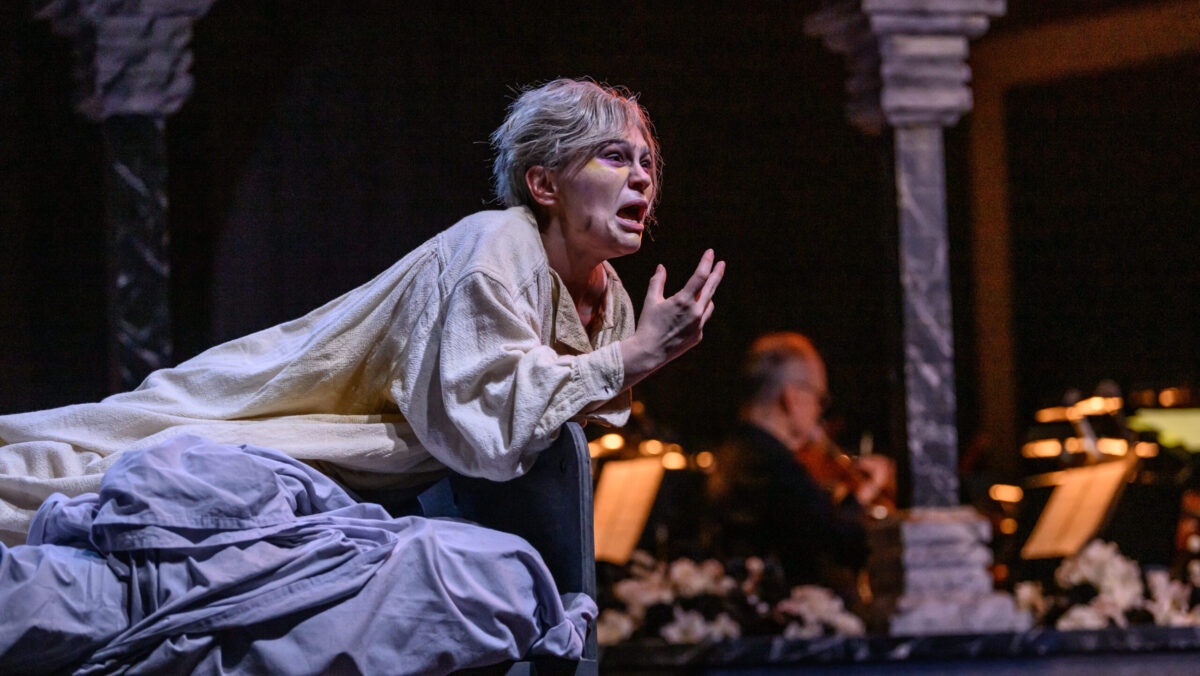
Cecelia McKinley deployed her powerful contralto to great effect as Madame de Croissy, the ailing prioress who welcomes Blanche to the order and dies shortly afterward. (In Act II, Sister Constance asks, “When one is 59, isn’t it time to die?”—a line that triggered laughs from the Wolf Trap audience.) The role showed off McKinley’s smooth, generous lower range and airy upper. McKinley’s raw take on the excruciating death, which prompts the Mother Superior to question her faith amid gasps of pain, was captivating.
Mezzo-soprano Gabrielle Beteag gave a warm, polished sound to Mother Marie, the senior nun tasked by the dying Mme de Croissy with looking after Blanche. Beteag’s mezzo countered the encroaching revolutionary forces with a steely edge and fiery resolve, solidifying a dominating stage presence. Keely Futterer’s pure, clear soprano lent dignity to Madame Lidoine, the new prioress selected over Mother Marie to lead the convent. Singing in full command of his powers, Jonathan Patton sported a stony baritone that made him a stately patriarch as the Marquis de la Force, Blanche’s father. Tenor Travon D. Walker sang the Chevalier de la Force, Blanche’s brother, with intensity and enthusiasm.
Rich Kessler
The anxiety of Poulenc’s score found poignant expression under the baton of Geoffrey McDonald, particularly during one of my personal favorite smaller moments of the opera, the frenzied orchestration that accompanies the Marquis de la Force’s recounting of his painful memories of a mob. It’s a quintessential example of Poulenc’s adept hand at musical storytelling and one that succeeded in the Wolf Trap Opera Orchestra’s performance. As the chorus, Wolf Trap Studio Artists excelled in the opera’s great renditions of sacred music from the Catholic tradition under the leadership of chorus master Christopher Turbessi.
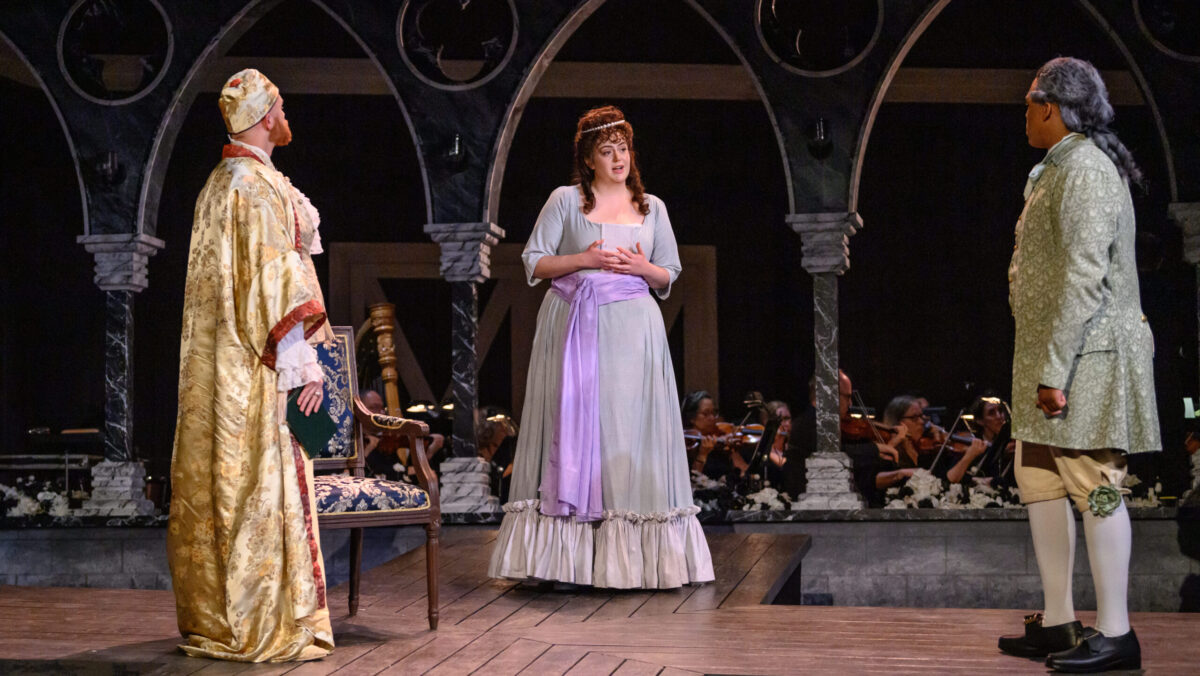
Director Katherine M. Carter’s production honored the spirit of Poulenc’s work with a focus on the artists free of distractions, though the simplicity of the finale’s staging hit a somewhat anticlimactic tone after the musical buildup to the nuns’ martyrdom. Scenic designer Lawrence E. Moten III’s set deftly recreated a cloister reminiscent of French Gothic ecclesiastical architecture. The set’s giant raked wooden cross may have become de rigueur for stagings of Carmélites but that doesn’t make it less effective, and Carter leveraged it efficiently in blocking the singers. Costumes by Caitlin Cisek compellingly evoked the era of the French Revolution.