SF/Ruth Walz
Fin-de-siècle Vienna was charged with political, social, and cultural uncertainty and upheaval. Arnold Schoenberg and his contemporaries led a revolution in music too. 12-tone serialism upended traditional tonality and the idea of Klangfarbmelodie explored timbre in new ways.
The latest chapter in Peter Sellars and Esa-Pekka Salonen’s legendary collaboration at the Salzburger Festspiele, One Morning Turns into an Eternity tied together three works written almost contemporaneously by titans of Austrian modernism: Schoenberg, Anton Webern, and Gustav Mahler. A follow-up to his semi-staged 2024 Erwartung in San Francisco, Sellars now linked the opera with Webern’s Five Pieces for Orchestra and Mahler’s “Der Abschied” from his late masterpiece Das Lied von Der Erde in a brief, operatic meditation on death and the afterlife.
As Mahler reinvigorated the symphonic genre, Schoenberg took revolutionary free tonality approach to opera with Erwartung from 1909— “nothing like this monodrama has ever been heard before,” remarked Webern at the time. The opera is a monologue for soprano accompanied by massive orchestra, its story stark and simple: at night a woman waits for her lover in a forest. As she questions her surroundings and memories, she makes a horrifying discovery —her lover’s actual corpse.
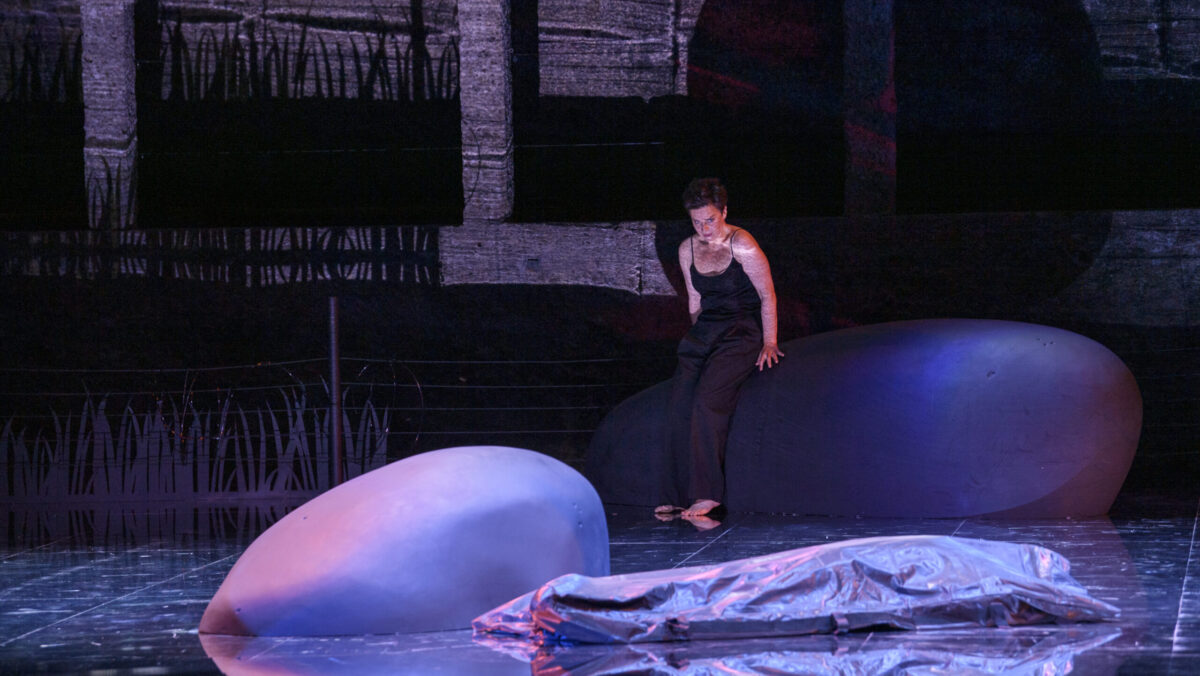
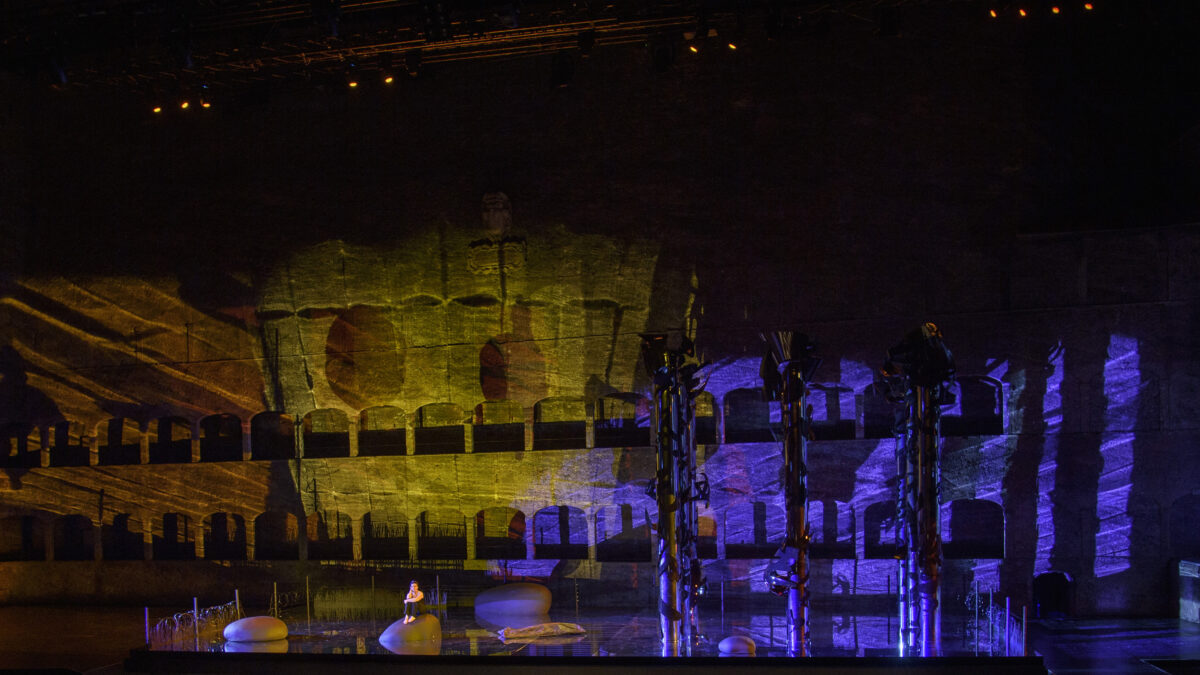
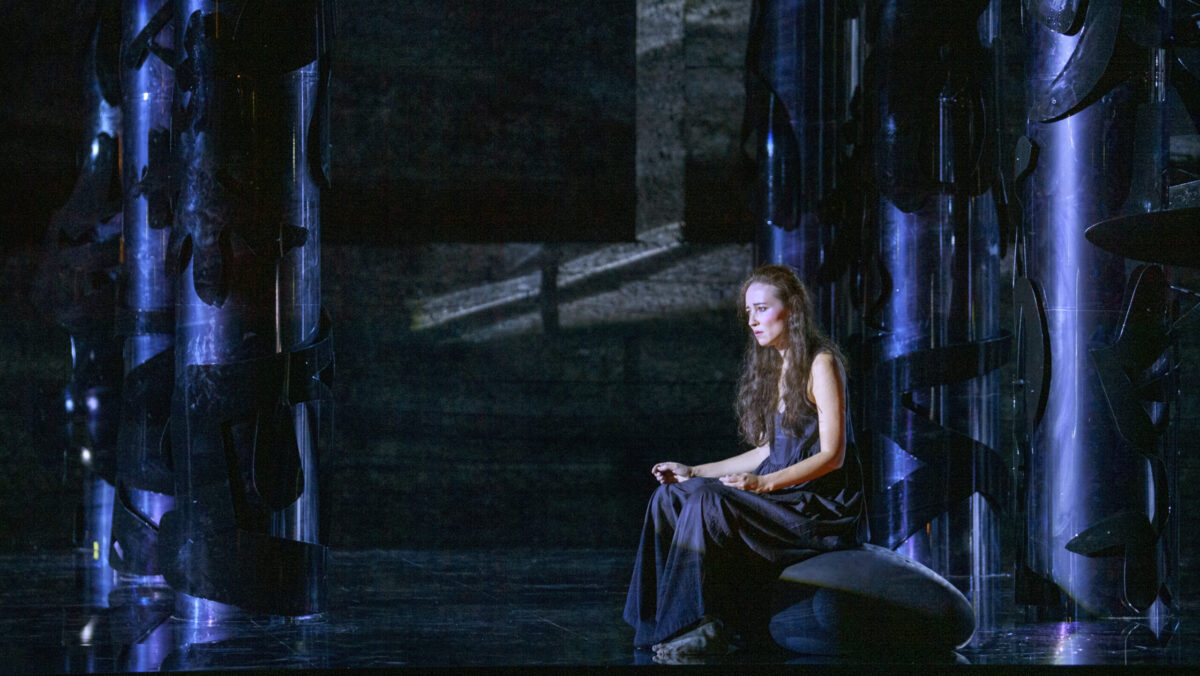
Though Schoenberg’s opera is primarily a stream-of-consciousness psychological thriller, Sellars frames it as a political drama. Before the music starts, two guards bring a body bag, lay it on center stage, and make the Woman sign some paperwork. One assumes the Woman’s erstwhile lover, the unseen man she waits for, is in the body bag lying beside her. Per Sellars’s program notes, both characters are part of a “resistance movement” in which “their generation has never been able or allowed to have normal relationships” due to state violence. George Tsypin’s stage design makes this immediately clear as barbed wire lines the perimeter of the cavernous Felsenreitschule stage. The trees described in Schoenberg’s forest setting are within this camp, yet they look metallic, as if their rotating branches are sharp blades meant to torture. Here the moon is substituted for a camp spotlight, as clever lighting by James F. Ingalls conveys the protagonist’s shifting psychological states.
The star of the opening monodrama was Ausrine Stundyte. She delivered a muscular performance that conveyed the Woman’s anguish and delusions in the face of the oppressive, unseen force. While one might question whether Sellars’s political framing limits the Woman’s emotional range and ambiguity, Stundyte’s noble portrayal stood in contrast with the common criticism of Erwartung as a misguided psychoanalytic exploration of hysteria. For example, in the fourth scene, when the Woman bends down to the body and exclaims “It is still alive, it has skin, eyes, hair, his eyes, it has his mouth,” Stundyte looked at herself, perhaps even suggesting a shock realization that the Woman is pregnant with her lover’s child. While her diction was not always clear, especially during the louder blasts of orchestral dread conjured up with precision by Salonen and the Wiener Philharmoniker, Stundyte nevertheless maintained a compelling and assertive voice.
AF/Ruth Walz
A brief interlude, Webern’s Five Pieces for Orchestra, formed an aesthetic and narrative bridge between the two larger works. Just five minutes of timbral and harmonic originality—glittering celesta, harps, and offstage bells reminiscent of late Mahler combined with the serial austerity of Schoenberg—the Five Pieces allowed Stundyte and Fleur Barron to swap places. Webern’s final enigmatic pianississimo high G-flat F-natural chord played by the celesta flowed directly into Mahler’s opening low C and funereal tam-tam. In this staging, therefore, Mahler’s farewell is sung by Schoenberg’s Woman as part of a continuous narrative.
The staging for Mahler’s “Der Abschied” from his late masterpiece Das Lied von Der Erde was only minimally interventionist. The two guards return to take the body away as the Woman, now Mahler’s narrator, tries to prevent them. Here the lyric that “tired men go home” takes on new meaning. Is it the unseen Man eliminated by totalitarian forces?
A gorgeous flute solo, performed by the Vienna Philharmonic’s Karl-Heinz Schütz standing in one of the Felsenreitschule’s stone archways above the stage, offers the narrator only temporary comfort. The other extensive woodwind solos sometimes felt disjointed, only really coalescing in the instrumental funeral march. This fragmentation is intentional in the score, as the narrator searches for the meaning behind her loss. The piece in many ways is about accepting fate and mortality. “Memories of better times. Freedom. Nature,” Sellars notes in his description. Perhaps this means in his staging that the Woman transcends the political and embraces the sublime? Nature’s eternity triumphs over temporary humanity. At the end of Mahler’s “Farewell,” the protagonist finally leaves the body behind and wanders out of the camp to the strains of the unresolvable C-Major-6 chord.
SF/Ruth Walz
Fleur Barron’s sensitive performance matched this thematic catharsis, bathed in soft green and blue lights as she sang “the dear earth everywhere blossoms in spring and grows green anew! Everywhere and forever blue is the horizon! Forever…” Her repetitions of the final “Ewig…” were almost quivering. Barron’s vocal colors and restrained acting were apt for a character coming to terms with loss and moving past the anxiety that permeated the first half of the double-bill. A late replacement for the indisposed Wiebke Lehmkuhl, Barron’s lighter voice will be certainly eagerly anticipated as she makes her New York Philharmonic debut later this season with David Lang’s new oratorio The Wealth of Nations.
The 2025 Salzburger Festspiele opened the previous week with a performance of Hanz-Werner Henze’s Das Floß der Medusa (The Raft of the Medusa) by the ORF Vienna Radio Symphony Orchestra (the broadcast was recorded by ORF Radio). Alongside One Morning Turns into an Eternity, the concert was another entry in Salzburg’s ongoing “Ouverture Spirituelle-Fatum” series, which also includes Stravinsky’s Oedipus Rex, Michael Jarrell’s Kassandra,Salvatore Sciarrino’s Macbeth, and several other concerts.
A much more explicitly political exploration of death and resistance compared to Sellars’ collage, Henze’s oratorio tells the story of the infamous 1816 shipwreck of a French ship on its way to re-colonize Senegal after the Napoleonic Wars. After accidentally striking a coral reef, the captain fled on one of the few lifeboats, leaving 154 people stranded on a makeshift raft, stocked only with minimal water and some wine. The raft drifted aimlessly for 13 days before its 15 survivors, some of whom resorted to cannibalism and murder, were ultimately rescued. Evading censorship the surviving surgeon’s contemporary account of the shipwreck and the captain’s incompetence served as the basis for Ernst Schnabel’s German-language text, which he supplemented with passages in Italian from Dante’s Divine Comedy, sung by the chorus of the dead.

Henze recast the shipwreck, famously depicted in Théodore Géricault’s 1818 painting, as a universal cry against tyranny. Dedicated as a requiem for Che Guevara shortly after his execution, the piece was supposed to premiere in 1968 with Edda Moser and Dietrich Fischer-Dieskau singing the vocal parts, but student protest disruptions in the concert hall caused its cancellation. Henze reframed the historical material by focusing on Jean Charles, a Black crew member who over the course of the story tries to organize the raft’s members and waves a red flag in a desperate attempt at catching the attention of a passing ship. (He dies shortly afterwards.) Charon, the ferryman of the underworld, serves as a narrator while Death is assigned to a soprano.
Georg Nigl sung the role of Jean Charles, requiring vocal acrobatics with a range of over two octaves and a mix of melodic lines and Pierrot-like Sprechgesang. As the boatsman becomes increasingly desperate — “there is no law but death” — Nigl portrayed this sense of shock and anger with a surprisingly light voice.
As La Mort, death personified, Kathrin Zukowski mocked the raft and beckons its members to enter the world of the dead with an eerie but lucid voice. Udo Samel as Charon/the narrator occasionally lagged when switching between the free verse and rhythmic, percussive intricacy of his expository text, but nevertheless recounted the horrors of the shipwreck with gravitas.
SF/Marco Borrelli
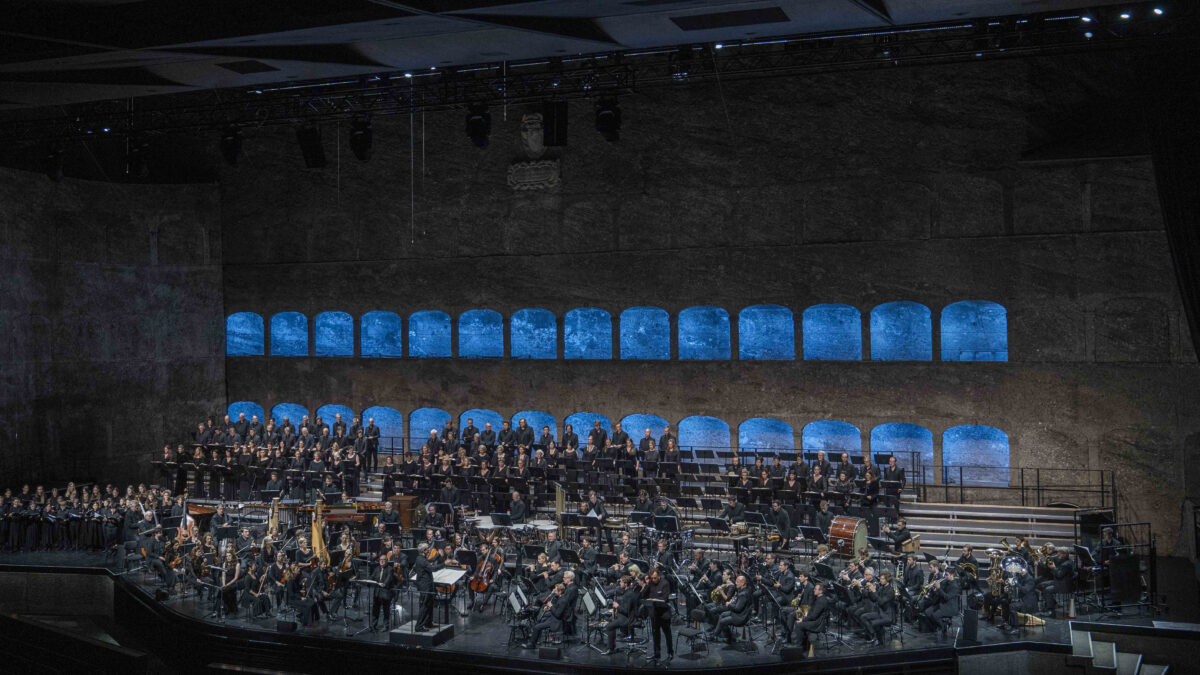
Conductor Ingo Metzmacher is a Henze expert, having premiered several of the composer’s works. Managing the kaleidoscope of orchestral timbres—including an electric guitar and bass, Hammond organ, ophicleide, and a large percussion section —is no easy feat. Yet Metzmacher gave a reading of Henze’s dense 12-tone score that highlighted its quality as a bleak landscape-painting of sorts, a depiction of human desperation crushed by the forces of nature and oppressive governments. The piece’s ending — the percussion escalates a rhythmic ostinato of the “Ho, Ho, Ho Chi Minh” rallying cry—felt appropriately abrupt, as if Henze’s call for revolution is in fact a lingering echo of historical horrors like those seen on the raft.
Although presented as concert performance, the wide stage at the Felsenreitschule offered a smart venue for the oratorio. Members of the enormous choir (the combined forces of the Bavarian Radio Chorus, WDR Rundfunkchor, and Salzburger Festspiele und Theater Kinderchor) moved from stage left to right as the piece progressed, representing the raft members’ passage from the realm of life to death. Unlike the cavernous feeling of Sellars’s staging, here the extensive stage evoked the perilous open sea.
Both concerts in Salzburg featured works composed in two very different times of uncertainty—the eve of World War I and the 1960s disillusionment. Even if one finds Sellars’s take on Schoenberg and Mahler’s enigmatic works too reductive, or Henze’s musical manifesto too on-the-nose, the performances nevertheless felt urgent in today’s climate.