Geoffroy Schied
In today’s world, Lohengrin is a hard opera to produce, especially in Munich, where the opera is currently part of the Munich Opera Festival and where the production of the 1860s cast a spell on King Ludwig II, who immortalized his obsession in buildings that are now the staple of a kitschy Bavarian tourist industry. Neuschwanstein, Linderhof etc. are built around the idea of swans, knights, and magical rescues.
Modern audiences can’t – shouldn’t – want that kind of stuff, so productions in recent years tended to satirize, or mock, the opera. Richard Jones in 2009 put on a Munich production that had a real-looking swan (dead), and a central metaphor running through: Lohengrin and Elsa were building a house, and a pair of really great singers, Jonas Kaufmann and Anja Harteros, were reduced to moving building blocks around. The great music critic Joachim Kaiser appropriately described it as Schwachsinn, baloney, or as we would now say, bullshit.
The new Munich version, which premiered in 2022 but has been effectively and sensitively developed, takes a much more thoughtful — and a more radical — approach. The piece isn’t a blue-silvery evocation of the otherworldly, a metaphysical confrontation of purity (Elsa), transformative faith (Lohengrin), and the relics of a worldly pre-Christian cult (Ortrud). Instead, it is presented as a depiction of modern politics, in particular populism, with Lohengrin as a charismatic leader, invented by manipulators or influencers to deal with a double problem: leading the people into a war they don’t know about or care about against a barbarous eastern threat — these are Hungarians in the Wagner text; appropriately the director, Kornél Mundruczó, is a real Hungarian — as well as solving Friedrich von Telramund’s legal challenge against Elsa.
Everyone, including Elsa, is thus supposed to trust a figure who emerges out of nowhere: he has apparently been on stage all the time, hidden in the large chorus, instead of breaking onto the scene as Lohengrin did in the 1999 Munich production by Götz Friedrich, which had the shock effect of Lohengrin bursting through a conventional painted nineteenth-century style backdrop. Mundruczó’s production neatly captures the call for blind trust and obedience, the way that Elsa worries from the beginning about that call, and how Ortrud gives Elsa sensible psychological advice that she would be better off not committing to a figure about whom she knows nothing. Here, as in Wagner’s original text Lohengrin is acclaimed the Führer of Brabant rather than the Schützer (protector), the word used in Bayreuth and elsewhere in an attempted sanitization of the libretto.
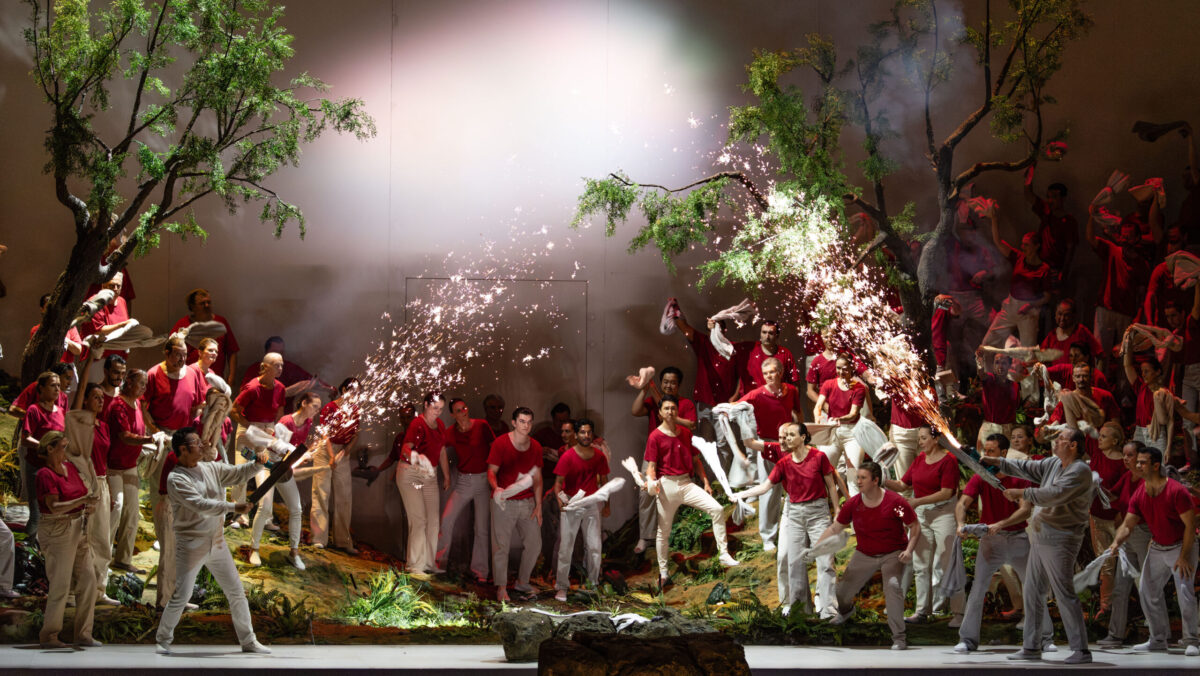
This is, in short, a production about populism, violence, and, in the end, apocalypse. The vast chorus, onstage almost all the time, alternately picks up flowers to hail the hero, little (or not so little) pellets to stone outsiders who have violated the social compact, and little red flags to wave in approval of political gestures. As this is a coproduction of the Bavarian opera with Shanghai, the observer is bound to wonder how those flags are viewed there.
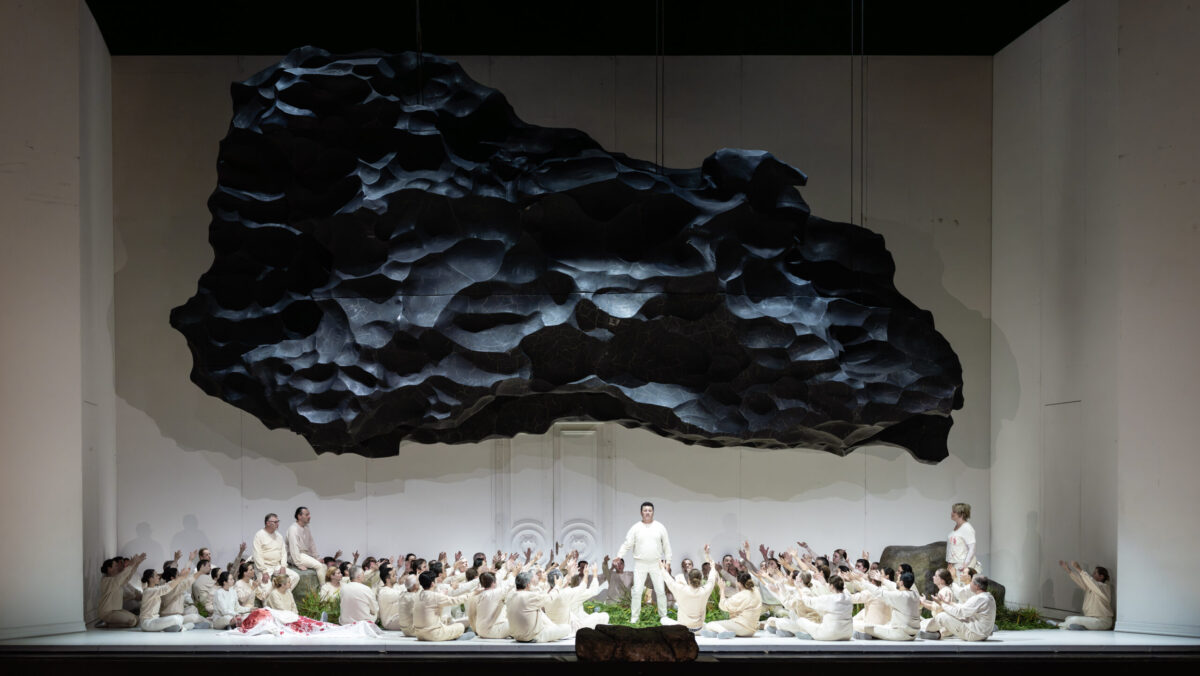
The death of Telramund, by stoning after he emerges as a witness to Elsa’s persistent questioning in Act III, is exceptionally bloody, with a gaping red wound on his forehead. And then a larger version of the stones appears, suspended over the stage and slowly descending as Lohengrin calls on the swan. It’s a asteroid, on its way to kill everyone, except for Elsa, who seems to walk onboard the asteroid, and her young brother Gottfried who has been brought back to rule a Brabant that has no live inhabitants.
Geoffroy Schied
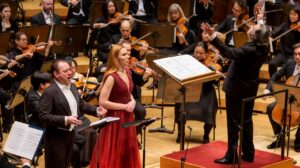
In this bleak, brutal, and conflictual world, the two central characters are Lohengrin and the pagan princess Ortrud, and they are both sung with utter conviction and brilliance, by Piotr Beczała and Anja Kampe. Beczała is replacing Klaus Florian Vogt, who took the part at the premiere in 2022, and whose softly elegant and otherworldly tenor is much more appropriate for a classically metaphysical rendition of the piece.
Beczała has sheer vocal brilliance, making the case for a charismatic leader who expresses force beautifully with overwhelming power. And Kampe is a wonderfully expressive actress too, stalking around the stage and at times following Elsa as if she is reenacting Donald Trump’s bizarre moves in his television debate of 2016 against Hilary Clinton, when he aggressively moved behind his rival with the same intimidating smile that Kampe bears.
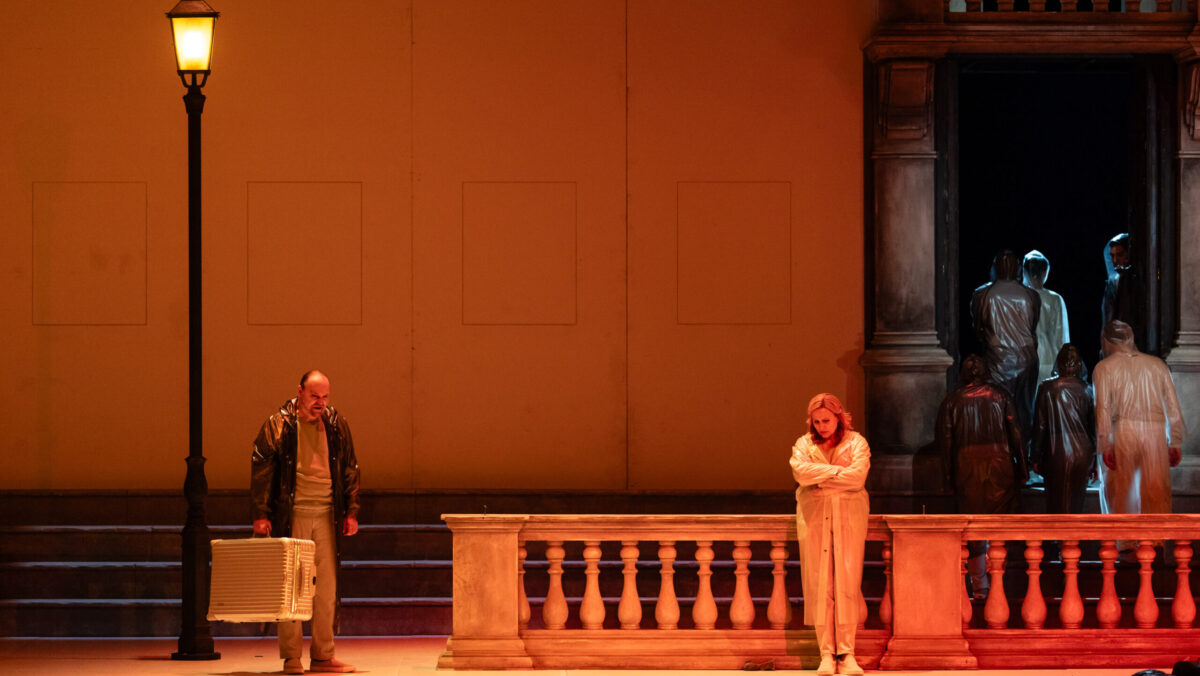
By comparison, Rachel Willis-Sørensen as Elsa von Brabant has a harder task, since she is effectively reduced to a minor character who cannot handle the psychology of a politically broken world. She appears first dressed in drab baggy black clothes, while the rest of the cast, including the King, Telramund, and Ortrud are in some variety of light grey or beige exercise clothing. (They look as if they have been in a cult-like meditation session, and then in the second Act they appear in plastic raincoats, perhaps referencing the large amounts of rain experienced in Munich this summer.) Willis-Sørensen sings both beautifully and powerfully, but she looks constantly like an alien presence in the brainwashed setting.
Geoffroy Schied
It is striking when, at the beginning of the third Act, she tries to escape, but all the doors are barred, and then, in the bridal chamber, when she and Lohengrin are surrounded by the large chorus. (Some members of the audience tittered at the words of Lohengrin, “Wir sind allein, zum ersten Mal allein.”) Telramund, portrayed with a subtle element of demented hysteria by Wolfgang Koch, is just a cipher. King Heinrich, sung by René Pape, who played the role in the days of the Götz Friedrich production, sounds tired and worn; he was outsung by Kostas Smoriginas as the army herald. That is all quite appropriate because in this interpretation of Lohengrin as populist, the king is just another enabler.
The beautifully playing Bayerisches Staatorchester, with the four trumpets sounding out from an upper proscenium lodge, are reliably directed by Sebastian Weigle, who in line with the general direction of the piece, emphasizes power and even brutality over otherworldly transcendence. After all, you can’t be too transcendent if you’re going to be eliminated by the apocalypse in the form of an asteroid.