Maria Baranova
Bedřich Smetana’s Dalibor had an uneasy entry into the operatic canon. It was a failure at its premiere in Prague in 1868. Smetana revised it with little success and it was only a revival in 1886, after the composer’s death, where it received acclaim. This led to an 1892 Vienna State Opera premiere production with Gustav Mahler conducting. From then on it was hailed as a Czech operatic masterwork and entered the national repertory. It has never been performed at the Metropolitan Opera or New York City Opera and its only local outing was with Eve Queler and the Opera Orchestra of New York in concert at Carnegie Hall on January 9, 1977 as a vehicle for Nicolai Gedda in the title role with Teresa Kubiak and Paul Plishka in support. The Bard SummerScape Festival Dalibor, which opened last Friday, is the first staged production in the United States.
The initial Czech audiences didn’t know quite know what to make of Dalibor and it still is an odd duck. There was a desire to create nationalistic operas using folk songs, which Smetana had already done with The Bartered Bride. Initial critics found Smetana’s score “not sounding sufficiently Czech,” too Wagnerian and reminiscent of Lohengrin.
The libretto by Josef Wenzig, which was given a Czech translation by Ervín Špindler (Smetana and Wenzig both spoke German as their primary language), has similarities to Beethoven’s Fidelio, the heroine donning male disguise to rescue a noble prisoner she loves who is imprisoned for political protest. Yet here too are oddities – the Czech knight Dalibor murdered the Burgrave in revenge for beheading his bosom friend Zdeněk. Milada, the murdered Burgrave’s sister, falls madly, irrationally in love with Dalibor when she hears his testimony at his trial, sets aside her grief for her brother and resolves to save Dalibor – not for justice, but to be near him and gain his love. Politics and nationalism are very much in the background, personal desire of a certain kind dominates. Here is what Dalibor states about his dead friend Zdeněk at his trial for murder (translation via Supraphon):
I swore a deadly vengeance
And vengeance, just as honor bids, I fulfilled!
No female charms ever have bewitched me!
To have a friend was my heart’s one desire!
My wish was granted me, I lived Sweet friendship’s
dream in Zdeněk’s company and knew no ire.
When Zdeněk mine in sacred ecstasy
With music sweet chased all gloom from my heart,
I felt transported there, in daring fantasy,
Where the stars in heaven their journey do start!
Zdeněk is a violinist and a minstrel who represents music which has also seduced Dalibor’s soul. But the relationship here is more homoerotic than anything else.
In Act II, Milada, in disguise as a minstrel boy, enters Dalibor’s cell in order to give him an old violin which he can play and conjure memories of Zdeněk to assuage his despair. In his reverie he hears a violin (a gorgeous violin introduction) and awakes to say this:
[…]
For there’s no other way – Zdeněk mine!
Oh, Zdeněk, just one fleeting touch of hand
And paradise would here to me descend.
Oh, freedom, thee and wealth would I resign
For Zdeněk’s friendship one sweet sign!
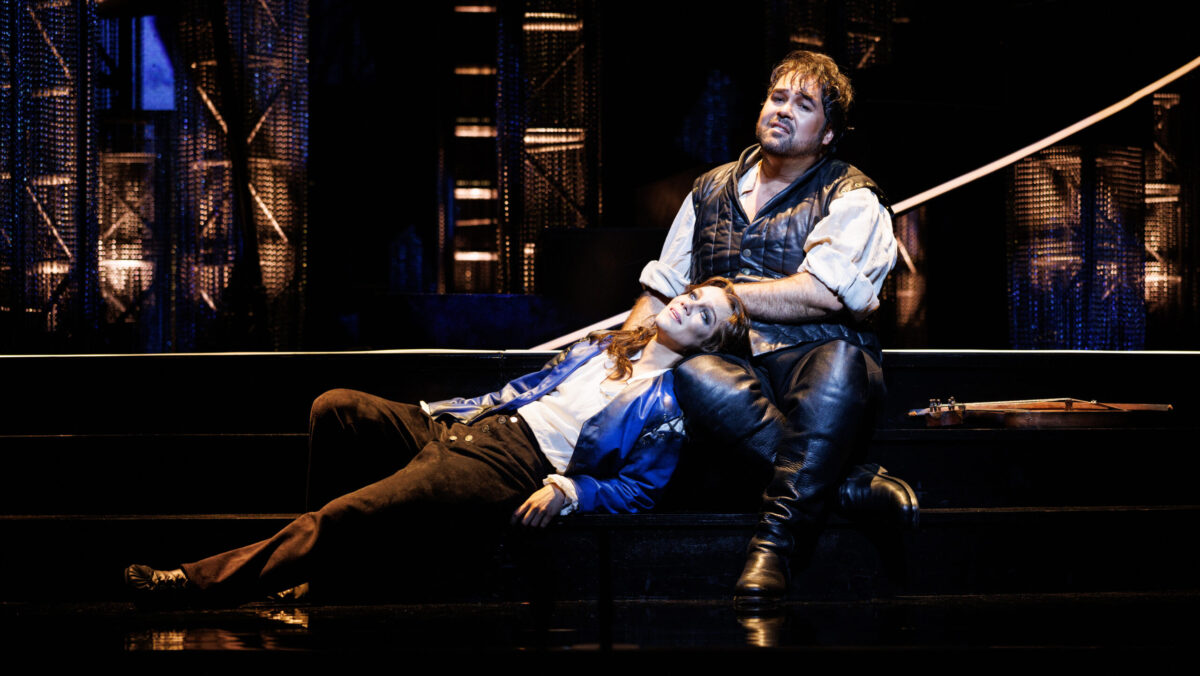
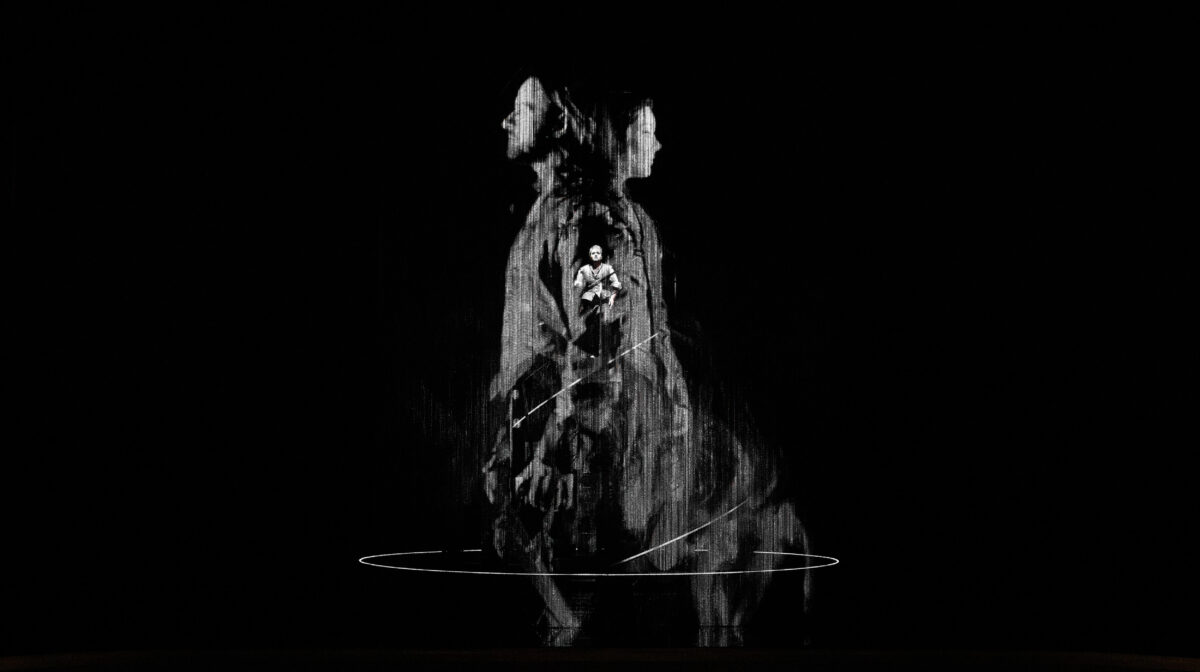
Bard’s production, intelligently directed by Jean-Romain Vesperini (who directed Henri VIII at Bard in 2023), has the ghost of Zdeněk (actor Patrick Andrews) onstage throughout silently hovering in the background literally haunting the hero. Meanwhile, Milada as the minstrel boy (also a musician, as are Zdeněk and Dalibor) is costumed in an identical blue doublet and Milada enters in Act II from the opposite direction, crossing paths with Zdeněk like doppelgangers. Dalibor briefly mistakes Milada for Zdeněk when she enters his cell. Milada identifies herself and confesses her love and they join in a rapturous love duet as lights on the set blaze brightly and the curtain falls. Yet the whole time Milada is dressed as a boy. There is very little convincing psychology here – Milada irrationally drops her grief at brother’s murder and falls for Dalibor in an instant while later Dalibor seems to fall for Milada and forget his beloved Zdeněk equally precipitously. Projections of Zdeněk and Milada (looking like twins) on the bead curtain scrims dominate the final scene like they are two halves of the same person.
One wonders if those initial Prague audiences were put off by the homoerotic element in the hero’s emotional life. Meanwhile, we are told throughout that Dalibor is a hero even though he is entirely passive. It is the women in his life, his orphaned ward the peasant girl Jitka and Milada, who act to free him. Meanwhile, King Vladislav is forced to condemn Dalibor to death while rebellion brews in the background. The rebellion fails, Milada dies mortally wounded in battle in Dalibor’s arms, and Dalibor is condemned to die by the sword. The how, who, and why of that rebellion is vague. In the finale of Act III, our hero seems to be ready to join Zdeněk and Milada in the afterlife and does not resist his tragic fate.
The tenor’s Act III aria “The Song of Freedom” did not particularly impress me as a hit tune. The arias are rather free-form and have strong elements of recitative/arioso. The most gorgeous melodies come in Act II with the violin solo introduction to the final scene and the soprano/tenor love duet. The audience loved the Milada/Jitka duet in Act II. In Act III that melodic inspiration cools, as does the dramatic temperature.
The Bard production made the strongest possible case musically, dramatically and visually for Smetana’s opera. Dr. Leon Botstein, as I have said before, is at his best conducting densely orchestrated late 19th century and early 20th century German and Central European scores. Such was the case here with Smetana which the American Symphony Orchestra played superbly sounding like a top-tier international ensemble. The Bard Festival Chorale also acquitted themselves well.
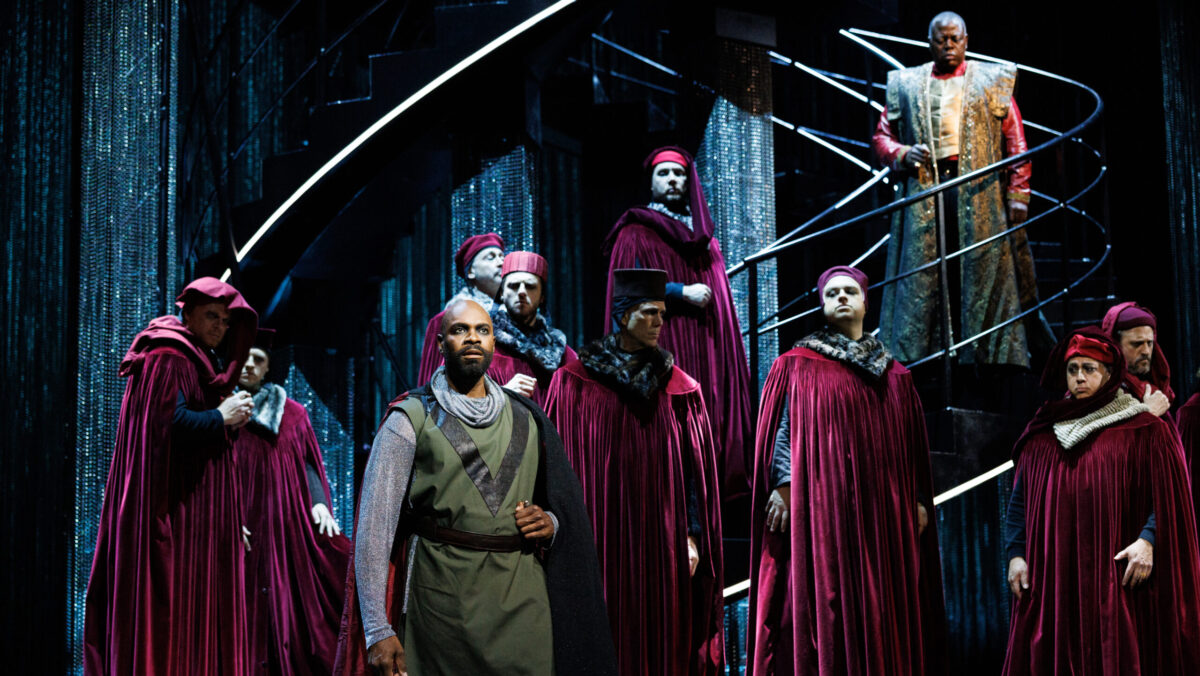
Jean-Romain Vesperini’s production aimed for truth and clarity rather than imposing a concept on the opera, suitable for a piece that is entirely unfamiliar to the audience. Vesperini highlighted the sexual ambiguities of the story effectively. The sets by Bruno de Lavenère were similar to those of Henri VIII (which he also designed): a central unit set of a revolving circular staircase with platforms. Scrims of hanging metal bead curtains descended and ascended from the flies, creating different stage areas for the varying locales while evocative projections transformed the scrims into different stage settings. The color scheme was largely black and white while the costumes of Alain Blanchot were more colorful but still in modernized period style.
Maria Baranova
The cast was vocally strong from top to bottom. I don’t know Czech but the entire cast seemed to be well-coached in the text and pointed it up with dramatic intention. Botstein stalwart Alfred Walker was resonant and sturdy as King Vladislas while Eric Greene was an energetic Budivoj, commander of the palace guard, both bass-baritones. Bass Wei Wu as the Rocco-like figure of the prison warden Beneš had a real, imposing basso voice and stirring emotional conviction that won over the audience. Tenor Terrence Chin-Loy as Jitka’s soldier lover Vitej did well in his one scene and love duet, but the character then disappears and plays no role in the plot.
The ladies were both lovely and both very similar in voice; Milada is supposed to be a youthful dramatic soprano while Jitka is a contrasting light coloratura. As Jitka, the fast-rising Erica Petrocelli produced a rich, soaring full lyric soprano suggestive of the stalwart rebel she was directed to play. (Petrocelli is covering Micaela at the Met next season and is adding Butterfly to her repertoire soon.)
Meanwhile, the young and fresh light lyric soprano Cadie J. Bryan (a late addition to the cast due to the originally announced Dalibor and Milada canceling because of visa problems) stretched herself to the limit as Milada, her high-placed voice unfurling rich tone at the top that soared over the orchestra. Her middle and bottom registers could have used more depth and weight, but Bryan never wavered and delivered radiant singing throughout. She is also a lovely stage figure, moving elegantly on the stage while conveying deep engagement with the character.
Maria Baranova
In the title role, tenor John Matthew Myers repeated the enormously positive impression he made as Strauss’s Guntram just a few months ago. His dulcet, soft-grained tenor also has weight, ring and projection and he sang with plangent tone, ardor, and lovely legato. He was another late replacement, but one would never have known. Also, in a staged opera, Myers had a chance to act and delivered well in presence and commitment, creating a positive and sympathetic protagonist against some odds.
Strauss reportedly will return to Bard next summer with a staging of Die ägyptische Helena which is not one of my favorite Strauss/Hofmannsthal collaborations and was done at the Metropolitan Opera over a decade ago with Deborah Voigt. There is another earlier version of the score which Botstein has conducted in concert at Avery Fisher/David Geffen Hall, also with a young Voigt. Perhaps Ms. Bryan can be Aithra and Mr. Myers can be Menelaus.
Meanwhile, our collective debt to Dr. Botstein has been increased with this excellent international festival level presentation.