Drew Altizer Photography
Festival Napa Valley is an annual music, food, wine, and lifestyle festival in Napa Valley, presented by Napa Valley Festival Association. Aiming to fund arts education in Napa County’s public schools, the Festival, inaugurated in 2006, has so far generated millions of dollars to support visual and performing arts programs in addition giving scholarships for emerging musicians and the festival’s tuition-free Blackburn Music Academy, as part of their “Arts for All” initiatives.
More than 200 musicians, wineries, resorts, theaters, restaurants, chefs, and vintners participate every year. The festival typically takes place every July and, in some years, also in the spring and fall, with performances at theaters, wineries, resorts, estates, and vineyard settings throughout Napa Valley. This Summer, the Festival was held from July 5 to 20, 2025, with the theme of a tribute to the celebrated Italian film composer, Ennio Morricone.
Since returning to live programming in 2021 after the pandemic, one of the highlights of the Festival Summer season is the Manetti Shrem Opera Program, underwritten by philanthropist Maria Manetti Shrem. FollowingGianni Schicchi (2021), L’elisir d’amore (2022), Don Pasquale (2023), and last year’s Die Entführung aus dem Serail (all directed by the Parisian director Jean-Romain Vesperini), this year the Festival returned to Gaetano Donizetti for his effervescent La fille du regiment, which Vesperini mounted at the Royal Opera of Versailles last April.
Not satisfied with just presenting the opera, the Festival achieved an impressive coup this time by bringing along the Versailles Royal Opera Orchestra and its conductor, Gaétan Jarry, together with some of last spring’s principals, for their North American debuts, giving the Festival audiences a taste of Versailles right in their own backyard!
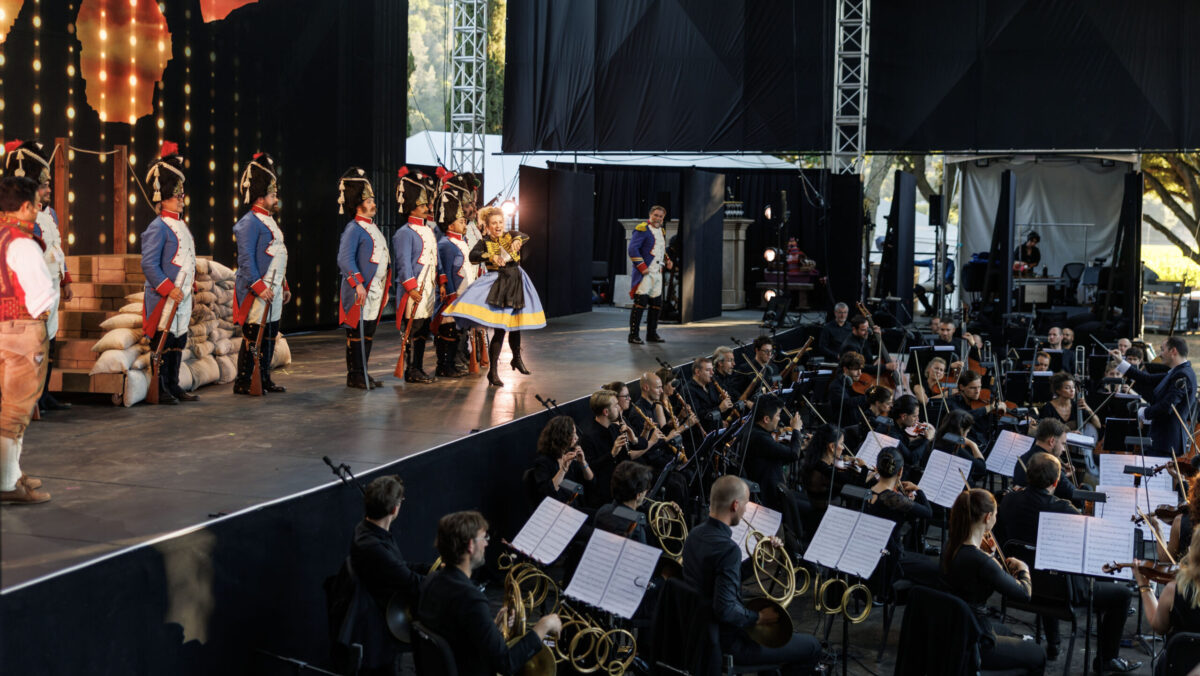
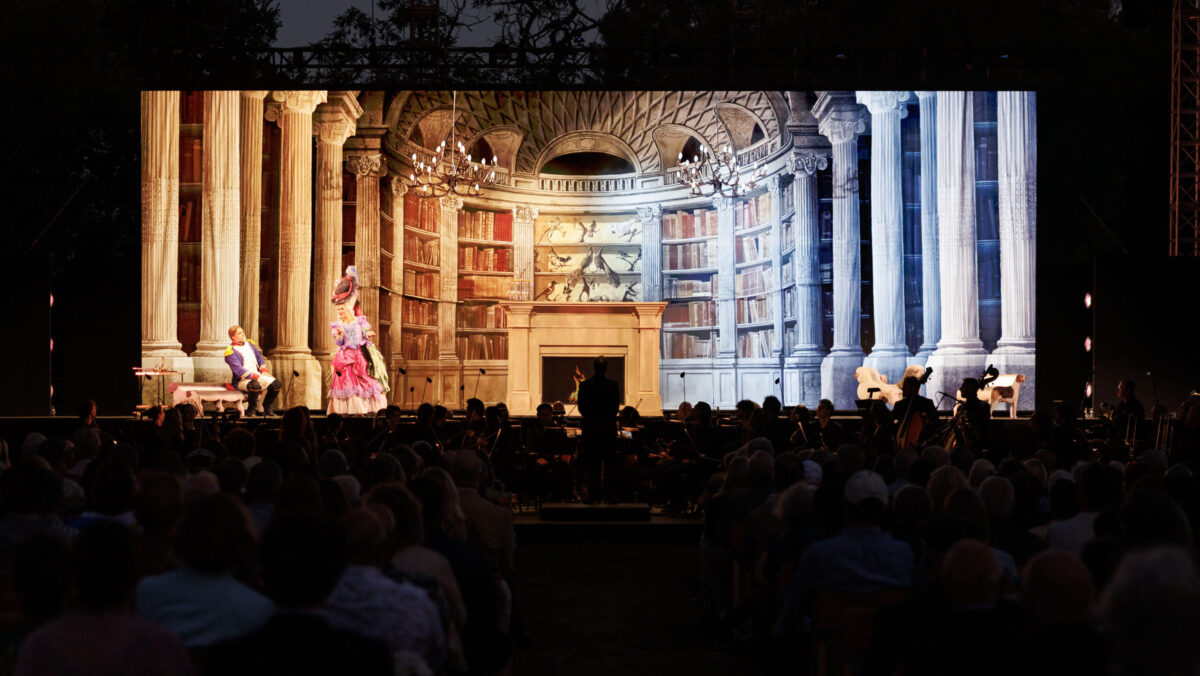
To many people, myself included, La fille du regiment is closely associated with Laurent Pelly’s gorgeous production which has been widely performed since its premiere at Royal Ballet and Opera in 2007 (It is scheduled to return to the Metropolitan Opera next fall.) Vesperini’s colorful staging provided a nice counterpoint to Pelly’s, brimming with humor and energy even on the tiny Festival Napa Valley Stage at the great lawn of Charles Krug Winery. As was customary for most of Versailles’s productions (and detailed in the article above), Vesperini married the period costumes designed by Christian Lacroix and the period instruments played by the Versailles Orchestra with a contemporary staging and Étienne Guiol’s projections and videos. The result was a zany, exuberant performance that stayed true to the story yet adapted to modern tastes, a perfect concoction for a summer evening picnic in Wine Country!
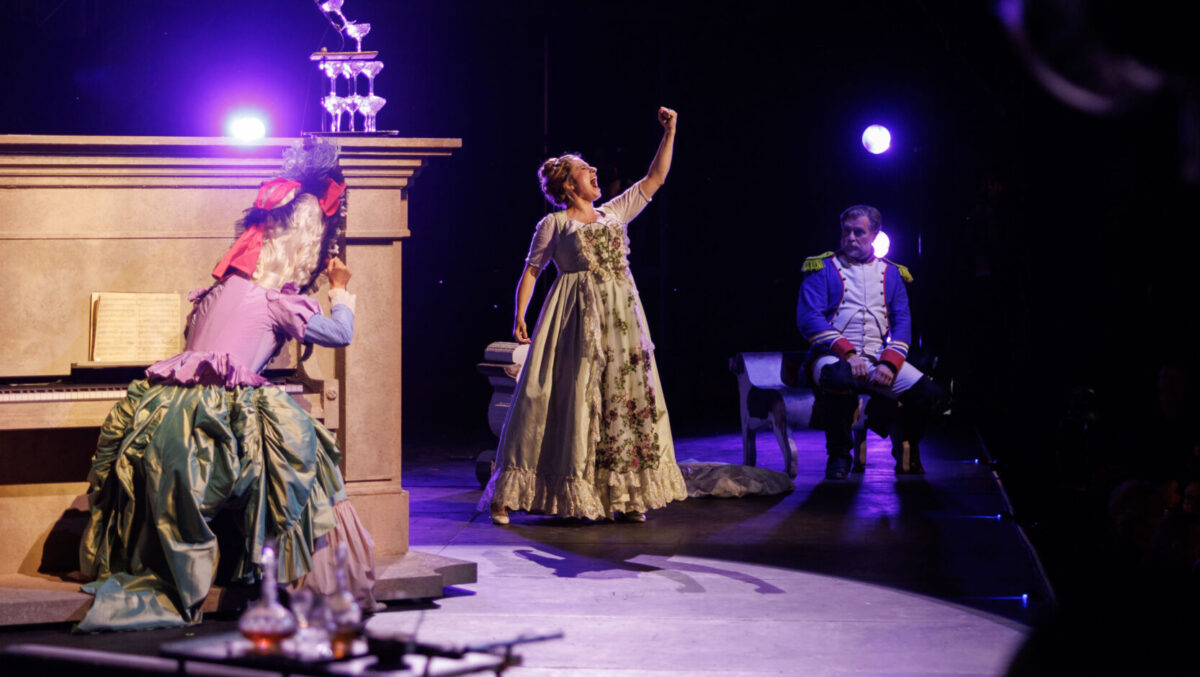
Lacroix’s costumes were particularly noteworthy, as they immediately placed everyone on stage in the time of the Napoleonic Wars, the opera’s setting. From the soldiers’ blue and white uniforms to the Tyroleans’ green Lederhosen, every detail was meticulously accurate in historical context. He juxtaposed those starkly with his whimsical haute couture creations for The Marquise of Birkenfeld (complete with her matching dessert cart, pushed by her butler, Hortensius), and her esteemed wedding guests in Act II, subtly yet unmistakably denoting the class system.
Drew Altizer Photography
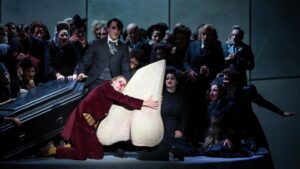
The spirit of contrasting the old and the new permeated every aspect of the show, including a few of Roland Fontaine’s sets that managed to appear in Napa (the others ended up as projections), most prominently in terms of the large fireplace at the Marquise’s drawing room that spun into the piano that she played! Similarly, Guiol’s detailed projection of the library in the Marquise’s castle suddenly burst into pieces with the arrival of the soldiers. But the pièce de résistance, at least for me, was undoubtedly Versperini’s decision to stage the Madonna to whom the Tyroleans prayed in the first Act as stepping off her pedestal, blowing a kiss, and bidding them “Auf wiedersehen!” à la Mel Brooks! It was all oh-so-French and oh-so-fun!
Festival Napa Valley assembled a competent group of singers to bring out the drama and the laughter. While Sahy Ratia’s Tonio didn’t have much explosive quality in his high Cs during “Ah! mes amis,” he otherwise sang earnestly as the lovesick Tyrolean Tonio, particularly in the second Act. Even better was the soprano Manon Lamaison as the titular role; her bright voice and bubbly persona imbued Marie with a sense of charm and naivety, and she sang the regimental song with glee.
The other three principals reprised their respective roles from Versailles, and their familiarity with the staging and the opera made them standouts. Éléonore Pancrazi’s Marquise stole every moment she was on stage with her ease of delivery and her comedic timing as she dressed in a colorful ball gown complete with a towering wig and hat, assisted by the scheming Jean-Gabriel Saint-Martin’s Hortensius. Their banters during the spoken parts lighted up the stage, especially since they often referred to current affairs.
I was particularly mesmerized by Jean-François Lapointe’s Sulpice; not only was it very well sung, but Lapointe’s acting as a doting father figure was exceptionally on-point, and he truly embodied a warm, kind person who cared deeply about Marie. The comprimario roles were all handsomely handled by the members of the chorus, namely Shiddharth Chand as the notary (and peasant), Andrew Pardini as the corporal, and Caroline Flett in the spoken role of La Duchesse de Crakentorp.
Drew Altizer Photography
Nevertheless, the night truly belonged to Jarry and the excellent Versailles Royal Opera Orchestra. It is a rare occasion to hear Donizetti scores played with period instruments, especially here in the US, and boy, did they deliver! After a slight flub at the beginning of the Overture, Jarry proceeded to conjure the image of a Swiss mountaintop with his enthusiastic conducting, aided heavily by the sounds of the period woodwinds and horns. By the end of the Overture, there was no doubt in the audience’s mind that it was witnessing something great and it heartily cheered the orchestra.
Throughout the opera, Jarry led the Orchestra in a reading that was full of excitement and vigor, yet he remained sensitive to his singers. He chose a well-judged pace that kept the momentum forward but still allowed breathing space for the more tender moments. He also achieved a great clarity with the Orchestra, letting the occasional solos shine bright. It was an extraordinary debut for the Versailles Royal Opera, and I genuinely hope they will come back in the future!
It was not easy to produce an opera, especially in such an outdoor setting, and I think with this fifth iteration, Festival Napa Valley nailed it completely. Judicious cuts to the score, a reasonable starting time, a 60-minute intermission, and the availability of reasonable food and wine all played significant factors in ensuring the evening was a complete success. Not to mention, Festival Napa Valley set the pricing for general admission and lawn seats at just $35 (and also offered pay-what-you-can options as low as $5), making it truly an exceptional value for such high-quality entertainment.
So, Festival Napa Valley, what’s in store for next year? I simply can’t wait!