
Antoni Bofill
Great auteurs have transformed Rusalka by stripping it from a traditional setting while also finding an innovative and different meaning behind the opera’s plot. Two especially intelligent ones — Stefan Herheim and Martin Kusej — immediately come to mind. When presenting their Rusalkas, both took liberties with the setting of the opera but hewed close to the opera’s libretto, in so doing embracing the darkness underneath the piece and, in Herheim’s case, finding relentless joy.
Christof Loy’s production of Rusalka (seen at the finale performance on July 7 at Gran Teatre del Liceu) seeks to separate itself from the trappings of a traditional production but fails to honor Jaroslav Kvapil’s exquisite libretto. Worse still, Loy intentionally drops the folklore magic of Rusalka’s source material. Thankfully this opera was led by the indomitable, if initially hesitant, singing of Asmik Grigorian along with a pairing of opera luminaries. While the production never quite succeeded, a stunning cast of professionals made what could have been very a dull evening something worth talking about.
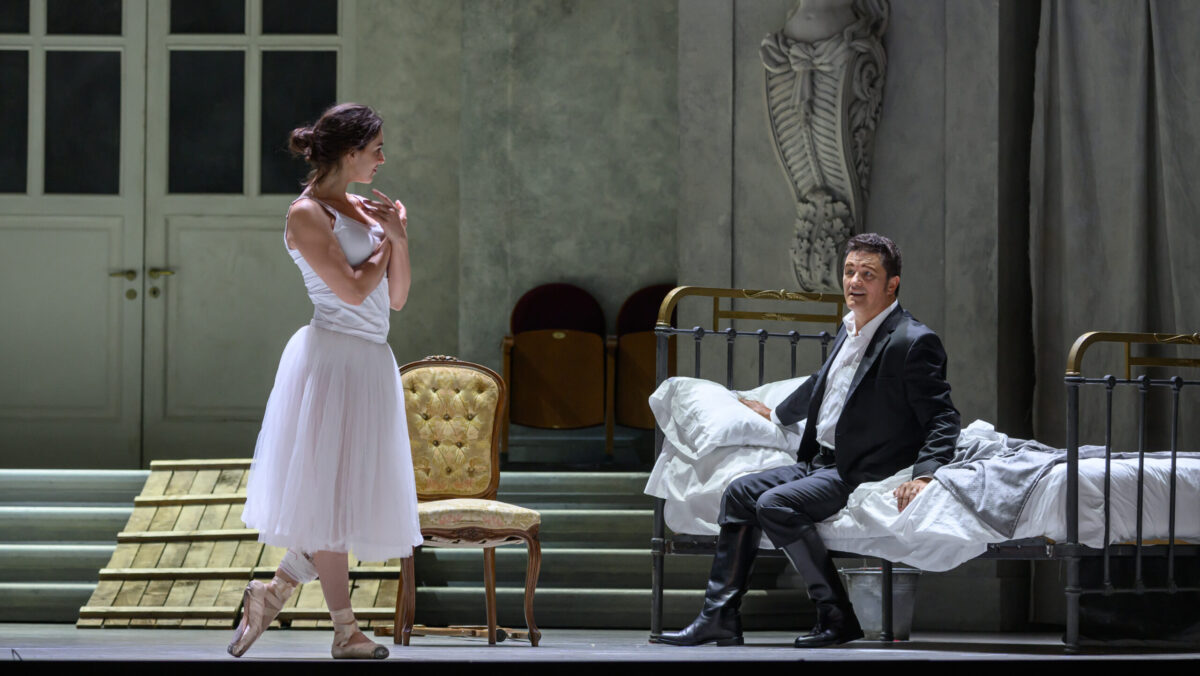
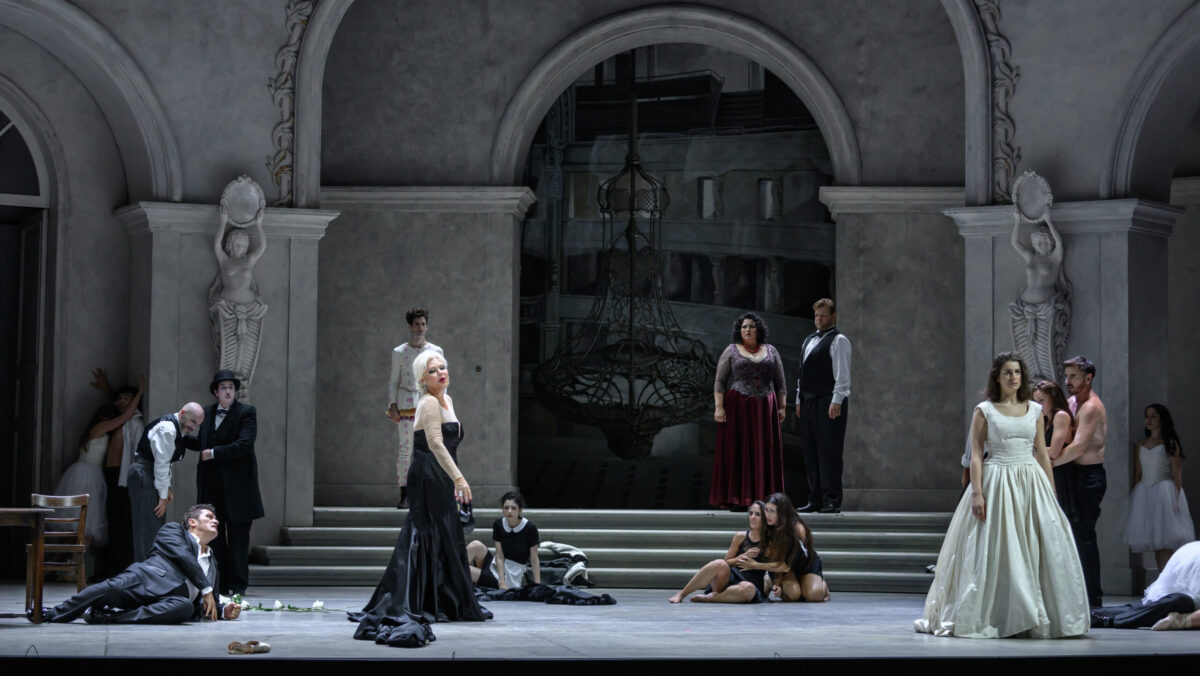
In Loy’s reimagining, we are immediately thrust into a world that is decidedly not mythical. There is no forest, no lake, and, sadly, no magic. Instead, Loy has staged his Rusalka in a vaguely aristocratic early-twentieth century home, decorated with elaborate crown molding and neo-classical sculptures. The set is a unit piece consisting of one large room with three very large archways and colored in Loy’s signature chalk-white palette. The costumes (designed by Ursula Renzenbrink) would not be out of place in an episode of Downton Abbey or The Gilded Age.
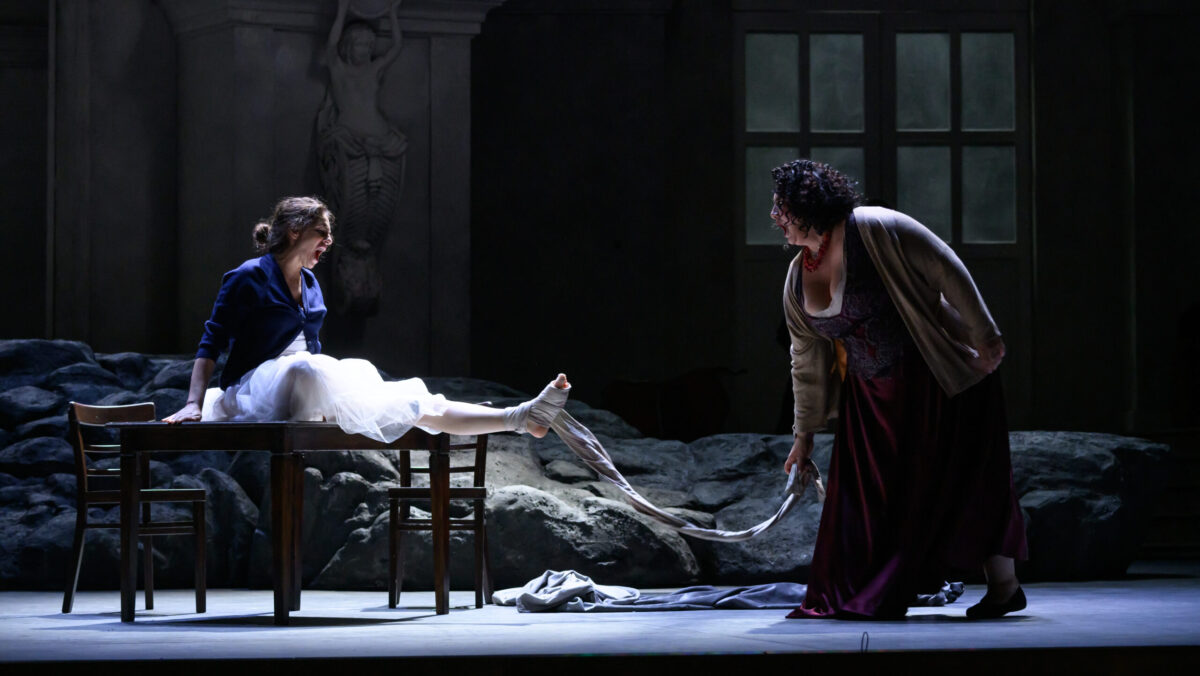
Here is where we find Rusalka, dressed as a ballerina laying in a convalescence bed suffering from a foot ailment. She is surrounded by a troupe of ballerinas, presumably other water nymphs, pirouetting their way around her, as if taunting Rusalka’s ailment. This is the central conceit of Loy’s production: our ballerina cannot dance, though it seems everyone around her can and only Ježibaba can restore Rusalka to top ballerina form. Loy’s device begs the question: isn’t this antithetical to Hans Christian Andersen’s (or, as I’ve come to understand, Karel Jaromír Erben and Božena Němcová’s) fairytale? Isn’t the point of Rusalka that the protagonist wants to be different from her fellow water sprites and thus desires to be human? Moreover, Loy’s production is intent on removing the fantasy from this opera: there is no magical transformation, Ježibaba is little more than a carnival tarot card reader, and any hint of water sprites or goblins are completely eradicated from the opera.
The propósito of this production is the incandescent Lithuanian superstar Asmik Grigorian. Already a Metropolitan Opera maven after only one run as Cio-Cio San and a Carnegie recital debut (she will be returning to Carnegie this season performing Verdi’s Requiem with The Cleveland Orchestra), Grigorian has obtained a level of praise few could garner even after a much longer career. Expectations running quite high, I was disappointing to leave Act I feeling unaffected.
Initially, it appeared that Grigorian was modulating her voice to adjust to the modestly sized Liceu. “Song to the Moon,” sung while lying in bed, was a particular disappointment and partially inaudible despite my sitting close to the stage.While not vocally penetrating, Grigorian’s distinguished her physical performance early on, highlighted by her unexpected and impressive ability to plié, pirouette, and arabesque. Griogrian’s portrayal is that of a Rusalka scorned but not defeated, dancing in the face of tragedy. Her deliberate stare and paused movements in the first half of Act II showed a woman not just hurt by the Prince’s repudiation, but instead intent on retribution.
Antoni Bofill
While mostly mute in at the beginning Act II, It was a relief to hear Grigorian in full voice by the end of the Act and remain luminous through the remainder of the opera. This was the dark-hued and resonant singing, carried by an almost surreal power, Grigorian has shown before to deserved acclaim. Audibility issues were resolved but now, finally, her considered and contemplative acting matched the intensity of her voice.
While Grigorian’s first Act singing felt tentative and self-aware, her second act “Rusalko, znáš mne, znáš!” and third act duet with Beczala (“Milá? ku, znáš?”) was ferocious in its vocal force and agility. Not as beautiful as other Rusalkas (see, e.g., Renée Fleming), Grigorian’s singing instead contains a fire I had not associated with the role, a power only complemented by her complex and contemplative portrayal.
Piotr Beczala’s “Ustante v lovu…” made clear that, if modulation was Grigorian’s approach, her full-throated tenor was not following. Sung with clear diction and elegant timbre, Beczala’s prince remains impressive more than ten years after his Met role debut under Yannick Nézet-Séguin. The might behind his voice has noticeably increased, having since conquered, among many roles, Lohengrin. The elegance and beauty of his voice is perpetual and the clean diction of his singing even more noticeable in a smaller house. Whether a cad or a romantic hero, Beczala is comfortable vacillating from one to the next on stage. He provided a worthy complement to Grigorian, particularly in their final moments together.
Antoni Bofill
Luxury casting was a hallmark of this production, and it doesn’t get much more luxurious than Karita Mattila as the foreign princess. Having witnessed many of Mattila’s triumphs in New York, most recently her moving Prioress in Carmélites in 2019, it was nothing short of a joyous delight to see her back on stage. Not dissimilar from her Emilia Marty, Matilla here exuded a vampish glamor and, magnificently, ate up the scenery. Wearing a long black dress and (of course…) a full-length fur stole, Mattila was having an infectiously marvelous time. While her singing may not be quite as formidable and top notes not so easily executed as in her prime, Mattila’s charisma has only grown. In a very serious evening of opera, it was a delight to have this boundless ball of brilliance tread the boards, even for only one Act.
Okka von der Damerau’s robustly sung Ježibaba did not provide the same delight, but the fault was not hers. The absence of any form of fantasy – in a folktale, no less – deprived Damerau the opportunity of embracing the part. Damerau tried her best to present a faux-witch to the extent Loy’s production would allow, but “Čury mury fuk” just didn’t make much sense and felt like Loy had no other choice but to partially abandon his concept, if only for one aria.
Alexandros Stavrakakis certainly fit the imposing description of Vodnik, full chested and broad shouldered, but he was given little to do other than wander aimless around the rear of the stage. While generally a central figure to the opera, Loy turned Vodnik into more of a singular Greek chorus, punctuating the threats that lie ahead, and less of an actual character. Stavrakakis’s singing was robust throughout but showed some difficulty in his lower register.
Josep Pons and the Liceu Orchestra presented a refined presentation, if a bit mundane. Like the production itself, Pons took a pensive approach to the score with no opportunity to applaud until the end of each Act. While not inappropriate, some distinction in performance would have been appreciated. Even “Slavnosti hudba – balet,” among my favorite pieces of orchestral writing in opera, felt somber and low-spirted.

Antoni Bofill
When an opera is sung well, you could forgive a passable production. Loy’s Rusalka is not horrible, just poorly thought-out. Fighting a libretto (“I’m Rusalka, a water nymph. Give me a potion, dear aunty”; “Strange magic is wandering in the forest”; “If you should lose the love for which your feelings crave, then the curse of the watery powers will drag you back into the deep”) does not help any opera, especially Rusalka. To his credit, Loy elicited poignant portrayals from his cast, but with a cast this stacked, it’s questionable whether he really had to do much: any one of these actor-singers could have stepped into this production and made the production work without Loy’s concept. I wonder if that’s not exactly what happened.
While writing this, I went back to Zachary Woolfe’s New York Times review of Herheim’s Rusalka at La Monnaie. This production was the first Regietheater I witnessed, traveling specifically to see it twice in one trip. In his review, our distinguished (and soon to be former) Chief Classical Music Critic, writes: “Though Mr. Herheim’s work is rigorous, it is also fun, and this ‘Rusalka’ is serious but the opposite of dour.”
Loy could benefit from this assessment: Rusalka can be serious, but more importantly, it should be engaging and the opposite of dour. His production said nothing new about the opera and simply moved around the chairs while stripping Rusalka of any joy. Thankfully though, a stunning cast made this night worthwhile and made clear, to me at least, that we’ll be talking about Grigorian for a very long time.


