Steven Pisano
For their 2025 season, Teatro Nuovo chose two operas that deal with sleepwalking heroines but in very different genres – Verdi’s Macbeth (original 1847 version) is red-blooded tragic opera seria while Bellini’s La sonnambula is an opera semiseria in the pastoral vein. Opera semiseria was a sentimental genre somewhere in between opera seria and opera buffa.
Often it dealt with an innocent heroine who gets herself into terrible trouble (usually involving alleged sexual transgressions with the ensuing social ostracism), flirting with tragedy until a final miraculous reprieve restores our heroine to safety and happiness. Such is the plot of La sonnambula set in a pastoral Swiss village where the virginal heroine’s sleepwalking into another man’s bedroom causes her fiancé to believe her untrue and only when she is discovered publicly sleepwalking is her honor restored.
Often the libretto by Felice Romani is ridiculed for being naïve and silly – Peter Gelb and Mary Zimmerman were dismissive of it when the opera was last given a new production at the Met in 2009. Many of the critics didn’t understand how opera semiseria is supposed to work, expecting either comedy or tragedy but not the sentimental melodrama in between. Most critics and audiences have little linguistic appreciation for the poetic qualities of Romani’s beautiful Italian verses. Bellini’s gorgeous music, however, never misses.
Steven Pisano
Naïveté and simplicity are qualities that were cherished in the early Romantic era and beyond – not so much in the latter 20th and 21st centuries. When it comes to sentimental rustic comedies, Andy Hardy and Ma and Pa Kettle don’t have much cultural currency these days. La sonnambula has been mainly seen as an old-fashioned canary fancier’s vehicle for a popular coloratura star, like Joan Sutherland, the heroine of the Met’s previous production in the 1960s. Bellini’s endless supply of melody has weathered the vicissitudes of public taste better than Romani’s libretto.
Will Crutchfield is no stranger to the work having presented it in 2005 at Caramoor as part of his Bel Canto at Caramoor program starring Sumi Jo, John Osborn, and Daniel Mobbs. That concert utilized a then-new critical edition edited by Alessandro Roccatagliati and Luca Zoppelli which restored the original higher keys for the tenor role of Elvino, created by the legendary Giovanni Rubini.
Rubini utilized head voice or “falsettone” to extend the tenor voice into almost a castrato’s or countertenor’s high range. The generally available Ricordi score of La sonnambula has always had the tenor role transposed down into a more standard tenor tessitura, sometimes creating problems for the singer of Amina in their duets.
The critical edition with the higher tenor keys was also used at Teatro Nuovo, restoring cut passages and period ornamentation. The singers were not international stars like Sumi Jo but young artists in the first baby steps of their operatic career or trainees in Crutchfield’s Young Artist program.
As I have written previously, Teatro Nuovo uses a period orchestra with historical instruments led by a Maestro al Cembalo (Crutchfield) and a Primo Violino e Capo d’Orchestra (Elisa Citterio) according to early 19th century practice instead of a conductor.
I chose to attend La Sonnambula (and Macbeth) at the Alexander Kasser Theater at Montclair State University on Sunday 20 July. That was because I find the jewel box Kasser Theater more acoustically favorable to young singers than the much larger City Center where Sonnambula will be performed on Thursday 24 July. There was also a pre-opera recital of Bellini songs performed by the Teatro Nuovo young artists which is not being repeated at City Center. The greatest benefit is the intimacy of the Montclair State playing space – the delicate charms of La sonnambula are lost in the cavernous spaces of City Center or the Metropolitan Opera.

Steven Pisano
As to the performance itself – the period orchestra had a gentler, less brilliant sound than modern instruments – mellow wooden flutes, valveless natural horns and violins using gut strings that balance the strings with the woodwinds rather than having the strings dominate the orchestral texture. I was convinced by Crutchfield and Citterio’s tempi and the orchestra maintained good ensemble with only a few lapses in intonation, as is to be expected of historical instruments.
The female singers were generally well-suited to their assignments and their singing was above average. Unfortunately (as is often the case with smaller opera companies) the male singing was very variable and, frankly, downright bewildering.
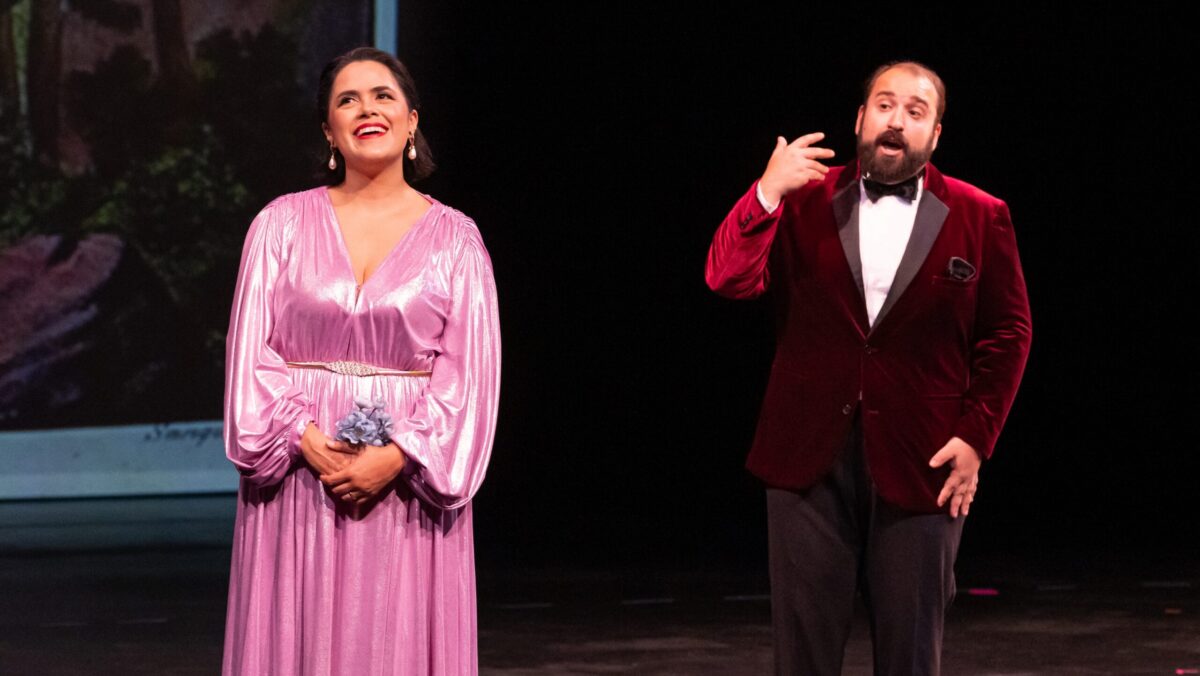
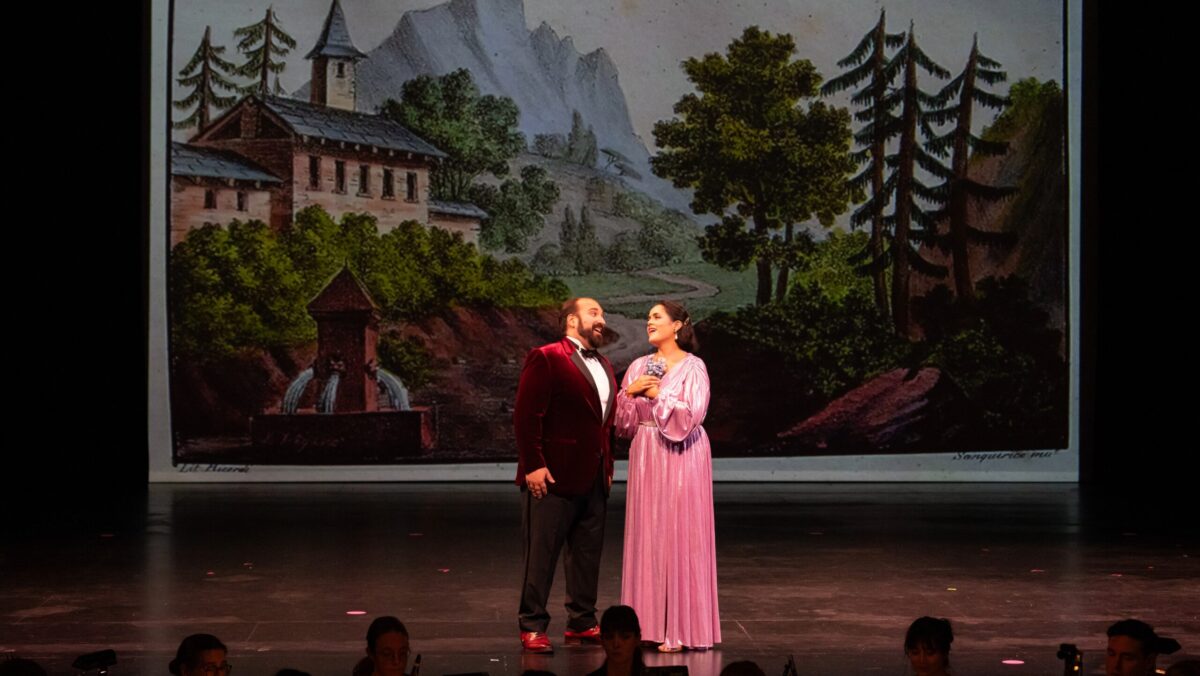
Christopher Bozeka, our Elvino, with his dark beard, russet colored leather shoes, and burgundy velvet jacket resembled the comedian host at a borscht belt resort club and sang almost as weirdly as the retired “World’s Highest Tenor” Stefan Zucker of the WKCR-FM radio program “Opera Fanatic.” (A program that indelibly shaped this critic’s opera obsession, musical aesthetic, and twisted mind as a teenage listener in suburban New Jersey.) Bozeka, performing in the highest Rubini keys, used a recessed back-of-the-throat emission that lent a raspy, sandpapery quality to his tone. On his high notes, he used a pharyngeal attack off the soft palate that sounded oddly hollow and disembodied. This odd technique resulted in uncertain onsets, register breaks and pitch problems. Oddly, Bozeka sang out in the ensembles with a strong, bright, resonant spinto tone that made me think that that is his real voice. His bumbling, often goofy demeanor suggested Nemorino more often than Elvino.
Steven Pisano
More bewildering was our Count Rodolfo, bass-baritone Owen Phillipson, who seems mainly to sing concert and oratorio in his native Canada. He simply didn’t have the voice for the role – musicianship and careful coaching were on display but also hollow tone and pitch problems on top and bottom. His lower range is nearly toneless and the quality above totally lacks color and depth. Where was Teatro Nuovo mainstay and cat daddy Hans Tashjian? He was sorely missed…
Our Alessio, Vincent Graña, had the most attractive and consistently functioning voice among the male cast. He also created a vivid, engaging character out of a role who is usually a complaining hanger-on. Several of the male Teatro Nuovo young artists possess better tenor and bass-baritone voices than the lead singers in the main Sonnambula cast.
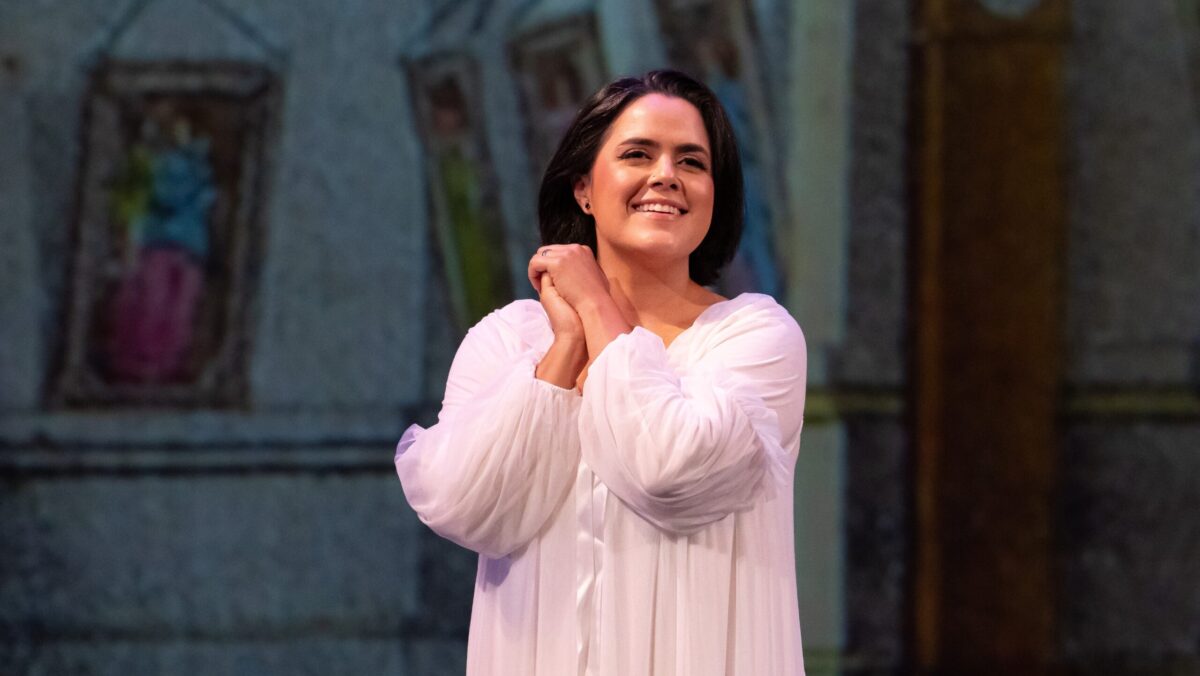
Teresa Castillo as Amina was a very positive presence with a bright, evenly produced coloratura voice with confident technique and agility. It’s a somewhat insistently bright timbre without a lot of variety of color but she did soften the tone effectively for “Ah, non credea” in the final scene. A lot of period ornaments were used, including some that were composed by Bellini himself but never used. I found the second verses (sometimes even the first verses) rather overdecorated, the melodic shape and structure were lost underneath all ornamental overlay. The display sometimes impeded emotional expression rather than intensifying it.
Another oddity all through the Teatro Nuovo season, both in Macbeth and Sonnambula, was that ornamentation of all kinds was used extensively, especially in second verses of cabalettas. However, ending the solo or ensemble on a traditional climactic high note was eschewed. Castillo in “Ah, non giunge” ended on a high E-flat but Bozeka went down on the ending of “Ah! perché non posso odiarti” after adding all sorts of interpolated high notes before. Sometimes the high note was in the middle of a climactic cadenza which then ended in the middle range.
I think some of those climactic high notes were also part of contemporary bel canto vocal practice and they were missed not only in Macbeth’s arias and cabalettas, but also in the “Schiudi, inferno” ensemble that ends Act I, scene 2 of Macbeth where you really want the Lady (and the Dama) to honk out a HUUUGE high D-flat. Castillo seemed to be the only one allowed to blast out any final high notes.
Abigail Raiford as the spiteful minx Lisa started out with somewhat labored tone in her opening aria but warmed up quickly and sparkled her way through the second Act solo “De’ lieti auguri a voi son grata” where her exultant coloratura made Lisa all the more obnoxious. Raiford proved a sparky, vivacious antagonist and stole scenes. As the adoptive mother Teresa, Abigail Lysinger showed a spiky temperament of her own when confronted with Lisa’s planned marriage with Elvino. Her mezzo-soprano has a honeyed warmth.
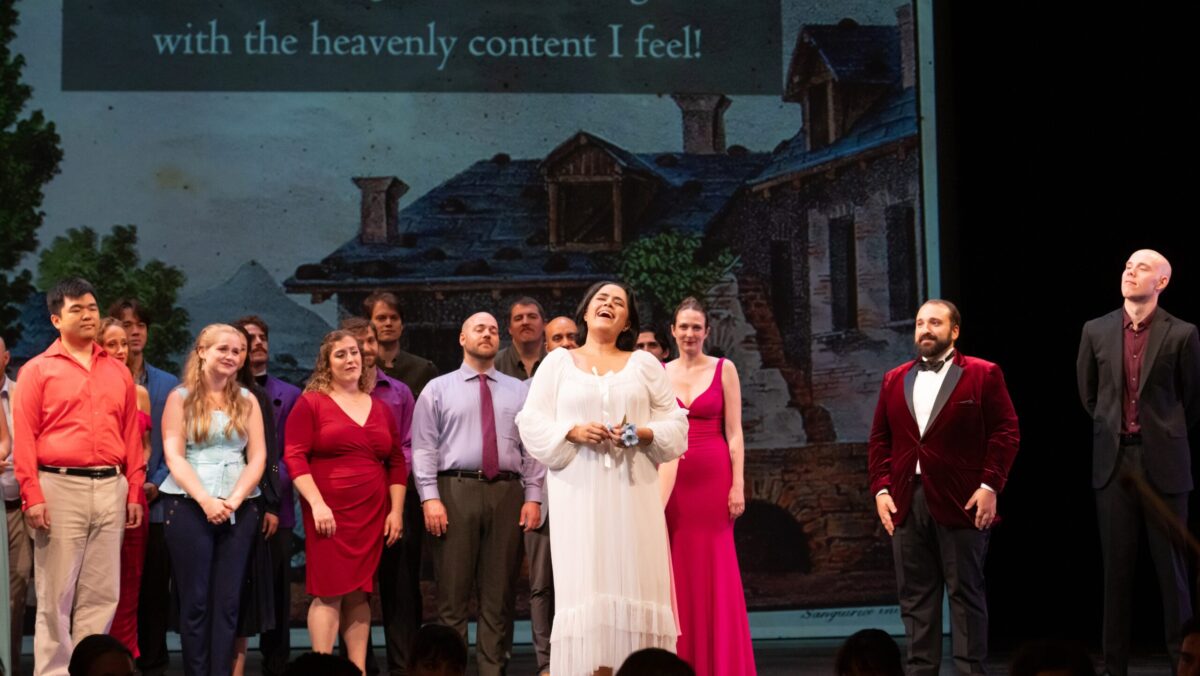
The soloists and chorus were totally off-book and there wasn’t a music stand in sight. Everyone reacted to each other, acted, and moved around the stage with basic blocking and generally gave a complete operatic performance. Projections by Adam J. Thompson of watercolor prints of stage designs for an 1831 La Scala production designed by Alessandro Sanquirico provided eye-filling backdrops and atmosphere but also allowed supertitles. You got the sense, as with Macbeth, of a fully realized staged production rather than a semi-staged concert version.
Steven Pisano
Despite my reservations about the uneven casting, this was a delightful afternoon that highlighted the many charms of Bellini’s bel canto masterpiece with musical details that were lovingly presented and everyone seeming deeply invested in the piece. The performance is definitely worth seeing and hearing this Thursday.
While my colleague John Yohalem will be reviewing Teatro Nuovo’s resuscitation of the 1847 Verdi Macbeth at City Center this coming Wednesday night, I’ll say that I found it a revelation; I love the 1865 Macbeth, but the 1847 is leaner, meaner and more to-the-point. Verdi added a great deal of brilliant new music and orchestration for the 1865 Paris version but the new music was in a different, more evolved musical style. The ensuing “mosaic in music” created a stylistic patchwork that has startling juxtapositions of his early brash risorgimento manner and more sophisticated middle period styles.
The 1847 Macbeth has outdated musical conventions (like cabalettas, several of which were excised in 1865) but it nevertheless is a more streamlined, forward-moving musico-dramatic structure with stylistic unity. The 1847 Macbeth was actually an early Verdi hit and was quickly produced in many Italian opera houses; the Paris 1865 Macbeth was not a great success and only reappeared in the 20th century, then totally subsuming the original 1847 version. Hearing the original version, you can see why it was a hit. Teatro Nuovo cast this with much stronger and vocally consistent singers. Anyone who loves Verdi and loves opera should check this one out.