
 The San Francisco Opera is batting a thousand where young singers are concerned this season. There, see? A gesture of goodwill to local sports fans. Boy, the “Niners” really took a “beating” in “game two,” huh? Anyway, where were we?
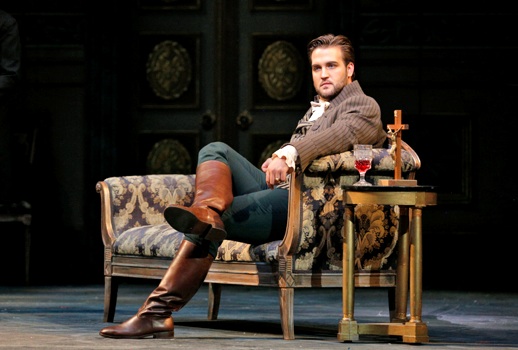
Ah, yes. Young singers. Partenope was crawling with ‘em, and profitably so. Ballo’s only big splash was a cover with “up and coming” written in LEDs on her tiara. Tosca was a more evenly matched affair, but it’s hard to deny that the headliner and crowd favorite was Brian Jagde, an American lirico-spinto who can’t be more than thirty-two and who’s still singing a fair amount in smaller houses (who will soon be unable to get their mitts on him soon, by the look of things.) Jagde is a handsome guy and has an unfussy, comfortable stage comportment. More to the point, he’s vocally in the clover as Cavaradossi.
“Recondita armonia” strikes me as a particular kind of gift to tenors—it sits high, but it’s short, and someone else is muttering along while you build up to the B-flat, and the melody lets you make a money note of the G if you’re not feeling it quite that early in the evening. Jagde made the most of it. Much as I’ve enjoyed hearing veterans belt the thing over the years, it was refreshing to the point of mild disorientation to hear such a tight and youthful sound lavished on it.
His is not the richest timbre, but it’s a voice that, while sleek, fills the house most gratifyingly. He could not have more effectively signed up a fan base had he opted for “You’re Gonna Love Me” as a suitcase aria, and the rest of the evening made good on early promise.
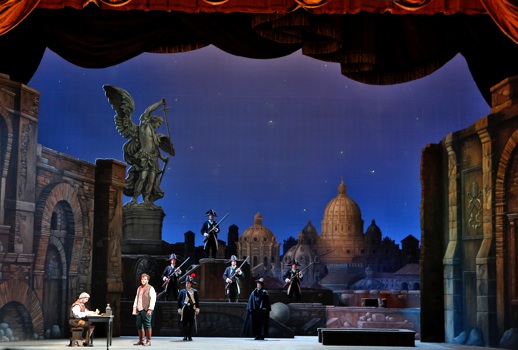
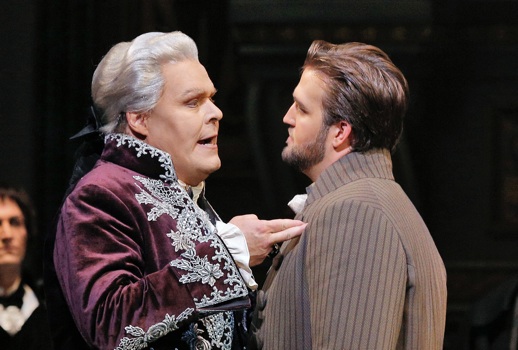 As befits a Scarpia, this is not Mark Delavan’s first time at the rodeo. He’s a veteran, a pro, and a walking counterexample to last week’s kvetching about Thomas Hampson, whose status he has never really attained. I should say a word about the production, here, though: Jose Maria Condemi, who also helmed Ballo, has demonstrated in the intervening week the difference between a successful backward-looking production and a soporific one.
His Tosca shows us the past as another country—the land of perversely affecting melodrama and scenic resourcefulness with limited means—where in Ballo it was something of an outlying suburb, something with a mall in it. Thierry Bosquet’s sets, based on the 1932 production whose floors were brushed by the hem of Muzio’s Empress Josephine knockoff, substitute nostalgia for the more customary necrophilia, and between the look and the staging (respectful of cherished stage business, but not slavish) the result is a reminder of why we still go to Tosca even though they put it on approximately every goddamn season.
As Miss Golightly was saying before she was so rudely interrupted, Mark Delavan understands Scarpia as a figure of melodrama, which is to say he knows that audiences in the age of Bernhardt weren’t idiots and wouldn’t have responded to unadulterated moustache-twirling. It isn’t that Scarpia is a character with any real nuance, but if he’s completely predictable, he’s a bore or, worse yet, a joke.
 Delavan does play Scarpia as an all-purpose sadist, flitting from subjugation to subjugation, whose interest in pawing at Tosca is minimally sexual (a good choice in itself) but there are hints there that his Scarpia is a politician who knows when to play nice for a moment to keep his subject guessing. Shortly after holding a knife to Spoletta’s throat, he releases him with a football-coach squeeze to the shoulder. It’s creepy, and kind of hot. It works.
Vocally it’s an authoritative reading, full of menace and then occasionally suave or unctuous as the music dictates. Delavan bites up the text like a general giving orders, and only once was outmatched by the orchestra, vivid but occasionally oddly balanced under Riccardo Frizza’s idiomatic direction.
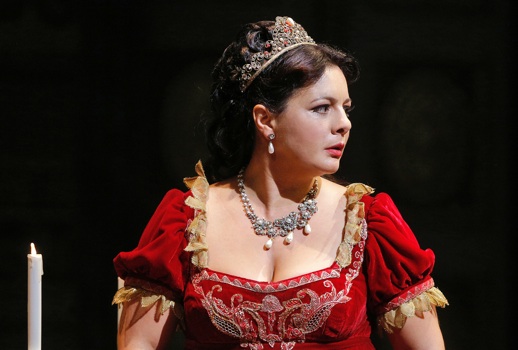
But wasn’t there a soprano around here somewhere? Why yes there was. Armenian soprano Lianna Haroutounian, who should record a duets album with with Aleksandrina Pendatchanska and use up all the syllables, is a fine if not riotously exciting Tosca. Dramatically, her portrayal could use a touch of the feral, and really the same could be said of her vocal characterization now that I’m going on about it.
 High points of the role were delivered unstintingly (though it seems to me she uses the trick known to all Turandots of putting a big note across by singing it ever so slightly sharp fairly often) and she knows her way around The Big Number. If it felt a little undercooked at times—the death of Scarpia, the rage over Attavanti, it’s probably dumb to complain about a singer so basically untaxed by the demands of the role, and it’s certainly an attractive instrument.
Tosca plays again Sunday and then three times after that. You should probably catch this rarely-heard musicological curiosity now, or risk having to wait until 2016.
Photos ©Cory Weaver/San Francisco Opera.