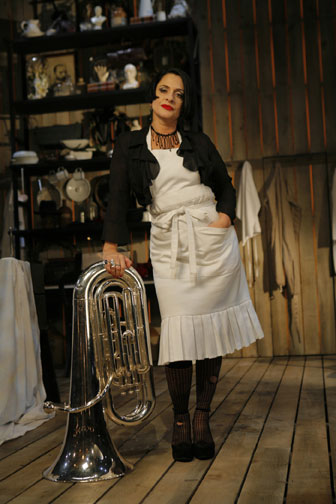
 Two nights in a row at the War Memorial—it’s all a mad, gay whirl! If I’d gotten an hour less sleep you’d now find me mixing everything up and writing about Mrs. Lovett making her entrance on a bronze horse like Peter the Great.
A little hand-waving at an obvious question: Opera houses do put on Sondheim, of course, and there’s no real point in wasting words on whether Sweeney Todd is a musical. To do so is to engage in a thinly veiled referendum on the piece’s worth, and it’s just too clear that it’s a worthy and lasting piece of American culture to bother.
Plays are done on television, or they used to be, and remain plays. Sweeney Todd done in an opera house is just Sweeney Todd. Few real changes are needed—a bigger orchestra, mics for the dialogue, and what the press packet, with presumably unintentional cuteness, informed us were “various small cuts.”
One thing is certain, though: for all audiences adore it, Sweeney Todd is not one of those foolproof pieces. Patti LuPone, in her recent memoir, calls it “the most difficult score I’ve ever sung” and despite her intense, peculiar performance, the John Doyle production was a mixed success; its plodding minimalism, taken with the grimness of the tale, at times gilded the tuberose.
Worst of all, nobody tried to take any pictures so we shall never know the extra-grand Guignol of seeing an audience member brained with a tuba by a severely bobbed Cockney.
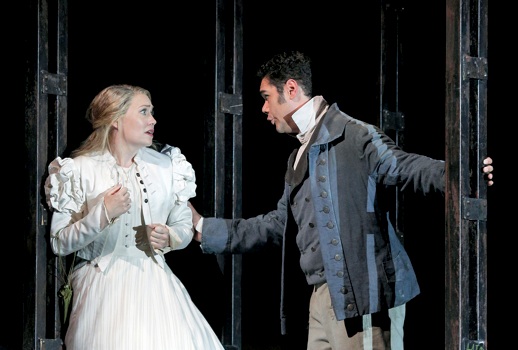 In any case, a three-thousand-seat hall does present different performance issues than one a third as big. Singing technique that travels well to standing room isn’t often learned alongside idiomatic musical theater style.
Going in, I wouldn’t have expected Stephanie Blythe (now, in my reckoning, primarily a Wagnerienne of noble bearing) to be the person onstage who best obliterated that dichotomy but there she was, fitting her famously clarion instrument into a performance that would be warmly received in any Broadway house.
Nellie Lovett isn’t as simple as she looks, but Blythe found the right midpoint of vulgarity, charm, and malevolence that makes the character one of Sondheim’s best creations.
Her comic timing, and again I’ll admit to being surprised, is also impeccable. I’ve known the words to “The Worst Pies in London” for decades but laughed at Blythe’s delivery as if the jokes were new.
 Brian Mulligan, heard recently on these boards as Anckarstrom and Chorèbe, was another pre-season substitution but in no other sense a substitute, claiming the role fully and fearlessly from his entrance.
Mulligan’s diction rendered supertitles unnecessary, and his lack of vanity in a role that is starry but deeply unglamorous put to rest the doubts I had about opera singers making much of Sweeney—doubts I think I can blame on Bryn Terfel, who mugged his way through the role in Chicago a dozen years ago in one of those funniest-kid-in-drama-club scenery buffets that sometimes eclipses his glorious singing. Mulligan sang from a place of creepy stillness. Mulligan was, in short, magnificent.
As a team, Mulligan and Blythe also had… chemistry is the wrong word, since we’re talking about a couple of hastily groomed sociopaths, so let’s just say “A Little Priest” produced that rare electricity in the house, building to the familiar tableau of Sweeney and Mrs. Lovett, rolling pin and cleaver in hand, and a rowdy intermission ovation.
Supporting roles were less consistently cast. Judge Turpin seemed to lie uncomfortably for Wayne Tigges (who I keep thinking is married to Idina Menzel) and in casting Heidi Stober as Johanna, SFO continued its streak of not knowing quite how to use her.
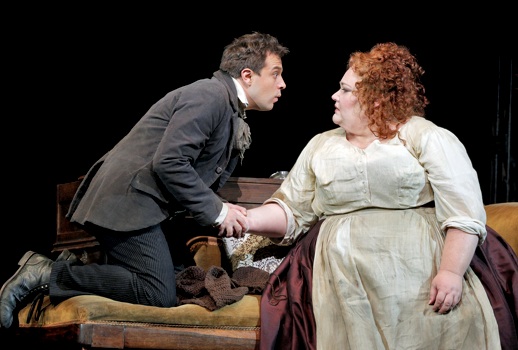 Elliot Madore sang handsomely but somewhat indistinctly as Anthony. It was strange to see Elizabeth Futral, still active in starrier, more youthful parts, as the Beggar Woman, but she threw herself into the role.
The great surprise was Matthew Grills, like Madore a recent Met Council winner. While Toby’s Act I carnival shill number offers little opportunity to shine—it’s the weakest piece in the show, the over-cleverest of Sondheim rhymes stacked atop one another on an appropriately grating melody—”Not While I’m Around” was a revelation, sweetly sung with great vocal suavity.
Here was where someone sings “Dalla sua pace” had an edge over someone who mostly sings “Hello, Dolly!” Grills is shipping off to Munich to join the ensemble for a few years, they’ll have to give him back eventually, won’t they?
Conductor Patrick Summers and director Lee Blakely, whose credits include opera and quite a bit of Sondheim, gave the evening a nervous, energetic pace. There are six more performances of Sweeney Todd through the end of the month.
Photos: ©Cory Weaver/San Francisco Opera