

 As suggested in Part I of this piece, to experience Glass’s Satyagraha as a purely aesthetic experience is unfortunately to succumb to a romantic ideology promoting detached reflection on art which is wholly inapplicable to such a politically-charged opera. The idea that Gandhi’s action-oriented philosophy would be packaged and sold for the sake of passive introspection would have bothered him deeply.
To memorialize Gandhi in such a way is, ironically, to forget him– his spirit killed in the act of dramatic revival. How might Gandhi’s legacy truly be respected in the face of a world abounding with injustice? And what, then, might be the best response to the Metropolitan Opera’s production of Glass’s Satyagraha?
For Gandhi, the antidote to an unequal system premised on competition and greed—such as the one currently at large around the globe—was solidarity and active resistance. In his South African newspaper Indian Opinion, Gandhi writes:
No race or community has ever achieved anything without the communal spirit. . . . A chain is no stronger than the weakest link in it, and unless we are prepared to stand and work shoulder to shoulder without flinching and without being daunted by temporary disappointments, failure would be the only fit regard, or rather, punishment.
Today, such rhetoric could easily be heard coming from Occupy Wall Street, which is revitalizing the spirit of resistance in a country which has for decades been steered toward complacency. Like Gandhi, Occupy sees gross wealth disparities as an engine of violence and social unrest, and as an indicator of system which is at its core unjust and unsustainable. Watching Gandhi and his followers face repression and abuse on the stage of the Met, one could imagine Occupy protesters joining the Satyagrahis and supplementing the Sanskrit libretto with their familiar cry, “This is what democracy looks like!”
The affinities between Glass’s Satyagraha and Occupy Wall Street don’t stop there. Indeed, many of Gandhi’s pioneering techniques of civil disobedience and nonviolent direct action which the opera highlights have seen their contemporary realization in the Occupy movement, among other protests worldwide. One of the strongest parallels between Gandhi’s early activism and Occupy is the emphasis on claiming a physical space, within which the seeds of a better society may be planted. Inspired by the writings of Ruskin and Tolstoy, Gandhi procured farmland while inSouth Africa where he and his spiritual disciples built a self-sufficient community dedicated to simple labor and mutual aid.
The setting for Act I Scene 2 of the opera is Tolstoy Farm, where Gandhi and the Satyagrahis work together to sustain a cooperative, autonomous space reminiscent of ZuccottiPark, the original base of the Occupy movement. “The weak became strong on Tolstoy Farm,” wrote Gandhi in his Satyagraha in South Africa, “and labor proved to be a tonic for all.” The same may have been said about Zuccotti, where participatory structures of horizontal governance fostered a similar environment of empowerment and self-managed work.
Cleo Carol Knopf, a professional aerialist and active participant in the Occupy protests, elaborated on these connections after attending the final performance of Satyagraha. In the scene on Tolstoy’s Farm, she said, “we see Tolstoy in an elevated space off to one side and the people on the farm below. His elevated space indicates that he is not just a person, but an idea.” That idea is further developed in Act III, where Martin Luther King assumes a similar elevated posture. “The figure of MLK does not move from one spot and there is a vast expanse around him. He gestures but does not move, for if he took one step he would fall,” Cleo said. “This evokes the idea of occupying space and standing one’s ground. We must not step off our space of power nor deviate one step from the truth in order to win.”
King and Tolstoy were two of the three historical figures Glass chose to frame each act, the third being the poet Rabindranath Tagore, a contemporary of Gandhi. “For the three witnesses,” Glass writes in Music, “I searched for characters who represented for Gandhi what, in India, is known as the ‘three times’—past, present and future.” Each of the three ‘witnesses’ is silent for the duration of their respective acts, suspended above the particular action surrounding Gandhi.
Their temporal designations emphasize the timelessness and boundless applicability of Gandhi’s principles. Glass sought further to universalize the work’s content in his use of an unfamiliar language for the libretto and minimal subtitles, so that the “listener could let the words go altogether.” By increasing the distance between the audience and a predefined text, Glass writes, “the weight of ‘meaning’ would then be thrown onto the music, the designs and the stage action.’”
Though Glass’s emphasis on the universal and symbolic aspects of the principles of ‘Satyagraha’ may inhibit the specifics of Gandhi’s radical message from coming through, those same aspects lend the opera to open-ended interpretation. “I expected,” Glass writes, “that the audience would further personalize the work. Whatever interpretations they brought to it, and how it became meaningful to them, was really not predictable by me.”
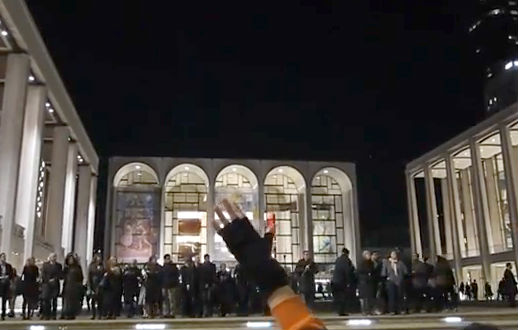
On December 1st around 10:00 p.m., toward the end of the last performance of Glass’s Satyagraha, a crowd of protesters began to assemble at the steps of Lincoln Center Plaza. Within a half-hour, hundreds flooded the sidewalk on Columbus Ave between 63rd and 64th street, talk of Gandhi in the air. Occupy Museums, an action group affiliated with Occupy Wall Street, had organized a demonstration around Glass’s opera, given its highly relevant subject of nonviolent resistance. How could an opera about Gandhi be let to pass without a protest?
For the members of Occupy Museums, the Satyagraha protest was the active extension of a serious reading of the opera’s content given the conditions of its performance at Lincoln Center. Two weeks earlier, the action group had organized a similar protest outside the Juilliard premiere of Peter Maxwell Davies’ Kommilitonen—also about activism—amidst a disproportionately large police presence.
A couple dozen protesters marched across 65th Street to the foot of Lincoln Center Plaza, outnumbered by their NYPD chaperones. Once on the steps of the empty Plaza, a line of cops andLincolnCenter security officials prevented the protesters from entering and forced them to return to the sidewalk. The message was clear: despite its claims to the contrary, Lincoln Center is not a site of free expression.
Fast-forward a fortnight to the Satyagraha demonstration. Again, Lincoln Center recruited an elaborate police presence to barricade the outskirts of the Plaza, so the normally buzzing platform around the fountain was completely deserted, save a few armed cops, while hundreds of unarmed protesters and interested onlookers swarmed the front sidewalk. Many protesters adorned costumes made from issues of The Occupied Wall Street Journal, Occupy’s newspaper, mimicking the Met’s set-design which prominently featured the Satyagrahi’s newspaper Indian Opinion.
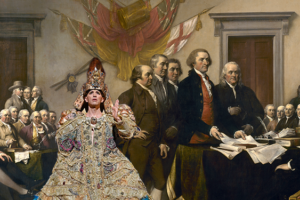
Other symbolic parallels were drawn with the ongoing production within the halls of the Met: a giant Statue of Liberty puppet found its way to the protest—eerily similar to the large puppets used in the production, while several protesters removed their shoes and placed them beneath the police barricades in an expression of humility similar to that performed by the fictional Satyagrahis inside. The spirit of nonviolent civil disobedience found its way to the streets as well. One Occupy protester, David Suker, who is a season ticket-holder at the Met, tried to test police boundaries by walking onto the plaza level while carrying a copy of The Occupied Wall Street Journal. He was immediately arrested.
It says a lot about what ‘culture’ means in this country when its most cherished institutions are guarded more heavily than Wall Street. What could have possibly justified such a display?
Taking advantage of legal technicalities which distinguish between ‘traditional’ and ‘limited’ public spaces, Lincoln Center won a court order in 2002 legitimizing the enforcement of its long-standing policy of prohibiting political demonstrations on the Plaza. By neutralizing this preeminent cultural forum ostensibly dedicated to free creative expression, Lincoln Center effectively certifies the spurious distinction between art and politics and uses it as a weapon to protect its own (high politicized) corporate interests. Thus freedom of movement is guaranteed on the Plaza so long as individuals remain passive consumers or idle spectators, but curtailed the moment they pick up a sign and speak their mind.
The repression of free speech at Lincoln Center is representative of a larger tendency in Americatowards the privatization of all aspects of life, and indicative of an increasingly corporatized culture which privileges personal self-interest and excessive accumulation of private wealth at the expense of most people’s basic human needs. Since Occupy Wall Street began, city-owned property ostensibly set aside precisely for the sake of free public assembly has consistently proven to function as little more than a walkway between shopping centers. If there were any lingering doubts about this before November 15th, NYC Mayor Michael Bloomberg put them to rest early that morning.
Shortly after1:00 a.m., hundreds of NYPD riot police and counter-terrorism officers effectively shut down access to Lower Manhattanin order to launch a surprise raid on Zuccotti Park. Occupy protesters were either forcibly evicted or arrested, the bulk of their belongings committed to dumpsters. Members of the press were systematically prevented from documenting the raid and the surrounding premises were purged of hundreds of livid protesters who had just arrived to defend their camp. Bloomberg’s ‘personal army’—as the mayor likes to refer to the NYPD— had waged a veritable war against the basic rights of freedom of assembly and won. (The following week, thousands of shoppers camped on the sidewalk outside Macy’s in midtown Manhattan in anticipation of Black Friday sales. Riot police were not called.)
Imagine the irony, then, when just a few days the Met transmitted a live broadcast of Glass’s Satyagraha into movie theaters worldwide, where audiences were treated to an advertisement for the mayor’s multinational news corporation, Bloomberg L.P., which is “proud to be the global corporate sponsor of the Met Opera: Live in HD.” The juxtaposition is stark; while Bloomberg funds the representation of Gandhi’s pioneering tactics of nonviolent civil disobedience in theaters around the world, he simultaneously orders a paramilitary-style raid of the peaceful public occupation of Zuccotti Park, blacking out the media, while protesters are beaten, tear-gassed, and violently arrested.
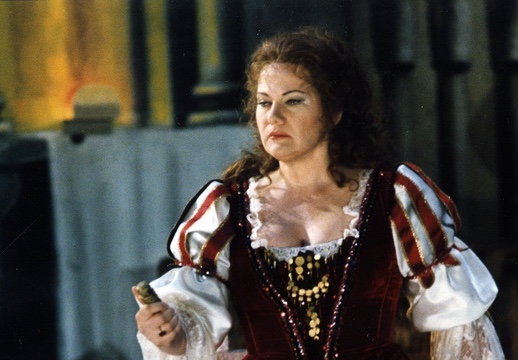
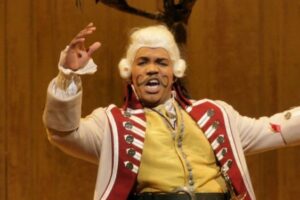
In a striking parallel in Act 3 of Satyagraha, high above the stage near MLK’s podium, projections of riot police appear on large screens in the form of dark silhouettes whacking Civil Rights protesters in slow motion with nightsticks. Soon the police come to life, and their figures descend to the stage to beat and arrest Gandhi’s fellow Satyagrahis until only the spiritual leader is left standing. The police are represented in the form of unidentified shadows without specific designation and belonging to no particular authority, their anonymous character rendering their brutality universal. They could have easily been members of Bloomberg’s ‘army,’ the Satyagrahis members ofOccupy Wall Street.
Bloomberg’s financial support of Satyagraha only underscored the necessity of an active response to the opera. Just as each of Satyagraha’s three acts features a witness spiritually connected to Gandhi’s principles of nonviolent resistance, Occupy Wall Street became Gandhi’s fourth witness, honoring the spirit of ‘Satyagraha’ by staging Act IV outside the Met Opera House. Given the circumstances, an honest interpretation of the Met’s production would have allowed for nothing less. Gandhi, assuming he wasn’t already sitting in a prison cell onRikersIsland, would certainly have joined the Occupiers behind the barricades in front of Lincoln Center Plaza.
“The highest honor that my friends can do me is to enforce in their own lives the program I stand for or resist me to their utmost if they do not believe in it,” Gandhi writes in Young India. “Blind adoration in the age of action is perfectly valueless, is often embarrassing and equally, often painful.”
In a sanitized setting like Lincoln Center, ‘blind adoration’ of Gandhi’s message is all that is possible. Only by pushing against the illegitimate boundaries between the private and the public, art and politics, could something like Gandhi’s ‘truth-force’ be achieved.
After the curtain closed on the final performance of Satyagraha, Cleo stood up from her seat in the audience and called a ‘mic-check’ to announce the protest which had begun outside. It fell on deaf ears. What did the outside world have to do with this opera about Gandhi, which, within the halls of the corporate opera house, should inspire only internal reflection?
“There was an enormous sense of having broken with theatre decorum by yelling in the opera house,” said Cleo. As the audience exited the theater, they found a deserted Plaza surrounded by police directing them away from the demonstration. Nevertheless, many audience members made their way towards the barricades from within the Plaza, against police orders. The bluff of Lincoln Center’s dedication to free-expression was being called in dramatic fashion, and the operagoers paid attention.
“It is interesting that inside the opera house the people seemed contained with all their thoughts inside of them. But outside they opened up, and you could see the audience members who came out develop a glow on their faces,” said Cleo. “The contrast between the atmosphere inside the opera house, and outside, made me see that there is something vital in giving people a regular forum for free expression rather than all the forums we have in our culture simply for consumption.
“There was a sense that opera was not really finished giving its message until the outside action was expressed.”
As the presence of operagoers swelled from the Plaza-side of the barrier, police attempted in vain to maintain the barricade separating them from the protesters on the sidewalk. Soon enough, the crowd had unified, and everyone—inside and outside the Plaza—was an Occupier. A general assembly had begun, and the human-mic was passed around on both sides of the fence.
Dozens of protesters spoke, offering testimonials of personal struggle, rants about the corporatization of culture, and inspiring commentaries on the legacy of Gandhi. What was most important is that everyone’s voice could be heard, a rare thing in a culture where only the highest salaried voices are empowered.
One speaker, John, who had attended Satyagraha, gave an impassioned plea for the continuation of the opera’s themes of love and truth. He then turned to address the police officers guarding the barricades. “I want to say to my brothers right here / that every time / we lift a hand / against our brothers and sisters / we make a moral choice,” he preached. “We don’t have to do this. / You are my neighbor / I am you / and you are me. / I care about you. / I know you care about me. / We’re going to do this together. / Satyagraha!”
Another speaker took the human-mic from the inside of the Plaza. “I performed tonight / at Lincoln Center,” he yelled. “And I stand with you / in solidarity!” At the end of his speech, he hoisted himself onto the metal barricades, his legs straddling either side. “As a symbol / of my solidarity / I’m going to straddle this barricade / because we are / one!” The crowd then broke into Occupy’s trademark chant, “We are the 99%!”
The central attraction of the assembly was Philip Glass’s own participation. A few days prior, Glass had approached Occupy Wall Street with the help of his colleague and fellow composer, Laurie Anderson. After taking his final bow on the stage of the Met, Glass headed to the steps of Lincoln Center, encouraging members of the audience to join him. Once on the human-mic, Glass delivered the final stirring lines of his opera, an excerpt from the Bhagadvad Gita, this time recited in English so the message was crystal clear.
Anderson and her partner, rock legend Lou Reed, also took a turn on the human-mic, after waiting patiently for nearly an hour. Andersonmade an appeal for inclusion in the Occupy movement, and a mending of sectarian divisions. “This is a movement / for all of us!,” she proclaimed.
Reed was more subdued, his verse laconic, but nevertheless emphatic. “I’ve never been more ashamed / than to see the barricades tonight,” he confessed. “I want to occupy Wall Street. / I support it / in each and every way.”
An oft-cited criticism of the Satyagraha protests was its purported targeting of expensive tickets as the smoking gun for opera’s supposed ‘elitism’ or ‘snobbery.’ The criticism is misplaced. It is true that such sentiments were floated by a couple individuals at the protest’s general assembly—which gave voice to anybody who wanted to speak—but was never a position endorsed byOccupy Wall Street orOccupyMuseums.
Even if opera were free, much of the population would still feel alienated from it and never come. This is sad, and the reasons for it have to do with the aforementioned movement towards total corporatization of culture, and the consequence of having fine art made even more detached from a population increasingly driven toward fashionable consumption. This is ironic, given that art’s corporate sponsors are members of precisely the class whose preferred policies have warped culture in this direction (see: David H. Koch). To return opera to the people (and vice-versa, to return people to the opera), serious political change is necessary. Hence, Occupy.
The movement is still in its nascent stages, and much work is still needed to amass a movement capable of dethroning the existing institutions of power. As Gandhi knew well, politics turns on public opinion, and the success of Occupy will depend greatly on its continued ability to inspire rather than alienate the public. “It is our exclusiveness and the easy self-satisfaction that have certainly kept many a waverer away from us,” Gandhi wrote of his Satyagrahis in 1921. “Our motto must ever be conversion by gentle persuasion and a constant appeal to the head and heart.”
The seeds have been planted for genuine radical change, and the fate of human society depends crucially on the success of a movement inspired by the principles of Gandhi’s ‘truth-force.’ Though mostly symbolic, the demonstration outside Lincoln Center on December 1st revealed the power of a movement dedicated to truth and justice, and to the nonviolent confrontation with the sources of power that divide and embitter the population. For a few hours that night, the artificial divide between public and private had been dissolved, Glass’s opera was released from its corporate shrink wrap, and the commons were reclaimed.
Benjamin Laude is a Juilliard pianist and an organizer with Occupy Museums, an official action group within the Occupy Wall Street movement. In drafting and revising this essay, he received input from members of Occupy Musuems, though the thoughts and opinions expressed are his own and do not necessarily reflect those of the movement.


parterre in your box?
Get our free weekly newsletter delivered to your email.



Comments