
 That Philip Glass’s opera about Gandhi’s nonviolent civil disobedience should be revived by the Metropolitan Opera in 2011—a year marked by nonviolent revolutions and uprisings around the globe—is timely, to say the least. The most recent production of his Satyagraha (1979) was first premiered by the Met in the spring of 2008 as America stood on the precipice of the most devastating economic crisis in three-quarters of a century.
Three years later, with unemployment rates still hovering around Depression-era levels, Satyagraha returned to the Met this past November in time for the world premiere of Occupy Wall Street, which just two months before had staged its own production of nonviolent civil disobedience in Lower Manhattan.
Inspired by the Arab Spring and the summertime uprisings in major cities acrossEurope, a small group of activists occupied Zuccotti Park in New York City’s Financial District on September 17th in protest of the gross injustices of the global economic system. Situated just a few blocks from Wall Street, the encampment’s location was both symbolic and strategic: the primary culprits in the infliction of three decades of economic misery were the Wall Street-based multinational financial firms, whose singular dedication to the maximization of private profit has concentrated wealth and power among a short-list of their most esteemed shareholders, ensuring the minimization of equality and democracy among an increasingly debt-burdened and dispossessed populous populace.
With Washington in bed with Wall Street, the only hope for the marginalized majorities was to take matters into their own hands: move in to the neighborhood and begin waging a campaign of nonviolent resistance against the institutions of oppression and domination. Within a few weeks, ‘Occupy’ had exploded and hundreds of similar occupations began cropping up acrossAmericaand the rest of the world.
On December 6th, a week after closing night, I had the privilege of watching Satyagraha in an encore showing of the Met’s HD broadcast in a theater on the East Side of Manhattan, intent on writing a review for Parterre Box. The film-like presentation allowed those of us in the theater access to many of the opera’s details not available to the fixed perspectives of in-house audience members at the Met, and Glass’s portrayal of Gandhi came through vividly on the big-screen.
Nevertheless, there was something unsettling about the whole experience. How was I to react to a four-hour meditation on Gandhi’s nonviolent resistance in the comfort of a private theater, while real acts of nonviolent resistance were taking place around New York and the rest of the country that same day? In writing a review of the opera, I decided to push the limits of a purely aesthetic interpretation (Part I), before realizing the necessity of an alternative response (Part II). Given the loaded content of the opera, and the conditions of its cordoned-off production amidst a growing popular movement of resistance, only an active political reaction would suffice.
When Philip Glass first conceived of an opera about Gandhi’s activism in the mid ‘70s, Occupy was little more than a twinkle inAmerica’s eye. Globalization was in its incipient stages as the corporate world was scrambling to address falling profits. The manufacturing industry which had formed the crux of the postwar boom had set sail for the Third World, and America’s business shifted to finance. In response to a perceived crisis of insufficient demand and underconsumption, newly empowered financial industries donned their Santa-hats and dropped credit-cards in the stockings of endangered middle-class Americans everywhere. A nation-wide shopping spree soon commenced, and a generation of home-owning, SUV-driving, cable-watching optimists vied to keep its repertoire of electronic gadgets up to speed with a rapidly innovative tech-industry. ‘Terrorism’ and ‘foreclosure’ were not yet household names.
One hundred years earlier, the glimmer and glamour of a post-industrial consumeristAmericacould not have been more foreign to Mohandas Gandhi, who in 1893 arrived in South Africa as a young barrister hired by an Indian law firm in the Colony of Natal, recently having taken a vow of vegetarianism while studying inLondon. Upon witnessing his fellow Indians treated as second-class citizens under British colonial rule and experiencing the humiliation of ethnic discrimination himself, Gandhi expanded the scope of his disciplined moral convictions from the realm of mere self-purification to encompass the broader terrain of social struggle.
Over the next 21 years, Gandhi led a civil rights campaign inSouth Africa, pioneering many of the tactics of nonviolent resistance for which he would become famous. He called his philosophy of active civil disobedience ‘Satyagraha’, a Sanskrit word meaning ‘truth-force.’ The two decades Gandhi spent in South Africa perfecting his method of ‘truth-force’ are the focus of Glass’s opera.
For those audience members looking for a narrative retelling of Gandhi’s time in South Africa, Satyagraha has little to offer. The three-act opera, totaling nearly four hours in length (including two intermissions), eschews the typical linear plot structure in favor of a more spatial, collage-like sequence of extended meditations around select events from Gandhi’s early life.
In his 1987 autobiography Music, Glass writes that “the difficulty for me of using short scenes was that my music tends to have a greater emotional impact when it is allowed a longer sweep of time in which to develop.” Elongated phases of repeating melodic fragments were more conducive to a symbolic portrait of Gandhi, whose spirit could gradually unravel before the audience’s eyes. For Glass, watching the opera “would be more like looking at a family photo album, viewing pictures taken over a span of years. The order in which you saw them might not even matter; it wouldn’t prevent you from forming a picture of the family growing up, growing old together.”
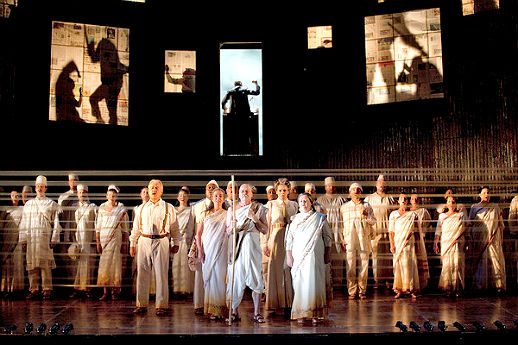
In its recent revival of Satyagraha, which first premiered by the Netherlands Opera in Rotterdam in 1980, the Met marshaled its extensive resources to build a production in the service of Glass’s vision. Like Gandhi, whose principles of modesty and simplicity led to larger-than-life status, the set of Satyagraha utilized such unassuming materials as newspaper, Scotch tape, and corrugated iron to spectacular effect.
The opening scene depicts the mythical battlefield of the Bhagavad Gita (Gita, for short), from which the libretto was drawn by Glass and playwright Constance DeJong. At the beginning of the opera, Gandhi is joined with the two principle characters from the Gita, Prince Arjuna and a Krishna, enshrouded in a radiant blue glow. The three perform a trio in which Gandhi has the last word, singing from the text of the Gita: Hold pleasure and pain, profit and loss, victory and defeat to be the same: then brace yourself for the fight. So will you bring no evil on yourself.
Having been exposed to the ancient Sanskrit text as a young man, Gandhi would adopt the core principles of the Gita throughout his life, often tailoring its themes of self-renunciation and personal transcendence to fit his unique circumstances. Glass cleverly depicts the persistent influence of the Gita on Gandhi by substituting its passages for dialogue otherwise appropriate to the action of a given scene.
For example, in Act I Scene 3, Gandhi and his followers receive news that the British Government has enacted a racist amendment profiling individuals of Indian descent in South Africa. Rather than sing about their specific efforts to resist this so-called ‘Black Act,’ Gandhi and his fellow Satyagrahis instead sing from the Gita: These works of sacrifice must be done. From old did the Lord of creatures say that in sacrifice you sustain the gods and the gods sustain you in return.
The resistance vows are kept in Act II Scene 3, when, after the British Government refuses to repeal the Black Act, the Satyagrahis join with Gandhi in the collective burning of their registration cards. In the Met’s production, they toss their cards one-by-one into a cauldron, each time igniting a controlled flame around its circular rim until a halo of fire stood at center stage, all the while singing from the Gita’s lofty verse above Glass’s transfixing repetitive structures. It is an uncommonly powerful spectacle.
Scenes such as this reveal the uniquely high demands Satyagraha places on its singers, particularly the chorus. Challenging operatic casting conventions, the work functions almost like a staged oratorio, given its scriptural text and its heavy use of choral material. Chorus master Donald Palumbo and conductor Dante Anzolini had their work cut out for them in the preparation process, though the most challenging parts belonged to the individual chorus members and soloists, who had to commit their roles entirely to memory.
Given the lack of obvious structural markers in the repetitive landscape of Glass’s music, entrances had to be thoroughly internalized by the cast. Moreover, the Sanskrit libretto poses a major language barrier for singers more comfortable with Italian, French, and German. At the HD broadcast, the chorus showed what intense preparation can achieve, performing admirably in spite of these significant technical obstacles. Their collective voice juxtaposed neatly with the singular lines of Gandhi, reincarnated by Richard Croft, who delivered a sublime (if somewhat hefty) portrayal of the ‘Great Soul’ (‘Mahatma’).
Perhaps Croft’s most memorable moment of the opera came in its final Act, though the word ‘moment’ is somewhat misleading here. Act III consists of only one scene, an extended ‘moment’ of protest stretching an upwards of 45 minutes. The scene depicts Gandhi and his Satyagrahis joining striking miners inNew Castlein 1913 for a thirty-six-mile march in protest of immigration laws and taxes specifically targeting indentured Indian laborers.
The march proceeds at a snail’s pace, so mind-bogglingly slow that neither the music nor the drama seems to be subject to temporal constraints. The act of protest is literally suspended in time, ever-present for eternity, as if to plead for the perennial necessity of nonviolent resistance in the struggle for truth and justice. Social change does not happen after one or two protests, but as the result of a patient and enduring movement, a piece of Gandhian wisdom which reveals itself throughout the gradual unfolding of the final act.
During the slowmo demonstration, several long rolls of Scotch tape are stretched across the length of the stage at various heights, creating a Cat’s Cradle-like array through which the protestors traverse. The web of tape is at once a barrier and a passageway. The opera culminates in the web’s undoing, relinquishing the artificial boundaries which divide humanity.
To underscore the universal applicability of Gandhi’s principle of ‘Satyagraha’, an unidentified dark figure appears upstage during the unfolding of the final act, his back turned to the audience. At some point it becomes clear that the man in question is Martin Luther King. Having climbed up to a ready-made altar suspended high against the backdrop, the Civil Rights leader begins to gesture charismatically, but at such an imperceptibly slow pace as to preempt any hint of demagoguery. His audience is a limitless overcast sky, expressing the boundlessness of his message. Throughout the unfolding of the protest, King doesn’t sing a word, remaining a silent silhouette suspended above theNew Castlemarch, representing Gandhi’s spiritual shadow projected into the future.
The seemingly interminable scene is accompanied by a series of repeating scales in the orchestra covering several octaves in register, reinforcing even more the static nature of the action on stage. But watching the final scene is not like watching grass grow. While anticipation is lost, an eternal present is found, at peace with itself. The timelessness of the Gita’s themes finds its symbolic expression in the suspended dimensions of the scene itself, as Croft ambulates around the stage repeating a breathtaking ascending scale as if it were caught in an infinite loop of perpetual reiteration.
Director Phelim McDermott and set-designer Julian Crouch, not to mention Glass himself, deserve praise for achieving such a rare and appropriate symbolic effect with only the conventional resources of an opera company (albeit one of the most well-endowed).
Despite the hypnotic beauty of Glass’s music and the rich symbolism achieved by the entire production, there is nevertheless something contradictory about the idea of Satyagraha as a theatrical event. The problem lies in the very idea of representing Gandhi’s philosophy of nonviolent civil disobedience through a staged medium for a collection of spectators functioning as the passive receptacles of the work’s ‘message.’
Perhaps Glass’s opera might have inspired one or two individual audience members at the Met to fully adopt the principles of ‘Satyagraha’ in their own lives, but more likely they experienced the opera by way of disinterested appreciation and detached contemplation, leaving Gandhi and his staunchly anti-consumerist philosophy reduced to an object of conspicuous consumption.
This is not a criticism of Glass’s opera itself, but rather the conditions of its production. The Met, as is true of most prestigious cultural institutions in theUnited States, is able to exist due to the charitable contributions of a wealthy class of individuals and corporations for whom the arts offer a kind of refuge from the messy world of material affairs.
For most concertgoers as well, the purity of aesthetic experience is a welcome relief from the mundane and alienating conditions of ‘everyday life.’ Such a romantic conception of the function of art is built into the very institutional network which produces and sustains it, and has the effect of systematically stripping artworks of their potential critical capacities.
Preeminent cultural sites like Lincoln Center, which houses the Met, thus present themselves as apolitical spaces where artworks may serve as vehicles of transcendent experience, going beyond the depressing world of economic and political affairs to allow for the harmless rumination on ultimate questions of truth and beauty.
But a fundamental contradiction lies at the bottom of the pretense of neutrality and disinterested artistic experience. The very institutions which have actively contributed to the world’s recent political and economic turmoil are precisely those that fund these ostensibly free and neutral cultural institutions dedicated to escaping that world. The refuge of fine art—despite its apolitical ambitions—proves loaded with ideological baggage, inevitably compromising the aesthetic experiences taking place within.
Insert an opera about Gandhi and the contradictions multiply. In his journal Young India in 1924, Gandhi’s made an appeal for radical social change which would find him demonized by the mainstream media outlets today. He writes that the “mad rush for wealth must cease, and the laborer must be assured not only of a living wage but of a daily task that is not a mere drudgery.”
Considering the untold millions who are unemployed or living below the poverty line in theUnited States alone, where corporate executives are simultaneously receiving pay-raises of unprecedented proportions, Gandhi’s words offer a stinging criticism of the fundamental foundations of our social system. “The saving of labor of the individual should be the object and the honest humanitarian consideration, and not greed the motive,” he writes. “Replace greed by love and everything will come right.”
‘Greed,’ of course, is a quality regularly scrutinized in popular culture. But mainstream outlets tend to target specific individuals and never the foundations of the mainstream itself. The implication is clear: solving the financial crisis will involve little more than the simple task of removing the few remaining Bernie Madoffs left in the system. Once these bad apples are gone, so it goes, the economy will thrive once again.
Gandhi knew better than to locate societal ills in the personal greed of a few individuals. “The fault is not of men,” he writes, “but of the system”—a system premised on severe economic inequality, a phenomenon he saw as ultimately responsibility for state violence. “A non-violent system of government is clearly an impossibility so long as the wide gulf between the rich and the hungry millions persists,” he continues. There must be a “voluntary abdication of riches and the power that riches give, and a sharing of them for the common good.”
Considering the strength and moral force of Gandhi’s words, there is little doubt that he delivered his message with the intent of inspiring committed political action in his readers. Yet the heavily figurative, dramatized operatic medium tends to invite contemplative aesthetic reactions from its spectators, Gandhi’s radicalism easily purged in the process. In an increasingly corporatized society fractured by unprecedented income inequality, what is left of Gandhi’s revolutionary message when delivered on a stage brought to you by Bank of America but a cheap slogan suitable for a refrigerator magnet?
Part II of this review will follow tomorrow.
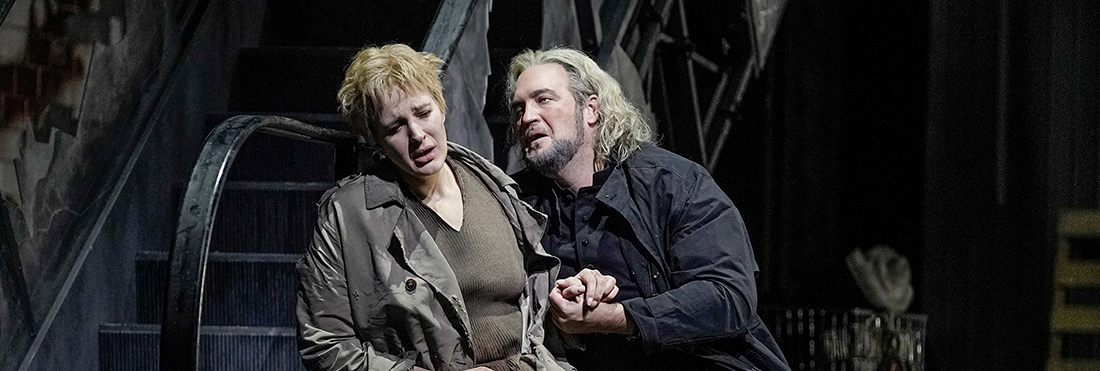
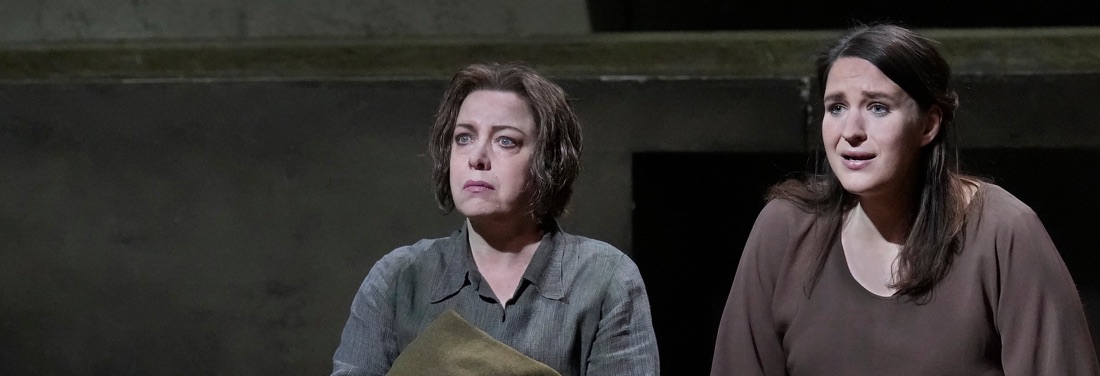
Photo: Ken Howard/Metropolitan Opera.
Latest on Parterre


parterre in your box?
Get our free weekly newsletter delivered to your email.



Comments