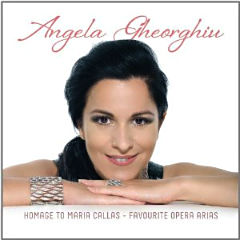
 It would be a shame, I think, if EMI’s stunt video of Angela Gheorghiu “in duet” with Maria Callas backfired powerfully enough to prevent serious opera fans (well, okay, let’s say “enthusiastic opera fans,” that’s more like it) from listening to the Romanian diva’s new CD Homage to Maria Callas. There’s a lot on this mixed-grill disc to enjoy.
Gheorghiu is now in her mid-40s (46, according to her official bio) and she’s been singing professionally for at least 25 years. Here’s one of the earliest YouTube clips of the young Angela Burlacu in 1986:
And a performance from just a few months ago:
What interests me here is not the small but noticeable changes in the voice (the weaker lower-middle register, a slight edge on the highest notes) but rather how well the instrument is preserved: a pure lyric soprano with a slightly veiled quality that opens excitingly into brilliance on top, plus an easy access to a “mixed” chest voice in the lower fifth of the range.
She’s never had a big sound, and generally she has never pushed for size. Instead, she’s either kept a steely eye on the conductor to hold down the orchestra or, other times, simply allowed the band to cover her, especially in passages that are either of secondary musical importance or (one suspects) less grateful to the voice.
What this new disc puts on display admirably is the rare beauty of the voice and, more to the point, Gheorghiu’s fetching musicality. She has a fine instinct for legato and the shape of a phrase, and, more to the point, the singing always communicates feeling.
Now, the range of emotion Gheorghiu can evoke is not especially broad: she is especially fluent at being wistful (as in the album opener “Donde lieta uscì”), but unlike a lot of sopranos, she doesn’t wallow in sadness. She’s always on the inside, experiencing, instead of on the outside, observing and judging.
This selection illustrates the point: no sobs, no exaggerated vibrato, just a quiet sense of resigned heartbreak behind a gallant half-smile. As in all her music, she favors a relatively fast tempo here, but in context it works: this scene is not about self-indulgence but rather trying to break off a relationship with a minimum of rancor: best to do it quietly but firmly.
The other Gheorghiu emotional trademark is manic fascination, as she demonstrates on the second cut, the “Jewel Song” from Faust. Again the aria is quite fast (Marco Armiliato and the Royal Philharmonic Orchestra are her faithful followers) and Gheorghiu stays in tempo most of the time, with only the slightest lingering on “Ah, s’il était ici!” While I don’t think the soprano consciously mapped out a plan to attack just ahead of the beat or to rush the ends of a few phrases, these little tweaks to the otherwise straightforward quick waltz rhythm strikingly suggest the character’s fatal lack of impulse control.
I don’t want to give the impression that this is singing actress territory: for one thing, Gheorghiu is not that specific an artist: basically she does what’s on the page. The other point is that what she does is almost always ravishing simply as singing, the voice supple and even, a firm little trill to launch the aria, suave scales and the last phrase done in a single breath without rushing, the high B clear and ringing but in proportion to the rest of the phrase.
In a way, doing an homage to Maria Callas is ironic for Gheorghiu: they are very nearly polar opposites as singers. True, they could produce some remarkably similar-sounding effects when singing long phrases in middle voice. But for Callas this was something of an acquired virtue, the tone needing some manipulation to produce an even effect. With Gheorghiu it seems more instinctive, even inborn. She is not consciously aware of creating all these effects. Rather, I believe Gheorghiu’s sound simply has star quality; as the old Hollywood definition has it, the voice is interesting even when it’s doing nothing.
The differences between the divas are significant, though. Gheorghiu shows little affinity for bel canto beyond the basic loveliness of her legato. The myriad tiny changes of tempo and emphasis that illuminate a Bellini melody like “Col sorriso d’innocenza,” from Il pirata, the sort of unfussy detail that was Callas’s genius: that’s not anything Gheorghiu can get a handle on. Her performance is square, almost singsong. Later, as the line sprouts ornamentation, she sounds like she’s sight-reading, the various leaps and quick scale figures unprepared and hasty. It’s the only real failure on the disc.
Surprisingly, on “Dei tuoi figli la madre” and “Pleurez mes yeux,” two dramatic soprano arias far out of her fach, Gheorghiu sings ravishingly—in miniature as it were. Cherubini’s Medea here sounds youthful, injured, speaking to her betrayer intimately, almost whispering in his ear. Of all recordings of this aria I’ve heard, this one is closest to what I think an 18 th century performance might have sounded like, poised and elegant even in a moment of anguish.
The Massenet, too, is a young girl’s plaint, once again in a brisk tempo, but with a lovely filigree to the sweeping phrases. Gheorghiu negotiates the chest voice easily, using mostly a “closed” tone that matches the cool, smoky middle register. For special emphasis, she can also open up the chest to a throaty, throbbing cry.
This finesse in the lower register also informs “La mamma morta,” where Gheorghiu’s very slim tone in the opening section (admittedly not a valid approach in a staged production) suggests Maddalena’s emotional fragility. The shift to very soft dynamics early on also enables Gheorghiu to build the climax of the aria into the effect of a fortissimo even though in absolute terms the top of the voice doesn’t get all that loud. The long phrases banging at the passaggio (which almost all Maddalenas simplify to save up for the high B) hold no terrors for Gheorghiu: as she leans into the voice more here, the vibrato widens just a bit, thrillingly, and the top note again is in the context of the whole paragraph of music, the crest of the phrase and not a whole separate event.
The most gorgeous singing on the disc, I think, is the opening section of the “Ballatella,” airy and dreamy, with a true, haunting piano high A on “O che bel sole di mezz’agosto!” It’s hard to imagine a truly ethereal Nedda, but this is what Gheorghiu achieves, a sort of Calabrian Mélisande. And if that’s not exotic enough for you, this cut also offers an example of Gheorghiu’s one real eccentricity of diction, a “b” consonant substituting for “v” as some Spanish speakers do. Thus “Banno laggiù berso un paese strano.” See also the soprano’s sleek, long-breathed “Mon coeur s’ouvre a ta voix,” in which she seems to command Samson to rock a Jewess to sleep (“Berce-moi, berce-moi l’hebresse?”)
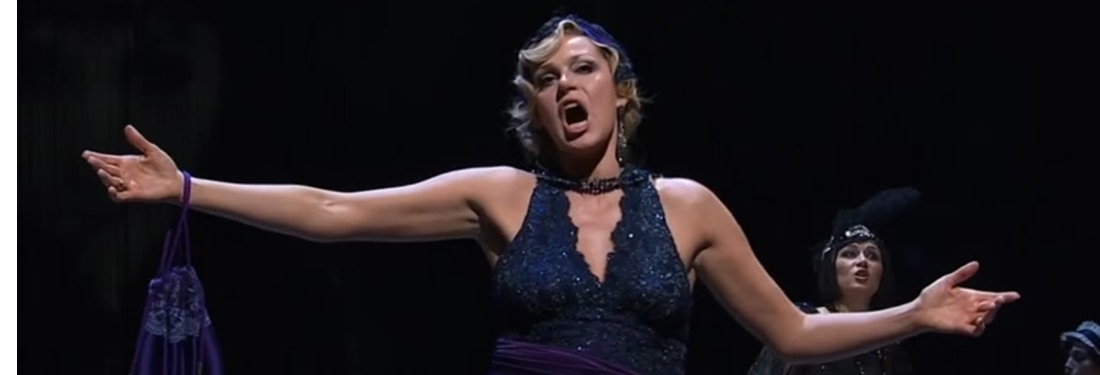
That bizarrerie aside, a final aspect of the Gheorghiu personality only suggested so far in this discussion is the quality of diva that can be called valor if it comes off and gall if it doesn’t. The “Habanera” video with Callas is an example of the latter, but there’s a certain bravery in programming the Traviata double aria at this point in Gheorghiu’s career, coming up on two decades since her breakthrough performance of that opera at Covent Garden.
On this CD she demonstrates that both voice and personality remain a sleek fit for Verdi’s courtesan. The opening recitative and slow movement (both verses) Gheorghiu keeps intimate, almost hushed, drawing the listener in closer and closer. Then she takes the cabaletta at an almost frightening clip, faster than most “coloratura” sopranos would dare. The coda phrase “dee volare il mio pensiero” sounds literally true, a “flight of ideas” symptomatic of bipolar disorder. At this tempo, the quick scale passages sound aspirated and a few other ornaments get a bit smudged. But this is a Violetta who vibrates with excitement, no victim but rather a tragic heroine with the seeds of her destruction sown in her psyche.
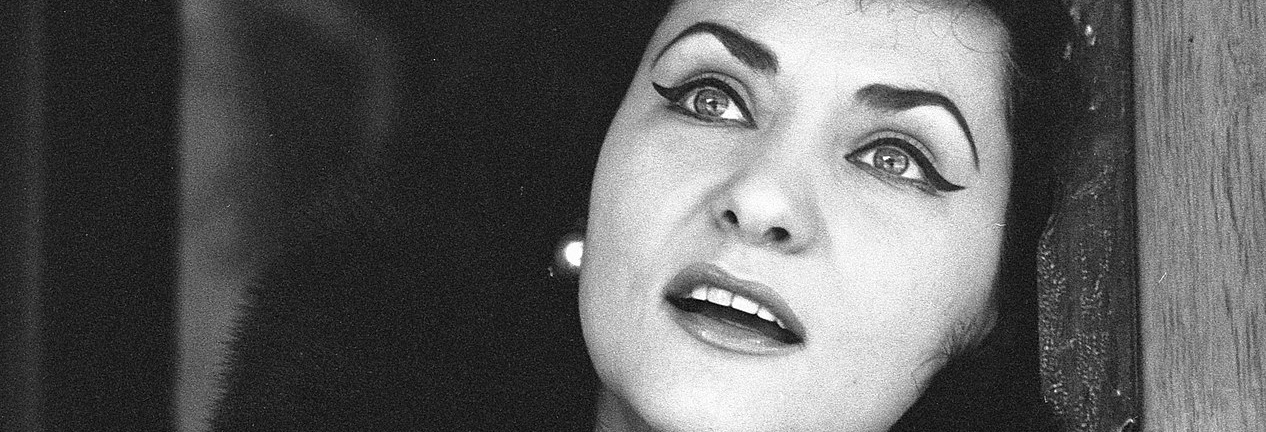
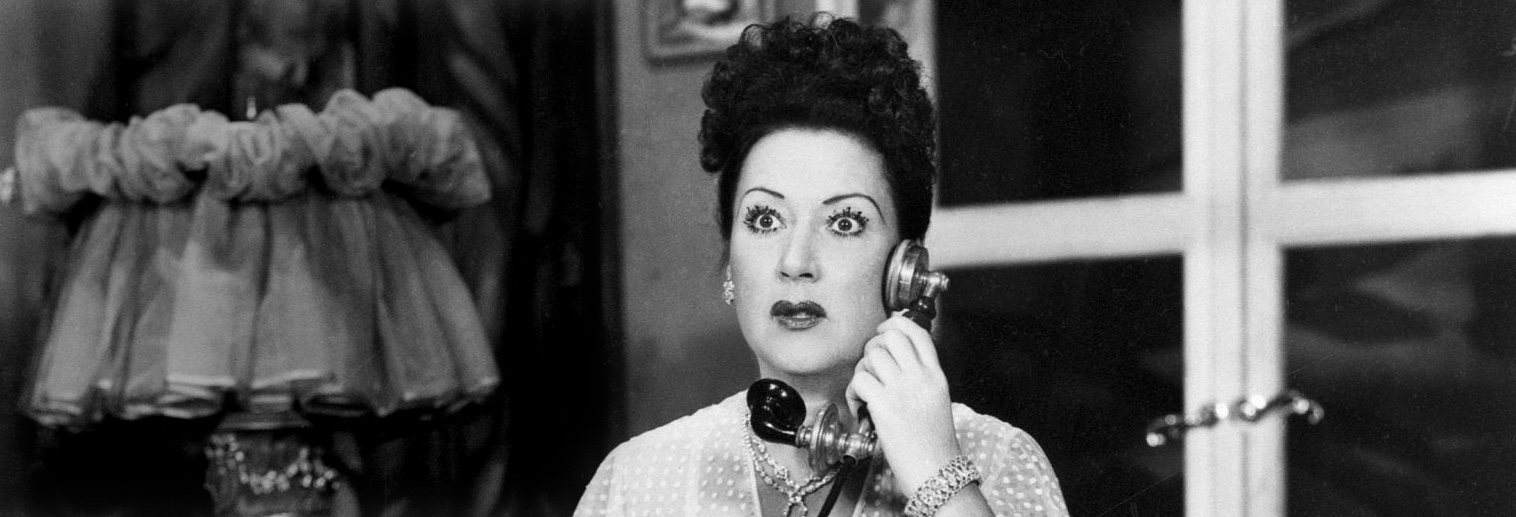
The book surrounding the CD is amusing, offering heavily styled photos of Gheorghiu in Callasesque poses, with archival images of La Divina on opposite pages for easy comparison. An essay presents a few quotations from Gheorghiu that sound heavily mediated, if not downright invented, by a PR team, though it’s hard to read much of anything in typography consisting of teensy white fonts on a bisque background. (Aria texts are bisque on white, which isn’t much better, though the girliness of the effect is very much in keeping with the “Disney Princess” styling of the diva’s photo shoot.)
It’s a campy cliché to say about a singer “she’s never dull.” Angela Gheorghiu, though, is fascinating for many very good reasons, and this CD is an attractive souvenir of her practically infinite variety.
Latest on Parterre

parterre in your box?
Get our free weekly newsletter delivered to your email.



Comments