Headshot of La Cieca

Cher Public

  • MrGuy1804: You are right on the money. I was not terribly impressed with any of the singing. There were a few... 12:29 AM
  • Camille: That was fun, thanks! I had completely forgotten Eastern Airlines, the Wings of Man. With a name like... 12:22 AM
  • Henry Holland: Thanks! Too bad they didn’t do Der Zwerg instead of the (wonderful) Puccini. The LA Opera... 12:09 AM
  • Camille: Thanks Blue, for the review. Lord, what are “earthy colorings”? 12:06 AM
  • Gualtier M: Here is Carmelita Pope in the actual 70′s era Pam commercial at 2:36 in: httpv://www.you... 12:03 AM
  • CruzSF: kashania, please tell us more about these performances. Who? How presented? And don’t neglect the... 12:03 AM
  • bluecabochon: Lucky you, Bob! I;d see it again if I could. Here’s TT’s New York Times review:... 11:53 PM
  • kashania: HH: I thought of you tonight while watching the COC’s double of Florentine Tragedy and Gianni... 11:28 PM

Open mouthed

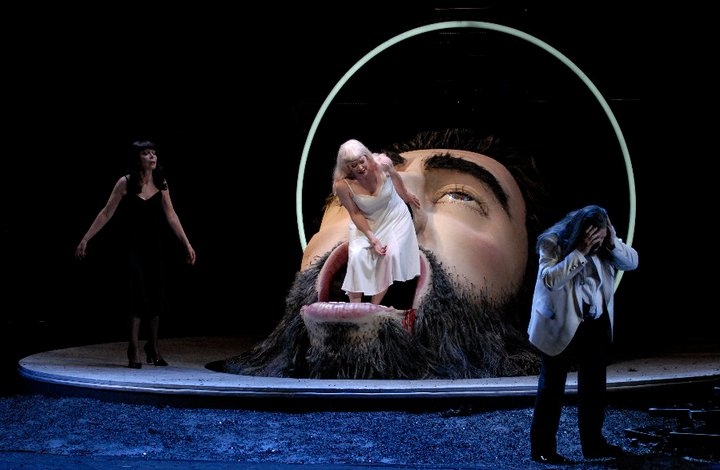
An exciting album of photos from Stefan Herheim‘s new production of Salome that opened tonight at the Salzburg Easter Festival. (All images by Monika & Karl Forster).

156 comments

  • Quanto Painy Fakor says:


    Sick of dramaturgs!

  • CarlottaBorromeo says:

    A friend was at the premiere last night. She’ll have more to say about the staging when I see her next week but she says there was major booing for the production team. Also she says the orchestra was unbelievably loud!

    • Feldmarschallin says:

      from the first reviews the singers were panned. What can you except by having Emily Magee as Salome. Mittelmaessig if there was every such is a thing is perfect to describe her. Denoke was wonderful a few summers ago as was Mattila years ago at the Met. Denoke can still sing the role but with Mattila I am not so certain. Perhaps Jennifer Wilson?

      • A. Poggia Turra says:

        Feldmarschallin – what about Marlis Pettersen, in the near future (her website doesn’t list the role as being in her reprtorie) but I think she (the voice) may be there soon.

        I heard Susan Anthony do it at the Deutsche Oper Berlin about seven years ago (the Achim Freyer “deadly Lolita” production) – she did quite well, but I don’t know the present state of her voice.

        • Feldmarschallin says:

          Petersen as Salome? Are you mad? She is a lyric coloratura soprano. I just heard a fantastic Medea (Reimann) which is out on DVD. She sings much Mozart and the Donna Anna was quite a stretch but fits in with todays lighter casting (Damrau, Schaefer, Gruberova even). She sings Zdenka and Zerbinetta but might have given up Zerbinetta now. Sophie Faninal as well. She was superb as Lulu and quite good as Ophelie but I wouldn’t want to hear her as Salome. Never.

          • Feldmarschallin says:

            The Zdenka btw I heard and she was excellent. She was the star of the show which was kind of sad since the Arabella was beyond horrible.

          • A. Poggia Turra says:

            Feldmarschallin – not mad, just uneducated as to “fach” – that’swhy I rely on those of you who know about these kinds of things :D

          • Feldmarschallin says:

            BTW Nagelstad sings the role as well and I was quite taken by her Tosca. I wonder why she doesn’t sing at the Met given that she is a big improvement over someone like Racette. Nagelstad does sing at all the other major houses. Herlitzius would be interesting as well as Salome and got raves for her Elektra last season.

          • Regina delle fate says:

            Hard not to agree with most of that Feldmarschallin, but I imagine a lot of people thought the same when Inga Nielsen started singing the role – one of the vocally outstanding Salomes of recent times imho. And didn’t Strauss want Elisabeth Schumann to sing the role? And wasn’t Cebotari second only to Welitsch – that surely wasn’t a huge voice either – as the Salome of choice in the late 1930s and 40s? Cebotari also sang Turandot of course which is something I can’t quite get my head round. But clearly lighter voices were able to sing these roles in smaller houses with sensitive conductors who kept the orchestra transparent. I could imagine Petersen being able to manage it in a house like Graz, for example, in a few years time, under such conditions.

      • spiderman says:

        Well, Magee actually has a better voice and more vocal technique than Angela Denoke.

        Petersen was already overparted as Traviata. It was like Lulu goes Verdi and then – surprisingly – she had her biggest difficulties in “Sempre libera”.

        • Feldmarschallin says:

          Violetta is certainly a ‘Grenzpartie’ for Petersen and she sang it in Graz. Maybe she wanted to do it since it is a dreamrole for many sopranos. The review I read was a rave but I myself prefer a slightly fuller sound for my
          Violettas. Callas, young Scotto, Zeani, Harteros. Gasdia was quite good too early on. Funny that you say she had difficulties in Sempre libera since she comes from KdN and Konstanze. Damrau will also be singing the role in the future and I also really don’t hear that in her voice either but she stated it is a dreamrole. Sometimes maybe it is wise to keep dreaming about them…

          • A. Poggia Turra says:

            I wonder if her desire to once again work with Konwitschny was the reason for her doing it – they had a great success together in the 2003 Hamburg Lulu.

          • CarlottaBorromeo says:

            Petersen gave an extraordinary performance in Graz and sang with some distinction, not least considering the opera was given without intervals. But it seemed clear that Violetta would almost certainly be too much for her in a larger theatre

          • spiderman says:

            actually even graz was to big a theatre for petersen as violetta.
            when she could sing piano it was very pretty but all the time a bit of power was required she was helplessly drowned out and lacking vocal heft. actingwise it was very good of course, but vocally it was disappointing

      • Nerva Nelli says:

        Th eobvious Salome of the moment:

      • Pu-Tin-Pao says:

        Jennifer Wilson would be great for this production of Salome as she could actually swallow the entire head of John the Baptist at the end. I think she should be considered for this production only, however as her physique du rôle is not quite right. Mrs John Claggart can cover for Wilson and sing the Sunday matinee.

        I still think that Netrebko singing in the thinned down orchestration of the French version might be quite interesting…

  • grimoaldo says:

    http://www.guardian.co.uk/culture/2011/apr/15/tsars-bride-review

    OT: Review in the Guardian of the ROH’s new “Tsar’s Bride” which Andrew Clements finds a bit dull as a work until the last act but praises the singing “even though Marina Poplavskaya gives one of her typically glacial performances as Marfa”.

    Edward Seckerson in The Independent likes the opera as a piece much more:

    http://www.independent.co.uk/arts-entertainment/classical/reviews/rimskykorsakov-the-tsarrsquos-bride-royal-opera-house-2268327.html

    and he praises the singing too except for

    “Marina Poplavskaya’s Marfa displays her customary cool but little warmth on stage and the voice (too much vinegar in the mix for my taste) is undermined by failings in technique which don’t allow for those ethereally spun pianissimi in her climactic mad scene.

    She is anyway sung off the stage by Ekaterina Gubanova whose Lyubasha – a blond bombshell of a mistress scorned if ever there was one – arrives with an a capella folksong which throws the old and new of this exciting evening into startling relief.”

    • manou says:

      Am going on Wednesday – strong black coffee beforehand?

      • Belfagor says:

        Manou, definitely – the 1st and 3rd acts seem interminable, and the radiance of Act 2 is undermined by the visuals – however logical the updating can be seen to be, it’s rather literal and flat. 4th act is fun (if that’s the right word) but it’s a long wait. Some splendid singing though from Vinagradov, Burchuladze and the new tenor…..Conducting got raves, but I thought it was a bit arthritic…….

      • Su Traditor says:

        I’d say a nice sherry in the Opera Tavern would be in order

    • manou says:

      To be fair to poor Marina, she has had better reviews elsewhere :

      The Observer :
      Poplavskaya’s cool, contained yet febrile presence suited the title role, though her voice was not at its best; moments of poor intonation and dryness were no doubt down to first-night nerves

      Musical Criticism :
      As the eponymous bride, Marfa, Marina Poplavskaya’s performance was beautifully sculpted and the making of the opera’s climactic final act, her Italianate ‘mad scene’ controlled to great effect, her tone almost heartbreakingly girlish.

      The Stage :
      Marina Poplavskaya’s sensitivity is to the fore in her recreation of the vulnerable Marfa.

      Evening Standard (positively dithyrambic):
      The merchant’s daughter, Marfa, the unfortunate bride of the work’s title, receives an appropriately classy performance by the rising star Marina Poplavskaya. Her deeply affecting mad scene, in which the delirious Marfa appears in a white wedding dress, references Bellini and Donizetti in generic, though not musical, terms, and briefly Poplavskaya attained the stature of a Sutherland.

      Opera Britannia (not usually tender with anyone):
      Marina Poplavskaya takes the role of Marfa, a role she’s previously sung, with charming innocence and pure tone, particularly in her lower register. Her Act II aria where she sings about her childhood with Ivan showed fluidity in her phrasing, arching easily upwards, a touch of thinness towards the top on occasion. The revelation, however, was her Act IV ‘mad scene’, where Poplavskaya scaled down her voice to a whisper on occasion, almost speaking some lines of recitative parlando rather than singing, reflecting both Rimsky’s pianissimo marking in his score and the fragility of her character’s mental state; the Adagio section features a solo clarinet recalling the theme from her earlier aria, beautifully played here. When she opened up her voice towards the end, the sound had a golden richness to match the gilt decoration of the set.

      • Nerva Nelli says:

        “Poplavskaya’s … voice was not at its best; moments of poor intonation and dryness were no doubt down to first-night nerves”

        Then what accounts for this being true of every performance she sings?

        Clearly a “critic’s darling” in the UK, no?

        • MontyNostry says:

          Well, she made her breakthrough in London and came to attention on Covent Garden’s young artists’ programme, so, for people like our beloved Vicar, she is an honorary ‘Commonwealth singer’. Can’t stand the woman myself.

        • Regina delle fate says:

          She’s hardly a critic’s darling. Apart from her remarkably promising Rachel in La Juïve, the commentariat has proved increasingly sceptical about her vocal gifts and the “Ice-Princess” tag is clearly sticking. Even Seckerson, who loves everything, calls her “cool”.

        • Cocky Kurwenal says:

          As has been pointed out, not really a UK critic’s darling, no. A certain New York based critic didn’t exactly hold back with the praise for her Met Violetta.

          Clearly a divisive singer, something which I think applies in the UK as much as elsewhere.

      • LittleMasterMiles says:

        Critics in Texas were approving:

        [img]http://parterre.com/wp-content/uploads/2011/04/marfa-texas.jpg[/img]

        • phoenix says:

          Miles, are you confused? … perhaps out of fach? I can understand it, since the fach referred to above is closer to my native territory than yours.
          – The above signage obviously signifies Texan approval of Olga Borodina as Marfa in Mussorgsky’s great masterpiece Khovanschina, not Popsy in that Rimski-Korsakov thing.

      • IdiaLegray says:

        Saw the opening Thursday. Poplavskaya gave the least lively performance. The men were all superb as was Gubanova. The updating works for the most part. The chorus placement in Act I was clumsy and the supposedly raunchy dancers tiresome. One also wondered where Marfa’s house was in Act II. Everyone sings about it but it was off stage left somewhere. The staging improved in the second half.
        There’s something dull about Poplavskaya on stage. Her singing of her big scene in the final act was fine, but everyone else gave more lively, committed performances.
        The critics all raved about Elder’s conducting. I thought it was cautious and unidiomatic. Perhaps it will be less so in later performances.
        I like Rimsky-Korsakov’s operas so was delighted to see such a good perfomance of one of the best

        • Baltsamic Vinaigrette says:

          Thanks Idia. I have yet to hear Poplavskaya live but I feel we got in at the ground floor with Gubanova here in Dublin. Three years ago while on a ROH Young Artists’ Programme she stepped in as a late replacement for our own Patricia Bardon in Das Lied Von er Erde at the National Concert Hall and was cheered to the rafters. There hadn’t been a buzz like it in years and years. Her announced return the following season in a concert-only Duke Bluebeard’s Castle caused an unseemly crush at the box office.

          Gubanova has been disparaged on occasion here but nobody who saw those two performances will hear a jot of it. She is young; I hope she lasts.

          • stevey says:

            This is certainly rather exciting Gubanova (iffy sound notwithstanding…)- the final part of the ‘Les Troyens’ duet between Cassandre & Chorebe, which shows off a ringing high C!

        • Cocky Kurwenal says:

          Now Elder, on the other hand, does seem to be a darling of the UK critics. Not that it isn’t necessarily deserved, but it is quite striking how universally positive his reviews are.

  • sorry for the threat hijack,here’s a little something from the ENO Lucrezia Borgia that was just telecast.

    Cieca Carissima, is there a way that we can post our videos using the new YouTube nomenclature? The new links do not attach.

    • IngeK says:

      Thanks,Lindoro.
      I’m sorry, I just can’t get past the use of English. Are there others who feel that way?

      • MontyNostry says:

        Bel canto in English is especially painful – and the translation for that Lucrezia (by the conductor, Paul Daniel) was almost universally execrated … But the singing was pretty impressive.

      • CruzSF says:

        IngeK, you are not alone.

      • Liana says:

        How nice to be a foreigner. I didn’t make out a word and simply enjoyed the music. Although it did sound rather weird….

  • manou says:

    OK – I could only take 39 seconds of it. It is really a complete mistake and feels so alien and harsh. The poor woman sings “Oh! Don’t say it” – she is completely right. If you finish on a consonant, it just sounds so abrupt, whereas Italian words always end on a vowel, which is open and allows the music to take flight.

    Ugh.

    • armerjacquino says:

      OT: psst, manou and cruz- I did it.

    • CarlottaBorromeo says:

      Few people here will want to acknowledge this but the idea of singers performing in a foreign language to an audience listening in a language other than their own is a fetish of the later 20th century. Until the second world war opera in Germany was overwhelmingly sung by artists using their native tongue to audiences hearing their native tongue; in Italy the same… When artists perform in their native language to an audience listening in its own language there is a quality of communication which simply does not exist in most “international” opera houses. It’s not the only way to experience opera but it’s valid and worthwhile – not something over which to screw up our so refined noses in distaste.

      • Henry Holland says:

        Yes, ideally I wouldn’t have to spend half my time at the opera looking at a screen above the stage (or at certain places, in front of me) to get the words, but there it is. I went to the LA Opera Turn of the Screw recently, and even though I know the libretto well, I still ended up using the titles at some points. Why?

        Because some of the singers’ diction sucked and amazingly enough with only an orchestra of 13, their voices got drowned out if they were on the “wrong” part of the stage or facing the wrong way due to the staging. If an opera is in German, I don’t mind, because I’m reading the titles anyway but for an opera written in English, it’s frustrating.

        Yes, the ideal would be fluent in German, French, Italian, Spanish, Russian and Finnish, but oh well. Frankly, I don’t see much point of doing opera-in-English translations of non-English texts if the diction is going to be poor and poorly projected in to the house.

        • manou says:

          Furthermore, ENO have surtitles over their English translations so that you can read what is incomprehensible anyway (choruses anybody?).

          Not to mention the graceful lady in black who sign-interprets some performances presumably for the illiterate deaf people who have chosen to go to the opera….

          • Regina delle fate says:

            Haha – Manou. She’s one of my pet-hates, too. I try to avoid the sign-interpreted performances like the plague. The late, lamented Sir Charles Mackerras refused to conduct those performances. There was always one performance in a Mackerras run conducted by someone else and it was always the opera-for-the-deaf one! Terribly un-PC, I know. In times of cuts, this is an extra the opera companies should definitely dispense with.

          • MontyNostry says:

            What about the deaf directors they have been getting in at ENO recently? Maybe they need some help.

          • IngeK says:

            I thought Manou was pulling our leg with the “sign-interpreter” remark, but apparently not. It brought to mind an experience I had at the Met a number of years ago when the woman sitting next to me apologized for her husband’s occasional restlessness. “He’s deaf, but he comes with me because he knows how much I like opera.” What a guy! He deserves the trophy.

        • CruzSF says:

          I’ve heard Traviata in English (ENO recording) and there is a greater immediacy, I’ll grant that. But the words seem just a bit off the music. The fit isn’t seamless. That’s a trade-off too great for me, I’m afraid.

          • semira mide says:

            Beautifully put, CruzSF, “words seem just a bit off the music” hits the nail on the head.

            The recent profile of Muti in the NYTimes ( not the review) observes how Muti works with the integration of the text and the music.

            “Even before the real singers arrived, he would linger over an individual phrase or word: “ma,” say, meaning “but,” accompanied by a note that changes the direction, and thus the inflection, of the music.”

            Now, admittedly “ma” and “but” are each one syllable. However “but” seems to land on its .. whatever, where “ma” floats, just like the music.

          • Regina delle fate says:

            Funnily enough, no-one seems to have problems with Don Carlo in Italian or I Vespri Siciliani…..

          • MontyNostry says:

            It’s hard enough to get anyone who can sing the notes in Don Carlo, never mind Don Carlos with the added challenge of French vowels and nasals. I have the Abbado recording of Don Carlos on DG, but have never been able to force myself to listen to it all the way through with all those Italian singers mangling the French (as well as, to some degree, the notes).

          • Cocky Kurwenal says:

            Thanks for that Monty, I’d often wondered about the Abbado French DC. I won’t bother. The singing on the Pappano is all a bit raw, but they are pretty good with the text – at least its pronunciation.

          • MontyNostry says:

            I’ve always thought is was a shame they didn’t get Margaret Price and Jessye to do Elisabeth and Eboli for that recording rather than Ricciarelli and Valentini Terrani (who doesn’t even have the top notes for the part). Both were regular Abbado singers, so I doubt he would have objected. Maybe they weren’t available/prepared to learn the role in French (or learn the role at all in Jessye’s case)/not wanted by DG for the roles/not wanted by La Scala’s sponsors who wanted Italians … or whatever.

          • Cocky Kurwenal says:

            A Jessye Eboli sure would have been interesting, and since you’ve brought it up I’m sad it never happened. She could probably have got away with the Veil Song, based on her Medora, and in that era would surely have turned in a decent ‘O don fatale’ too. But it does seem quite left field.

          • manou says:

            Ah but Regina, the Don Carlo is not a translation of Don Carlos – in fact one of the arias (Io la vidi) has a completely different text and a completely opposite meaning to the French.

          • Lucky Pierre says:

            cocky, jessye’s temperament would not have suited eboli. her recorded attempts at carmen, salome and santuzza reveal quite a bland personality.

          • kashania says:

            Jessye had a limited interpretive pallette. When a role spoke to her, she could be very inspired but other times, she didn’t offer too much by way of interpretation (though her singing was always beautiful and musical).

            I think she really did try with Carmen but ended up sounding too matronly and not to most people’s tastes. But I think she was inspired for that recording. I don’t see Eboli being a good fit as far as temprament. Amneris would have been much more interesting, I think.

          • Lucky Pierre says:

            ok, i shouldn’t say she had a bland personality, but she was not fit to sing verismo, for sure. her carmen was rather too ladylike, and i think she was very good when the role called for some kind of grandeur and regality. but not enough fire for the 3 roles i mentioned, nor the typical verdi dramatic mezzo role.

          • Gualtier M says:

            Jessye was full of surprises. In that weird “Carmen” recording she sings the whole thing like a Satie or Poulenc melodie – “bohemienne” in the Paris Left Bank sense. Ozawa in the it isn’t helping anyway and you have Simon Estes with his horrible French and disjointed registers, a matronly Micaela from Freni and Shicoff overemoting. No one seems to be on the same page.

            I think that Eboli has a certain remote grandeur and hauteur and with some coaching Jessye could have killed in it. I also believe that Eboli is a falcon soprano role, not a mezzo part and her voice and style might have been a very good match.

            As for Italian opera in English – early Verdi and Donizetti have a horrible way of sounding like Gilbert and Sullivan in English. You begin to see how much Sullivan cribbed and parodied them in his operettas and the twee translations and English accents just heighten the whole G&S atmosphere. You expect Dr. Grenvil, Monterone or Alfonso to break into a patter song at any moment.

          • kashania says:

            It should be said that Jessye has very decent coloratura skills which she rarely got to display. So, vocally, Eboli would have been well within her reach. Dramatically, the trio would have been probably been the best fit. I could see her really ripping into Carlo once she found out that he’s in love with Elisabetta.

          • Lucky Pierre says:

            kashy, have you heard this?

            i think i have a recording somewhere of her rachmaninoff vocalise as well…

          • Lucky Pierre says:

            i must point out that was a very young norman (1978).

          • kashania says:

            Thanks, Pierre. I have that Armida recording. That’s what I was basing my comment on. It’s the only time I’ve heard her sing coloratura.

      • Nerva Nelli says:

        That was the OPERA magazine party line for many years, and was true of Germany, France and Russia ( until c. 1990 in fcat) but actually in Britain in the 19th century and in the United States throughout the 20th century opera in the vernacular was NOT the norm. And in places like Argentina, Brazil, Chile, Malta and Egypt, traveling Italian companies sang everything in that language, not the local one. Buenos Aires– very important seasons- heard Wagner and Strauss in German.

        So there are plenty of counterexamples to what you cite.

      • IdiaLegray says:

        In the 1950s at the Met, unfamiliar operas were introduced in English. Thus Cosi, Arabella, Wozzeck, Eugene Onegin were given in English. Boris Godunov was performed in English. In the pre-surtitle days this was helpful even when one didn’t get all the English being sung by non-English singers.
        Once the ENO moved to surtitles, I lost the point of their insistence on performing opera in English, particularly in translations as awful as the one for LUCREZIA BORGIA. At least the singing in that production made up for the awful production and clunky translation.

      • Regina delle fate says:

        Hear, hear Carlotta – I imagine hearing Frida Leider singing Leonora in Der Troubadour in Berlin, or Big Renata singing Eva to Tito Gobbi’s Hans Sachs in I Maestri Cantori di Norimberga must have been very involving indeed. It’s not so long ago that Cotrubas and Luxon sang Onegin at Covent Garden. Covent Garden sings less frequently in English now that ENO is just down the road singing everything in the vernacular (albeit often with terrible diction). Some Italian operas – Lucrezia, Lucia – don’t work too well in English but the Jonathan Miller Rigoletto did and Falstaff always seems to “fit” an English version. I even know some Germans who think Andrew Porter’s translation of the Ring is easier to understand than Wagner’s original.

        • armerjacquino says:

          I would not want to live in a world without Big Renata’s ‘Dolce e calmo/Sorridente…’

    • IngeK says:

      Having experienced performances in Copenhagen where each singer sang in their native tongue and didn’t understand each other, I’m partial to opera sung in the language of the librettist – it makes musical sense.

      • Fritz says:

        Well, here’s Wagner’s opinion on this issue. He’s answering a letter from an Australian correspondent who has just seen a performance of LOHENGRIN in Melbourne:
        “May you see to it that my works are performed among you in English; only then can they be understood intimately by an English-speaking public. We are hoping that this will happen in London.”
        (From the Alex Ross blog.)

        • manou says:

          Could it not be the case that Wagner might have approved of the solution of surtitles?

          (Here I am pausing to wrinkle my refined nose)

          I also thought that we were no longer compelled to follow (wait for it) the composer’s intentions.

          Maybe Shirley MacLaine knows a way to get in touch with him.

        • Regina delle fate says:

          Most composers wanted their operas to be understood by audiences. Mozart was delighted when Figaro and Don Giovanni were translated into German as they were almost immediately after the Italian-language premieres.

          • pyramus says:

            Different times, different tastes–and his audiences didn’t have the luxury of surtitles or supertitles or closed-captioned DVDs or even libretti and tiny penlights.

            I don’t much mind German operas performed in English: the languages aren’t interchangeable, but they’re not too dissimilar, either. (The Met’s Taymor Zauberflote is pleasant enough to listen to.) Likewise French and Italian. But I’ve tried and failed to listen to English-language Toscas and Figaros: Italian is just too different from English to make it workable, or even bearable. I don’t suppose an Italian Peter Grimes or a Russian Faust would be any more attractive. (I adore Mady Mesplé but she did a French Queen of the Night that just sounded vexed at having a head cold. There are ways to express fury in French, but translating from German is not one of them.)

          • armerjacquino says:

            This is one of the few websites on the net where ‘Different times, different tastes’ becomes a massively controversial thing to say.

          • Henry Holland says:

            This is one of the few websites on the net where ‘Different times, different tastes’ becomes a massively controversial thing to say

            You must not spend any time on baseball-related sites then, there are still people that lament changes that happend in the 1940′s.

          • LittleMasterMiles says:

            Different times, different tastes–and his audiences didn’t have the luxury of surtitles or supertitles or closed-captioned DVDs or even libretti and tiny penlights.

            Of course they had libretti, which were sold at every public opera performance going back to the 1630s in Venice. And penlights weren’t needed, as the house lights stayed on throughout the performance (there being no practical way to turn them off before gaslight became common).

    • Cocky Kurwenal says:

      What struck me as particularly silly about this Lucrezia Borgia was that it seemed to be OK with the powers that be at ENO to show naff films in Italian, but not to sing in Italian.

      I think bel canto suffers possibly more than any other genre for the reason Manou gives about words ending in Vowels in Italian. It applies to Italian opera sung in German just as much.

      Conversely, I don’t think it poses nearly so much of a problem when Wagner is sung in English. Apart from the fact that the vowel ending to words ceases to be an issue for the most part, it also seems to be more possible to come up with a translation that has the right number of syllables and the same sense, sometimes even with the emphasis in the right place too. It does seem to be difficult to preserve Wagner’s intended language register though, without coming up with English that still sounds foreign. I quite like ‘Schweigt eures Jammers jauchzender Schwall!’ as ‘Peace with your cries of useless lament!’ but it’s undeniably weird.

      • CarlottaBorromeo says:

        Of course something is lost when opera is sung in translation. But something different is lost when non-native Italian speakers sing in Italian to a non-native Italian-speaking audience… (or French, or German…) Despite what the self-help books may tell you, you can’t have it all….

      • Regina delle fate says:

        what would “the powers that be at ENO” know or care about opera?

  • papopera says:

    European directors are getting insane. Singers are whores to participate in that kind of trash. Singers should unite and strike such shitty productions.

    • Cocky Kurwenal says:

      They’re not whores, they are people trying to make a living, very few of whom are in such a position of choice about where and when they appear that they can afford to turn down amazing opportunities like Salome at the Salzburg Easter Festival. They are not responsible for the overall artistic result of the opera in which they appear.

      I’d add though that I think it looks like an interesting, effective production as far as one can tell from photographs. It looks a lot less ‘shitty’ than McVicar’s basically traditional (if updated in terms of costume and architecture) ROH Salome.

    • La Cieca says:

      Yes, you’re exactly right. Artists should violate the terms of their contracts and deprive themselves of a livelihood so that you don’t risk accidentally glimpsing photographs of a production you’re never going to see anyway.

      Calling artists “whores” on this site is a quick and easy way to get put on moderation. Next time try to express your subtle aesthetic theories in more temperate language.

      • A. Poggia Turra says:

        Like all of us, singers make compromises and take stands concering the type of employment they will take or not take.

        Singers are free to determine what their tolerances are – one example not necessarily concerning regie per se is the South African baritone Jacques Imbrailo, who sang Billy Budd at Glyndebourne (DVD is coming out soon). Apparently he’s a hard-core (in the best sense, I’m sure) born-again religious person, and as such he’s extremely picky about productions, and accepts that he will miss out on certain opportunities.

        Even someone like Beczala, who has stated his preference for traditional-leaning productions in interviews, regularly appears in regie shows. IIRC he’s said in interviews that (paraphrasing) he stays away from what he feels are the most extreme examples. But I’ve seen him in productions by Wieler/Morabito and Konwitschny, and he’s well represented on DVD in productions by Kusej, Carsen, Bechtolf et al, so he seems to keep an open mind.

    • phoenix says:

      – You tell pappy all about it, Cocky! These fotos from the new production of Salome in Salzburg look great. I can’t say I’d want to go over there & put up with the Europeans having to put up with me in order to see it, but still it looks very fine.
      – And as far as ‘whores to participate’ pappy has become unbelievably proper in later years. pappy may choose not to remember, but when pappy assumed the role of Salome in 1971 at the venerable old Regio di Triangle on 14th Street, it was quite an affair to take note of, so I saved a souvenir of it:
      see below pappy as Salome reclining on the barcounter at the old Regio di Triagle in the grasp of Herod with John the Evangelist in the background:

      [Edited for NSFW reasons. - LC]

      http://parterre.com/wp-content/uploads/2011/04/000001.JPG

      • ianw2 says:

        As many fond memories as that photo brings flooding back, can a boy get a NSFW warning here?!

      • Harry says:

        phoenix: What I find in your mocking aside about papopera, is almost the claim that unless something is restyled to meet the current demands of some present decade, it is dated. That eschews the whole notion that an opera has its instinctive worth in its music and text. I think the first reason people go repeatedly to opera is to see the chemistry generated by various pairings. Not to see what some clot of a director has ‘come up with’. I have never heard of singers doing a superb job of ‘singing the scenery or the concept’.

        What sickens me is people , desperately trendy – wanting ‘to be part of the In-In crowd of some transient Present’. Projecting on some work, various aspects and actions that often can nowhere be found in the text. If something is s…t now, it will remain s..t!.It is then you start sleuthing the career path journey of the director, It is not too long you come across what their personal own hackneyed obsessions, and their hang ups are. Finding what ‘their bag is’ rather than seeing them being professionally detached: guided only by what the task at hand is: presented. When you present before the supporting ‘trendies’, various insane situations created by a director doing an opera or play, I love watching them gasp for creditability in the intellectual vacuum, they have already set up for themselves. Creating all sorts of theories, some wilder and sillier that that, seen of the director. I enjoy punching the gaping rat-holes through numerous production done by opera directors thinking as if they are in film, as great or potential ‘auteur’. Opera has allowed a new form of prima-donna on the block specializing in ‘mod reductionism’, revealing that directors have not done their historical homework or research. It is all about some ‘brilliant idea’ they came up with.
        I suppose we can expect a fashionable myriad of Salomes around the world for the next decade about strained party figures finally ‘getting the guest’ who just tells too many tales out of school.

        No wonder live opera is literally going down its own cistern. It is not exactly in a healthy financial state, is it. The real drama is keeping the doors open.

        • Pelleas says:

          “part of the In-In crowd of some transient Present”

          I need that on a t-shirt so badly it hurts.

          • Harry says:

            Pelleas: The ‘Present’ will soon enough to be seen, as part of what is dated and has transpired.

            Far better to being part of : The ‘In – with the Out & Out Crowd’ who don’t accept s…t when they see it. I gladly identity with such a group of outsiders.
            They do not tolerate with any form of theater or music having their minds treated as if it is malleable and gullible kid’s plasticine by cultural carpetbaggers. Whose output is invariably quickly identified just by their individual bag of performance ‘histrionics’ they pull around to each production. The natural reaction:”F..k not…., not them again!” Showing not intellect,honed experience or enhanced ‘truth’ of some text, done with great respect but the extent of their mental development: the mind of a snail seeking to spread pestilence.

            Who somehow got into a position to abuse great works, by getting hold of the proverbial nuts of some cultural establishment board members. In turn,you often find such comfortable ‘seat-warming’ hierarchy are too embarrassed to tell the upstart pretenders to piss off and show them the door. To do so, would reveal their own failures at decision making.

        • phoenix says:

          I have no objection at all to opera-in-concert, in fact, since I am basically an audiophile, I couldn’t care less what they do with the regie. But if they insist on staging these operas, then the more interesting, passionate & bizarre the regie is the better I like it … it is far more preferable to the traditional pearl clutching crap I’ve seen for the last half a century. After all, many opera plots are passionate & bizarre anyways, and the ones that aren’t are definitely in need of extra enticements, however offensive they may be.
          – Still I am most loyal to the sound of these performances, like I am blindfolded oftentimes & it’s hard for me to see what’s going on, so I find opera-in-concert gives much better audio & minimal stagenoise for both listening in person & recording but they seem to be a increasingly rare nowadays because most people seem to prefer having someone to boo & castigate onstage at the end of the curtain calls inorder to jackup their adrenalin for the night. After all, they paid their money & they need their thrills. How can you get them incensed enough unless you ‘restyle’ the work in as shocking a manner as possible? Read the old posts on this site. None of them would dare profess to booing a singer: that is unacceptable nowadays, but they have a ball attacking the regie support crew. Therein lies the thrills.

      • Harry says:

        Phoenix: Perhaps some regie opera director ‘ought’ / needs to bring in ‘smell-o-vision’ for your added appreciation.

        • phoenix says:

          I’ve already got smell-o-vision over here from reading your pungent comments. But how can I get taste-o-vision? Any suggestions?
          [img]http://parterre.com/wp-content/uploads/2011/04/0001.jpg[/img]

          • MontyNostry says:

            Does someone give Salome a pearl necklace in Herheim’s production? If so, is it Herodes or Jochanaan?

          • MontyNostry says:

            … or even Narraboth?

          • CruzSF says:

            if Narraboth gives one to Jochanaan, I might be interested.

          • Harry says:

            Phoenix: Now in reply to 16.3.3.1 , just think for a minute. I don’t dare athe proper suggestion to overcome that problem… with what I am thinking. It would be even too much for parterre.
            Though others may be perceptive enough to know what I am alluding to.

            I always have the same visual impression when thinking of silly opera fans fawning over the indefensible work of some director.
            I do though agree about using imagination , regarding opera. Give me a sound recording of an opera and I will instantly create in my own mind: sets, costume ,and situational placement of characters. I am already there …in the theater.
            Just as a conductor can pick up and read a Score and hear the music in his head.
            There was a time when I religiously collected every available major label recording of complete operas. Allowing one to compare and decipher what this or that singer or conductor brought, to shine light on some character or a given situation. It adds up into some ‘totality’ of what the composer wanted.

            When we then find some regie director forgets to tick the essential points in their transverse of a opera and the in-probables keep stacking up: essentially stopping artists flesh out even the most signifying characteristics, I get extremely wild. So that ‘get out of jail’ word…’controversial’…then, is used. The game then played,: It is all right to talk about ‘how controversial it is’ but considered, poor form to and give it and drive home, the boot it deserves. You then know another insidious fraud, has slipped into the realm of opera. All one has to ask is “Where is the love?”. No matter how happy or violent an opera is. You are born with it or will never have that understanding.. It is not something that is quickly acquired by some director happening to be rather accidentally asked to now come ‘do an opera’ because they are considered hot and clever at the moment in some other area of the Arts..

            Notice ….how so many regie directors started so far away from opera, in theater groups where self-imposing a particular slanted stamp of outlook was the calling card for those types of group’s very existence. I used to call it, enforced socio-political propaganda theater. How coincidental!

          • Harry says:

            Didn’t Bumbry once make witty mention of doing Salome wearing ‘just pearls’?

          • phoenix says:

            Harry, thanks for the answer to my question in 16.3.3.1.
            – As far as Love goes, some of us don’t seem to experience much of it in our life; others seem to. If one hasn’t experienced it, how can you portray it with any spontaneous honesty, except in a parroting imitative manner. No matter how much they allude to such, quite often (but not always) in these operas I see people hot for a lot of things but not really for or in love, whether they realize it or not. Maddalena was right when she mocked Chenier at the party, but of course she had to pay for it later on…
            – I never heard that quip from Bumbry, but it makes sense now remembering Bumbry do Salome at the Met in the 1970′s. She really didn’t wear very much. All I can remember is something cover her tits and this g-string affair. From where I was standing, all I could see most of the time were these imposing buttocks & thighs, very similar to pappy’s Salome at Regio di Triangle.

          • Harry says:

            Phoenix: the photo of the woman with pearls in her mouth ‘tasting’ reminds me of a fellow that goes around old bric a brac shops. If he comes across anything remotely silver, he actually can smell it. Getting it home and further chemically testing it, always finds he was right. He maintains that as a young boy, his jeweler uncle trained him in the ‘art’!

            Your mention of Chenier (an 1896 opera I love) I am sure you have you noticed all the great similarities of its Act 4 to Puccini’s Act 3 of Tosca. dated at 1900..

          • phoenix says:

            Harry, honestly I never compared the 2 nor thought about their similarities, except both of them being classified as “verismo”. But no, I didn’t see very much similarity between them until you just mentioned it.
            – It took me over 30 years to really get to like Tosca; I loved Chenier the first time I saw it. The last acts of both of them begin with a tenor aria and then a duet ensues… I guess if I consider the duet in Tosca to stretch all the way to the end of the opera, then there is a very great similarity between them. It’s just that the final duet in Chenier is so straightforward but the one in Tosca is more meandering and conversational (in Puccini’s own personal, inimitable fashion).
            – I remember the last time they did Tosca here in town & they interviewed the soprano in the local newspaper. She stated that Tosca was the first modern opera, and I thought how absurd a statement, but now I see how correct she actually was.

  • schweigundtanze says:

    This is entirely off topic, but I was looking up the famous Behrens Geschrei tonight to share with a friend, and the link in the original post is, sadly, dead. If any dear soul would reupload this event, I would be most appreciative. :)

  • mia apulia says:

    Another highjack.

    Has anyone else seen the Minnesota Opera prodcution of Wuthering Heights (English sung with subtitles–but some obscure vocabulary made me grateful)? A problematic libretto, some odd setting of the language, and surprisingly few melodies for such traditional (read Hollywood) music. And a rather lackluster production.

    Maybe if the composer had been able to see it, revise, and had written ten other operas first to learn how opera actually works….then it might have been quite something. As it stands (I assume there were some cuts) it is a curiosity, with only the last act functioning in any way like a real opera.

    Glad for the opportunity to see/hear it, but a rather trying afternoon.

    • Harry says:

      I have the original English Unicorn label box of the complete recording with Morag Beaton on my shelves. At the time it was first released, it was claimed ‘as long as Parsifal’ in length.

  • stignanispawn says:

    This Salome looks soooooo completely over the top — I would see it just for the experience, and I very seldom say that about opera without knowing the singers.

  • poisonivy says:

    I just have a question to pose — how is it possible to even *do* a “traditional” Salome? For some operas, yes, I suppose it is possible and probably smart to stick to the original time periods and settings of the opera. But “Salome” — well, it’s a Biblical allegory and short of going Cecile B. DeMille, how is an opera director supposed to be “traditional” with this opera? It was intended to be a salacious shocker. Is the director really supposed to create a little nativity scene onstage? Come on.

    • kashania says:

      As far as I’m concerned, it’s not a Salome unless Herod and Herodias are being fanned by giant peacock-feather fans, just like they did in the olden times!

    • phoenix says:

      If my memory is correct, when they first did Salome at the Met one of the millionaire box owners in the Diamond Horseshoe insisted on the set director putting up a Star of Bethlehem in the background. What good that did, I still don’t know.
      – I always thought the opera was shocking just as it is… but when my mother went to see it with her girlfriends, they thought it was laughable & silly. I totally disagreed with them. I think it’s a very serious opera about political corruption & murder and there are no admirable heroes in it except for Jokanaan & the 2 Samaritans. The opera for me doesn’t need any extra shock value but if you are going to try to shock them, make it titillating too.
      – Considering how I feel about the Herodian dynasty (of Nabataean-Petra origin) in history, it suits me just fine to see how Wilde portrays them. But unfortunately it isn’t completely true. Salome lived a full life, got married & had 2 kids. Jokanaan despised the corrupt usurping Herodian Dynasty and so he was executed for such. According to Herodotus, Salome was quite skilled at court politics & intrigue, but how much she & her mother had to do with the murder of Joakanaan no one has left any valid evidence that I can find.

      • luvtennis says:

        Obviously, the Star prevented all the participants from going to hell for presenting and enjoying such scandalous, sin-full, work of art.

        Phoenix, do you really see Jokanaan as an “admirable hero.”

        I see him as tragically flawed. Unable to make the connection with Salome that might have saved her soul at a time when the decadence and violence of the world around her had awakened in her the NEED for salvation. He was as trapped by conventional morality (“the LAW”) just as completely as Salome was trapped by the flouting of the Law exemplified by Herod’s court and her delightful mama.

        Actually, in that sense, the Star of David is like an ironic commentary on the work, right? Not that the Robber Baron who insisted on the scenic addition had any clue. . . .

        • Harry says:

          luvtennis: Exactly! Johanaan is surrounded by what are various cries of others’ inner angst: all he can do is to denounce. Un-hearing and blind to what are crying-out appeals of the pain, doubts and agony of those around him. Like some raving fundamentalist stirring up a group with total un-compassionate rejection. Seeing it as further truth, of his own held sense of total self righteousness.
          Thereby, setting up the Court power play – with Salome falling in with, and aiding Herodias -the already ‘a black widow spider’ – in counter humiliation by the deadly ‘united female species’ kind. By playing a baiting pawn – on top of what is the spider web’s cistern grate..before both Johanaan and Herod.

        • phoenix says:

          This thread is so very aptly named “open mouthed”. luvtennis I don’t fully realize what you are trying to infer, but if had a tennisball right now it would be somewhere in the vicinity of your larnyx.
          – I wrote Star of Bethlehem NOT Star of David. You changed that to suit your own personal discrimination. Furthermore, the Robber Baron I referred to worshipped under the Star of Bethlehem, not the Star of David. And if you are not familiar with the history of that particular area of the Middle East, I suggest you read up on it. Jokanaan was a religious Jew… not a Christian. And as a Jew, for Jokanaan the practice of proselytization was not an option. The rules were the same in those days, they hadn’t changed just because he made it into the New Testament.
          – Jokanaan rejects their hedonistic self-aggrandizing indulgences & he follows the LAW and that is what makes him heroic.

          • luvtennis says:

            Phoenix:

            I knew you meant Star of Bethlehem. I also know the anecdote in question. I meant no offense. I was simply referring to the Christian tradition of viewing John as a foreshadowing of Christ. And while I certainly understand that Jewish observers would not see the Law in the same light as a conventional Christian would, it did not occur to me that my comment would give personal offense.

            Again, forgive me.

          • luvtennis says:

            Btw, my reference to Star of David in the original post was an error. I meant to write Bethlehem.

          • phoenix says:

            luvtennis, i didn’t fully realize what you were trying to infer. Thanks for the explanation.
            – I was a bit perplexed by your reference to salvation, which to me implies proselytization. I find that such could only have existed in the imagination of some of the authors of the New Testament, since Jokanaan was an extremely religious Jew, as you say trapped by the LAW, proselytization is not an option under any circumstances, as it is for Christians and Muslims.
            – I feel Jokanaan is the only main character who is heroic because as hostile & hateful as he may appear to be, he honestly does follow the LAW of MOSES. He doesn’t try to play lobbyist like the other Juden; he knows the origins of the Herodian Dynasty and their corrupt politics. He particularly disliked Herodias & her daughter because they were Nabataean-Petra gentiles (albeit royal ones) whom Herod welcomed into his family line since his roots, too, were from the same Nabataen-Petra Dynasty.
            – I guess Jokanaan today would probably be ostracized for all his condemning, like a member of the Westboro Baptist Church or something, but I still admire him more than the others. He stands out alone.
            – “although ruthless severity is not to be applied persistently and systematically, there may be times when it is the only means of safeguarding against guilt and remorse. In such situations ruthlessness toward oneself is the only means of saving one’s soul, which otherwise would succumb to irresolution and temptation.” — Hexagram 60 Chieh/Limitation, Wilhelm-Baynes translation of “The I Ching or Book of Changes“

    • Harry says:

      It IS possible to do a traditional Salome, that is a right royal shocker to make people, almost squeal in their seats. And no, I am not suggesting more nudity or explicit violence. There are many many aspects implicit in the text and score to be still capitalized on to take audiences into even darker abyss areas of the mind. Some productions have touched on some of those aspects. While some they never have. Brought together and propelled further would be the big whammy. Aided by co-ordinate combination of certain symbolism, costume and special lighting, plus some pointed weighting of some of the characters is all it needs.
      Give me Salome to do and if it was not a sensation, you could have the right to kick my backside mercilessly!

    • Poisonivy, I actually was wondering about that as I was watching Herheim’s production. Most Salomes aren’t strictly traditional, but they are for the most part fairly literal, which is odd for an opera that isn’t at all plot-oriented or realistic. The surface is so lurid that no one seems to think going beyond it is necessary. Herheim’s take on Salome’s character was far less superficial, which I really appreciated.

      • poisonivy says:

        Well I think at the heart of Salome is an old Biblical fear of dancing, and more vaguely, of female sexuality. The idea that when women allow themselves to be driven by sexuality rather than morality, they will literally strip down to nothing and kiss a decapitated head.

        I think the reason most productions are literal, if not traditional, as you said, is because the music is very literal. It’s like Tosca, in that you can always tell what is “supposed” to be happening onstage by listening to the score. It’s not a subtle score, although it is startlingly effective.