Headshot of La Cieca

Cher Public

  • Camille: I hope one day……e tc. 9:47 PM
  • Camille: Nerva, you are the funniest. TY for the word pn Carmelita Pope. Supposing I know her from PAM. I am one... 9:46 PM
  • Nerva Nelli: Surely it must be Christopher Alden’s ENO restaging of THE ENCHANTED ISLAND . 9:19 PM
  • actfive: Also saw this at LOC…Zajick looked totally bored, occasionally annoyed (maybe she was pissed at... 7:56 PM
  • phoenix: Fanciulla is primetime Puccini – I find Voigt about as italianate as Niamh Parsons – still,... 7:23 PM
  • Henry Holland: Good Dame Gwyneth as Minnie, Domingo as Jack Rance, LA Opera, 90′s sometime. At the end of... 7:16 PM
  • PushedUpMezzo: Well of course the mike’s the clue. She famously had no need of such things. The lady... 6:25 PM
  • La Valkyrietta: I voted, but it was not easy. I mean, for example, how do you decide which was a lousier... 6:17 PM

Che sera, Sarah

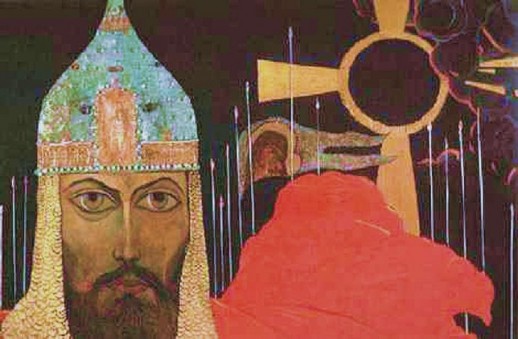
ilya-glazunov-prince-igor-1962La Cieca has just heard (from no less a source than Sarah Billinghurst herself!) a tidbit that will no doubt interest Daniel Stephen Johnson among many others. It seems that the Met will produce Prince Igor in 2013 with Valery Gergiev (naturally) conducting and Dmitri Tcherniakov directing. The Prince himself will be Ildar Abdrazakov.
55 comments

  • wenarto says:

    I am confused (been drinking whiskey) -- is this Prince Igor?

  • m. croche says:

    For God’s sake, don’t get those Polovtsii too close to Ground Zero.

  • Arianna a Nasso says:

    Tcherniakov? Oooh, lots of panties will be in a wad once the Met audience sees his work. Can’t wait :-)

  • louannd says:

    An interesting scene from Dmitri Tcherniakov’s DG at Aix-en-Provence

  • bash23 says:

    Tcherniakov did amazing work with Pulencs “Dialogues des Carmelites” in Munich.. That’s something to look forward to!!!!

    • spiderman says:

      The most amazing thing of the Dialogues was, that you could hardly see the singers in that stupid littlehouse from most of the seats at the State Opera!

      Isokoski was awesome though ;)

    • LittleMasterMiles says:

      Am I misunderstanding the film, or does this version feature Blanche rescuing the nuns from a burning convent at the end? ‘Coz you know, that’s not really what’s s’posed to happen….

      • spiderman says:

        Yes you are right. But it’s not a convent, it’s A Datcha, and it’s not burning, they are killed by gas. The explosion in the end kills poor Blanche though..

        • LittleMasterMiles says:

          Oh jeez, I mean, well, yeah, sure, but you know, I would have thought the music itself is pretty specific about that last scene. Not that Tcherniakov’s idea isn’t plausible, but I can’t believe it’s as dramatically effective as Poulenc’s.

    • Maury D says:

      Betty White alert at 3:03. Salve Blarrfingarr.

      From the clips I’ve seen, though, bring on the Cherniakov. Seems like maybe an opera director rather than a theater director trying to figure out what you do about all that music.

    • OMG! The Carmelites as a cult. This is fucking brilliant! I am not fond of this guys apparent penchant for changing the story, but some directors are like that, so whatever…. Does anyone know if this will be (or was) telecast in Europe? I want a copy.

      I sat through this guy’s Giovanni with several fellow members of the public and the general consensus was that the 1st act had interesting moments, even it it was infuriating at times and that act 2 was a fucking mess. So i would give his Igor a chance, but I would not expect the clouds to part and a dove come down from heaven and rest atop his head.

      • louannd says:

        I agree totally. Interesting doesn’t really mean you have to love what you’re seeing to appreciate it.

      • bash23 says:

        This was the first and ever production I’ve seen of Dialogues, so I can’t really say if the end is “as dramatically effective” as Poulenc’s.. All I can say is that I was shivering and crying as the curtain fell… I think this work is very difficult to stage, and Tcherniakov did an awesome job…. Besides, the cast was just amazing – Isokoski and Gritton and Palmer!
        And no, sadly they did not broadcast this at all…

  • peter says:

    Boy, is the Met overdue for a revival of Dialogues or what? Interesting casting possibilities.

  • manou says:

    Coincidentally, I have just seen the Bolshoi Tcherniakov Onegin (that’s one one with the table – lots of clips on YouTube).

    The main concept….(hang on whilst I find a word that carries less of a charge)….The main notion is that everyone is sealed into a certain set of circumstances and mores from which they cannot escape. In many ways this is more of a Chekhov atmosphere than Pushkin. The chorus is omnipresent, sometimes oppressively so (they giggle a lot at Lensky’s anguish in the birthday scene) and there are some unnecessary silly bits (Lensky sings the Monsieur Triquet ditty – in Russian, the duel is a drunken brawl in full view of said chorus…), and, I think, one miscalculation, which is that Gremin is present at the beginning of the last scene when Tatyana confesses to him that she is troubled by seeing Onegin again. He also walks off with Tatyana at the end, so that her choice seems to be dictated by his presence rather than being her own principled decision.

    The voices are amazing – wonderful Russian molasses. Ekaterina Shcherbachenko has all the makings of a major star. Her acting is excellent – she is a near catatonic Tatyana at the beginning, letting rip during the letter scene (excellent lighting) and transforming herself into a Grace Kelly figure at the end (yes, she is a real beauty as well). I saw Vasily Ladiuk instead of Kwiecien. He seems very young and was very well cast – a bit too much forehead slapping at the end but good aloofness elsewhere.

    The conductor was Dmitri Jurowski (brother of the more famous Vladimir) who was lucky to have the Bolshoi opera helping him along.

    This production makes an excellent case for taking a different approach to conventional stagings. I think that so long as one follows a clear and consistent view of the piece which hangs coherently together, this can work extremely well. It is extraneous bits of random staging which do not seem to coalesce with the whole that alienate the audience.

    Sorry for the rambling.

    • Belfagor says:

      I’ve seen Tcherniakov’s production of Eugene Onegin a couple of times now, and I think it’s one of the most absorbing new productions I’ve seen in a long long while – this was the production that Vishnevskaya got into such a hissy about and moved her 80th birthday celebrations from the Bolshoi, vowing she would never set foot in there again, because of it. What a shame. How could she not see that, though radical, it is so perfectly attuned to the music and the psychology of the characters. I saw Makvala Kashrashvili both times as Madame Larina – who could imagine M. Larina stealing the opening of the opera? – but she made her such an extraordinary character that her relationship with her daughters made perfect sense. It’s sheer brilliance all through, and devastatingly emotional. I’ve never seen a better ‘Onegin’.

      I’ve seen (on DVD) a slightly grim ‘Khovanshchina’, and a riveting ‘Kitezh’. He is very good news indeed and it will be brilliant to see what he does with ‘Igor’ and how he can make that piece, gorgeous music and ruined scenario, work.

      He’s also down to do a ‘Simon Boccanegra’ at English National Opera – can’t wait.

      • Dawn Fatale says:

        The DVD for this Onegin contains a riveting documentary about the rehearsals for the production. Tcherniakov gets into passionate debates with the singers about the dramatic implications of particular musical details. It’s very refreshing to see a director who not only knows how to read music, but actually knows how to listen to it, too.

    • Batty Masetto says:

      Count another vote for that beautiful Onegin, which I know only from the DVD. The lighting in the Letter Scene really is pretty mind-blowing (or maybe I should say fuse-blowing).

      An alternative reading of the last scene – which, again, I know only from the DVD so other performances might read differently: Gremin clearly adores Tatyana. She reciprocates by taking him into her confidence and he supports her. It’s a working marriage. Her principled decision is made before the scene, but she sees it through, and when the going gets impossible Gremin intervenes to help her get away. Gremin may be an unromantic choice as a husband but is a far more viable life partner than unstable, egotistical Onegin. Tatyana doesn’t do so badly after all.

    • (An insignificant quibble: Tatyana’s name-day, not birthday, darn it.)

  • !!!

    I’m a stranger in paradise.

  • LittleMasterMiles says:

    Back to Billinghurst, isn’t it a little fatuous to argue the best way to determine “the correct version” (her words) is to see several live and recorded versions, and then talk it out with the conductor and director? For a work with as complex a history as Prince Igor, surely a little musicology is in order?

    I’m not arguing for some slaving adherence to what any particular scholar thinks was Borodin’s (or Rimsky-Korsakov’s, or Glazunov’s) “original intent”—a work like this pretty effectively give the lie to that kind of thinking anyway. But to pick and choose from the versions that happen to be available as though they all had equal authority—as seems to be the Met’s method here—is willfully to ignore the whole question.

    For those of us who find opera to be not only dramatically exciting but also historically interesting, it’s a real shame. I’m sure Richard Taruskin will share his opinion in any case—but will it be with the Met before the fact, or with the NY Times after it?

    • DonCarloFanatic says:

      Good point, but haven’t we all wished we could pick the Act I from one version and the Act II from another? Maybe that’s more their line of thinking.

    • Taruskin has a typically thought-provoking and entertaining piece from 1994 on the political issues of Prince Igor, though he doesn’t go into the edition issue in detail: http://bit.ly/d84DOb

      Excerpt: “So for those who want to soak up their nega [eastern exoticism] undisturbed, and to insure the successful suspension of their moral indignation, I offer a catalogue of things one must not think about while watching Prince Igor.”

      There is potential for Tchernikov to really go to town on this one.

      • The most entertaining bit, of the many, was the straight line that he drew from Borodin to the Soviet war in Afghanistan.

        Some people have made careers out of looking for Orientalism and proto-fascism in various operatic works. Whatevs, the way they want to earn a living is their business. I will continue to laugh at rudimentary notions of what a work of art is and how it means what it can mean.

        (And I grew up in a country which Lehar used for his Pontevedro. If that’s Balkanism/Orientalism, please I want more.)

        • LittleMasterMiles says:

          Some people apparently believe a work of art can carry whatever meaning makes them feel good, so long as they don’t have to think about it too much.

          Taruskin wasn’t looking for Orientalism and protofascism in Prince Igor; he was finding it the nineteenth-century Russian society for which the opera was written. Isn’t knowing that much more interesting than going in with a bland taste for pretty tunes and whispering “ooh, I know this bit!” at the Act II ballet?

        • You’re arguing with a straw man, there. Mind if I join you?

        • I’m sorry, but Prince Igor is one of the most blatantly Orientalist and imperialist operas out there. If you don’t see that you are willfully ignoring it. I think we need to acknowledge that this is music with an insidious agenda, just as we are careful to do with Wagner. It doesn’t mean we don’t perform it, just that we’re aware of the issues.

          Also, “Tcherniakov.” I misspelled it above. Based on what I have read about his Dialogues, I don’t think he’s the kind of director to unthinkingly stage an exotic extravaganza in Act 2. So I am very intrigued.

        • m. croche says:

          I’ve said this before, but I’m curmudgeonly and occasionally repeat myself.

          In thinking about Borodin and “Orientalism”, an interesting comparison can be found in the operas by the Azeri composer Uzeir Hadjibeyov (Latin spelling varies, sometimes Uzeyir, sometimes Hajibeyov, sometimes something else.) His active compositional career was from c. 1908-1937. The first of these, Leyli & Majnun, is styled a “mugham opera”, wherein some sections are sung along the lines of traditional Azeri mugham and others are performed with an augmented European orchestra in a Borodinesque style. In his subsequent operas, Hadjibeyov gave up using traditional-mugam (finding female mugam singers willing to go onstage undoubtedly played a role) and wrote a number of through-composed operas.

          The style of these works obviously hearken towards that the “orientalist” style of Balakirev, Rimsky and Borodin – but here it’s been appropriated by one of the colonial intelligentny. Hadjibeyov of course, avoids the violent/sexy dichotomy found in the music that Borodin etc. wrote for the Polovtsii – the characters are drawn from the same stock of legendary figures, heroic figures and village/urban types that one might find in a Rimsky opera.

          So while Borodin’s opera does indeed trade in the type of ethnic stereotyping common in Russian society from the beginning of the 19th century through to the present day (“war in Afghanistan” may be updated to “war in Chechnya”), the music itself was helped provide some of the colonized with a language through which they could portray life in the Caucasus as they saw it.

          Some excerpts from Youtube:

          Leyli & Majnun: http://www.youtube.com/watch?v=RdrjA50oPMk

          Arshin Mal Alan (1913): http://www.youtube.com/watch?v=PopQmh0l_54&feature=related

        • m. croche says:

          Ok, here’s a couple clips -- I can’t resist:

          Am I now officially a Hadjibeyov-crank?

        • m. croche says:

          Yes, I am! One more clip before cara La Cieca bans me from the site for being Baku-obsessed. I misspoke when I said Hajibeyov abandoned traditional Azeri mugham after Leyli Majnun -- you can still here some in the comedy O Olamisin, Bu Olsun (1913) aka Mashadi Ibad aka If Not This One, That One.

        • m. croche says:

          Curiously, the greatest Occidentalist (or anti-Occidentalist) opera was being developed in Russia at the same time: Mussorgsky’s Khovanshchina. How great a leap is it from the sympathetically-treated Old Believers/Raskolniki, who immolate themselves at the close rather than join a modernized and Westernized Russia, to a anti-Western suicide bomber?

          Yes, it’s a leap – but a big one?

        • Indiana Loiterer III says:

          I think we need to acknowledge that this is music with an insidious agenda… It doesn’t mean we don’t perform it, just that we’re aware of the issues.

          So why bother performing the music if it has an insidious agenda? That’s the question I always want to ask such scholars.

        • @ Zerbine’ & LMM
          No work of art comes with unequivocal political messaging, and therefore can’t be dismissed as (simply and only) ‘imperialist’, ‘liberal’, ‘communist’, ‘social-democrat’, and so on. The audiences across time and geographies don’t receive the same envelope, open it and have the same reaction — supposedly the one leading to a certain political action. This especially goes for music (which is extremely elusive politically), and for the performing arts (where the essence of the piece is to be re-enacted, its meaning and possibilities slightly shifted with each new performance).

          Interpretive habits and interpretive communities do develop around works of art. Probably any kind of art can be — under certain unfortunate circumstances — used for nefarious political ends. So it’s legitimate to investigate whether the czarist regime used Prince Igor to propagate pan-Russian lebensraum, and whether it did so successfully (this is the part that makes endeavour forever inconclusive: there is no way of audience-testing through some strange stimulus-response model). You can also try and demonstrate — and I’d be interested in reading that — that there have been specific productions Western and Russian for which you can argue imperialism-worship. Etc.

          But you can’t say that PI is inherently X and that we can close its interpretive and political possibilities, thank you very much, nothing else to see here. That this work will inspire those who see it (and presumably enjoy it) to join the Russian army and go to Chechnya.

          You can also be Adorno and write at length how reactionary a lot of Stravinsky is and how progressive a lot of Schoenberg, and you will create an interpretive community of people which will survive you. But it won’t mean your school will have the last word or ‘win’ in any epistemological sense.

          Oh and another thing: I say we start by getting fussy about imperialism in governments, international associations, politicians, corporations, historians and media pundits, rather than the artists. They usually don’t have too much power, whatever the regime happens to be.

          Sorry to sermonize! I’m off the soap box now, and about to turn on some Wagner so I can go and invade a small East European country later on.

        • m. croche: yes yes yes! This is also crucial:

          “The style of these works obviously hearken towards that the “orientalist” style of Balakirev, Rimsky and Borodin – but here it’s been appropriated by one of the colonial intelligently.”

          Minorities, the ‘subalterns’, the perpetual others, can reclaim the language of whatever the art we’re talking about is, and undermine the dominant communities of interpretation.

        • m. croche says:

          Definitely: “No work of art comes with unequivocal political messaging, and therefore can’t be dismissed as (simply and only) ‘imperialist’, ‘liberal’, ‘communist’, ’social-democrat’, and so on.”

          No one is “dismissing” Prince Igor. They are, however, describing it. No messaging is unequivocal (see Derrida, Jacques), but some is less equivocal than others. Nobody is foreclosing on interpretive possibilities here – however, if you have a counter-interpretation, perhaps you should, you know, actually advance it.

        • m. croche says:

          (Just to clarify: in the quotation at 9.2.1.10, I wrote “intelligentny” i.e. member of the intelligentsia. So a noun, not an adverb.)

        • m. croche: No, I don’t have an elaborate leftist interpretation of the PI up my sleeve. I was arguing in favour of a principle — the principle that works should NOT be read as containers of straightforward and immediate political messages. Whether there’s currently in circulation a plausible Marxist interpretation of Wagner or a credible Wiccan interpretation of Prince Igor, doesn’t matter too much.

          (Description vs dismissal… also see under Derrida, Jacques and no clear line between value judgments and statements of fact. Descriptions have quite a bit of evaluation going on. Certainly the word imperialist does. But now we’re getting into scholastics.)

        • m. croche says:

          My impression is that there’s not a single person here who doesn’t love Prince Igor, or at least who doesn’t like it a whole bunch. But even things we love (or perhaps especially the things we love) can still call forth ambivalent feelings. I think what you see in some of these posts are not dismissals of Prince Igor but attempts to manage conflicted feelings about it.

      • Belfagor says:

        I think this discussion should give the director quite a bit of ammo – much more interesting than the usual perception of this opera being a rather broken-backed optimistic recounting of a defeat, where the logic takes second place to the dancing.

      • m. croche @ 9.2.1.4: thanks for repeating yourself because I missed it before and it’s very interesting.

        Definitely @ 9.2.1.9 and 13: What M. Croche said. And a lot of this is not interpretation, it’s background. I fail to see what doctrine Taruskin or any of us here are advancing other than attempting to read the text in some kind of historical context (though Taruskin does throw a few bricks, as he does in all his Times pieces). As for documentation, Taruskin has a whole chapter on exoticism in his book Defining Russia Musically that puts Prince Igor into a larger tradition. Most of the chapter is not on Google Books, though.

        Indiana @ 9.2.1: Because it has totally gorgeous music. Obviously I’m not giving it a free pass on the political issues, but I still think it’s got beautiful stuff in it.

        • Indiana Loiterer III says:

          Btu is having “totally gorgeous music” really enough to redeem any work from having an insidious agenda? I don’t think so. (I’m speaking in general terms now.) It seems to me as if you have a split between the presumably dumb, wallowing pleasure of immersing yourself in totally gorgeous music and the historically aware moral judgments that come from intelligently identifying ideological agendas; nothing in between. There must be more to art (to life!) than that. Otherwise, why bother with iit when there are so many easier ways to amuse oneself around?

  • Quanto Painy Fakor says:

    Buncha Bullshit from the SOW.