

Second chance?
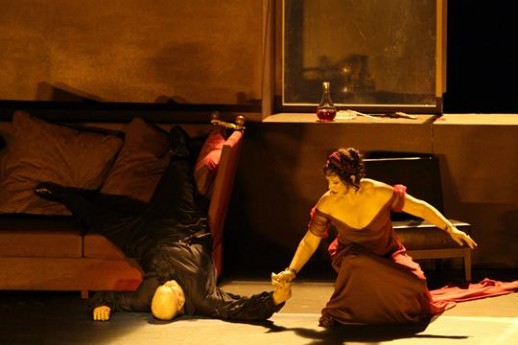
Okay, so here’s that Luc Bondy production of Tosca again, this time as seen at the Bayerische Staatsoper earlier this summer, with the “original cast” of Karita Mattila and the singer who did all the rehearsals in New York until the last week, Juha Uusitalo. They rehearsed again for the co-production in Munich for festival performances and a telecast.
Where La Cieca is going with this is: what we see here likely is as polished as the staging will ever be. And so, cher public, shall we revisit?
PS: It’s Fabio Luisi conducting and, yes, that does make a big difference, doesn’t it?
Bondi is a genius-- I haven’t seen such a richly-textured, revelatory depiction of evil since
Well, see, what I see here is a number of good ideas spoiled by bad timing.
The first thing that goes wrong, I think, is having Tosca try to stab Scarpia underhand. I realize that in a real situation a woman not accustomed to armed combat might well do something clumsy and even ineffectual. The problems here are (a) for reasons of the plot, the first, or at most the second blow of the knife has to be enough to kill Scarpia within seconds, something that is unlikely to happen with a badly-aimed and weak stab; and (b) even if the attack depicted were plausibly lethal, it doesn’t read: you just sort of see some kind of tussle that you have to assume was the stabbing taking place because you know that’s where the stabbing is supposed to go.
I appreciate Bondy’s idea of having Tosca drape herself on the divan à la Récamier, a subtle reminder that even in this horrible moment the diva is thinking in theatrical terms, or rather that for her the only sure reality is what she creates on the stage. The issue is that at the angle she’s lying, she only has access to the knife with her left hand, and since Mattila is right-handed, it looks unnatural and clumsy for her to use the wrong hand at such a moment. If we have to grab at something in desperation, we tend to use the dominant hand, and the use of the “wrong” hand throws off the whole body language into something that looks contrived.
So, the knife should be somewhere convenient to Tosca’s right hand, perhaps concealed in the back cushions. Alternatively, Tosca could lie on the sofa in the opposite direction, i.e., with her head stage right. That way her right arm would be downstage and she could conceal the knife in the seat cushions or on the floor beside the arm of the sofa. But for the moment let’s assume she stays as per the staging here, with her head on the left.
Now, when Scarpia seizes her, Tosca can use her free upstage arm to stab downward into his upper chest, neck or upper back depending on the effect desired. Working from this angle, she doesn’t have to tumble to the floor (which, frankly, just looks like Karita Mattila taking a bad spill) and that when I think the changes in timing of the remaining blocking can cut in.
I like the look of Tosca standing on the sofa and I think it should be exploited more, her towering over Scarpia. So I would keep her there for the whole “Ti soffoca il sangue? E ucciso da una donna! M’hai assai torturata!” through “È morto! Or gli perdono!” at which point the tension breaks and she could slump for an instant onto the sofa and drop the knife. I like very much Bondy’s idea of having Tosca wipe the blood from her hands on the sofa cushions, and I think this could be built up even more by having her move down to the little dinner table and wipe her hands with a napkin there.
Now this is the point at which Bondy sends Tosca to the window. I think this happens rather too early. I would prefer to send her lurching over stage left for a moment. (If the singer needs a motivation for this move, she can head toward the standing secretary desk for a quick look for the safe conduct, though she won’t have time for the whole slow motion Nancy Drew routine.)
From there she goes to the window (arriving around 6 measures after rehearsal #63, page 270 of the Schirmer vocal score) and her lunge as if to hurl herself into space will be at the forte sostenuto con passione. (Now, watch what happens!) Recovering herself, she looks not down but out, seeing the cityscape of Rome. She turns, marveling, and glimpses from above the safe-conduct in Scarpia’s hand. Leaning back into the jamb, she mutters, “E avanti a lui tremava tutta Roma” framed by the window.
Now, at rehearsal #64 she gathers her courage and climbs down, rushes over to the corpse and recovers the safe-conduct (rehearsal #65, lentamente), quickly glances at it and puts it away, then turns and find the Attavanti fan. Staring at the fan, she walks aimlessly toward the stage left divan, and suddenly collapses there an instant before the offstage drumroll. Then, on the final four measures, she can do the business of slowly, mechanically fanning herself. (I would prefer that she do this in full-face toward the audience so she can do the glazed-eyes expression. To tell the truth the profile tableau devised by Bondy suggests repose which confuses the audience. I don’t think that’s what he intended, but his solution was just too subtle.)
So, really, with just a few minor alterations, I think you would have a much stronger murder scene, with less of that deadly “waiting for the music” that happens as it’s done now.
Too bad Bondy didn’t have you to helpful finetune his staging ideas, La Cieca. I, too, felt that she went to the window too quickly. And the main weakness of this scene is the rather anticlimactic stabbing. Uusitalo (who is otherwise dramatically effective) doesn’t help matters by looking obviously at the conductor right after being stabbed.
The rest of the scene works very well, I think. I felt real tension during the few minutes leading up to the stabbing. That’s Bondy’s finest work there.
As for Tosca fanning herself, it makes a nice tableau, but you’re right: she looks too much like she’s resting. And the thought of Mattila staring directly at the audience during the final tableau is chilling.
I’m a big fan of Mattila but one thing that I find puzzling about her acting is that she often incorporates a nervous, jumpy quality into her acting. One can see this all the way back the 91 Bondy Don Carlos from Paris. She’s all jumpy and nervous and frankly, I don’t know why she keeps incorporating that into her acting. Vocally, she’s not an Italianate Tosca but I think her undertaking is a worthwhile effort — not one of her greatest performances — but still interesting and more successful than her Manon Lescaut (which also had the nervous, jumpy quality).
And that is how you stage an effective murder scene.
I have to say that i love the whole fanning business, but I would not stage it slow, i would stage it real time, with Tosca fanning herself furiously and whipping her sweat with something, as if to control her emotions before leaving.
Yes, Tosca fanning herself furiously is much better. Similar point can be made about Zeffirelli’s staging for Callas at the end of Act II. Instead of having her walk slowly off stage, looking back over her shoulder importantly, he had her hurry off. The door slammed against the backdrop of those sombre chords in the winds section. I think that dichotomy between the sombre, slow music and the Tosca’s agitated state (whether it’s fanning herself or running out of the room) is very effective.
I do like the idea of Tosca looking directly at the audience in the final moments. It recalls to me a similar effect in earlier productions of the same scene.
Just before Scarpia died, the great Tito Gobbi, lying on the floor in his final agony, turned his head so that his eyes were directed straight out at the audience. His eyes widened and his face contorted in horror, as if in his last conscious moment, he saw a vision of hell itself.
The exact moment of death was clear to the audience as the life left his eyes, which remained wide open until the end of the scene.
He performed the role for almost 20 years at the Met, always a perfect Scarpia. The last time I saw him perform it was 12/25/75, Dorothy Kirsten’s 30th anniversary at the Met. Quite a night.
For me, the thing is off the rails before the murder. I have to wonder if Bondi instructed the Spoletta to deliver his ‘come Palmieri’ in such a anvil-on-the-head obvious way (“I want it more Snidley Whiplash!”).
That same thudding obviousness comes in molesting the statue of Mary, the whores, the game board, the fan business… the villain is even dressed in black for god’s sake.
What is the advantage of this kind of regie over the most strait-jacketed Zeffirelli production?
Completely off topic but I just got word from the Jussi Bjorling group that Sirius has a broadcast scheduled on 7/19 at 6 a.m.of the 1950 Don Carlo in tribute to Cesare Siepi: Cesare, Jussi, Bob, Jerome H, and Fedora! Wonder what Bondy et al would do with a cast like that!
Tim
Not to be faceoutious, but I imagine that Bondy et al would still try to do their jobs as directors and present effective theatre on stage.
Add a Delia, maybe?
I actually enjoyed the way Scarpia fell on the knife. I’ve only seen Tosca a small number of times — Puccini just isn’t my cuppa — but I didn’t lose the gist at all, and I liked the surprise.
In fact it seems more natural and likely that a feminine diva would kill a big man by using that man’s weight and momentum onto the knife against him, than by using any physical strength or assassin’s training she may have received at the Conservatorio. Did they have those kinds of electives back then? Did she pick up some samurai hara-kiri techniques from Pinkerton? Oh. Wait. Never mind.
Anyway, I also like the way that the stabbing has a sexual connotation in a dramatic reversal — he tries to take her, but in his same aggressive motion she ends up taking him. I found the killing scene compelling and effective.
I also agree with operadent, kashania and richard that the snare drum’s cue should not been ignored. I admire Bondi’s decision to use the fan the way he does — it’s a thought-provoking and dramatic staging for a challenging musical interlude, and provides more satisfaction than having people run away and leaving the stage empty — but I wonder whether the snare drum might have been incorporated by having Tosca give a slight and subtle start — who? what? oh!! — and then after showing a look of pain, resignation, grief and/or exhaustion, have her faint gently away as the music takes us to curtain.
Mario del Monaco does his best Howard Hughes impression.
K, hate me if you will, but I truly loathe this opera more than just about any other (you know, the shabby little shocker thing), and have in fact therefore NEVER seen it in any form whatsoever straight through. So I come to this video clip pretty much a virgin, at least visually speaking — no preconceptions, no expressed fondness for candelabra — hell, I didn’t even know Angelotti’s execution is written into the music, I so ignore this piece. Oh wait, I take back the visual virgin thing: I have seen the film of this scene in the 1964 Callas-Gobbi Covent Garden production, but I don’t remember much of that, either, other than Callas’s reaction to seeing the knife in her hand (awesome).
All that said, this was about as undramatic a scene as I’ve ever had to sit through (“Is this gonna end or is she just gonna stumble aimlessly around the stage for another five minutes?”) — largely paceless, torporific, with no momentum and mistimed climaxes, it just seems like a random sequence of concatenated stage busy-nesses. First this thing happens, then she does this, then she does that, then she does this other thing, etc. It’s like reading a movie script. Having her stick him like a pig in the gut (three times) may be appropriate to his character but is still kind of undramatic, unbelievable (this kills him almost instantly? It should have worked so well for Will Smith in Six Degrees of Separation….) and distasteful all at the same time.
K, I ain’t sayin this is the only way to do this, I’m just sayin this really works.
Call me old-fashioned, but this has ten times more tension and dramatic integrity than the Bondy’s version. Look, the very notion that Tosca, diva though she may be, would–even for effect–put herself in the come on and fuck me position on the sofa is pure nonsense. Standing on the sofa? I thought she’d start bouncing up and down. And all that unbearably tedious staggering around and then lying on the sofa fanning herself with the Attavanti fan straddles the line between ludicrous and comical. That fan, there? Can you say, “Hey, let’s go down to the barn and put on an opera with some really cool irony”?
But in this Zeffirelli version we have a steady line of rising tension, with not one false or unrealistic move. Callas, of course, is brilliant here. Her shifting despair and hoplessness to vengeful killer to horrified Catholic is seamless and oh so right. Only one moment is too heavily theatrical: the slow lowering of the glass makes me scream, “Just put it down the way anyone would and lean on the knife as always done. It’s always done because it works so well.” But aside from that, perfect.
Listen, I was a kid in the audience of the Shriners Theater in L.A. when Kirsten, with the SF opera, kept having to blow out the recalcitrant candels that continues to relight. She ultimately shrugged at the audience and finished her business. That had more tension than this Bondy thing. I’m with K here: how long does this have to go on? Strikes me this is a performer without real character purpose at that moment.
“Look, the very notion that Tosca, diva though she may be, would–even for effect–put herself in the come on and fuck me position on the sofa is pure nonsense.”
I know you’re “OLDdansker” but are you really so old that you know how a ‘diva’ in the year 1800 would behave in such a situation? Unless you’re not the latest incarnation of Elina Makropulos, you really can’t make such pronouncements with credibility. Doing so without substantiation just invalidates your comments.
” the slow lowering of the glass makes me scream, ‘Just put it down the way anyone would’”
I couldn’t disagree more. This is the crossroads of her life. The moment when her fate is sealed. To have impaired motor control as Callas brilliantly does there is entirely expressive of the fact. Why should a great heroine at fate’s highest moment act “the way anyone would”?
But at least you know the work. We get lectures about its supposed low quality from one above who admits (boasts?) that he/she has never even seen it except in clearly-misunderstood excerpts. Bah.
I said you could hate on me — I just don’t like it. Sorry. I’m not alone in that, however. Geschmacksache. I’ve HEARD it, if that counts, I just wouldn’t pay to see it.
Oh, and “that shabby little shocker” is a famous quote from Joseph Kerman’s Opera as Drama. Sorry, guess I should’ve put it in quotes just to be safe/clear. Kerman REALLY hated it — I was just being facetious.
No, in your present company you needn’t put such a notorious saying in quotation marks. And, as someone who knew Kerman and attended many AMS meetings with him, I can assure you that it was his reputation, not Puccini’s, that was damaged by that intemperate and unsupported remark of his.
Kerman’s still alive, last I checked. And while there undoubtedly some members of the AMS who didn’t care for some of his music criticism, I find it difficult to believe that his “Tosca” remark – notorious though it may be – would have done his reputation much damage on publication. It’s not as though the climate in the AMS was particularly Puccini-friendly before the 1990s.
And I can hardly imagine what Alto means by “unsupported” – Kerman offers several pages in two portions of “Opera as Drama” arguing for the musical-dramatic insufficiency of the opera. Since these criticisms are detailed and coherently-presented, it’s hard to consider them “intemperate”.
One can disagree with Kerman – I certainly don’t agree with everything in those passages from the book – but Alto’s characterization of both the passage in question and the subsequent reaction to it seems off-bass to me.
tee-hee, “off-base”.
When I referred to my having known Kerman in the past, I did not mean to imply that he ceased to live when I no longer saw him.
Just because I mentioned the AMS as a venue for association with him, I also did not mean that that was the most significant forum for discussion of his ideas on Puccini.
And, by “unsupported” I did not mean that he didn’t argue his case. I did meant that I think Puccini’s stature as a dramatist comes out it unscathed.
Sorry if I didn’t make myself clear.
Ok, so Kerman’s reputation didn’t suffer in the AMS because of that remark. (Indeed, the Musical Times in 1963 reported that the famous phrase had “already passed into critical commonplace.”) So if his reputation suffered on publication of Opera and Drama, republication in paperback, or the new and revised edition – it wasn’t in the marketplace either.
I think it’s much more likely that Puccini’s reputation suffered because of Kerman’s critique than the reverse. Kerman would have been seen as setting a marker for high-minded criticism of the art-form, helping to set sober critical standards for a genre that seemed suspiciously frivolous, demonstrating the difference (in his view) between the inspired and the meretricious.
We have a more balanced assessment of Puccini now, but I think it’s a mistake to think he enjoyed the highest critical esteem in post-war America.
Even more old school: the great Amira Kamel:
A model for Vera Galupe-Borszkh?
I am just back from the Orange Tosca, which you could all see here
http://video-direct.france2.fr/player.php?id=850
tonight at 21.45 French time (that’s 3.45pm NY time).
I liked the production, and Naglestad, (but many of the French critics hated her). Alagna is in his element there, and wore the tightest pair of trousers I have ever seen in my life, and Struckmann was very disappointing in the Te Deum, but better in the second Act.
Have a look (and not just only at Bobby’s pants).
Ah non! Got home too late and can’t find a re-watch option with France2.
Do not despair – I am afraid the French ran true to form and would not allow the broadcast beyond its borders (including les territoires d’outre mer, of course).
“C’est notre Roberto national! Nobody but us gets to see his… performance!” Domage.
You can catch a glimpse here
http://mediterranee.france3.fr/info/provence-alpes/orange-roberto-alagna-et-tosca-est-de-retour-64103451.html?onglet=videos&id-video=mars_1243946_150720101152_F3
…well – just a soupçon!
To Manou further down: Yep, saw that one when looking for the whole thing the first time round. But thanks anyway!
(Torturing Cavaradossi with cigarette butts has been done before, but still looks interesting…)