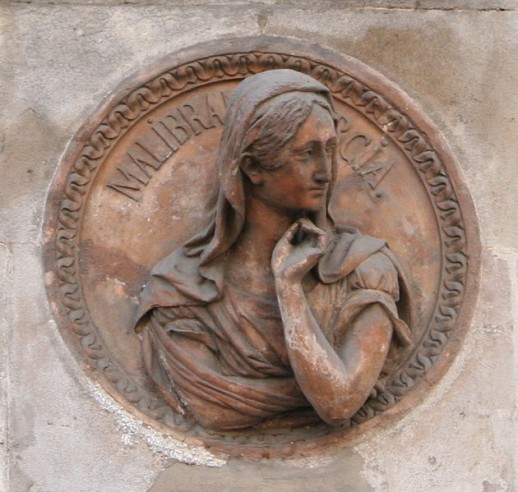
You can ring my bel canto
Since last night marked the debut of history’s newest and perkiest interpreter of the role of Norma, and (more to the point) since Bellini’s druid priestess will grace the woods of Katonah, NY during the month of July, La Cieca thought it would be exciting to organize a YouTube competition on the theme of bel canto. The very special prize to the winner of this week’s competition: a pair of tickets (complete with transportation) to the Bel Canto at Caramoor presentation of Norma on July 16. Your task, cher public, is to find and to embed a YouTube clip that illustrates or embodies the meaning of “bel canto.” Entries will be judged both on the musical quality of the clip and on your introductory paragraph explaining to us why and how this clip is a sterling example of the art of bel canto.
The contest will close on Monday, July 5 at midnight. The commenter who posts the clip and comment La Cieca judges the best (and her whim is final!) will receive a pair of tickets of the July 16 performance of Norma at Caramoor plus a pair of passes on the Caramoor Caravan departing from the Grand Central Station area at 4:00 pm and returning after the opera.
And now, a singer who has been ringing La Cieca’s bel canto for several seasons now, joyous Joyce DiDonato. In this selection, she perfectly balances the technical control necessary to bel canto (long breath, smooth legato, seamlessly blended registers) with the musicianship and emotion required to bring the piece to vivid life. In particular, note the aggressive vocal attacks on the strong rhythms of the main theme of the cabaletta, bordering on the declamatory but always within the context of a breath-supported legato.
So, cher public, let’s hear it from you: what is bel canto and who can show us how to do it?
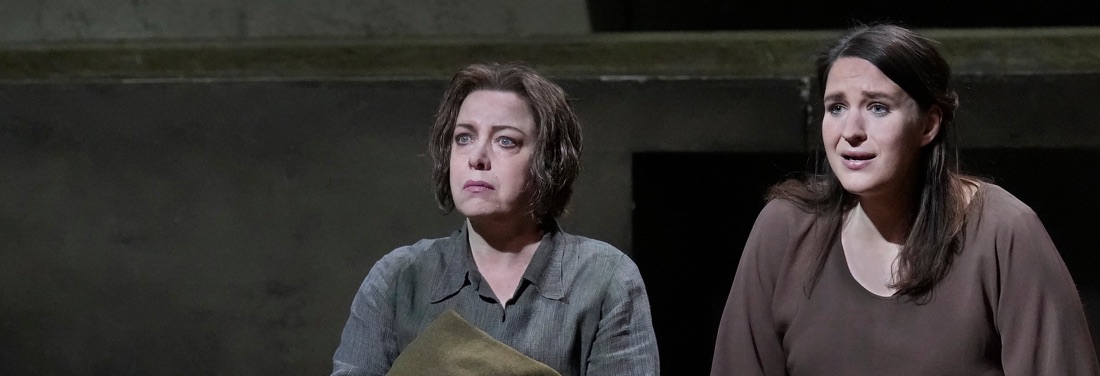
Speaking of Norma and Adalgisa, a great mezzo inspires an imperfect soprano to stay on her best behavior during this duet.
In my mind, this is what every bel canto singer should aspire to. In this celebrated live performance of Anna Bolena (“Al dolce guidami”), Callas shows that the drama should always be rooted in the music. She uses her superb musicality (phrasing, dynamics) to convey the emotion of the character. There are no extra-musical histrionics here. All the expression is in the musicality. Besides, she was in particularly good voice that night and her control of pianissimi is incredible.
I think this speaks for itself. She has been dubbed “la nueva Susan Boyle”.
This is going to end badly, I know it. The video will become an instant hit with the cher public (a la Joan on a swing), our doyenne will not recognise its greatness, and there will be mass riots. I feel like Cassandra.
Did I mention she won and the resulting album has an accompanying trap set on this number?
Can I propose that all of these YouTube contests be deemed NSFW. They are very conducive to 5 hour YouTube death spirals, and really do a number on your productivity.
Help!Desparately seeking Msgda!
At Magda olivero’s recital at Carnegie Hall, she sang “O quante volte”…..It was absolutely haunting in Magda’s own style of verismo bel canto. I was there. I believe the concert has been released commercially. I can’t find it on youtube. Anyone??
First this --
This is going to raise a few eyebrows. Before hearing this recording I was extremely suspicious. I’m not particularly fond of both ladies. Despite both having, of course, gorgeous instruments they are less than conscientious musicians, each in her different way. Sutherland not really bothering with the line, the center of the phrase and, of course, the pointing of the text. Caballe tends to chop up phrases and exchange portamento for real legato. Anway, by 1981 or so, when this recording was made, they were both past their best. Yet something special happened here. Both retain some mannerisms, yet trascend them to achieve some moments of pure beauty and musicianship. Perhaps the older Sutherland was able to identify with the role. Past a subpar Casta diva she is extremely moving and believable as a character. Caballe’s agreeing to sing Adalgise to Sutherland’s Norma is surely a unique moment in recorded opera. They LISTEN, both to each other and to the music. You get a very strong feeling of a special bond between the two women. So this excerpt has beauty and dramatic vraisemblance combined. Technically imperfect, perhaps, but surely perfect in its own unique way.
Second, more obvious
The great Gencer in her 1957 ultimate best. IMHO the best recorded Leonora (yes, I know the Ponselle excerpts and whatever the young Muzio recorded of the opera, I also love Callas’ 1952 live recording, truly patrician) in Verdi’s swansong to bel canto. Gencer has it all here -- ductile, velvet sound, perfect legato, burnished top, covered pianissimi (which I love, ala Cerquetti), defined, warm center and connected chest voice. She manages to present Leonora’s anguish and still spin a beautiful line. I could write an article about the sense of dramatic progression, of delicate shadings of her recitativo “vanne, lasciami”. Just listen to the one word “sospiri” (at 1:48) and what she makes of it, while making it all sound natural and not contrived.
Third, so very obvious -- this:
Anything I will say is totally superflous. The person who truly understood (IMHO) what bel canto stands for in the second half of the 20th century, and was fully able to present an INTERPRETATION to the public. This, in what is perhaps the most vocally and dramatically demanding scene in the entire bel canto literature. The acting in the orchestral introduction is worth every milisecond of your attention. More than acting, she is reacting to the music, and it seems as if whatever is happening in the orchestra is stemming out of Imogene’s rapidly changing mental states. Callas understood that to express horror no gasps or shouts are needed. “No, non e questo” is in fact done in the extreme opposite way -- it is uttered under the breath. For this person opera, and bel canto, were not a superficial vehicle for vocal demonstration, but a reflection of real life. Callas demonstrated here all that you need to know about the school of bel canto as both musical and dramatic (in the true sense of the word, not histrionic or hysteric) modes of expression.
The whole thing is laughable , from
the opening Pola Negri acting bit
to the Gloria Swanson ending , never
mind the under rehearsed flower bit
and the two sweet things chasing after her with their cameras,
the whole show brings an English word to mind “humbug”Years ago
when this was shown it had the
audience hysterical with laughter.
I am sure it was posted tongue
in cheek for laughs -and it does
still makes one laugh.
This is your warning.
It’s your territory and you can
censor and block whatever displeases you
if one comes too close to a nerve . The Johnny one note
seems to refer only to a sacred cow that must be fed an endless
note of praise and adulation no
matter how ridiculous-in this case
it is not so much about a sacred cow as it is about
serving the composer and
not using music as a stalking
horse to fame and glory.
An die Musik as sung in the Falgstad farewell says it all .
It should be read by many opera buffs who seem to know much about opera and very little about music.
Apparently I don’t know much about opera, either. Who is Falgstad?
Only the greeatest Burnhilde of her day! Sheesh!
It seems I inadvertaently typed the L in wrong order – it should read Flagstad instead of Falgstad-
there will be a mental giant
who will grasp a this error to
show that mental prowess
is at work -much like waiting
for the high E to decide on
whether a performance works .
threw in another typo-can
you find it ????
All my errors are advertaent.
Just as I thoughgt.
Now that should give the maven
something to work on -
Instead of incessantly exposing other people’s tasted for being vulgar and trite, try to consider an optional direction? Use this thread to “show us the light” and post something that you think represents the epitome in bel canto singing? Or is it too much to ask. Constructive criticism might be much less fun than a destructive one, but it helps to forward intercommunication instead of hampering it. A food for thought, and sorry for the dreadful English. I’m really tired.
Tastes, even.
CF—Your “dreadful English” is infinitely more grammatical and coherent than that of your correspondent in this instance.
Were it all that easy ..I don’t
recall anyone being put down as
vulgar or trite in their tastes. The
point was always how the music and the composer (as one) was being treated ,whether the
performer as performer or the peformer as artist
was serving the music .Bel canto
only means beautiful or perhaps perfect (?) singing ,which of course varied from generation to generation and for any one to say they know the art of bel
canto is hubris .You can compare the art of singing to violin playing -some aspects
of violin playing of the past
would be laughed off the stage to-day , Kreisler wouldn’t make
it in the world of to-days’ hot
shot players-,he walked out quietly and played the best he could which at times was just
what life was about and his audience loved him for his
serving the music ,mistakes,
lapses , and all .A different time
No one can show anyone “the light” you arrive on
your own-hopefully not like those two appalling creatures
waiting in line to hear Ms. Callas yapping about her being
the greatest this or that .The
trouble starts when the personality takes over the art ,
as Vickers took over Grimes,
it was quite a performance , but
it wasn’t what the composer had in mind.He made the work his own -sort of artist larceny on a grand scale .Word has it
that the composer walked out
on the performance.Vickers
is supposed to have admired
Callas and for just reason ,she
never served the composer ,she
served herself . One who served the composer was the singer Souzay- one always went
to hear composer X as sung by Souzay -it was never let’s go
hear Souzay sing works by composer X- a great difference.
Always in the service of the music opera or lieder.Start with Orfeo then Schubert -if
that doesn’t demonstrate the
art of truly beautiful singing , nothing will.
Ah, Wladek, there it is. In lines #1 and #2 you say you “don’t recall anyone being put down,” and yet in line #22 you refer to two young fans as “appalling creatures.” I’d be most interested to hear how you construe that as not being a put-down.
In most of your posts, I read a consistent thread of disdain for high note aficionados, which I choose to read as heavy-handed humor. For many, it is not all that funny and feels like a bit of a put-down.
A third point, since we’re clearing the air, I sensed you feel that we should overlook your occasional typos and grammatical lapses, and most times I am happy to do so. Yet you find it impossible to overlook imperfections and lapses in taste in performers who are otherwise pretty damn good. For example, the only thing you said about Ms. Norman was that she should have retired long before she did. While this may be stretching a point, I hold that it is not an apple-oranges comparison but a difference in degree.
I quite disagree that the input of the artist supercededs the wishes of the composer to quite the degree you posit. I would much rather hear a truly creative artist make mince-meat of Mozart marvelously than endure another oh-so-circumspect bit of ennui.
Finally, while I laud your devotion to Holy Art, I can only quote Sir Toby Belch, “Dost thou think because thou art virtuous there shall be no more cakes and ale?”
Dear wladek, I think CerquettiFerrell is on to something @ 27.1.2. I don’t agree with all of your dislikes and certainly not the overly harsh words you sometimes use…but when it comes to performances you DO like you can be right on target…like that Souzay Orphee. Of course if you accentuated the positive,I guess you wouldn’t be you.
No expert-one is harsh because
one loves the art and hates to see it hijacked by giant egos
and air heads.
My professors always taught me to repect the composer -one
especially , always said the notes are not there for you to leave out
if you can’t manage practise until
you can -or try something else.
Expert, if you wrote something and someone came along and put
a different twist on your original
you would be perhaps interested but pissed that your
thoughts were distorted . A
musical score is a” document ”
but it seems in the world of opera
a document isn’t worth much .
I have yet to see a musical
document titled Lucia Di Lammermoor ad libitum.
OMG…!
A smokin’ hot Sam Ramey,,,still in his prime--with June Anderson , who aint exactly chopped liver , in this, either…
If this ain’t a good example of “Bel-Canto…I dunno…..
Somewhat off subject–did anyone notice the ad for Castleton in Opera News? One night they are doing Il Trittico and Suor Angelica. Does this mean they are doing Angelica twice? Another night they are doing Il Trittico and Gianni Schicchi. Maybe they need to invest in an editor for their ads.
Okay–way off subject.
I always feel that bel canto is music for mezzo-sopranos -- there’s only so high a squeaky soprano can go, and the real / very good bel canto tenors are so rare that when one comes around he instantly becomes a star.
When talking limpid, you don’t get anything better than von Stade. And she also managed the incredible feat of making the increasing complexities of the line entirely organic. Each vocal coloring is chosen wisely eg Mori, che duol ingrato! -- the mark of an intelligent artistry. More than the florid singing of Lucias and Elviras, this is the heart of bel canto.
“very good bel canto tenors are so rare that when one comes around he instantly becomes a star.”
I don’t see one single clip of JDF so far! Just using your post to wonder since he is a big star and all.