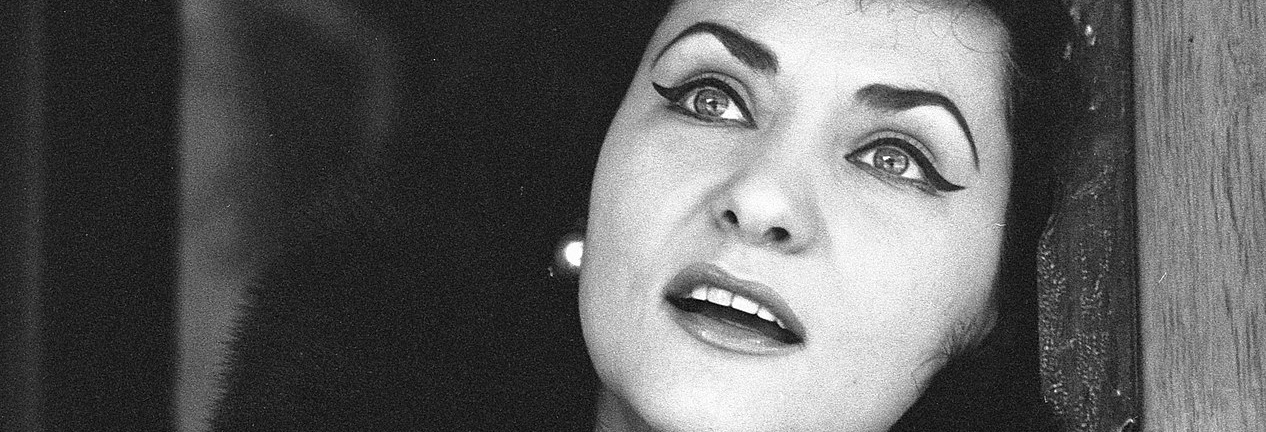
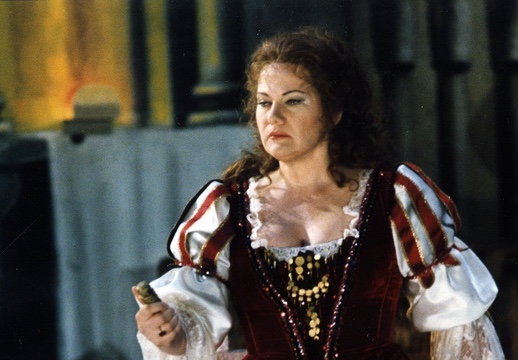
Headshot of La Cieca

Happy Birthday Renata Tebaldi

tebaldi_thumbThe “Voice of an Angel” was born February 1, 1922.

Related:

Support Doctors Without Borders in Haiti

122 comments

  • 1
    messa di voce says:

    I can’t imagine what it must have been like to be on stage hearing that voice.

  • 2
    perfidia says:

    That sound was just womanly. And she may have been placid on stage, but she had temperament to spare in her voice. That Tosca from 54, I think, is a great example of a demented performance.

  • 3
    kashania says:

    Indeed. To hear that huge yet silky sound live must have been something else.

    Perfidia: I don’t know which Tosca you mean but if it’s the one from the Met, it was from 1956 (with Tucker, Warren and Mitropolous). One of my top two or three recordings of the work.

  • 4
    Olivero is my Drug of Choice says:

    I’ve tried and tried and tried for my entire 52 years of Opera Queendom to like the voice of Renata Tebaldi and, as of yet, have been entirely unsuccessful.

    • 4.1
      Max Zook says:

      As a lifelomg Tebaldi fan, I mean this without any snark: Thank you for trying.

      For what it’s worth, I feel pretty much the same way about Callas’s voice. And yet I keep trying.

  • 5
    Feldmarschallin says:

    well I am much more of a Callas fan myself but do have a lot of Tebaldi’s recordings and there is much to admire in some of the early ones. For me the absolute best is the Forza from 1953 from Firenze. She is on fire and the top is there and pitch is very good. Also there is a Butterfly live from 1958 Napoli which is very moving. If you don’t like her after those two performances than I would give up.

    • 5.1
      Bill says:

      I cannot imagine anyone not liking Tebaldi’s voice. In her earlier years, her voice was one of he richest evenly produced Italian spinto voices of the post-war era. One might quibble with pitch at times, or perhaps the lack of flexibility (though she did sing Handel’s Cleopatra and other roles which, even in a cut performance, required some florid ability). But for pure beauty of sound, her Desdemona, Mimi, Manon Lescaut, Andrea Chenier Maddalena, her Leanora in Forza and roles of that ilk, were matchless and later, when her voice hardened on top (as often happens to lyric sopranos with sumptious middle registers) her middle voice remained quite lovely. She had taste, and according to Lisa della Casa, Tebaldi always did exactly as she wished on stage, always agreeing to suggestions of stage directors in rehearsal, but during the performances reverting back to a staging for which she felt comfortable. I cannot think of any Italian spinto soprano since Tebaldi who had the warmth of voice and projection and volume which Tebaldi had. And at the time we could compare her to Milanov, Stella, Callas, even Zeani. (I never saw Cerquetti or Gencer on stage). Each had considerable merits and it is hard to find anyone today who can match any of them in similar repertory. Of course, many Callasites found Tebaldi a little dull on stage and the famous rivalry betwen Callas and Tebaldi probably did not really exist except between fans of one or the other. Callas and Tebaldi never had to sing on the stage together as did Jeritza/Lehmann (fierce rivals), Schwarzkopf/Seefried or say Nilsson/Rysanek all of whom were frequently paired together in certain operas but were coevals in numerous other roles (or in the case of Schwarzkopf/Seefried or Fischer-Dieskau/Prey on the lieder platform). Tebaldi is not to be underestimated nor forgotten – when one thinks of it, what a glorious era the 1950’s were for great singing on all fronts.

    • 5.2
      Olivero is my Drug of Choice says:

      This is the only clip I can bear….I think more for the camp value than anything else:

      • 5.2.1
        mrmyster says:

        If this had not been sooooo slow it might have
        worked. Remarkably in tune all things considered.
        But where was it transposed down one-half tone?

  • 6
    Will says:

    The voice was large, warm and enveloping. There’s little doubt in my mind that she gave too much. That ‘56 Tosca is a prime example–she threw herself into the part and poured out voice to the full extent of her capabilities. Years later, when the voice was compromised somewhat and she’d come back from the year off to rebuild, she still didn’t give a fig for carefulness–listen to the Fanciullas and the Giocondas for fully engaged singing that was passionate, thrilling and fully engaged even given the audible problems.

    I was asked once why she was so beloved. She was a very direct communicator–there was no artifice, no “persona” to get between Renata and her public. When her heroines got into trouble in their operas, you could almost feel people leaning forward in support, men wanting to be on stage to protect her as if it were their own sister in danger.

    She sang a concert at Lewisholm Stadium in mid-August 1966, just before the first season at the new opera house in Lincoln where she did her first New York Giocondas wigged and costumed as the Times would report “like Sophia Loren. Miss Tebaldi is very, very happy.”

    She was in good shape for the concert and ended it with a final encore of “If I Loved You” from Carousel. She had to encore the encore. People were standing and waving, there were flowers. She had altered the final line of the song from “If I loved you, if I loved you.” to “If I loved you, and I LOVE YOU!” Pandemonium. The love flowed back and forth between stage and audience always when she performed. Always.

    • 6.1
      iltenoredigrazia says:

      Will, I was at that concert too and even have a tape of it. Unfortunately, the quality of the sound is poor. I remember that she picked her encores to cater to different nationalites. First an Italian song; then one in Spanish; and then If I Loved you, which as you said, she repeated.

  • 7

    The voice was indeed very lovely and unique in colour but for this opera queen there is much, much more to an operatic performance than voice, yes even more than commitment and abandon, strange as it may seem. Tebaldi grew up in a very problematic Italian climate, stylistically speaking. There was the heritage of Caniglia’s bad excesses and other verismo horrors, which Tebaldi evidently tried but couldn’t always shake off. I do dislike her use of aspirates, and it destroys (for me) her Verdian cantilena. It’s less troublesome in Puccini or verismo composers, but I still prefer more conscious ’shaping’ of the line. Some people will say, ‘meddling’, to me such meddling (and consciousness of harmonic tension) is the essence of intense musicality and musicianship. Maybe I’ll grow out of my vocal OCD sometime in the future. I much prefer the (short-careered) Cerquetti and even Carteri and Pobbe at times. Yes, even the intelligent but obviously strained Tucci. Tebaldi is just not my type of singer. Maybe I’ll ‘get’ her in later years.

    A few caveats – her live work seems better informed, better integrated and more convincing than her studio efforts. She always had something to say in her live Forzas. I especially cherish the Mitropoulous. And also the Verdi requiem under de Sabata, she is on her best behaviour under ’strong’ influence (although for me her Karajan studio work was rather ineffective). The late opera recordings, after much re-working on the voice, are spot on for me (bar the effortful Ballo). The Gioconda is a real gem and more than crowns her whole career, shame about Gardelli’s shying away from the score. The Solti Don Carlo presents a fully integrated, moving character, ultimately better phrased and more musically intelligent than most of her earlier studio work.

    Now you can all kill me :-)

    • 7.1
      iltenoredigrazia says:

      Tebaldi did not enjoy working with von Karajan. In particular she did not like her Aida with him. She was ill at the time and he would not allow for retakes for the singers, only for the orchestra.

      • 7.1.1

        that explains quite a lot, thanks ildg!!!

        • 7.1.1.1
          wladek says:

          You have it correct , for me at least -hearing Tebaldi live was
          the real thing, In the house she
          was different than on record.When Tebaldi was up aginst the likes of Warren , Bergonzi , etc she got into gear and went for broke ,she wasn’t
          called in the house “The Iron Butterfly ” for nothing. ,Her Madeleine in
          Chenier was tremendous, and in Vicino a te etc.she wasn’t going to let the tenor outdo her and when the last notes
          rang out to aFFFF I believe some
          plaster come off the walls . On
          record she ,was nowhere near her sound in the house,
          perhaps she was too careful in wanting to leave a perfectly well sung role,the passion seems gone-I purchased a record or two but rarely played them ,none at all being close
          to her real sound from the score desk .And in that big house on a good night when
          she floated a note for dramatic effect
          she let you know who was boss.

        • 7.1.1.2
          Harry says:

          What I find remarkable when discussion comes up today about various singers’ voices of the past and the opinions that are held..They are ever based on fading memories of live performances or by using various recordings as documented ’standard’ for making appraisal.

          Having been a record collector for a good half century, I have listened to the various evolving technologies, used to treating various ‘editions’ of a singes’ voice.
          Take Tebaldi, for exampl, …some express a opinion of a hardness at the top….perhaps during,.. or at a certain period of her career whilst I accept their peronal reactions to her.I fear they may forget certain things,

          Those recordings have gone over that period, analogue and digital treatment processes to reach release and re-release. Regarding the digital era commencing from around the start of the 80’s: Are they A.A.D encoded or A.D.D encoded, for instance? I happen to have her complete Girl of the Golden West (Decca)= A.D.D encoded. Yet, I also have the highlights from the same-cast exact -identical performance done – A.A.D ( that is, with no digital re-mixing) from some clandestine pirate label supposedly, once situated in Europe- there is in fact no reference to them – even on the Web. Probably for their own protection! How they got hold of those tapes and many others including all the EMI Callas operas (is anyone’s guess!) All of ‘their- under the lap ‘ CD releases, they never used ‘Digital’ in the middle or ’sound upgrade’ chain for the finished product,…. up…. from a basis of analogue tape.

          Which brings me to the main point, this ‘edition of Trbaldi’ in that opera performance is ’streets ahead of the offical Decca version. The voice is warmer and rounder. So just using that ‘example’, is there such a thing as an absolute point on to judge, past singers’ voices?

    • 7.2
      mrmyster says:

      Yes, but her early studio work was far more in tune.
      “Big” had not yet invaded her sense of tonality.

  • 8
    The Vicar of John Wakefield says:

    How paltry her achievement seems set beside the attainments of Commonwealth artists Joyce Barker or Elizabeth Whitehouse.

    • 8.1
      Harry says:

      I have t say I have seen Elizabeth Whitehouse in Fying Dutchman and her Senta’s Ballad was sensational. Beautifully paced and judged. I have about a dozen Dutchman’s in my recorded collection I can refer to. And a lot of the Senta’s there, do a far lesser job of it.
      But then Tebaldi was not into Wagner country.
      A piece of Tebaldi I adore…the Zandonai Francesa Di Rimini love duet with Corelli………ah! Stuff, that’s sheer magic! Tebaldi helped to be: the reason I became really interested in Opera. I HAD TO own all her releases.

    • 8.2
      No Expert says:

      Ok, Vicar I’m going to give Ms. Whitehouse’s CD a try because I’m a sucker for rare French arias.

  • 9
    Ruxton says:

    Whether you can technically describe what thrills you (as CerquettiFarrell has so brilliantly done) or whether you can’t, the beautiful thing about the human voice is that you hardly have to understand a thing to know what sets a favourite apart- because beyond the techics a voice either speaks to your soul or it doesn’t.
    Vicar- do you mean Mary Whitehouse? ;)

  • 10
    La Marchesa Attavanti says:

    I saw her a few times in relatively late career. When she didn’t overdrive it, the basic “core” of her sound live was remarkable for its beauty, purity and clarity. It’s something that’s hard to hear to full effect on recordings, even live recordings.

    She was, in voice and persona, a very “grand” singer and tended toward the broad and expansive rather than the intimate and subtle.

    On the negative side, there was something very narcissistic about her singing, as though sometimes she got lost in reveling in the sheer sound of her own voice and was content to let time (and the tempo) grind to a halt while she enjoyed herself.

  • 11
    Clita del Toro says:

    I first saw Tebaldi in a 1955,a Saturday afternoon Otello with MdM and Warren (non broadcast). I immediately fell in love with her and her gorgeous, big, warm voice. I got to see her Aida in 1955 as well–again totally wonderful–even the Milanov fans had to admit how great she was in the role “except for the “O patria mia” LOL. I saw everything she sang up until about 1958: when her voice lost some quality and became edgy I stopped going to her performances and only saw a few + the later Gioconda.
    I am not a big fan now but appreciate what a wonderful, beloved, unique singer she was.

  • 12
    Clita del Toro says:

    PS When Tebaldi opened up, her voice was quite huge. In Aida you could hear her over the whole chorus and orchestra.

  • 13
    WindyCityOperaman says:

    La Tebaldi was supposed to give a recital here in town, ‘82 or ‘83 I think, and then she cancelled. Disappointing.

    I always wondered if her final years were lonely, if she really “sat and listened to her old records and wept” as it was reported. Loved her, but loved Maria, too.

  • 14
    blanchette says:

    daviddc: the heartbroken Sonya is in “Uncle Vanya.” forgive me ; couldn’t resist showing off my erudition.

  • 15
    danpatter says:

    I didn’t “get” Tebaldi until I saw her live, in concert with Corelli in the early 1970s. A huge sound of enormous impact and, in spite of hard top notes by then, real beauty. Backstage, she was a total delight (unlike Corelli, who looked alternately frightened and irritated). Since that time, I’ve come to prefer some of her recordings to their competitors in spite of my deep and abiding love for other sopranos – Callas, Nilsson, Price, Sutherland, etc.

  • 16
    Niel Rishoi says:

    I really enjoyed both the criticisms and the encomiums on Tebaldi. One thing I’ve noticed though. A lot of people write as if they expect singers to be perfect ALL the time; and if they’re not, it’s a basis for the dominant judgment call. In an art – singing – opera in this case – where nothing ever approaches the 100% (non)ratio, I always get the impression, based on how some people perceive, they’re looking for or expecting that elusive, hallowed perfect performance. In Tebaldi’s case, I feel that so much more was right than was wrong; and I get queasy at someone who writes that a few aspirates – or even a few missed pitches – prevents total enjoyment, or rather, enjoyment appears to be canceled out.

    Tebaldi had a voice that had few equals in the last century. I need not enumerate why, as it has been well-covered here. But I feel, that when a standard has been reached and has rarely been matched, as in her FORZA Leonoras, particularly the 1953 Firenze and most especially the 1959 kinescope (an operatic holy grail if there ever was one), there can be no fair quibbling. FORZA is my favorite Verdi opera, and I’ve heard just about every Leonora recorded, live and commercial. No one, to my ears, places ahead of Tebaldi. The purest Italianate voice possible, the splendor of the sound, the exquisite phrasing, and the genuine fervor in which she sings the character, it is the most satisfying account of the role I’ve ever heard. Plus: no soprano, outside of Maria Caniglia, sings the role to God as much as Tebaldi. The urgency in which she intones “Madre, Madre pietosa Vergine,” seems to come from within, she breathes it, she feels it, she LIVES it.

    Regarding Tebaldi’s aspirates. Hers are NOTHING. I have now for the past several months been listening to a century of coloratura sopranos, and coloratura singing. Do you realize hoe many sopranos sing “Ca-ha-ha-ha-sta Dee-hee-hee-vah”? Or how many coloraturas use puntature to get through their music? Switching words to passages dominated by “ha ha ha” – nearly every coloratura does her high note “ha HAAAA”. Listen to Sills’ coloratura passages – they are liberally sprinkled with “ha’s” – she begins nearly every scale passage preceded with an aitch, and rolls around them with haaa-haaaing. I became aware of this phenomenon just in the past year; you listen to coloraturas and invariably just “accept” this device, but now that I am aware of it, I’m beginning to loathe coloraturas, especially the nightingale types who rat-a-tat like birds on speed to no consequence whatsoever. And the amount of puntature most of them use!

    • 16.1

      Oh no, I want to correct this in case I sent the wrong impression. I don’t mind people being occasionally off tune, having breath trouble and high note trouble. I do not judge an operatic performance by technicalities. Oh no. Nobody is supposed to be perfect.
      For me a successful operatic performance (vocally speaking) requires all three:
      1) Technical control of the voice in a way in which it will do everything its owner wishes it to do. Thus no shortcuts taken to compromise artistic wishes and composer’s intentions. A strong bondage between both should be encouraged.
      2) Cultivation of the appropriate style and seamless possession and understanding of it.
      3) An ability to side-step technical issues and ‘penetrate’ the inner core of the character and enliven it from within.

      all of the above should, of course, come at the service of the composer and not solely in order to parade the performer’s vocal qualities / quantities.

      So I don’t really mind technical lapses, What I do mind is singing that is out of style and does not highlight the music to its best advantage. Singing 19th century italian repertoire (indeed ANY) repertoire while consistently using aspirates is unforgivable in my book. The term aspirate does not relate solely to coloratura passages. On the contrary, aspirated singing of slow lyrical passages is much more aurally obscene and unpardonable on any grounds. And it is, unfortunately, quite common in Tebaldi’s middle 50s studio work.

    • 16.2
      Alto says:

      Interesting that, like most of us, you reject the means by which other people judge a singer, beginning your post by pleading for a larger outlook, and then set up one of your own that can even justify “beginning to loathe coloraturas.”

      I guess we’re all humans or something.

  • 17
    thenoctambulist says:

    I am a Callas nut and I didn’t like her at all, not because of my fandom but because her voice seemed sterile compared to Callas and I found no beauty in it. Until I heard the card scene in Fanciulla that is.

    That converted me.

    • 17.1
      lorenzo.venezia says:

      Oh. My. God. Only ever heard this on studio recording. This blew me off my chair! Grazie tanti.

      • 17.1.1
        Harry says:

        From the moment of slapping down the ‘winning’ card to the end of the Act, Tebaldi sends exhilarating shivers of excitement down one’s spine…. that is acting… with the voice. What Opera should always do!

  • 18
    La Valkyrietta says:

    For me the real opening of the new Met was the second day La Gioconda with Renata. At that time she was my favorite soprano, believe it or not. It was a few years later that I was converted to Maria, but I will always love ‘La Sublima’, and I’m glad I saw her live many times.

    Thanks, the noctambulist, for that Fanciulla. She was fabulous at the Met in that role with Milnes as il sceriffo. Nobody has mentioned her Alice, wonderful too. Well, I loved her in everything she did. I wish I had heard her live in Rossini’s Stabat Mater. Also, I wish I had seen her as the Countess in Nozze, love her recording of ‘Dove sono’. I have a vinyl of a Lohengrin in Italian conducted by Santini, Naples 1954, Gino Penno as the knight, Elena Nicolai as Ortrud. Anyway, Tebaldi’s rendition of that first act aria is to die for.

    • 18.1
      iltenoredigrazia says:

      Valkyrietta, Tebaldi’s Rances were Gian Giacomo Guelfi and Anselmo Colzani. Milnes sang the role in the early 90’s new production. Just nitpicking. :)

      • 18.1.1
        La Valkyrietta says:

        iltenoredigrazia,

        Thank you, I was just wondering about this in another post here somewhere. So I was mixing memories and never really saw Milnes with Tebaldi in Fanciulla. That makes total sense. I do remember the first time I saw Milnes as the herald in Lohengrin, I was stunned at what a wonderful voice that herald had. This must have been perhaps around the time of Tebaldi’s Met Giocondas, a few years before her Minnies at the Met.

        Yes, the Minnies with Milnes were Barbara Daniels and Carol Neblett -I vaguely recall this last one undressed in some opera. They were not of the stature of Renata. La Sublima never undressed, and never rolled on the floor.

        • 18.1.1.1
          kashania says:

          Neblett went topless as Thais.

        • 18.1.1.2
          Krunoslav says:

          Milnes in fact sang three Student Performances in the New Met in Spring 1966 with Lynn Owen as Minnie.

          With Tebaldi he sang one CHNIOER in the Old Met with Bergonzi and Mrs. Claggart in her guise of Gladys Kriese Caporale. In the new house they sang together four GIOCONDA performances, a concert, and three shows of OTELLO.

        • 18.1.1.3
          Camille says:

          Tebaldi didn’t have to roll on the floor like Dessay or take her clother off like Neblett — she had class and a vocation to her art which very few have had. Plus an instrument of solid gold.

          One may go on and on about her inadequacies and her failings all one wants but she was the real mozzarella and una Grande Signora. And next
          to the pathetic array of Little Voices these days, it’s just pathetic to carp about her.

          She gave her heart. What do you get these days? Ersatz-IPA-robot-like- rolling-on-the-floor-over-the-top-regie -nightmare-diva-bullshit. And you can quote me.

  • 19
    Clita del Toro says:

    Just to show how much audiences adored tebaldi (including myself): after a Butterfly performance (maybe her first at the Met?), there was a HUGE ovation and the audience would just not leave–it lasted a very long time.
    They finally brought down the fire curtain; but still the audience remained–going nuts.

    So, up goes the fire curtain —and Tebaldi comes out in her bath robe for more applause!

  • 20
    parpignol says:

    I am right now loving her recording of La Wally; beautiful, and what conviction! she really believes in it!

  • 21
    kashania says:

    I’ve posted this clip before but go to 2:05 for an aboslutely huge high note from Tebaldi (live recording).

    • 21.1
      iltenoredigrazia says:

      There are at least two live recordings of Tebaldi singing Depuis le Jour in Italian and both are ravishing. High tessitura piano singing of extreme beauty. There’s also a Stabat Mater with a great high C at the end. High notes were not a problem for her until at least the mid-50’s.

  • 22
    kashania says:

    Hey, somehow my comment (no. 21) from only 10-12 minutes ago got placed earlier in the thread with a bunch of other posts (written last night) appearing as replies to mine. E strano.

  • 23
    La Valkyrietta says:

    It is funny how memory plays tricks. I saw many times Tebaldi in Fanciulla and I swear I saw Milnes as Rance, but searching the Met archives, I only see Anselmo Colzani in that role in 1970. The archive must be right and I wrong, I’m sure. Oh dear, I’m not that old or that senior.

    I also saw her Giocondas many times, both at the Met and at the Met on tour. I don’t think my memory is playing tricks when I remember in them Bergonzi and Elias. Of course I saw many times her Adriana with Corelli, Cossoto, and the debut at the Met of Domingo.

    She was tall, beautiful dark hair. Real stage presence. Does “legally” still wear a Tebaldi pin?

    There is a video I read about once, I think in an article in the NYT, that shows Tebadi walking into La Scala to rehearse Boheme. She sits down in street clothes and starts singing from the last act of Boheme, “Sono andati…” The reviewer raved about it, but I have never been able to find that video.

    • 23.1
      iltenoredigrazia says:

      Valyrietta, we were both at the same performance at least once: Domingo’s Met debut. Without checking the archives my recollection is that Cossotto did not sing with Tebaldi in Adriana but in Gioconda (the broadcast with Bergonzi). If you ever locate that video, pleeeeeeeeeeeeeease let me know about it.

  • 24
    mrmyster says:

    This seems a room where Big and Loud is
    preferred. Trouble is, pitch so often suffers.
    I’ll take a more slender tone (Kirsten?),
    better colored and in-tune any ol’ day!

    • 24.1
      figaroindy says:

      Not all of us, mrmyster! Don’t generalize!

      Although, I’m always happy with a voice where good color, and heft are both possible – with good pitch…..how I wish Farrell had recorded more! There was a voice that could do anything it wanted!

    • 24.2
      OlivePratt says:

      and yet today there are those who prefer WHITE tone as in Dessay and the absolutely out of pitch singing of Radvanofsky. Kirsten was a lovely adequete singer, with no real vocal glamour, at all. she would be star in today’s group to be sure. but preferring Kirsten to Tebaldi. Oh my, too much sand in thsoe ears it may be out there in opera challenged santa fe

      • 24.2.1
        mrmyster says:

        Olive Pratt you don’t lack for vinegar
        in your juice, do you?
        As ever, you are an inaccurate reader – I said
        I preferred color and pitch to those who do
        not offer it, and favor volume. Are we to
        conclude that you believe Tebaldi did not
        offer color and pitch. Dear me! Tut tut! :)

  • 25
    wladek says:

    I remember both Tebaldi and Callas
    from the old house . Was at debut of both . What is interesting about all
    the “experts” writing here on voice
    quality etc. etc . is the bias ,not the
    knowledge ,how Tebaldi couldn’t do
    this couldn’t do that ,how hard edged
    etc. but the divine Maria was almost without fault , . I was at score desk in old house , and was taken back
    how the flawless Callas cut line after
    line to suit her faulty technique,how
    she bent the role to suit this limited
    technique and watched the sheer
    force of will making the opera be about her will and not Lucia -and her
    astonishing ability to play the great “diva” to a cheering house .Talking
    with house staff during all this and
    expressing my amazment at the reception he tellingly replied “She’s
    a star for those without imagination”
    and walked away .Tebaldi did not
    have the ability to match the Callas
    histrionics nor did she have the Callas paranoia -and was held to a different singing standard. As they aged so did the voice Tebaldi over
    stayed ,but, at least left before it got
    too sad, Callas unfortunately decided on concert farewells screaming and shrieking with like
    minded tenor ,until word spread they were awful and concerts were cancelled.Callas ended up pathetic,
    in Paris apartment -and Tebaldi
    quietly in Italy .The only singer I
    know of who left while still in top
    form was Flagstad.

    • 25.1
      Bill says:

      I was at Callas’s debut as Norma at the Met. It was not truly an overwhelming success. First there were many Zinka Milanov fans in the standing room with their “Viva Zinka” buttons ready to dislike Callas no matter what she did. Not having heard Callas before I was surprised at how tight and constricted her voice seemed on that evening – Barbieri and del Monaco, both returning after a year or two;s absence, rather outsang Callas – When Callas sang a high note (I suppose a C) together with Barbieri one could not hear Callas at all, just watch her open mouth. So I was disappointed. Later that season Callas sang Lucia and all was forgiven as she was magnificent (we were used to Pons, pretty of voice and appearance, but singing all her high notes flat at least at that stage of her career).

    • 25.2
      Nerva Nelli says:

      Well, o broken record, Callas was not granted a new production of LUCIA at the Met, nor her choice of conductor, but put into the dismal old ruin that Pons, Munsel, Peters and others had been doing for years.

      The cuts made were doubtless the way the house did LUCIA then; did you go back for your score desk to hear Dolores Wilson and Mattiwilda Dobbs? I bet they had the same cuts imposed on them as Callas.

      One might as well blame Tebaldi for the way Bing’s Met presented a truncated FORZA. Very silly.

      • 25.2.1
        iltenoredigrazia says:

        Callas admitted in writing that she had not been in particularly good voice during her first season at the Met.

      • 25.2.2
        wladek says:

        N elli — Naw ! it won’t do -the “aria” cuts that were made were based on technical ability -Peters cuts were quite different -when Mde. Callas started ardon gl’ incensi she already was in trouble and cutting left and right and pulling the tempo to save whatever she could muster . Her voice at this debut was already in trouble .but not her fantastic ability to present herself as a great suffering put upon diva.No
        one could match this colossal
        self centered force. As a wag put it -she was the Judy Garland of opera ,voice gone to hell but
        her audience much the same as Garlands’ in their total devotion . Peters of course was a more healthy secure person and she presented Lucia more objectively
        Wilson and Dobbs I can’t address
        as by then I had grown more
        in a musical sense and had not the time nor inclination to waste
        the short time we have here on such nonsense as Lucia.

        • 25.2.2.1
          Nerva Nelli says:

          Well, you’re wasting your and everyone here’s time by your preposterous, senescent attacks on Callas.

  • 26
    luvtennis says:

    Niel:

    I have the greatest respect for your opinions, but I think have to agree with Cerquetti/Farrell. Tebaldi’s use of aspirates really tells against her. For me, a singer of 19th century opera needs a real, aspirate-free legato. Without it, the singer must be classified as technically unfinished. That’s why, despite the incredible beauty of the basic timbre, Tebaldi takes a distant backseat for me to Price, Milanov, Rethberg. Very distant.

    Interestingly, Bergonzi, who is often held up as a model technician among Italian tenors, is frequently guilty of the same sin. I tend to agree with C/F that this was a cultural/time period thing.

    A great lyric/spinto must be able to master Donna Anna, the soprano role in the Missa Solemnis (you can sing most anything of those parts are within your compass!). By that standard, Tebaldi does not measure up.

    Still, I would not want to live without her recordings. Many of them have moments of overwhelming vocal beauty.

    • 26.1
      Harry says:

      And how many so called ideal singers have buggered up the role of Donna Elvira….tons! But Tebaldi was NOT ‘into Mozart’ and good on her for that.
      Imagine now Nilsson cast as Mimi or better still say Suor Angelica. Imagine Schwartzkopf in Electra…

      Ah! the silly impossibilities.

      • 26.1.1

        Well Harry, she should’ve. Her recordings of Rosina’s arias from Nozze are just wonderful and it is a shame that she didn’t sing this role for a lot longer, as she would have given many so-called perfect Countesses a run for their money.

        On the same vein, it is a shame she never sang Fiordiliggi, Elvira, Anna and Ilia, as they would have showcased the beauty of the voice quite well.

      • 26.1.2
        iltenoredigrazia says:

        I believe Tebaldi did sing Donna Elvira early in her career. As a matter of fact, that was the role that Bing initially offered her for her debut back in 1950 or 51. She had made her debut in SF with Aida and Bing suggested that she sing one performance at the Met before sailing back to Italy. Sort of a tryout. Tebaldi turned it down.

    • 26.2
      OlivePratt says:

      who says a great lyric/spinto should have to master mozart? are you kidding? the true lyrico spintos of the arangi-lombardi Caniglia and tebaldi period, covering at least a thirty year span did not find that absolutely necessary. Backseat to Milanov, who whooped and scooped in her later years, sharp mostly but still silvery, and rethberg being a very rare exception in that she oculd do both wonderfully. this, THIS puts the formidable Tebaldi in the backseat? Best laugh I had all day.

      • 26.2.1

        And you know? YOU just gave me the best laugh of the week. Mozart was certainly good enough for these singers:

        * Nilsson
        * Price (Both of them)
        * Caballe
        * Ponselle
        * Tomowa-Sintow
        * Varady

        They certainly were not peep-squeak sopranos who sang Verdi with distinction.

        Or as the great Nilsson would say herself:Maybe Mozart might not be good enough for you but her certainly is good enough for me .

        I for once will not argue with that statement.

        • 26.2.1.2

          Ponselle, after being declared the Verdi voice of her generation sang Donna Anna at the Met and on tour…

          Caballe claims to have over 200 performances of Donna Elvira under her belt. As a matter of fact, the earliest known complete opera with Caballe in the cast is a Don Giovanni from Lisbon with her as Elvira (and at 26).

          Caballe also also claims to have performed a sizable amount of Fiordiliggis as well. Not content with that, she also claims to have sung Pamina to Wunderlich’s Tamino and that there is a recording of it somewhere in Swiss Radio. She was also thought enough of a Countess to have been casted as Rosina in Dallas, and judging by the in-house recording, she was spectacular.

          Plus, she included Mozart concert arias in her recitals all through the 60’s.

          In addition to that, after she became heiress apparent to the throne of bel canto, she came back to Mozart and sang Donna Anna in Madrid.

        • 26.2.1.3
          Harry says:

          If I am correct ,Nilsson made a statement at one time that she used Mozart as a means of keeping her voice flexible. No qualms about that.

          It reminds me… When are were ever going to get re-released the (what is also completely un-cut) the Don Giovanni with Nilsson,L.Price Siepi, Valletti and Ratti under Leinsdorf from RCA ? Sony, since they took over RCA may have the answer. Kick myself for not buying it when it was available.

        • 26.2.1.4

          I LOVE that Don Giovanni except for Nilsson, totally ruins everything she appears in. Price is a marvel, until Mi tradi, which is a) too fast b) breathless c) very uncareful. Her A chi mi dice mai is spectacular, though.

        • 26.2.1.5
          quoth the maven says:

          I think the point of Nilsson’s comment was entirely different. She was remarking how singing Mozart was good for keeping the voice light and flexible. Her words were to the effect of “I might not have been so good for Mozart, but Mozart was very good for me“—a great instance of her sly good humor.

        • 26.2.1.6

          And yet the sentiment is the same: After her successes in Wagner she thought enough of Mozart to continue singing it; whether it was for her voice’s health or whatever the reason, she still thought Mozart as a composer worth singing and mastering (or at least trying)

      • 26.2.2
        luvtennis says:

        Olive:

        You sort of make my point. Caniglia did not sing Donna Anna – at least not outside Italy – because Mozart would have risen from his grave and eaten her brains in revenge for the calamity that would have been Caniglia in that role. As it were.

        The failure of Italian spintos to master Donna Anna (truly the archtype of romantic operatic heroines both dramatically and vocally – not surprising since DG was one of the first operas to enter the standard repetoire) speaks volume about musical tastes in Italy during that period. And (excluding Arangi-Lombardi who was an old-school throwback) just how many Italian sopranos have been paragons of vocal technique since that time. I would argue that Devia has been the only really technically sound soprano from Italy since the first WW!!! (Freni had her issues, but the basic vocal mechanism was so perfect it didn’t matter. Not so for Scotto.)

        Ever stop and think that despite all the crap we here on this forum about “italianate style” just how many great sopranos have come from OUTSIDE italy. And just how many great italian roles were actually written for non-Italian singers.

    • 26.3
      wladek says:

      Poor Nelli-Mistakes observations
      as “attacks ” on obviously favourite singer “.Senescent attacks”
      makes one smile if not laugh out
      loud .Such a literary bent ! Do
      you actually speak for” everyone
      here’s time “.? Do you mean to say
      all opinions are boringly alike and in line only with your views? You might
      recall the story of the emperor and
      his new clothes and the voice that
      says it ain’t necessarily so -it seems
      a contrary opinion unerves you .

      • 26.3.1
        Nerva Nelli says:

        Callas is far from my favorite singer but that does not make your banal nay-saying on the grounds of her subpar Met debut and misbegotten late career concerts any more convincing.

        Obviously your last few decades have been warmed by your sense that you, Wladek the Magnificent, and only you knew and knows the Truth about Callas.

        I am not buying it. Very sad obsession, though.

        • 26.3.1.1
          wladek says:

          Nelli – obviously you can’t
          tolerate a difference of opinion,and obviously how ever
          you may deny it you are a “Callas groupie and obviously
          a very sad obsession to contradict any adverse opinion
          concerning Mde. Callas . For your enlightenment there were
          thousands who wouldn’t go to a Callas performance as there
          were also thousands who would .Bing knew it and we all did see it as fun ,The Tebaldi
          gang (as in democrats ) crossed
          over to see what Callas was doing the other side you know who -never did cross over in
          case they might hear some GOOD singing,and every one
          had a good laugh not believing
          the other side was” serious”.
          Mde. Callas had a short stay
          mainly because she began to believe she was “MARIA CALLAS” the Opera Star.Tebaldi
          on the other hand while being
          aware of her talent was always
          taken aback by the adulation of
          her fans .She had a better sense that it was all temporal .
          Mde. Callas went on to a sad end in Paris and Mde. Tebaldi
          to a rather serene end in Italy.
          And millions upon millions of
          people throughout the world don’t even know who either was and don’t give a rats ass
          that they were opera singers .
          Get a life .

        • 26.3.1.2
          Nerva Nelli says:

          Its mind wandering, the creature emitted a few incomprehensible noises and lay down to expire.

        • 26.3.1.3
          mrsjohnclaggart says:

          Oh, Nerva, I saw Callas three times in her prime. Norma (Philly on Met visit, they came seven or so Tuesdays during the season, we subscribed though my mother sometimes vetoed my visits because I often couldn’t sleep afterwards but we got extra seats and even she came to the Norma), Lucia at Met and Tosca both in 58, though I heard a tape of the Lucia in 56.

          Everyone I knew hated her. The man sitting next to me at the Norma got up and yelled “and I thought Milanov was bad!” before stomping out. My mother who loathed her recordings (I loved them) sneered, “I told you so!!”. My grandfather and great uncle whose first Norma was Giannina Russ and who had seen Pacetti (hated her), Cigna (hated her though loved her Aida and saw her do Gioconda, La Wally and Tosca, loved her in both) and Maria Pedrini (who they loved) thought Maria was ghastly.

          I agitated to see Miss Callas in Traviata but didn’t get my way. My grandfather went to the Tosca with me. But he wouldn’t go near Lucia (hated the opera until Joanie). Even in the Academy of Music (half the size of the Old Met) she sounded small and had trouble tuning the Norma (despite singing with the huge voiced but often out of tune Barbieri and the penetrating but ghastly and rarely in tune Baum). I seem to recall her doing the last act pretty well, though I was young (I had seen Milanov and yes Helluva Nerva (”quella fica disgraziat’” as my grandfather opined), and been one of Norma’s sons several times, usually the one the audience was rooting for her to kill in various productions around Philly). But she was booed and I was disillusioned.

          The Lucia (with my aunt from Brooklyn beside me upstairs standing) was just awful, TONS worse than the first recording — tiny, thin voice, no security at the top and I think Spargi ‘d’amaro’ was down, though I recall a major crack anyway, she also left out some tricky phrases. Some people in standing booed over small general applause (my aunt booed). Some cheered but one had to wonder what for.

          However, I thought the Tosca (58) was pretty exciting and suddenly her voice seemed large. However having seen the great Toni Starr, the greatest Big Renata, Zinka, Delia Rigal!!!!! (my first and second and according to grandpop ‘una porca infamia), the much loved Albanese (loads of fun and zinger high notes), Helluva Nerva (’la grassa ingolatta’ according to my grandfather), Kirsten (never bad) and having sung the shepherd boy five times (with inhuman volume according to those forced to listen) I didn’t think Maria was that special in relation to the others, though certainly on a higher tier than some. I thought the return as Tosca was very high camp.

          I saw three of the later concerts, there were some arresting moments but she couldn’t really sustain anything. I also was at the Julliard master classes and she did some exciting or impressive demonstrating but never sang for long.

          I saw Cerquetti do Norma a little later — she had everything a Norma needs but a waist. Utterly thrilling and an audience riot in response. Joanie’s Lucia, debut season was so astounding people literally stood during the Mad Scene unable to believe what they were seeing and hearing, and the riots for her were spontaneous; people were just overwhelmed.

          There are some wonderful Callas records and pirates (though whether her barking and shrieking through Armida is edifying beyond titillating queens is a question), which show her in much better and more secure voice than I heard her. So perhaps that was a really bad patch — but I just question the pseudo-definitive assertions of so many idiots on this thread about singers they didn’t experience live. If we are opining about who was able to record well, and got the most flattering engineering and producers (and whose records were then over-hyped, and then bought by infants who were imprinted by them)that’s one thing. All of us who love records adore recordings by people we couldn’t have heard and we must make assumptions about whether they were as good, almost as good, sometimes as good or even better live.

          If however the discussion is what people could actually do and opinions bear some relation to what experiencing amazing voices and appealing or charismatic personalities live in a real acoustic in a big opera house then so many of the windy opinions above are otiose, uninformed, uninformative, peculiar and unfair.

  • 27
    Harry says:

    Tamerlano says:
    “I bought the highlights on CD years ago (remember CD’s???).”

    Ignorance is sheer bliss.
    Who remembers those silly crappy mp3’s and downloads…..Hell, what were they about? Futurist ‘glitches and accidents’ conning gullible unwary people traveling along the Internet highway.

  • 28
    Harry says:

    All these insane vocal comparisons in minute degree, one hears and reads about ………Imagine going to work,( as opera singers are regularly expected to) then one day someone says……..”Ah! I remember you…. on such and such a particular night, being cast in some role… and then you were complete worthless, absolute shit!. On the strength of that alone, I then preferred other people that I could name and transferred all my total allegiance to them, – doing the same sort of work, you do ”

    Would these types of detractors like to face or put up with that demoralization , in their own work situation ….and, on a regular basis? I definitely , think not.

  • 29
    La Valkyrietta says:

    She was a bit shy, I think, otherwise she would not have backed out and let Sophia Loren impersonate her in Aida. She did not need to, she had great stage presence. The voice was the finest pure velvet, and it is wonderful she could be loud when she wanted. I saw Gioconda with Voigt not too long ago, and how I missed those Tebaldi Giocondas of the sixties! Yes, audiences adored her, including me. I don’t think I have screamed “brava” more often to any other soprano. Well, perhaps Nilsson and Rysanek, but perhaps not because I did see Tebaldi more often than them. I wish the Met had done the Boito opera when she was singing there, I love her recording, love her “L’altra note”. Nobody is perfect, and many here have pointed out some things less than perfect about her, but sometimes, in some notes, the mere sound was incredibly gorgeous.

  • 30
    javier says:

    I haven’t listened or watched many Tebaldi recordings, but from what I heard I can scarcely remember. I’ve just never been interested in her. Compared to someone like Callas she had one of those forgettable voices. At least to me. Usually when I hear a singer and they don’t grab my attention I just forget about them. So most of my knowledge of Tebaldi comes from her name in association with Callas, but not really any of her work.

    • 30.1
      Harry says:

      But at least Tebaldi appeared regularly in the my operas she tended to record. Ok! Like or lump Callas…but remember many of her ‘greatest roles’ attributed to her,via recordings – are in every -day accepted practice form – a complete myth!!! Check and examine side by side each one of Callas’ recordings and then see how: in many cases she did less than a mere tiny handful of single digit performances.

      She performed well and often enough as a opera singer : busy at the business….. ‘OF giving the impression of…. INTENDING TO perform’.

      Just where does anyone think the present A.G got her training, at the same cancellation ‘racket’?. Perhaps she is thinking by doing that, she is morphing ‘being the diva’ and Callas, in particular.

      Go back to those times: The newspapers and media attention with Onassis , her French fashions, her dieting / and then wanting to look like Audrey Hepburn, or being photographed millng and swanning around with Society’s then glitterati ….helped to fill in and covered the ‘cracks’ . She was just so so busy, occupied at ‘other things’. She wanted to be ‘Royalty’ by association with its ilk. Forgetting how cruel they can be, when it boils down to real ‘tin tacks’……They will slap upstarts down! No one is going to queer their ‘patch’. Opera or no opera ’singer’!
      With the sheer lack of actual number of actual performances from her : The EVENT BECOME: ‘WILL MARIA SHOW ?/ THROW A TANTRUM? /BE ILL?/ BE INDISPOSED ?/ RE-NEGOTIATE?/ WHO WILL MAKE THE EXCUSES FOR HER? ETC ETC..

      Time goes on , people like to, or want toforget ….they read too many adoring biographies and now it is poor poor Maria . ‘OH! OH! ..how she suffered for her ART!!!!’ Bullshit! She DID IT to herself!

      • 30.1.1
        quoth the maven says:

        <>

        If anybody here can decipher this language, could she tell me what it means?

        • 30.1.1.1
          quoth the maven says:

          oops–try this:

          But at least Tebaldi appeared regularly in the my operas she tended to record. Ok! Like or lump Callas…but remember many of her ‘greatest roles’ attributed to her,via recordings – are in every -day accepted practice form – a complete myth!!! Check and examine side by side each one of Callas’ recordings and then see how: in many cases she did less than a mere tiny handful of single digit performances.

          She performed well and often enough as a opera singer : busy at the business….. ‘OF giving the impression of…. INTENDING TO perform’.

        • 30.1.1.2
          Harry says:

          quoth the maven :It appears you not know sarcasm if it hit you over the head.

          Callas’ greatest performances were on the media’s world stage, producing idealised newspaper copy ‘as a diva enjoying the trappings of being a Diva’.Instead of knunckling down and steadfastly working at preserving her voice and ACTUALLY appearing regularly like other singers of the Time : INSIDE AN OPERA HOUSE! Some of Callas’ ‘famous roles she recorded’ she only appeared in, on stage – perhaps giving a couple of live performances, ever.

          Her most notable endevours were : unrelibility, her associations with rich tykes, in- bred Europeon royalty and othe hangers-on, , fashions, or just ariving and departing countries etc etc. The only thing the media did not do not report on, was when she went to the Ladies and how she wiped her arse. In the long run, she fucked up her life, her career , pure and simple. Finally and spectcularly coming a ‘gutser’ over Onassis’.

          Anyone remember the most classic example of the Callas super powered ‘hype’? Come the release of her EMI Carmen’……full page ads exblazoned with the words ‘Callas IS Carmen’. The opera set came in one of two editions – including a much more dearer priced red velvet covered box. Critics in the Gramophone later had the termerity to even remark “that Callas makes Leontyne Price’s Carmen sound ‘baby faced’………….Shit! That is just a hint of the ‘Callas -mania’ at that time, in every gossip and womens’ magazines. It is probably hard for newer opera lovers to appreciate this fact. Callas & Onnasis were the ‘Brangelina couple’ of their time….till Jackie K. queered Callas’ wicket.

          Those English Gramophone critics, they were up EMIs’ and Callas’ arse too, it appears. Heard today in comparision, Callas’ version is not remarkable…… more just ‘run of the mill’.
          Is it clearer now, what I was saying?

      • 30.1.2
        wladek says:

        Harry, you are only going to upset Nerva Nelli -Mde. Callas had a dam good
        run -the adulation of thousands -to this day.She couldn’t get into
        the “phony ” money class because she was worse ,and they can’t be
        upstaged .Onassis was to be her
        ticket, but she didn’t realize not
        every one would invite him to
        dinner -and there she lost big time. Churchill used Onassis
        Onassis used Churchill , Callas
        used everyone with money and
        they all used her -then the worms got them all .Wouldn’t
        this make for a great opera ?

        • 30.1.2.1
          The Vicar of John Wakefield says:

          The Greek woman was not a patch on Joan Cross or dear Betty Fretwell.

          It was all a matter of publicity and fidgetng with dials. She had no talent at all.

        • 30.1.2.2
          Harry says:

          wladek In saying what I said, I am not a ‘rampant hater’ per sec, of Callas as people might think. I do believe though in a sense of total proportion including the ‘warts & all’. I have all her studio work and many of her other live rcordings in my collection., Even duplicating in many cases(from buying that mammoth 71 CD box of EMI’s). The same goes for many another singer, not just her. It is funny though, how time passes, and points get blurred.

          Some deceased singers though, are made ‘determined hard working Saints of the Operatic Craft’ : for when they were around and ‘active’. Yet in fact, they were anyting but. Destroying opportunities and possibilities they may have had, with silly diversions; frittering away the talents and gifts they had. To think that Callas: rumoured to be in her Paris apartment, lonely and sitting up watching old Gary Cooper westerns on the TV , is a mind boggling thought.
          Having personally been, a performer’s agent I am mindful of having experienced watching many artists ‘being emotionally ripped off’ by all sorts of clowns, that wanted nothing but ‘the ego -glitz of close association’ with those said artists. Callas is a classic and fascinating case of this.

          No longer in the artist representative ‘game’ I sit back and watch the same patterns form -around some many others in all forms of the entertainment business. With this above-mentioned type of behaviour : being briefed on the people exactly involved / the particular situation…. Sadly most predictions one makes, most comes true.

        • 30.1.2.3
          Harry says:

          Talk about ‘fiddling with dials’; Vicar, I think I got my true calling at an infant. Remember those old floor standing radio consoles -the entermainment Unit that families sat around to listen to as a group……
          One of my earliest recollections is been inquisitive, getting behind the Unit and ‘playing and touching around the valves. Sure enough I got a shock and the family found me yelling, wih a ‘big puddle on the floor’. I had wet my pants as well.

  • 31

    This is legato singing :

    This is also legato singing :

    ………. and these are very nice too!!!!!!!!!! LOL

    I’ve been trying in vain to find on youtube examples of Tebaldi’s careless phrasing, but all I could find was sheer beauty :) LOL Makes me very happy.

    But the other two are still the better all around MUSICIANS and it’s not Tebaldi’s fault that the major part of her career blossomed alongside one of the most influential characters in opera.

    • 31.1
      kashania says:

      Thank you for all that lovely legato singing. The Cerquetti Vespiri clip was completely new to me — absolutely lovely! In fact, I’m going to listen to it again right now.

    • 31.2
      Camille says:

      Dear Mmes. Cerquetti/Farrell — is that from the same CD which has Cerquetti’s rendition of ‘Mare, o vasto mare’ — maybe the best rendition of same, albeit in italiano –?

      • 31.2.1

        Dear Camille, in fact no, this is taken from the complete opera under Mario Rossi, 1956 I think it is…. The rest of the cast is not so negligible either : Tagliabue and Christoff. The tenor is Ortica, not terribly good but not that bad either.

        http://www.amazon.com/Verdi-I-Vespri-Siciliani-Giuseppe/dp/B000006NZ9/ref=sr_1_6?ie=UTF8&s=music&qid=1265225231&sr=8-6

        Here is a surprisingly lithe, nimble and unbelievably graceful Merce diletti amici from the same evening. Unbelievable. So she scraps the final D (?) who cares. She certainly gives Maria a run for her money here:

        Camilly I LURV Cerquetti in Oberon but for me the one and only in this is Farrell in her HMV recording under Schippers. WOW

        • 31.2.1.1
          kashania says:

          This is supremely elegant, thank you C/F. I think the final note is an E natural and I don’t care that she doesn’t sing it either. I also don’t require an E-flat at the end of “Sempre libera”. It’s great to have, especially when the singer really nails it, but a great rendition doesn’t need one, IMO.

        • 31.2.1.2

          yeah, well, E Flat not really come scritto in both cases. But if it’s done well, super.

        • 31.2.1.3
          Camille says:

          Be still my heart! U love Cerquetti’s Ocean aria too? Then we are true soulmates as I’ve known anyone else who is even aware of it! Beati noi!,

          Oh yes, Eileen knocks the socks off it as well, but Cerquetti’s is more lyrical and graceful.

          For my small part, I am so deeply grateful to you for defending the honor of these two very great singers, both so dear to me.

          P.S. What do you think of Sylvia Sass’ Donn’Elvira on Solti’s Don Giovaani, if you please.

          Pps — so srry but I am travelling and do not have access to computer (Blackberry) so I may not hear your examples.
          XXX OOO!!!
          Camille

        • 31.2.1.4

          Yes I adore both of them… ref my nick!!!!

          Humbly admit to not having heard Solti’s first Giovanni after the Ottavio Anna duet… It seemed so cold and totally not in style… I’ll try to get Sass’ Elvira though. In Mozart the conductor is so much more important IMHO than the individual singers. A good / excellent Mozart conductor is able to coerce an OK cast into a stellar ensemble (ref Busch’s Giovanni). An excellent cast will not work on its own without a very strong personality on the podium. Especially not in Giovanni!

        • 31.2.1.5

          And reg Mozartean style my sympathies are totally with the chamber (or even, heaven forbid, HIP practice) aesthetics, an Anathema, I know, to many music appreciators in America. That doesn;t mean I don’t love Busch, Fricsay, E Kleiber, Szell, Davis, Rosbaud, Krips in Mozart. I adore all of them for their individual style and special way of balancing the texture and keeping everything smart and on the move. And all of them had were very ‘expressive’ conductors. But I tend to regard the mid 90s HIP recordings as reference in Mozartean style and what I prefer to hear in Mozart.

      • 31.2.2

        BTW Cerquetti’s greatest singing on that live Vespri comes in the act 2 duet (unbelievable!) and the great ensemble in act 3(?) -- addio dolce mia terra or something like that…

        And around 30 tears later Susan Dunn very nearly managed to achieve the same kind of greatness. Luckily for us, it was televised and is commercially available. The phrasing is not as classy and patrician as La grande Cerquetti but the legato is ravishing, the tone luminous and the control legendary. And there’s plenty of warmth and feel for the idiom and Verdi’s line.

        • 31.2.2.1
          iltenoredigrazia says:

          Is that really Susan Dunn? I don’t remember ever hearing her do singing of that quality. (The makeup and costume looks rather old.)

        • 31.2.2.2
          Sanford says:

          Well, she didn’t last long, but when she was good, she was great. I have the Werner Herzog-directed Giovanna D’Arco with her, and she doesn’t really achieve anything close to that in terms of line.

          But as the Vicar would say, she’s no Astra Desmond!

        • 31.2.2.3

          Around 1990 it was basically over. Such pity!
          I love her Decca debut recital. So many things are really impressive. A great Ernani involami, sketchy trill, but everything else is great. Very good Ah! perfido and good stab at Dich teure Halle. I think the top went pretty quickly (a similarity there with Cerquetti) and maybe she lost interest. I really don’t know what went wrong.

      • 31.2.3

        ugh, I meant 30 years, of course

  • 32
    wladek says:

    mrsjohnclaggart– nice going
    you really had to be there .I heard all her Met work sorry to say – but the interesting thing was you really wanted her to be a sensation to
    live up to all the press nonsense -and
    when you finally did hear her -she was dreadful in comparison to others.It was another age -the 1st
    Lucia was 2nd, rate and the others not much better – it was in a way
    the changing of the old guard , not
    that the Pons Lucia was something to cheerish .As for Tebaldi she was
    the last of the old school .Since
    not all sounded good on recordings
    no matter how “adjusted ” -you are
    correct in the thought “you had to hear them in the house ” to get a measure of their talent, otherwise
    it is silly chatter .

    • 32.1
      mrsjohnclaggart says:

      Wladek I applaud your courage. I do keep hearing that I saw only the bad performances at the Met (except for the Norma, which nearly all concede was a disappointment and apparently on the first night Callas made a point of applauding Barbieri at the curtain calls — perhaps to diffuse some hostility toward herself). Some say this or that Traviata or Lucia was terrific. Though of course I have known many like you — whatever she accomplished in Italy, Chicago and Dallas she did not match at least in NY as far as I can tell, though of course one or another performance might have been very good. My impression was that the Old Met was too large a house for her voice, and the (literally) dusty productions none of which were carefully rehearsed did not play to her particular strengths as a stage animal.

      Still, De Sabata’s son told me that he (papa) respected her work ethic and seriousness but didn’t love her, while he adored Tebaldi. Of course Countess Wally Castelbarco (nee Toscanini) chose Callas as diva of her cabal and drove first de Sabata out, and then Tebaldi, so de Sabata fils may have had an ax to grind. However, when I asked Gavazzeni about female singers he said, “the greatest dramatic soprano was Cobelli; Caniglia had talent but no pitch; Tebaldi had the most beautiful voice and was simpatica, perhaps too much so; and the greatest talent is La Scotto, though Freni (around the corner in her dressing room) has ability.” And Callas, I asked. “She worked very hard and some loved her,” he said.

      I asked Mo. Muti whose patron had been Antonino Votto about various singers. According to him among the females Votto (who had been Toscanini’s first assistant) had loved Arangi-Lombardi, Scacciati (”she smelled,” he said) Cobelli, Pacetti, Cigna (though ‘pazza’), Pampanini, loved Caniglia’s voice and temperament but couldn’t bear a lot of her singing, Tebaldi and Freni and Scotto, though the later was deemed difficult and there were divisions of opinion about her among the La Scala staff and public at the time. And Callas, I asked? “She was as you say in America, well connected but he said she was a great professional.”

      I don’t think the best records/pirates are frauds really but I do think it was a very short prime, and that perhaps after 55 she needed ’special handling’ to do her best. That she was the greatest musician EVER among singers is something I’ve seen here and elsewhere and there I am struck dumb, since even with her voice waning she could have done so much had she possessed the genius of say, De Gaetani, a stunning and amazing musician. She could have skipped the Carter and Crumb scores (though Jan’s handling of them was amazing, and her singing qua singing was very much part of the magic) but found other new work (she had the clout and backing to commission works for her limits), and of course have explored the more or less standard song rep (Berlioz, Gounod, Chabrier, Chausson, Massenet, Faure, Debussy, Ravel, Roussel, Poulenc — she had good French.)

      • 32.1.1
        Camille says:

        Mrs. J. Claggart — if you please — it interests me very much that these two great Maestros should mention Giuseppina Cobelli, in the first instance, as “the greatest”. In my attempts to track her down I have only happened onto dribs and drabs; an appallingly noisy bit of Tristan and another album with a couple of arias “Voi lo sapete, o Mamma”, is all that springs to mind. Do you happen to know if she has recorded anything else? I gather she died rather young and was deaf toward the end, but still sang. If you know something more would you care to illuminate me?

        Much obliged and my fond regards to you.

  • 32.1
    daviddc says:

    Never having had an opportunity to hear her live — she was before my time — I am forced to rely on recordings. For many years, I just didn’t pay any attention because she didn’t make an impression. Yes, shoot me, she just didn’t. At some point, someone made me listen to the very first recordings, including the Lohengrin Elsa, and I was able to understand the sheer beauty of her voice and extrapolate what an amazing experience as sound qua sound it must have been to hear her in the theater. Plus she was by all accounts good and loud, which is something very much NOT to be sneezed at.

    I do think as a creature of the stage, rather than entirely as a vocal phenom, she gets a lot of praise for sincerity and similar adjectives of the type Sonia objects to in “The Seagull.” Not quite as bad as “she had beautiful hair” but in that vein. Which is another reason I think I probably wouldn’t have gotten it.

    I’m don’t mean to condescend to her. My personal lack of interest would be of less than zero significance to her, and obviously her artistry spoke to a lot of people. I just never find her, for want of a better word, “incisive” and I think that’s something I value in a musician that I don’t hear from her. Something about the rhythm and how she hears the beats in the music. My loss, obviously.

    OK CF, now they can kill us both. [Listening to Mirielle's Melisande]

  • 32.1.1
    iltenoredigrazia says:

    I never thought of Tebaldi as “loud.” She could produce volume when called for but she was most comfortable in middle register and soft singing.

    For me what made her very special onstage was her feminity / vulnerability. She just seemed to look and feel the character. It was hard not to love her.

  • 32.1.2
    iltenoredigrazia says:

    davidc, try listening to her Elizabetta in Tanhauser with Bohm conducting. You’ll like it.

  • 32.1.2.1
    richard says:

    Indeed, her audiences did love her. I only saw Tebaldi from the late 60s on, the top was hard and often constricted. Often the middle was still rolled out with melting sound but sometimes there was so much tension in her singing that she would rush the beat on the higher notes, her jaw dropped down on her chest and her palms pushed together.

    But the audiences didn’t really care about the flaws.
    She was really one of those stage perfomers that had a kind of magic, she communicated openly with her audiences and they responded directly to her.

    I saw one of her Met Fanciullas. Her singing was almost poor, so much of the music was yelled and very flat. But it was impossible not to love her Minnie, who would fight to the death for the man she loved. The audiences simply roared their approval.

    It was really amazing for a newbie to see this kind of excitement, especially if you took into account that much of the singing itself was no longer on the level of her earlier days.

    I agree with a some of the comments of CF. Her use of aspirates compromises some of her Verdi singing and often she used simply slowing down as an expressive device. But I accept these kind of flaws as part of the package she was able to offer which was pretty amazing.

  • 32.1.2.1
    Will says:

    Oh, but she could be loud when she wanted. At a December 30, 1965 METBoheme opposite Konya, the big second act ensemble was moving to its climax when her voice came sailing up and over everybody else like a descant, then she nailed and held the high note thrillingly. There was no strain, no yelling, just full, rich tone. The place went wild.

  • []
    Often admonished says:

    The Decca stereo Boheme captures just that soaring sound in her Act 3 duet with Bastianini. Incredible.

  • []
    iltenoredigrazia says:

    I agree. When she sang out full voice, it was a very big sound. And she knew when not to be upstaged, like in the ensemble at the end of Act 2 of Boheme. Musetta would be at center stage at that point but Tebaldi was not about to be ignored.

    I remember jumping in my seat when she started Suicidio! They probably heard her in the real Venice.

  • []
    Tamerlano says:

    Yes, and her “sono andati” on that recording is remarkable in that her sound is soooo beautiful, even, affecting. Her’s is the sound that mean “italian soprano” for me…something in the dark, velevetty, femininity of the middle voice — from about G to F…the passagio was always a bit of a problem.
    I think she was one of the great Puccini sopranos.

  • []
    Harry says:

    The Decca stereo Boheme with Tebaldi ….My first opera recording(on vinyl, too)……and I still love the bloody thing (on CD) as much as when I first got it.

  • []
    Tamerlano says:

    I bought the highlights on CD years ago (remember CD’s???). Dramatically, she could sound a tad detached in the studio, and so she is here, but the sound is luxe, luxe, luxe. And the sense of style — knowing how to COLOR a line, how the slightest dip into chest can make all the differences (as in “sono andati”). This kind of thing is soooo important to the music, and makes it live, and so few sopranos do it anymore. Fleming tries, but it sounds pasted on, inauthentic, ham fisted. Perhaps only Georghiu still sings this way, and Trebs when she plugs in. Great voices still exist, but the style is absent. I once sat in on a coaching of Boheme in college in which the coach was insistent that you not sing any portamenti, everything come scritto, it was a nightmare and it made Puccini sound like shit. Style makes all the difference, and what a disservice she was doing…one of the singers was Dimitri Pittas, and I don’t remember him actually following any of the rules she laid down. Good boy.

  • []
    mrmyster says:

    Yep – “loud” is better. :)
    thanks, digrazia, for making my point.


adobe flash player ripper. best price adobe photoshop elements 5.0 rectangular marky tool in adobe photoshop Software Planetdownload free adobe photoshop 7.0 adobe indesign troubleshooting . adobe illustrator 12 adobe photoshop design business cards. adobe illustrator polka dot pattern adobe photoshop elements classroom in box Adobe Fireworks CS4 | Software Planetadobe photoshop how to free adobe photoshop heart brushes . adobe photoshop tricks adobe photoshop resume. fujifilm raf adobe photoshop adobe photoshop keystrokes Adobe Flash CS3 Professional | Software Planetadobe photoshop 7.0 brushes download adobe indesign cs2 seminars . adobe photoshop elements update mac adobe flash media. adobe indesign cs updates cartoonify photo adobe illustrator Adobe Flash CS4 Professional | Software Planetadobe premiere elements import project adobe flash player plugins . adobe premiere pro 2.0 adobe premiere pro mpeg. adobe photoshop elements 2.0 sn number adobe photoshop 5 tutorial albums Adobe Flex Builder Professional 3 | Software Planetadobe flash player crack adobe photoshop 7.0 fully functioning . adobe photoshop puzzles record adobe flash stream. adobe photoshop cs camera raw plugin free adobe photoshop elements 2.0 download Adobe Illustrator CS4 | Software Planetadobe photoshop le 5.0 adobe illustrator 8 download . adobe illustrator vector graphic free download adobe photoshop graphic design and mathematics. adobe flash cs3 professional serisl adobe premiere pro 7 manual Adobe InCopy CS4 | Software Planetadobe photoshop 8 serial no adobe illustrator art examples . converting autocad to adobe illustrator modify voice in adobe premiere pro. adobe flash player 9 install buy adobe photoshop elements 5.0 plus Adobe InDesign CS3 | Software Planetadobe illustrator cs2 scale fonts for adobe photoshop . adobe premiere pro 1.5 and mpeg4 adobe illustrator free file conversion. 8 adobe illustrator tutorial adobe premiere elements vs premiere pro Adobe InDesign CS4 | Software Planetadobe flash player for pocket pc download adobe flash player for free . adobe indesign trial crack free adobe flash version 9. free downloads for adobe photoshop 4 free download of adobe photoshop 8.0 Adobe Photoshop CS3 Extended | Software Planetadobe flash player version 7 download free adobe illustrator flyer templates . adobe photoshop cs3 extended serial cheap software adobe photoshop 7. adobe photoshop elelments funky flag adobe illustrator cs2 Adobe Photoshop CS4 Extended | Software Planetadobe flash player not detected adobe premiere pro 2.0 free download . linux adobe flash player adobe premiere pro download center. adobe photoshop 8.0 cracks adobe photoshop trial for mac Adobe Premiere Pro CS3 | Software Planetadobe flash 8 warez adobe photoshop elements 5.0 ireland . adobe illustrator download trial discount software adobe premiere pro. adobe flash player download installation adobe photoshop pdf files Adobe Premiere Pro CS4 | Software Planetadobe photoshop 7.0 serial adobe photoshop registeration . adobe illustrator torrent adobe illustrator artist designs. nec adobe flash player faq illustrator brushes adobe Adobe Presenter 7 | Software Planetcrack adobe photoshop cs 8.0 adobe illustrator cs crackz . plug-ins for adobe photoshop elements 5.0 adobe photoshop cs2 tips. tutorials for adobe photoshop adobe illustrator templates Adobe SoundBooth CS4 | Software Planetadobe flash player uninstall buy adobe photoshop 5 . adobe illustrator shortcut keys adobe illustrator baboon artwork. adobe cs2 illustrator serial adobe photoshop cs 8 serial code Autodesk 3Ds Max 2010 | Software Planetadobe photoshop elements 5.0 windows adobe photoshop activation . adobe illustrator templates we buy surplus