
 Gotham Chamber Opera presented Haydn’s Il Mondo della Luna on Tuesday evening at the Museum of Natural History’s Hayden Planetarium, in a production that took advantage of the museum’s NASA constellations and a multitude of other more economical yet impressive stage and lighting effects. Despite cramped quarters and inhospitable acoustics, the company made a strong case for the viability of this venue.
An appropriate feeling of uncertainty and discovery accompanied the audience through the darkened Museum of Natural History as we were led down one hall, then another, then to an elevator, then through antechambers and lobbies, before finally reaching the spacey landscape of the planetarium.
Even as the orchestra tuned up, it was evident that their sonority was choked by the deadened acoustics of the room, and the sound wilted like flora in an oxygen-deprived greenhouse. It seemed self-defeating to stage this work amid such logistical constraints, in exchange for the few benefits of having planetarium technology at the ready. Working with a small staging area, the performance was given essentially “in the round,” with audience spread widely around the cramped, domed auditorium. But imagination and musicality flourished in spite of these constraints.
Haydn’s opera is one of several in existence based on the libretto by Carlo Goldoni, the influential Venetian playwright whose works bear a beguiling yet piquant humanist message. The story concerns a plot by several youngsters of both high and low standing to win the hand of aristocrat Buonafede’s beautiful daughters. The fake astronomer Ecclitico, knowing Buonafede to be a gullible fool, sells him a phony trip to the moon by giving him a potion that that is really a sleeping agent. When he awakens, the youths put on an elaborate hoax, welcoming him to the “moon” and satisfying the whims of his wild imagination. Once he is putty in their hands, they secure his blessing to wed.
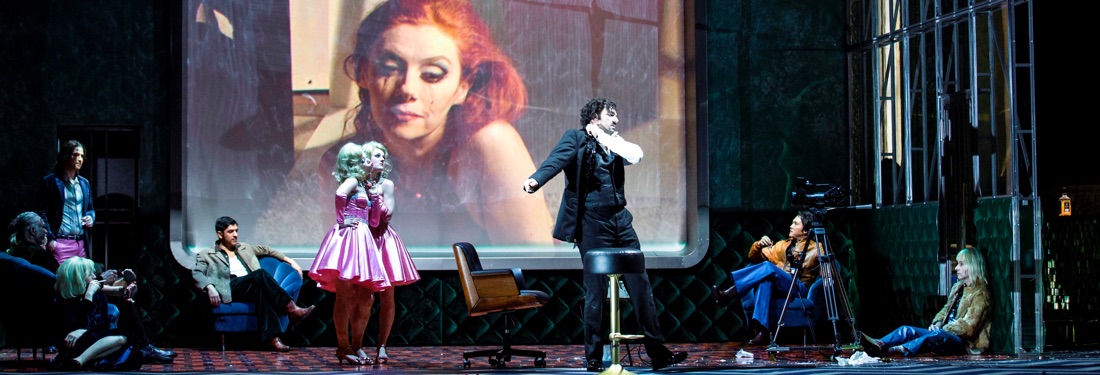
The inventive and impressively efficient staging, by Diane Paulus (of Broadway’s Tony-winning Hair) utilized a campy sense of sass and double-entendre that also had a winning spark of romance. Though she never stooped to dodgy, tasteless humor, she certainly relied on some flimsy gags, such as the anachronistic nightclub dancing that broke out in virtually every orchestral interlude. Still, there were cute innuendoes in the recitatives, and admirably balanced comedic hi-jinx with warm generosity and theatrical aplomb.
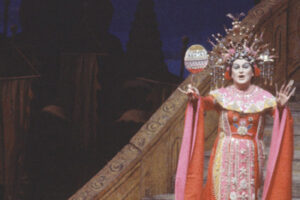
The outrageously complex physical blocking used three tall, rolling scaffolds to hoist the cast up into the audience’s line of sight, using the projections dome as a canvas. As supers moved the scaffolds, the costumed cast moved with a floating quality that perfectly matched Haydn’s lithe, buoyant phrases. Silly neon-lit costumes distracted a bit from the planetarium dome’s constellations during the Moon scenes, but acrobatic supernumeraries and complex set changes moved in jaw-dropping synchronicity with the lighting and projection work by Philip Bussmann.
Voices did not bloom in the unforgiving space, but neither were they distorted. Marco Nisticò, on loan from the Met, was a pitch-perfect comedic buffo and his dark, pliant bass-baritone shone well from top to bottom. Young tenor Nicholas Coppolo, somewhat strained in the higher register, created a stylish and dapper Ecclitico, showing both musicality and wide emotional range.
Hanan Alattar (Clarice) offered gentle but impassioned phrases of clarity and restraint. It was a pity that the padded room failed to flatter her seductive and elegant lyricism. So too Flaminia, sung by Albina Shagimuratova, who sometimes sounded thin and squeaky in spite of an impressive and bell-like coloratura top. Lisette, sung by mezzo-soprano Rachel Calloway, had the least presence of this uniformly young and light-voiced cast, but she hammed up her sexy French-maid shtick with comely enthusiasm.
Haydn’s opera was given in a cut-down 90 minute version without intermission. The evocative, yet economical and fleet score has moments of chiaroscuro that compare favorably with Mozart’s Cosi fan tutte. Gotham Music Director Neal Goren led a tasteful if overly cautious reading, intuitively supporting his cast through difficult transitions made even trickier by the awkward layout of the theater. He was particularly successful in the finely-blended ensemble finales, momentarily filling the room with an impressively large and impassioned sound that did not lack for precision and style.
This Gala fundraising premiere was attended by a star-studded and well-dressed crowd of older, tony elites mixed with downtown arts-scene denizens, all of whom arrived and departed in cheerful spirit. One hopes this success will serve their ambitions and spur more stylish and inventive productions of such high musical and theatrical quality.
It was one small step for space; one giant leap for Gotham Chamber Opera.
Latest on Parterre



parterre in your box?
Get our free weekly newsletter delivered to your email.



Comments