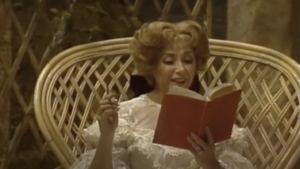
Bel can, too
Here’s a rare glimpse of those bad old days at the (then) New York State Theater, before tens of millions of dollars were spent installing a sound enhancement system, ripping a sound enhancement system, and finally doing an acoustic overhaul.
Note how distant and “small” the voices sounded back in 1976.
Just a note that private praise to La Cieca was returned to me as undeliverable. I publish it here and suggest that La cieca consider posting her excellent take on Tosca that appeared on Opera Hell for those who cover their eyes at the thought of that place. My opinion of her post was >excellent, logical, well supported, succinct, original>. It was indeed.
A) Stunning singing in this clip; and
B) I agree, MJC. La Cieca’s post to opera-L was very astute and wonderfully articulated. I think most opera-goers would do well to take a well-aimed copy of Divas & Scholars to the head (or just the section taking aim at what modern opera-goers think of as “traditional”).
It’s just another instance of privileging/not interrogating the familiar (and not doing one’s homework).
Could one or the other of you fellows, I mean Mrs. John Claggart or you Alex, tell me when this was posted on Opera-L? Thank you.
Meanwhile, the summation of the NY TIMES’ senior critic of the Met’s season to date is:
“After “Tosca” Peter Gelb, the Met’s general manager, needed a compensating success. That came — and how — with the Met premiere of Janacek’s final opera, “From the House of the Dead.” This audacious, bleak, yet moving staging was by the acclaimed director Patrice Chéreau in his American debut. Esa-Pekka Salonen, in his overdue Met debut, conducted a crackling account of Janacek’s searing score.”
No indication that the Janacek was a production developed and tested elsewhere that the Met was merely borrowing, and no mention of the pretty dreadful HOFFMANN ( about which TT write so cluelessly when it opened) as that would upset the pat formula of redemption he offers here.
Hoffmann dreadful according to whom, you? Who are you? The production got cheered by 4,000 people on opening night, not a single boo for the production team. Hoffmann is a success.
How a thread about the New York State Theater acoustics became another chance for losers in pajamas to bash Gelb is mystifying. Plus Tosca wasn’t a failure. The run was sold out and so will be the remaining performances. It’s coming back next season, despite the hate from the reactionary Nazis of opening night.
So agreed- Gelb is becoming like Harvey Weinstein, in that the movies that were ‘acquired’ while at Miramax (eg produced elsewhere with NO HELP from Harvey) got the awards and he took the credit… while the shit produced there failed and floundered….
Carmen is going to be the true test of the season I guess
So you’re against productions “trying out of town?” Many a Broadway show became better after being tested on out of town audiences (A FUNNY THING HAPPENED ON THE WAY TO THE FORUM, MOVIN’ OUT, just to name a few). Wouldn’t you New Yorkers rather get production with its kinks ironed out before having it bow untried and untested at the Met?
Besides, so many opera productions nowadays are co-productions. Pride of place will still go to the world premiere city, but at least you’ll have a more polished product by the time it reaches Manhattan.
Sorry, I have to step in here: Don’t we have a no-comparing-opera-to-Broadway rule around here? If not, we need one. Opera productions are not Broadway productions. You don’t try out an opera, you sing it.
Well, you often need to see how a new work plays before an audience before you get a sense of whether it fully works or not.
After its 1999 Met world premiere, John Harbison’s THE GREAT GATSBY underwent quite a few trims before it played the Lyric Opera of Chicago in 2000 and its Met revival in 2003.
Also, William Bolcom added a new aria for Catherine Malfitano in A VIEW FROM THE BRIDGE between its 1999 Lyric Opera of Chicago world premiere and its 2003 Met debut.
Although opera and Broadway shows aren’t the same, they both qualify as music theatre in my book.
i know i may not have squirrel’s clout in this site, but i OBJECT to this proposal.
i myself am not a musical theatre fan, but i think the salvation of opera in the united states MAY lie in getting the best of both forms together.
Scream “off with his head” if you want. But i’d rather you explain to me why this should not be the case. and please spare me the argument that theyre completely different styles.
La Cieca is not aware of such a rule, but, you know, she’s not around much on weekends.
I disagree. You sing a role for the 1st time to try it out and see if it is a good fit or not. JDF tried out the Duke, saw it was not a fit, confirmed it in Munich (am i right? can’t remember) and dropped the role.
Many other singers try out stuff in the provinces (sometimes in the company where they first performed and got some attention) before making the role part of their active repertoire and bring it to the Met, Vienna, CG or any other important theater..
I have, in fact, little clout – but I might warm up to the idea of trying out a production “out of town” before doing it in the big city, hypothetically, just so long as there is no mention of Broadway.
Opera productions unless it is the opera’s World Premiere, is usually what is called a new version of ‘a old favorite’ show, tried out before countless times!!!!!.. All the ‘songs’ in the show are usually the same… After all, have we not heard them ‘all before’?
Tosca/ Boheme? Tristan? whatever.
Broadway SINGS too! If such an embargo was placed on what is considered ‘ a try -out’ in Opera and that was strictly the rule, why would you a ‘silly full dress rehearsal?…Isn’t that also to iron out mishaps at the last moment? Whats more, allowing members of the public in, as the do – to have a sneak preview? That’s a try-out! As we see here on parerre…..’the cat gets out the bag’ about things before opera’s opening night. Where would La Cieca be without dress rehearsal reports?
The season is the test of the season.
LPR
Alerta! Alerta! Rea Artists at Work here:
No sucking the floor there!
Um, Dorion–
I don’t wear pajamas.
I saw the TOSCA and I saw the HOFFMANN in the house. They were both failures, artistically. My tastes are not reactionary, far from it, and I have seen opera and theater all over the world. I don’t care if anyone booed or if the publicity sold TOSCA out. The production was bad, and the HOFFMANN was perhaps worse.
That is my opinion. You are free to hail Gelb (be he your boss, your friend, your role model) and his efforts as much as you like and I am free to state my opinions. Ta!
Actual photograph of Krunoslav preparing to comment on parterre.com:
La Cieca, left, is listening with to Krunoslav’s objections to Jonathan Miller’s production of Pelleas: “You know, you’re right, Kruni, it’s such a cliche to put Arkel in a wheelchair.”
look who’s coming to dinner??
did I win?
Actually I believe its: The Man Who Came to Dinner with Monty Woolley.
I have indeed played that part onstage!
And off.
And, you, Cieca, will end up looking like this:
http://www.tvparty.com/bgifs15/betteheader05.jpg
Doesn’t she already look like that?
That is called “a old hag hanging on, sucking a fag”!
I don’t doubt that singers who are well trained can project and did project better probably in the “old days,” even in a house with “bad” acoustics, and messing with the acoustics was needless, but can we really tell how small or large a voice is from a video or any recording? I am asking, b/c I know a studio recording can fool us into thinking a voice is larger than it is. Even though this is a live video, don’t many factors come into play like the equipment used to record, etc.? I imagine a live video like this is a better way of telling than a studio recording, but I wonder about that at the same time. What does everyone think? Can we actually tell the size of a voice from even a live recording or video?
Very true -- and don’t forget that it’s dependent on the medium that transfers it (YT is what it is) as well as the technology that producers it on the listener’s end. For example, it makes an extraordinary amount of difference if a listener is listening in a room with speakers or via headphones.
Assuming that’s kept constant, listen to how different these two videos of the same singer singing the same thing sound.
Or even this:
The MET has been “borrowing” productions from other theatres for at least 50 years. They acquired FANCIULLA from Chicago in the early ’60s for Leontyne – who wisely abandoned the role after a few outings. But the production kept popping up both on 39th St. and then at Lincoln Center over the course of a decade or so. And I expect Chicago trotted it out once or twice, too.
FROM THE HOUSE OF THE DEAD isn’t just a “borrowed” item, but was developed in concert by 5 theatres – since they all know that such a work is a box office risk. The maligned TOSCA will soon be seen in Munich (or is it at LaScala?). About the only theatre that doesn’t share productions that I know of is Bayreuth. And with their new management…who knows?
Yep, it’s Munich for the Tosca. It will open the Festspiele, with Mattila, Kaufmann and Uusitalo.
I guess you’re right about the Bayreuthers being the only ones not sharing productions. They’re sold out years in advance, so they can plan with a solid budget.
In addition to borrowing, the Met often has created “new” productions that basically expanded a production from another theater – the Zeffirelli Turandot from La Scala, the Copley Elisir from Covent Garden, the Miller Figaro from Vienna Volksoper – or hired directors for new productions of operas that they have successfully staged elsewhere and presumably requested a production in the similar spirit – Zeffirelli’s Boheme, Tosca, and Traviata; Schenk’s Fledermaus; Everding’s Tristan.