




The Man with the Golden Ear
The amazing acute hearing of Anthony Tommasini detects an improvement in the acoustic of that place they used to call the New York State Theater, in fact, he’s willing to commit that the sound is “considerably better than it used to be.”
Which is pretty fucking impressive, considering that the last time TT heard an “unenhanced” opera performance in that space was more than 10 years ago.
La Cieca wonders, just what was Tony’s golden yardstick for measuring purity of aural experience? Could it have been Madama Butterfly with Oksana Krovytska and Barton Green under the baton of Guido Johannes Rumstadt? (How long ago was that, you ask? It was the NYCO premiere of the Mark Lamos production of this opera, that how long ago it was.) Was it Le nozze di Figaro featuring a “strapping” Dean Ely? (”As an actor he was hearty, yet light on his feet…”) Or could it have been the “naked splendor” production of Orfeo ed Euridice?
Ten years is a long time, but apparently not for this Mary Tudor of reviewers, after whose death, La Cieca suspects, we will find “acoustical enhancement” written on his breast.

On his own breast? But then he’d never read it! Better to write it on Nathan Gunn’s breast.
Frankly, could we now shift some attention to Avery Fisher Hall’s atrocious acoustics and hideous interior? Frankly that is the Lincoln Center house that needs the most acoustic work. I have been told that the f*cking Philharmonic has been unable to work with the renovation planners on what needs to be done and when to their home theater. Someone needs to smash some heads together.
The Philharmonic used to play at Carnegie Hall. If the Philharmonic board picked a year that Avery Fisher Hall’s interior would be demolished and rebuilt from the bottom up then they could book Carnegie for their season. They also could use the State…sorry David Koch Theater which has that rising enlarged pit and steel front curtain – the pit is very audible now only the stage still has dead spots.
I’ve heard that there are or have been discussions along the latter line. I agree with you that the Philharmonic could do worse than a season across the Plaza.
I wonder if AFH isn’t just hopeless. Since it was opened in the mid 60s, it went through several major
reconfigurations (originally there were “acoustic clouds” that could be adjusted to change the balance of sound; but that was a few years before my time)
Back in the 70s or 80s, the entire interior was gutted
down to the structural support and the auditorium was completely rebuilt. The current ugly interior is what was displayed when the hall was reoppened but the acoustical problems weren’t resolved. That was really just one step short of completely razing the structure to the ground and still didn’t help.
TT should spend some of those expensive words talking about how the Koch Theater achieved this supposed improvement. Methinks it’s by stripping down every surface to raw concrete. Do they have any plans to cover that junk with wood paneling? It looks awful and is an accident waiting to happen.
Not to mention his assertion “In recent weeks I have sampled the acoustics from different sections of the theater,” which turns out to be precisely two sections: the orchestra and first tier. Perhaps sweeping statements about the house’s acoustics should wait until he’s spent some time in the second, third, fourth, or — God forbid — fifth rings?
I don’t mind singing at Avery Fisher. In the right repertoire, and with the right positioning on stage, it can be a fine hall. It’s especially helpful when the stage is thrust out into the hall, although then it can be a little overwhelming for the audience. The same goes for sitting in the house. but it’s extremely dependent on where one is located.
That being said, I’ve sung in concerts that were total fucking nightmares because of where the maestro wanted the performers positioned. I went from loving the hall to hating it in the span of about five seconds. I would say that my experience in the hall was more comfortable than not, but it definitely needs help. It’s amazing to me that the Phil languishes while City Opera gets a hundred mil make over. That’s not a happy boardroom at Avery Fisher, I can guarantee you.
Jeepers. Do you think Tony clawed his way to the top only to have to sit at … the top?
Mr. T. is getting on my nerves — and I usually am interested in his opinions.
This is the second time in about a month he has put forward a statement like this:
“Yet the overarching goal of the project was to enliven the theater’s acoustics.”
Oh, really? In fact, the goal was to renovate a building that was over forty years old and looked every day of it.
The acoustics were a highly contentious issue where the two parties (NYCO and NYCB) had diametrically opposed interests. Whatever the outcome it most likely will be half-assed from an operagoer’s point of view.
Perhaps if Mr. Tommasini keeps repeating his delusion he thinks it will become true. I invite him to join the reality the rest of us inhabit by refreshing his memory with this NYT article from two years ago:
http://www.nytimes.com/2007/12/15/nyregion/15oper.html
Agreed! AFH looks and sounds awful. It must be dispiriting for the Philharmonic and I think they have suffered as an orchestra because of it. They did make a run for Carnegie some time back but were then smacked down by Lincoln Center and reminded that there was a contract that shackled them for years to come.
I have a neophyte’s question about the acoustics for opera vs. ballet. If they’re so diametrically opposed, why is it that it’s long been the tradition (especially in Europe) for opera and ballet companies to share the same theater (and indeed the same orchestra)? How do all those companies reconcile the differing demands? And why couldn’t it be done at the Theater Formerly Known as State?
The acoustics were a highly contentious issue where the two parties (NYCO and NYCB) had diametrically opposed interests.
I’m not sure what is so atrocious about the piece. It IS an issue. I only heard the Esther — the men all seemed to bellow (I thought Haman was a bass, and he claims to be a tenor), but the mezzos were alive and Flanigan sounded like Beverly Sills in the 1970s — not a sound I ever liked, but popular at NYCO.
I have loathed the “sound enhancement… See More” devices that made the orchestra tinny, and made me uncertain WHAT I was hearing from the singers, so that I seldom went unless I had very good, front orchestra or first ring seats and the opera was one I couldn’t hear elsewhere (Ermione, Semele, e.g.). I blame the whole experiment on singers from Glimmerglass horrified by the size of the hall when they’d rehearsed the show upstate. Sills didn’t need sound enhancement devices, and neither in their glory days did Treigle, Patty Brooks, Carreras, Domingo, Ramey, Vaness, Moser, Niska, Neblett — all of them singing gloriously (often) or anyway well. It was a fake, and it killed NYCO for me.
So I’m thrilled the damn things are gone, and I thought there was a definite improvement, but I’ve only gone the once. TT has gone more often, and deserves credit for cheering.
In re AFH, regards to Gualtier and Richard:
It’s variable, but mostly terrible. A friend hauled me on TDF tickets (rear orchestra) to hear Manny Ax play the Beethoven 3rd the other day, and Manny was good but the orchestra sounded like mud. It always sounds like mud when it’s playing music composed before 1900, IMHO. The second half of the program was Bernstein and De Falla, loud, brassy, marimba-heavy, crackling music, and we might have been in a different room in a different time. The place was alive. Maybe this explains why I enjoyed the Shostakovich there so much last year. It’s a 20th century hall. Bring on a season of Harry Partch!
A few years ago, I sneaked into a Messiah and sat at the very back wall. The chorus was about two dozen people, and I could hear each one of them individually, and the blend was sublime. Go figure.
For solo voices, only the first dozen rows or the boxes beside the stage will do.
I love Botstein’s concert operas, but I never know when I don’t enjoy a performance if the opera is shit or Botstein doesn’t understand it (he’s variable) or if it’s just the goddam hall.
Yes it’s a mess, Ernest Ansermet was right about it, but who has the kind of money to tear it down and rebuild it now?
back in the 60s the Koch (nee NYST) was built to the specifications of the City Ballet. They were aiming to create the dream environment for a dance company.
It was only after the place was designed that the City Opera was brought on as a tenant.
Since then the Ballet has basically dictated that any changes made for the Opera be reversible for when the dancers are in residence.
The Kellogg administration had an electronic system that could be switched off. And the new system being installed is, apparently, “portable”.
Which means: “Hey you, singers, get the hell out of here and take your crap with you!”
I can’t stand AFH, particularly what I call the “tumors” growing out of the stage walls.
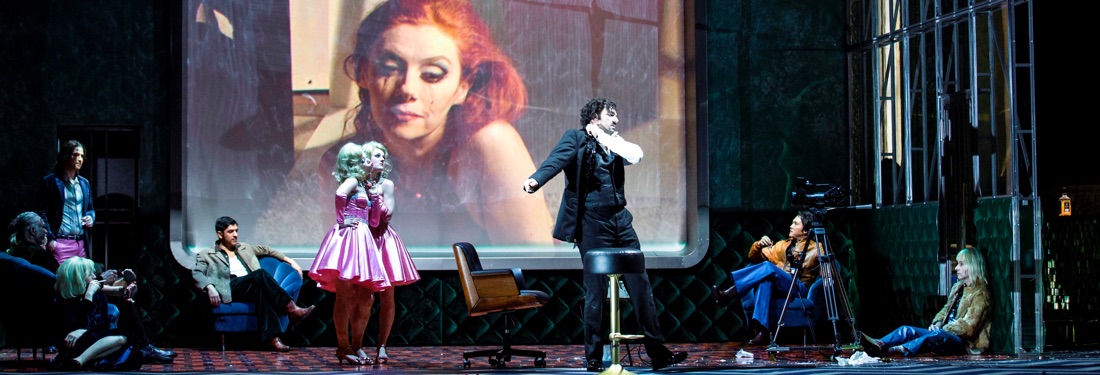
One thing Tommasini got right was that Don Giovanni had a better acoustic than Esther–and even Esther was better than the old version even WITH sound “enhancement.” And he called it correctly–The Don G. set with its paneled walls enclosing the playing space provided great sounding boards for the voices. Esther’s gauzes and drapes, essential for the cinematic projections that were the scenery, provided a soft background that was surely responsible for swallowing some voices upstage. He recommended George Steele to discuss this with designers and make sure there were solid surfaces as part of every production.
We may all have our frustrations with Tommasini, but he’s not a complete loss and he does seem to attend the performances he reviews, unlike Edward Rothstein who rather obviously didn’t in some cases, one notorious one in particular.
“He recommended George Steele to discuss this with designers and make sure there were solid surfaces as part of every production.”
Well, there has been only one new production in the new régime, and that’s the one that was cited as acoustically effective. The designer explicitly tried to make a set that would project the singing. So Tony’s “advice” to the management is at least unnecessary if not rudely officious. I suppose if they continue to show this concern for that detail at the NYCO, he can take credit for it in the pages of the Times?
“It’s amazing to me that the Phil languishes while City Opera gets a hundred mil make over.”
City Opera got nothing. The theater, home of the NY City Ballet, got all the dough. As a tenant, City Opera is enjoying some benefits of the makeover, but David H. Koch doesn’t give a flying you-know-what about City Opera. As a corporation, City Center might be interested in the survival of NYCO, but realistically, they could probably make more money renting out to itinerants when the ballet is not in season.
When Tommasini writes the sound is “considerably better than it used to be,” perhaps it’s poorly worded, but it seems clear to me that “used to be” simply refers to the last ten years, not to his recollections of the pre-enhancement period.
“David H. Koch doesn’t give a flying you-know-what about City Opera.”
While I’m ignorant of the sentiments of his inmost heart, he certainly gave a very good impersonation — at the dinner after the opening gala — of someone very much engaged with the success of City Opera.
You may have more intimate information, of course.
I think all this is quite unfair. Tommasini’s words are: “Every general manager of an opera house knows that certain sets project sound better than others, something Mr. Steel will have to impress on the production teams he hires.” I don’t think Tommasini is presuming to advise the management; I assume he’s reporting on the situation that exists, and very likely paraphrasing what Steel himself told him.
“While I’m ignorant of the sentiments of his [David H. Koch's] inmost heart, he certainly gave a very good impersonation — at the dinner after the opening gala — of someone very much engaged with the success of City Opera.”
Actions speak louder than words.
“No Koch Float for NYC Opera
David Koch is funding a renovation of New York City Opera’s home, and that’s enough. His $100 million donation will transform the New York State Theater—home to City Opera and New York City Ballet—into the David H. Koch Theater, and he feels bad about the opera’s financial and administrative mess. But he isn’t planning to bail it out. “I hope they can deal with this situation successfully, but I think what I have done for the theater is plenty,” the billionaire (whom Forbes ranks the second-richest New Yorker, after Mayor Bloomberg) said at the opening-night gala for the ballet on November 25″
http://nymag.com/news/intelligencer/52592/
Read more: David Koch Won’t Bail Out New York City Opera — New York Magazine http://nymag.com/news/intelligencer/52592/#ixzz0Yc0t6Rcw
(Sorry I couldn’t get these to transmit as links)
“City Opera got nothing.”
Quite the contrary. CIty Opera got a brand new house. While the renovation may not strictly have been for them, they nevertheless received most of the benefit because of the sound overhaul and the attending PR.
“but realistically, they could probably make more money renting out to itinerants when the ballet is not in season.”
I seriously doubt this is the case, and when NYCO has threatened to leave for other theaters, the Ballet has quickly turned into a whining little bitch about how they won’t be able to meet their rent if the opera leaves.
Like it or not, the NYCO and NYCB are tied to each other for the foreseeable future. I have no idea how your mention of City Center has to do with anything at this point. This is not 1960.
No one wanted to bail out the opera dragged into a financial morass by a stupid, inadequate board.
Koch was completely within his rights not to wish to fund their downfall when he had all ready laid out a hundred mil to fix a house in serious disrepair.
“I have no idea how your mention of City Center has to do with anything at this point.”
City Center of Music and Drama, Inc. The nonprofit corporation whose mission is to maintain and operate the David H.Koch Theater for the presentation of the performing arts, primarily dance and opera.